User Interviews: Worksheet
Question
To be confirmed
Desired outcome
To be confirmed
Scope
Prepare an interview round
Time: Several appointments; plan interview duration and analysis separately
Complete this worksheet on paper or in your own document during the work.
Preparation for this scope
Method setup
- Materials: Research question, flexible guide, contact and appointment plan, and a note template. Record only with agreed consent and appropriate access to the storage location.
- Roles: One person interviews and one participant shares their experience. An additional person may take notes with consent. The research owner coordinates selection, analysis and use of findings.
- Advance information: Collect existing knowledge and assumptions, identify relevant experiences for recruitment, and distinguish research questions from the questions asked in an interview.
- Overall time needed: Allow roughly 30 to 60 minutes per interview. Plan recruitment, the guide, immediate follow-up and synthesis separately; a complete round may span several days.
- Setup: Explain purpose, process, voluntary participation and data handling clearly. Create a quiet setting, pilot the guide and avoid interruptions.
Prepare for the work steps
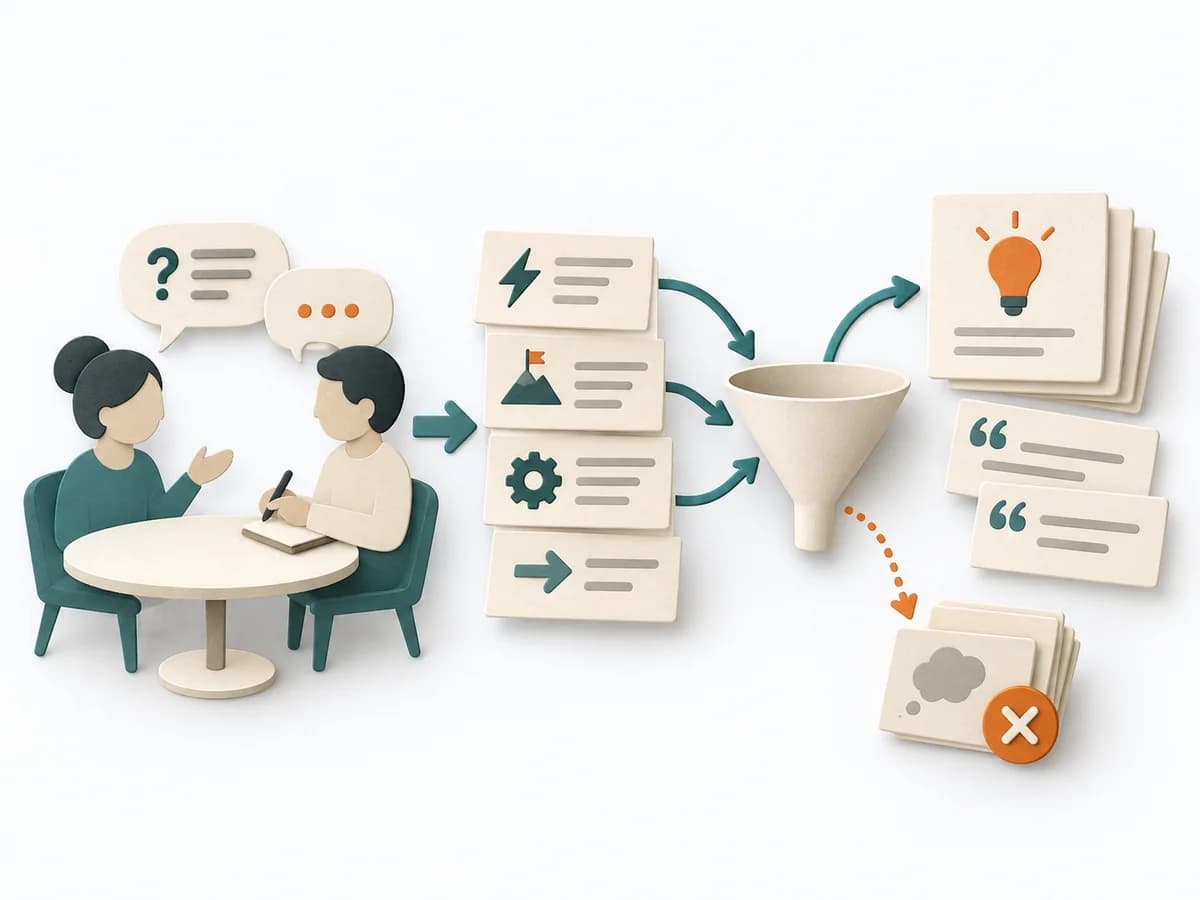
Frame: Define learning and participants
- An open product or service question
- Existing knowledge of the situation
Prepare: Pilot the guide
- Research focus and selection criteria
- Existing knowledge and visible assumptions
Listen: Explore specific experiences
- A relevant participant and agreed arrangements
- Guide, available time and a way to take notes
Synthesize: Check patterns and contrasts
- Completed notes and source references
- Research question and documented selection
Apply: Use the learning
- Synthesis with evidence and open questions
- An upcoming product or service decision
Guide and note structure
Research focus
Name the question, situation and relevant experiences.
...
Opening and arrangements
Clarify purpose, voluntary participation, time and note handling.
...
Interview prompts
Ask openly about the last specific case and explore its sequence.
...
Source-linked note
Record participant code, context, account, interpretation and open question separately.
...
Pilot the guide before interviewing. Preserve context and source references; record personal details only within the agreed scope.
Methodatlas teaching template based on GOV.UK
Frame: Define learning and participants
Expected artifact: Research focus
Question · situation · selection criteria · open gaps
Entry:
...
Prepare: Pilot the guide
Expected artifact: Piloted interview guide
Topic · open question · possible follow-up · note field
Entry:
...
Listen: Explore specific experiences
Expected artifact: Attributable interview notes
Participant code · context · account · follow-up · interpretation
Entry:
...
Synthesize: Check patterns and contrasts
Expected artifact: Traceable synthesis
Theme · evidence · contrast · interpretation · open question
Entry:
...
Apply: Use the learning
Expected artifact: Learning and next steps
Insight · scope · decision · open question · owner
Entry:
...
Open questions and next steps
...
Method guide: https://methodatlas.meierhoff-systems.de/en/methods/user-interviews/run-sheet