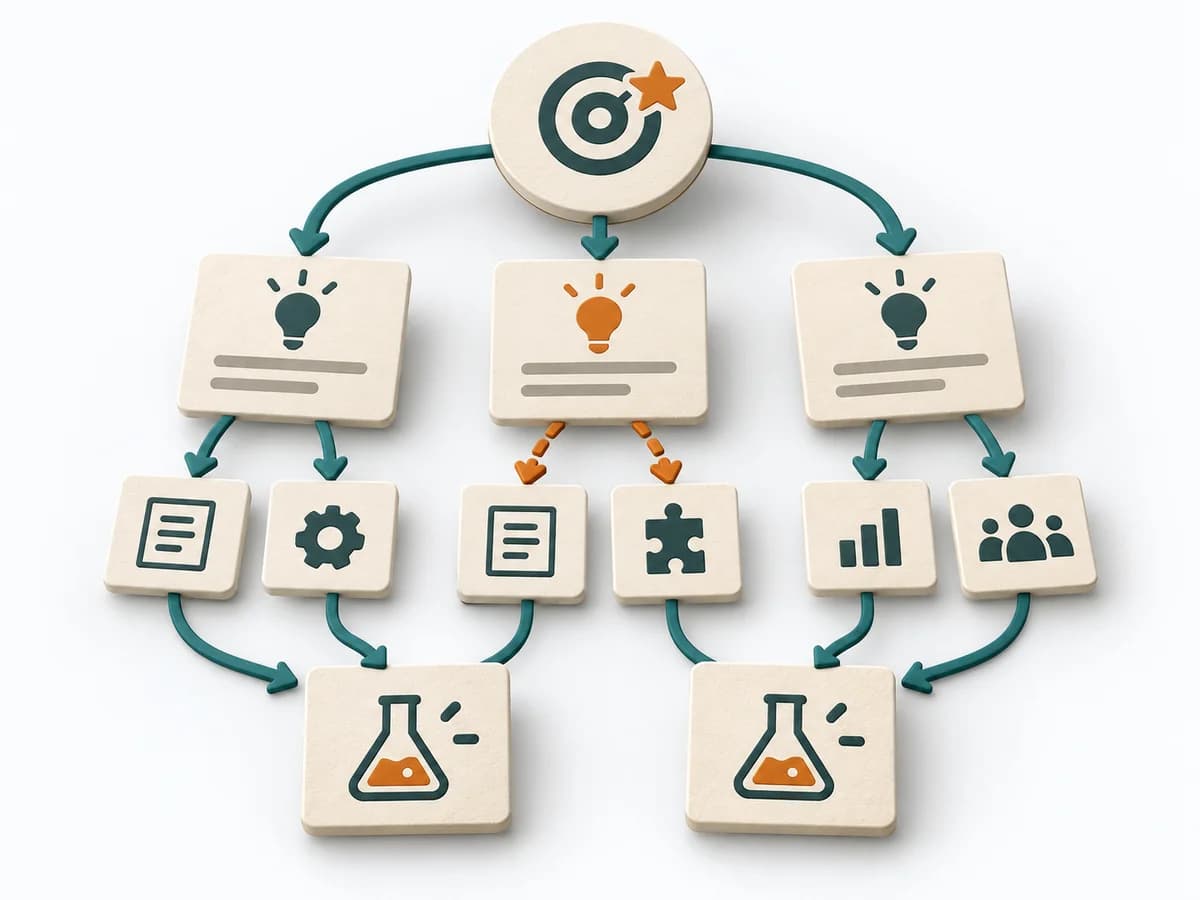
Purpose
When switching motives and progress are unclear, it reconstructs the situation from real customer circumstances. It shows why a switch happens and what kind of progress is being sought.
Product Discovery Analysis method
Shows the progress people seek in particular circumstances.
Jobs to Be Done examines what people or organizations seek to accomplish in particular circumstances. This guide uses qualitative, story-based interviews about a recent real decision; a job is neither a customer role nor a requested feature.
What progress is the person trying to make in a particular circumstance, and which forces shape the decision?
This guide uses qualitative, story-based interviews through a progress-in-circumstances lens. ODI job mapping and quantitative outcome surveys are separate variants.

Change
Jobs are understood as progress in particular circumstances; a concrete decision provides the story frame.
Timeline
The participant recounts the first thought, search and trade-offs through the decision and early experience.
Job and forces
Analysis connects circumstances, functional, social and emotional dimensions, and forces that encourage or resist change.
Synthesis
Individual stories are compared, differences stay visible and the job hypothesis receives an explicit evidence status.
Compare concrete stories, add counterexamples and update job hypotheses as evidence changes. Qualitative interviews do not establish market size or prevalence.
Use it to understand why people choose, switch to or deliberately retain a solution in a particular circumstance.

Events, alternatives and statements from first thought through early use.

Progress sought in context, separate from a particular solution.

Cross-case comparison, differences, sources and next research.
Fictional teaching example
This guide uses a qualitative, story-based JTBD lens on concrete decisions and circumstances. ODI / Outcome-Driven Innovation is a separate operationalized variant and is not conflated with this interview approach.
What concrete circumstance set the decision in motion?
Fictional: A household is planning a repair and realizes it lacks the right drill.
What happened from the first thought through search, choice and early use?
Fictional: Alex first asks friends, then checks a local tool library and eventually reserves a tool. No real interview took place.
What pulled toward the new option, pushed away from the old situation or made switching uncertain? Which habit kept the person with the old behavior?
Fictional: Repeated unsuccessful requests are push; local availability is pull; concern about tool condition is anxiety; borrowing from friends is a habit.
What progress is the person trying to make in this circumstance?
Fictional: “When a one-off repair comes up, I want reliable access to a tool without having to buy and store it.”
How does the person judge success, what evidence is available and what remains to learn?
Fictional: Availability and a suitable collection time may be criteria. Both hypotheses need checking in further real cases.
All statements are fictional. The example illustrates interview questions, not real customer insight. Do not generalize a job from a single story.
Define the research question and decision circumstance. Recruit people with recent, relevant experiences.
When switching motives and progress are unclear, it reconstructs the situation from real customer circumstances. It shows why a switch happens and what kind of progress is being sought.
It reads interviews for situations, triggers, and desired progress and condenses them into recurring motives. This aligns opportunity design with observable reality instead of assumptions.
Jobs to Be Done helps because it shifts attention from product opinions to concrete desires for progress in real life situations. Good use carefully reconstructs switching moments, forces, and uncertainties from interviews, instead of collecting mere feature wish lists. Impact appears where the team understands what kind of progress people are buying or pursuing and why existing solutions only partly deliver it.
Work with material from real switch or non-switch situations and lead early into a concrete moment rather than general satisfaction. It gets especially interesting exactly where a trigger, a fear, and a desired gain become visible together. Close with a few clear job patterns and open points that further interviews can sharpen.
The method guide walks execution through 4 phases, timing, 4 pitfalls, and clear stop criteria.
Open method guideYour perspective
Your feedback helps shape the next improvements to methodatlas.
Plan interviews about concrete switching and decision circumstances, including synthesis.
To be confirmed
To be confirmed
Conduct a JTBD interview round Time: Multiple interviews over multiple days; about 45–60 minutes per interview
Complete this worksheet on paper or in your own document during the work.
What concrete circumstance set the decision in motion?
...
What happened from the first thought through search, choice and early use?
...
What pulled toward the new option, pushed away from the old situation or made switching uncertain? Which habit kept the person with the old behavior?
...
What progress is the person trying to make in this circumstance?
...
How does the person judge success, what evidence is available and what remains to learn?
...
Blank worksheet: collect a concrete decision story. Keep events, statements, interpretations and questions distinct. Form a job hypothesis only after comparing cases.
Sources: Christensen Institute
Expected artifact: Concrete decision scenario
Circumstance · decision · time
Entry:
...
Expected artifact: Timeline of traceable events
Event · timing · statement/evidence · open question
Entry:
...
Expected artifact: Job hypothesis and influencing factors
Circumstance · progress sought · forces · evidence
Entry:
...
Expected artifact: Provisional job, evidence base and learning plan
Job hypothesis · evidence · differences · next question
Entry:
...
...
Method guide: https://methodatlas.meierhoff-systems.de/en/methods/jtbd/run-sheet
Fitting alternatives with decision guidance, followed by other related methods.

Instead of Jobs to Be Done, when you want to use Personas to build stable target-group profiles for communication, design, and prioritization.
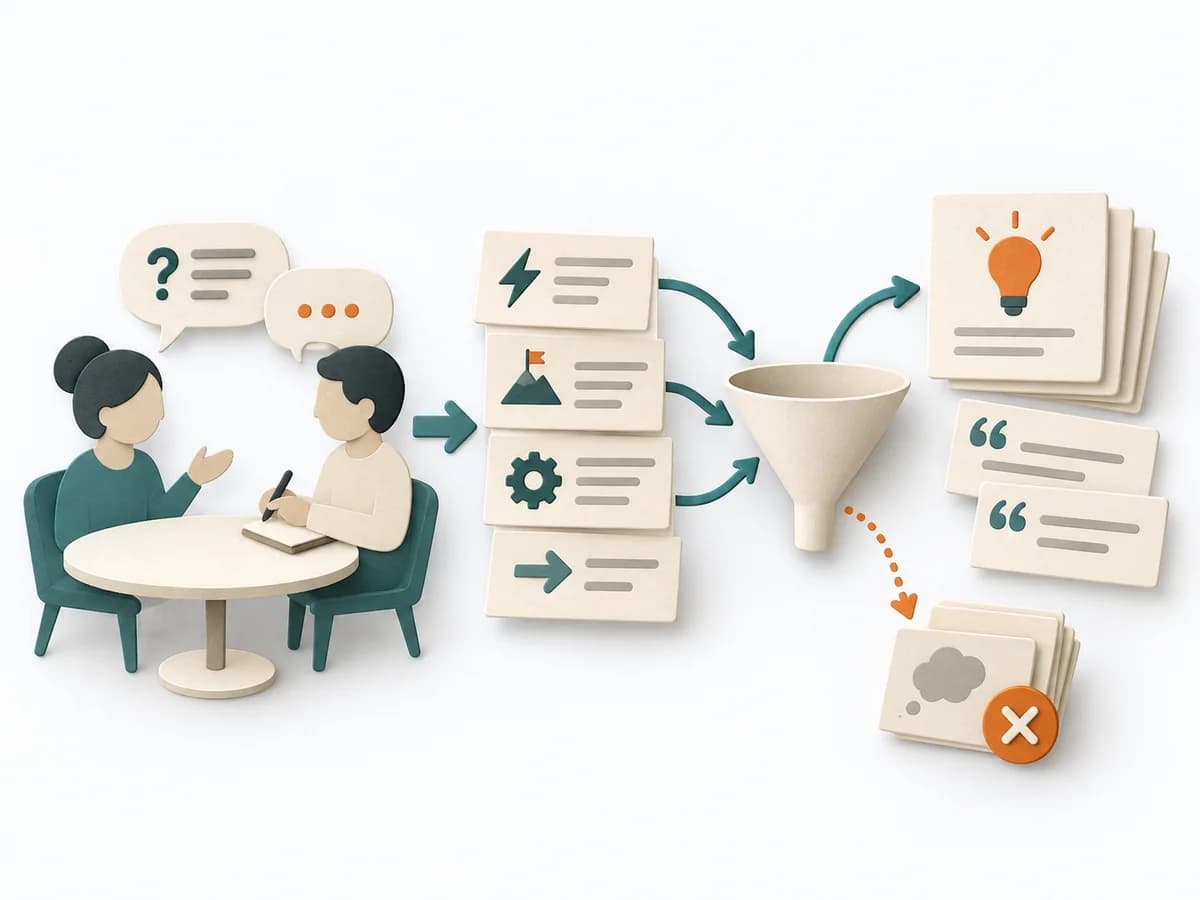
Clarifies customer problems, solution ideas, and evidence by framing an opportunity hypothesis, recruiting participants, and turning insights into opportunities.

Moves customer problem, solution idea, and evidence toward a concrete result through "collect outcomes from discovery", "define an importance scale", and "calculate and sort the score".
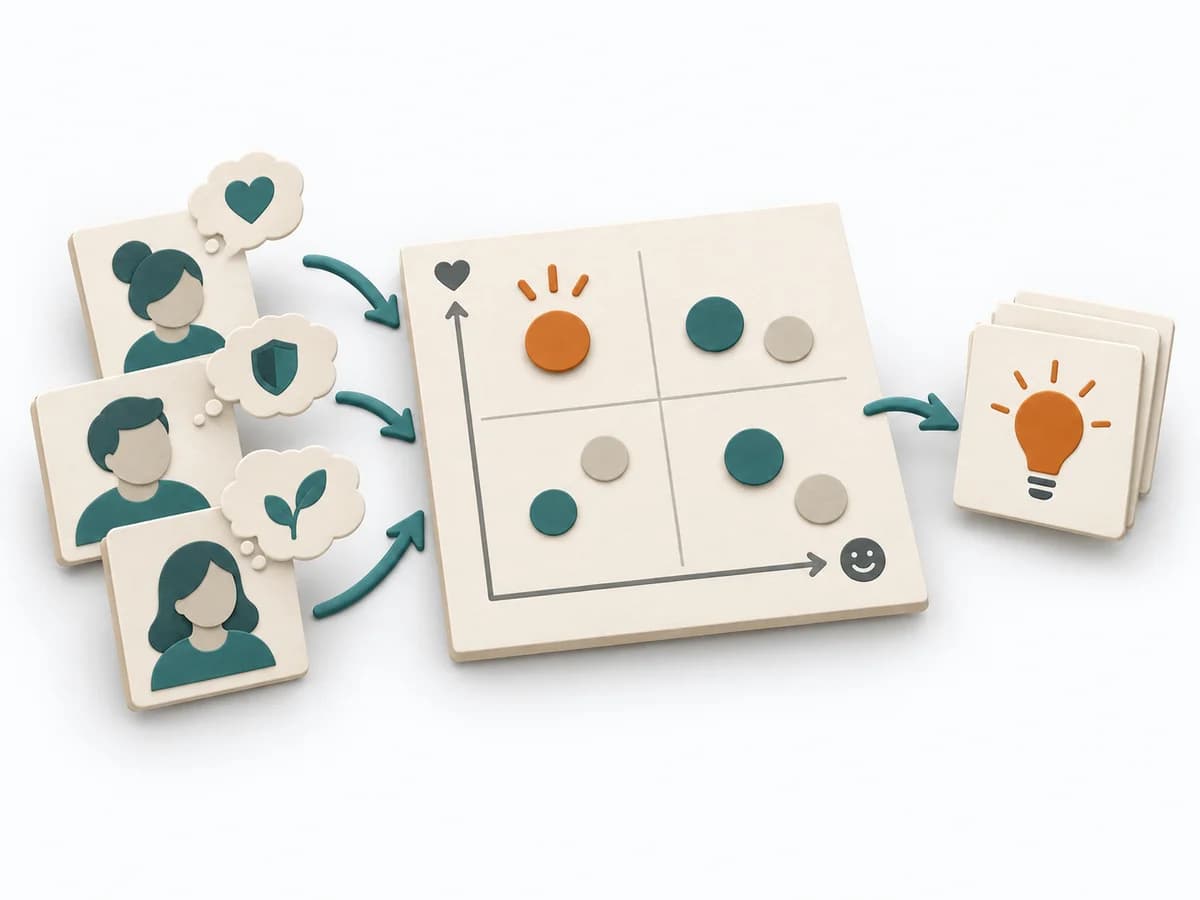
Quantifies customer desired outcomes for a job and identifies underserved needs as innovation opportunities.
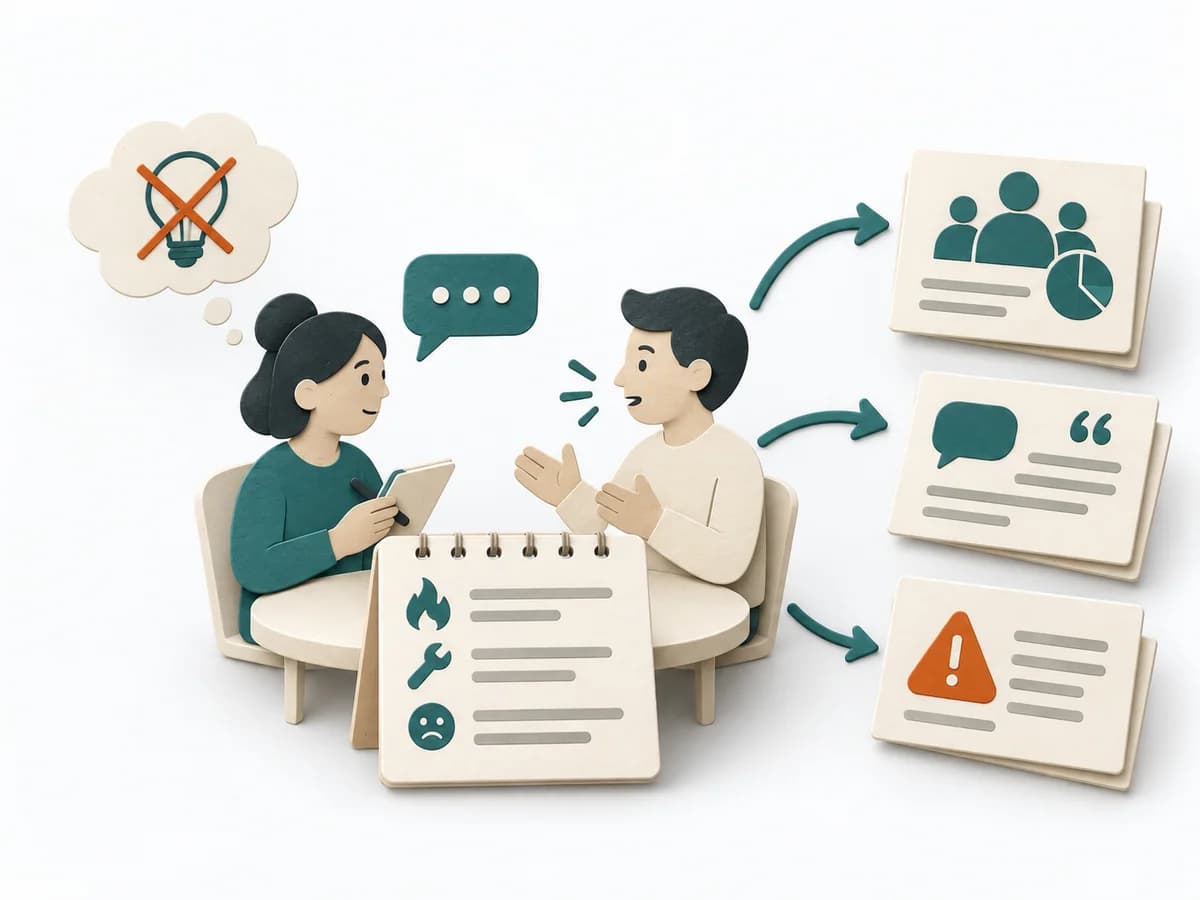
Clarifies customer problems, solution ideas, and evidence by framing problem hypotheses, recruiting the target group, and assessing problem risk.

Classifies features by their effect on satisfaction, showing which expectations create basic, performance, or delight response.