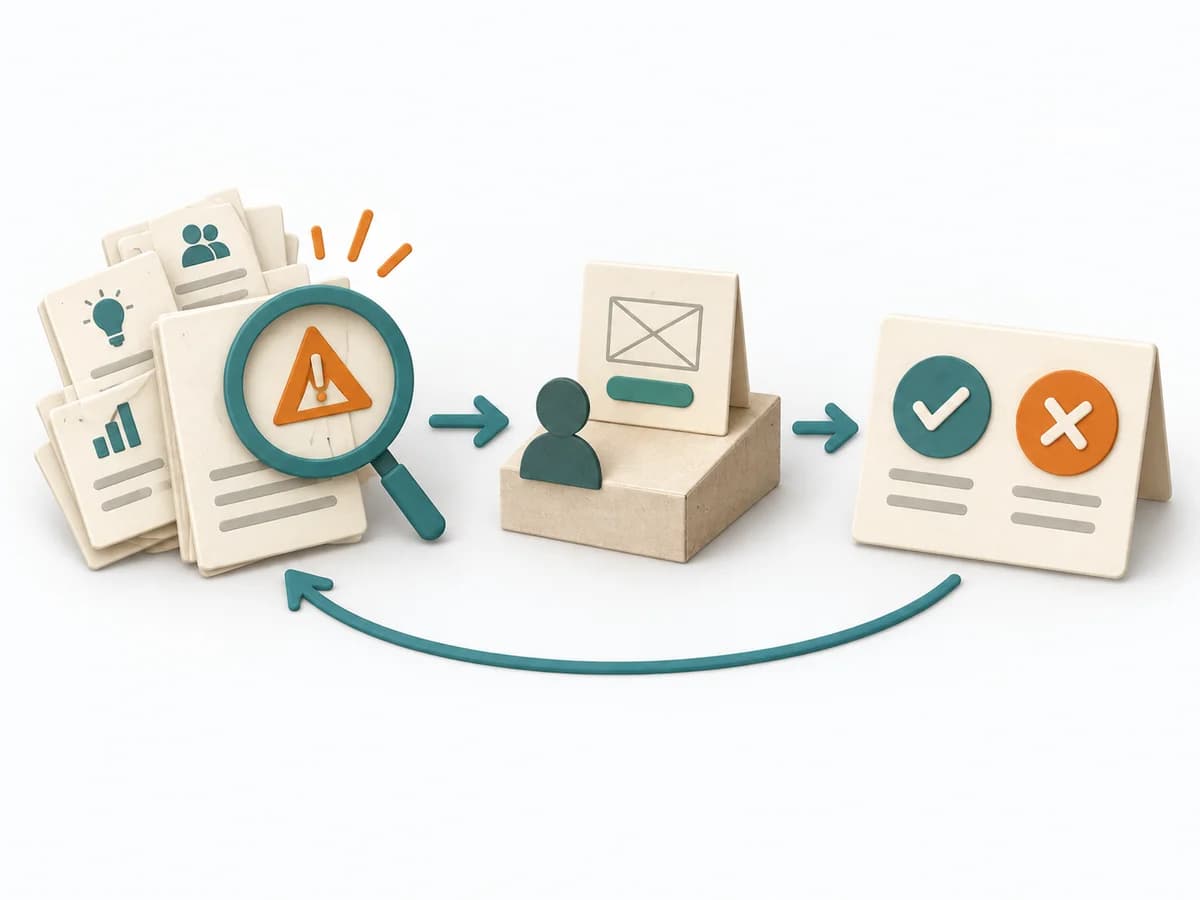

Purpose
When assumptions still sit unordered in the room, it weighs uncertainty against leverage. It makes visible which hypotheses should be checked first.
Product Discovery Mapping tool
Assumption mapping surfaces critical assumptions and focuses tests on high importance with little evidence.
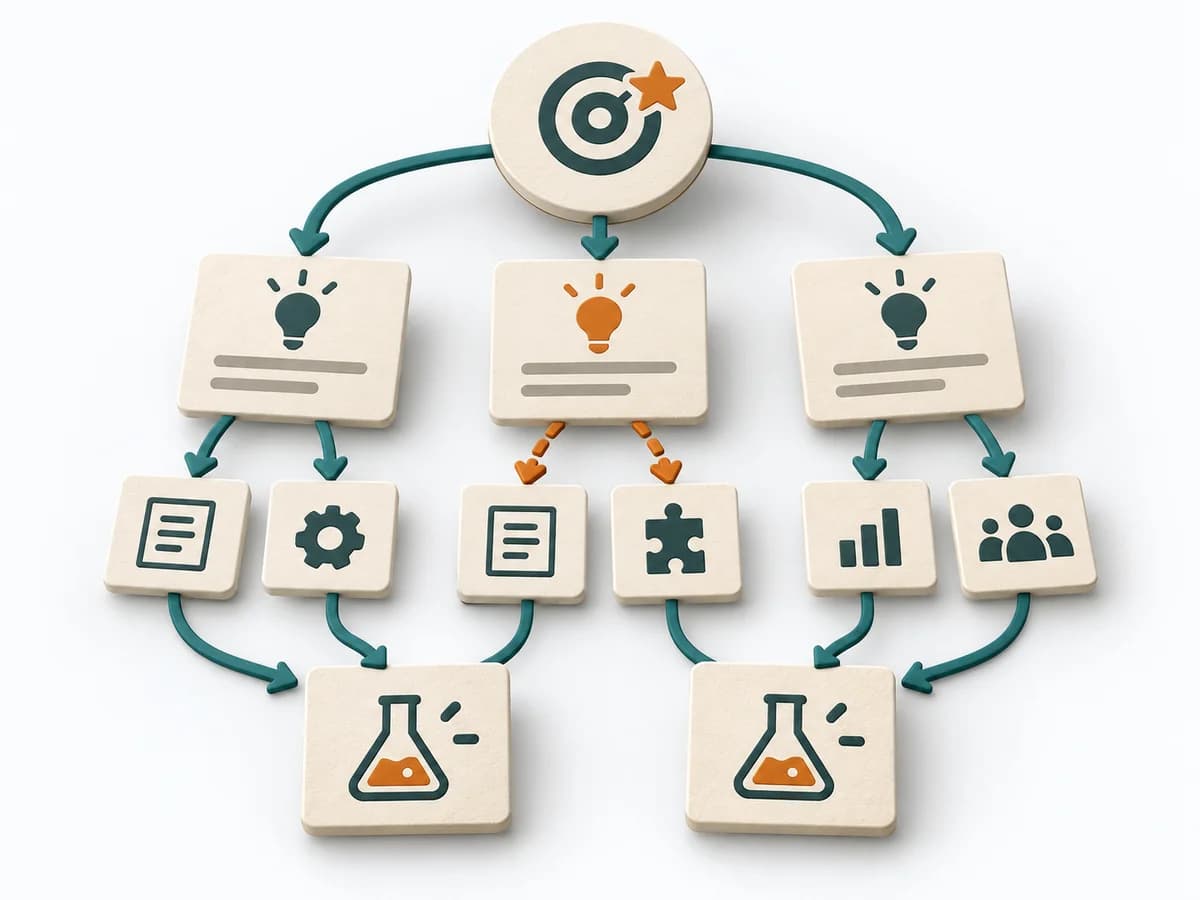
Assumption Mapping surfaces testable hypotheses behind an idea and prioritizes them by importance and existing evidence. This guide follows the 2×2 variant described by David J. Bland and Strategyzer.
Which assumptions are critical to the idea and have the least supporting evidence?
The 2×2 map is qualitative prioritization by importance and existing evidence, not a quantitative risk calculation.

Decision
The map examines assumptions on which a specific decision or idea depends.
Assumptions
Testable, precise and discrete hypotheses are derived from the idea and its rationale.
Map risk
Each assumption is placed qualitatively by how important it is and how much evidence supports it.
Plan tests
Prioritized assumptions are connected to a test, expected signal and later decision.
Update evidence and positions after experiments. Record disagreement rather than creating false precision.
Use it before larger investments or when a team has many assumptions but cannot see which risks matter most.

Precise, discrete assumptions across relevant risk areas.

Assumptions placed by importance and evidence.

Experiments, decision signals and updated uncertainty.
Fictional teaching example
Qualitative 2×2 map: first test assumptions that are important to the idea and have little supporting evidence.
| Importance | Little evidence | Existing evidence |
|---|---|---|
| High importanceWould the idea fail if this assumption were false? | Fictional: Households reserve tools online rather than by phone. Untested. | Fictional: In three invented tests, participants recognized the status indicator. A small qualitative sample, not behavioral proof. |
| Lower importanceHow much would a false assumption affect the current decision? | Fictional: Some people prefer green rather than gray cards. | Fictional: The library opens on Saturdays. An illustrative schedule confirms the time; this is not a critical risk for this test. |
All entries and test results are fictional. Positions are relative judgments, not probabilities or precise risk scores.
Frame one specific idea or decision and gather existing data, customer learning and delivery risks.
When assumptions still sit unordered in the room, it weighs uncertainty against leverage. It makes visible which hypotheses should be checked first.
It places assumptions on a shared map by risk and significance and prioritizes the most critical points from there. This focuses test planning instead of overloading it with equally weighted guesses.
Assumption Mapping helps because it orders assumptions by uncertainty and relevance, bringing the riskiest thinking errors forward early. Good use breaks large claims down into testable individual assumptions and doesn't just discuss what sounds important. The method works strongly where it turns diffuse gut feeling into a clear test order and thereby focuses discovery.
Ask the team in advance for the silent premises behind the idea, user behavior, and feasibility, so the map gets substance. The work gains weight when a seemingly harmless assumption suddenly carries many other points. Close with a few top risks and an explicit choice of what gets tested or broken down further next.
The method guide walks execution through 4 phases, timing, 4 pitfalls, and clear stop criteria.
Open method guideYour perspective
Your feedback helps shape the next improvements to methodatlas.
Checklist for critical assumptions by risk and knowledge level.
Frame the idea, surface critical hypotheses and choose next tests.
To be confirmed
To be confirmed
Map assumptions behind an idea Time: About 60–90 minutes; tests are additional
Complete this worksheet on paper or in your own document during the work.
| Importance | Little evidence | Existing evidence |
|---|---|---|
| High importance | ||
| Lower importance |
Blank worksheet: phrase each card as a testable hypothesis, note its source or evidence and place it qualitatively by importance and existing evidence.
Source: David J. Bland, Strategyzer
Expected artifact: Idea frame and consequences
Decision · success · consequence
Entry:
...
Expected artifact: List of testable hypotheses
Statement · risk area · possible evidence
Entry:
...
Expected artifact: Assumption map with rationale
Importance · existing evidence · disagreement
Entry:
...
Expected artifact: Prioritized test plan for critical assumptions
Hypothesis · test · signal · decision · owner
Entry:
...
...
Method guide: https://methodatlas.meierhoff-systems.de/en/methods/assumption-mapping/run-sheet
Fitting alternatives with decision guidance, followed by other related methods.
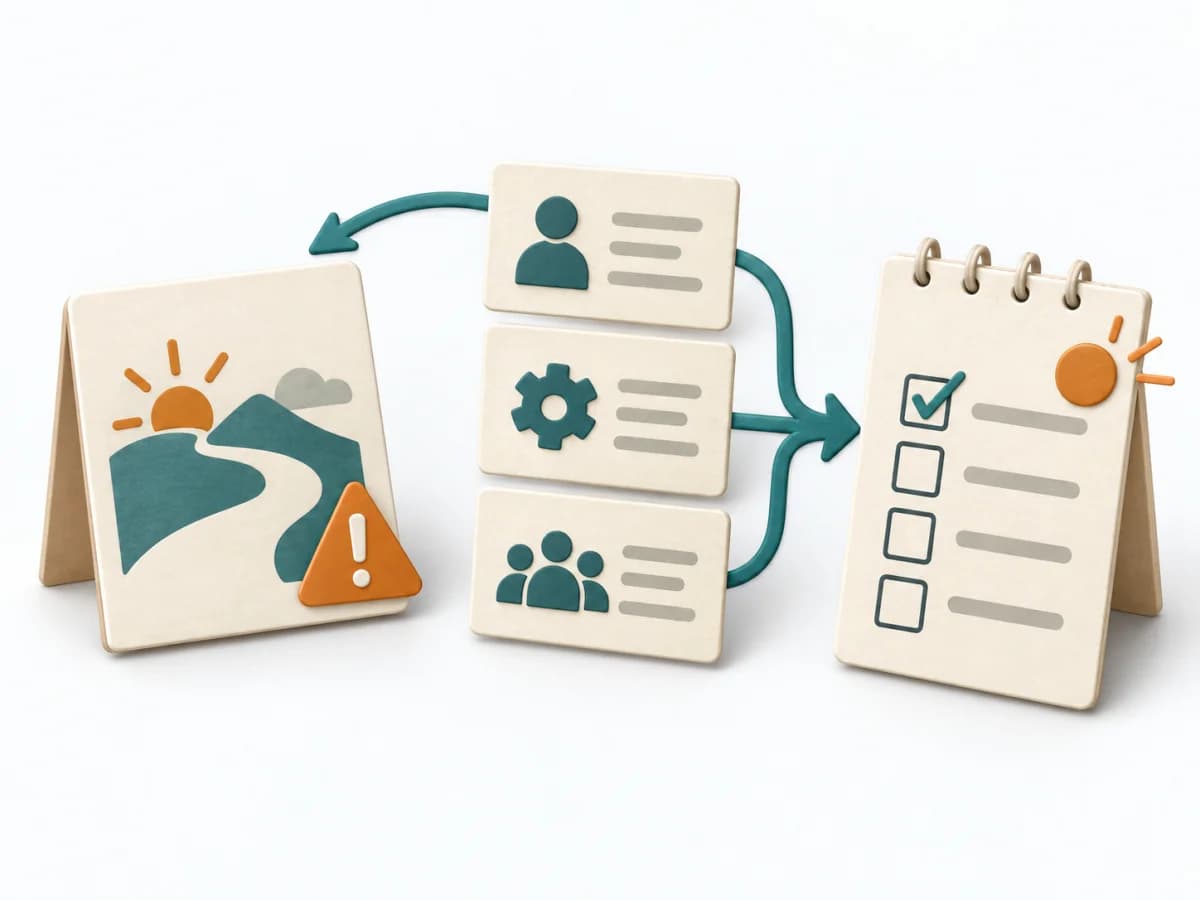
Instead of Assumption Mapping, when you want to use Pre-Mortem to play through failure scenarios in advance and name risks early.

Separates hypothesis, observation, insight, and next action into four fields after a test.

Condenses hypothesis, test, metric, and success threshold onto one card before execution.

Clarifies options, criteria, and risks by framing the initiative or decision, collecting implicit assumptions, and planning tests or research.
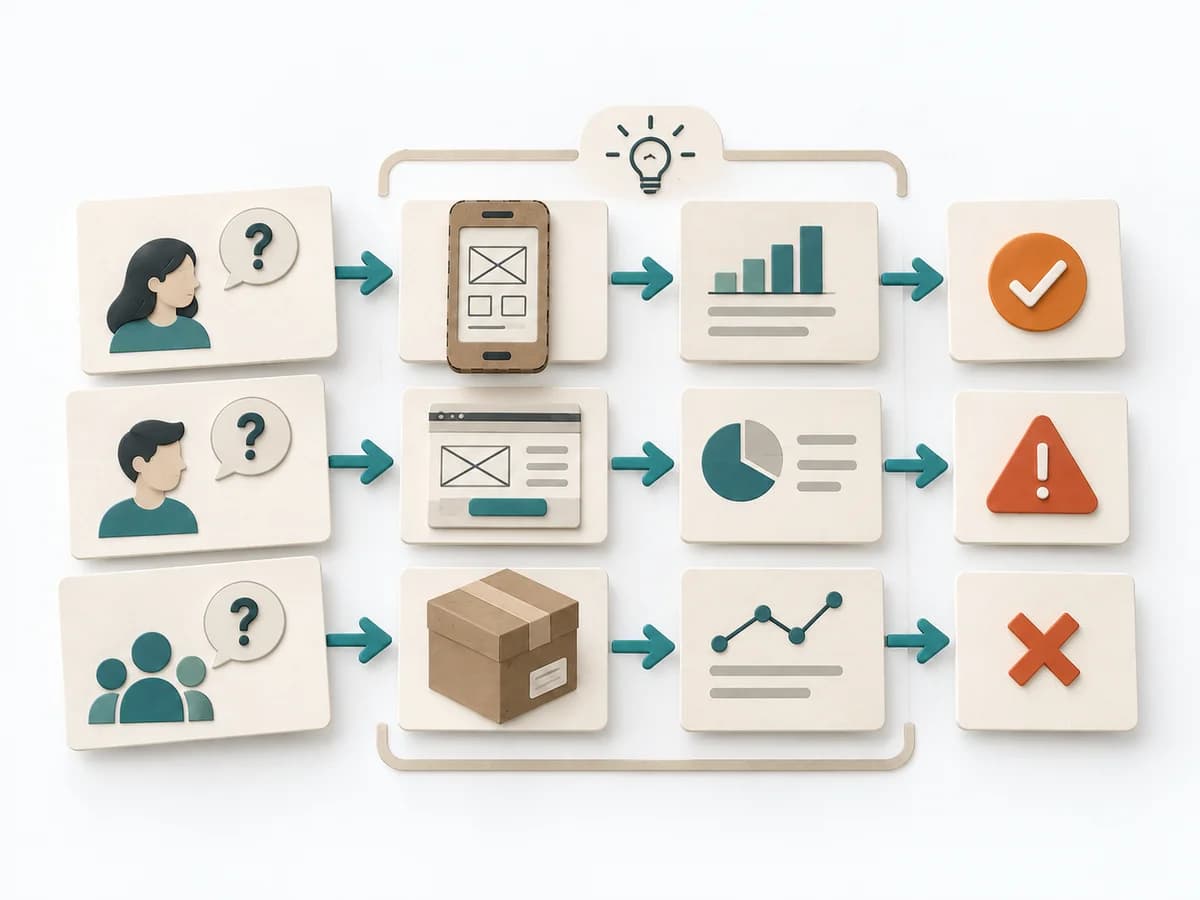
Moves customer problem, solution idea, and evidence toward a concrete result through "list assumptions", "map assumptions to dimensions", and "derive the test plan".
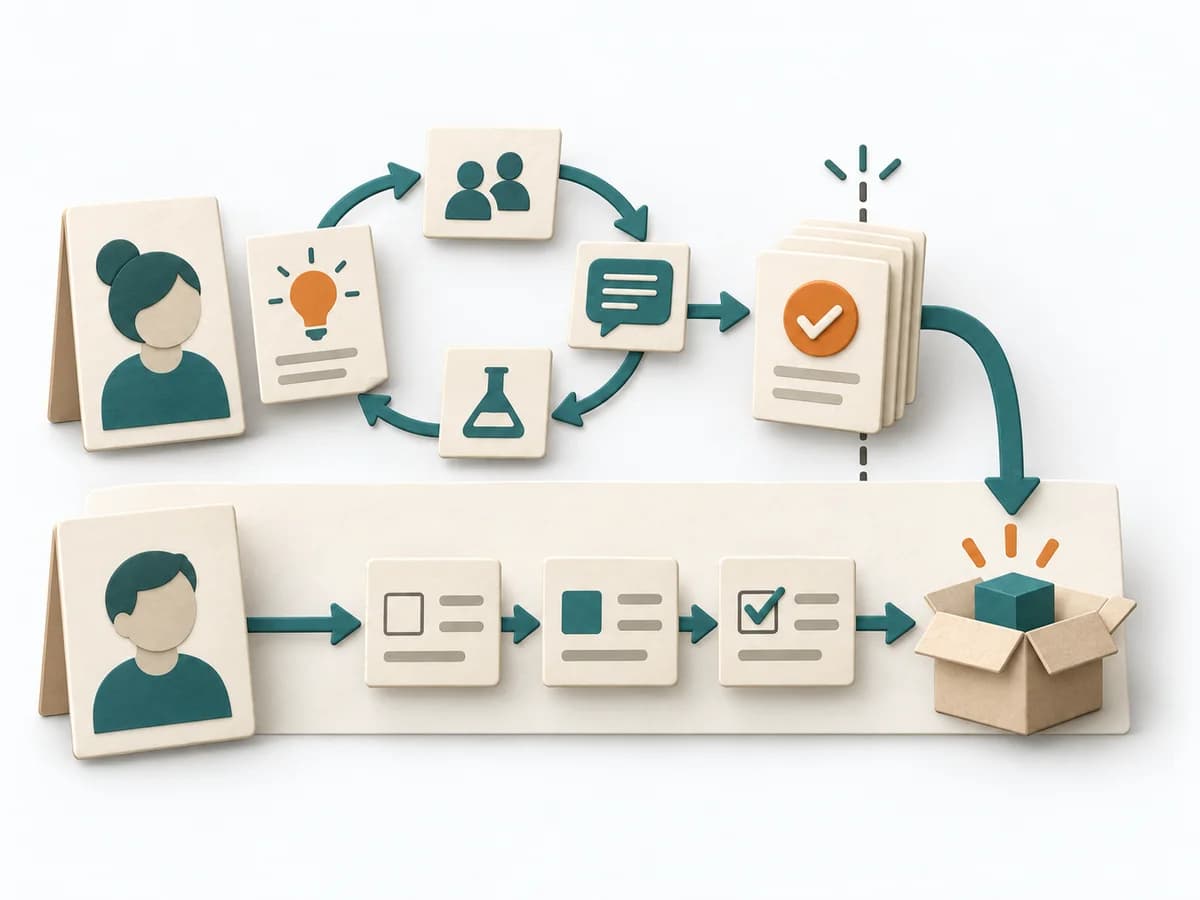
Separates discovery and delivery so that validated stories only move into implementation after learning loops.