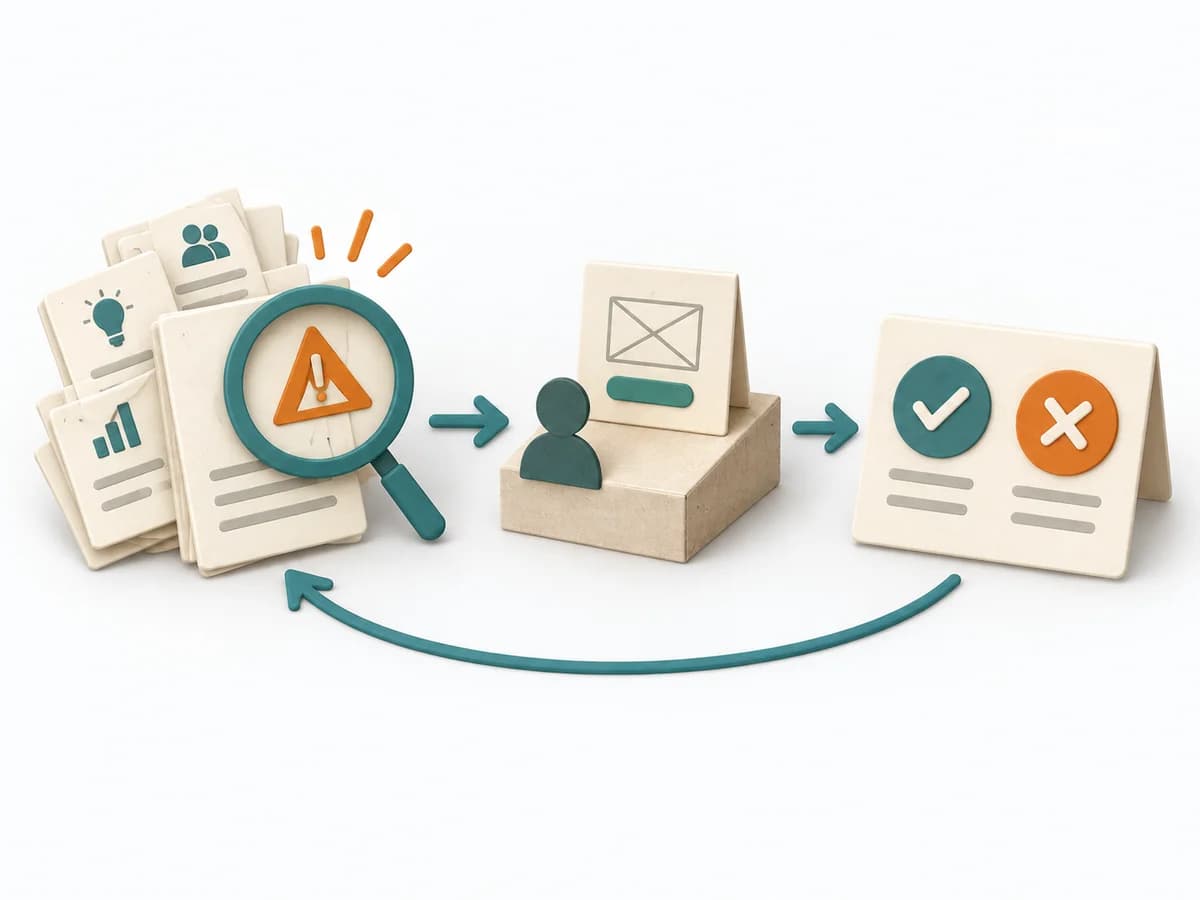
Complete firstSpecific idea
An offer or decision and intended result are clear.
Importance cannot be judged without a frame.
A practical method guide: clarify prerequisites and materials, understand the complete process, and look up outputs, pitfalls, and stop criteria.
What needs to be finished first
An offer or decision and intended result are clear.
Available research, data and evidence gaps are visible.
What needs to be ready before start
Hypothesis cards, a 2×2 map, existing evidence, cross-functional perspectives and experiment cards.
A cross-functional team from product, design/research, engineering and business ownership. Facilitation keeps assumptions discrete and testable.
Gather the decision frame and success signal. Extract assumptions about customer desirability, viability, feasibility and other critical areas.
About 60–90 minutes to map assumptions and choose tests; experiments and evidence follow separately.
Write each hypothesis separately. Discuss importance, then examine existing evidence. Use the map as qualitative prioritization, not a calculation.
The one question this method answers
Which assumptions are critical to the idea and have the least supporting evidence?
Phases with goal, actions, output and pitfall
Assumption Mapping surfaces testable hypotheses behind an idea and prioritizes them by importance and existing evidence. This guide follows the 2×2 variant described by David J. Bland and Strategyzer.
Fictional teaching example
Qualitative 2×2 map: first test assumptions that are important to the idea and have little supporting evidence.
| Importance | Little evidence | Existing evidence |
|---|---|---|
| High importanceWould the idea fail if this assumption were false? | Fictional: Households reserve tools online rather than by phone. Untested. | Fictional: In three invented tests, participants recognized the status indicator. A small qualitative sample, not behavioral proof. |
| Lower importanceHow much would a false assumption affect the current decision? | Fictional: Some people prefer green rather than gray cards. | Fictional: The library opens on Saturdays. An illustrative schedule confirms the time; this is not a critical risk for this test. |
All entries and test results are fictional. Positions are relative judgments, not probabilities or precise risk scores.
Decision

Goal
The team understands what is at stake if assumptions are wrong.
Inputs for this step
Actions
Output
Idea frame and consequences
Decision · success · consequence
Quality check
Can the team name what could cause the idea to fail?
Pitfall
The team lists solutions without a shared decision or goal. Frame the idea and intended result first; then surface its underlying beliefs.
Timing: About 10 minutes.
Assumptions

Goal
Assumptions are observable and distinct.
Inputs for this step
Actions
Output
List of testable hypotheses
Statement · risk area · possible evidence
Quality check
Is each card one distinct and testable statement?
Pitfall
An aspiration or goal is mistaken for a hypothesis. State what is believed to be true and what observation could support it.
Timing: About 20 minutes.
Map risk

Goal
Critical assumptions with weak evidence become visible learning priorities.
Inputs for this step
Actions
Output
Assumption map with rationale
Importance · existing evidence · disagreement
Quality check
Are top priorities both important and weakly evidenced? Are placements based on sources rather than the loudest opinion?
Pitfall
The group assigns falsely precise probabilities or averages. Use relative positions as a conversation aid; record evidence and disagreement openly.
Timing: About 20 minutes.
Plan tests
Goal
The workshop ends with a prioritized plan to examine one critical uncertainty.
Inputs for this step
Actions
Output
Prioritized test plan for critical assumptions
Hypothesis · test · signal · decision · owner
Quality check
Does the planned test examine risk rather than generic concept interest? Is it clear how the later decision depends on the result?
Pitfall
A test plan is presented as if evidence had already been collected. Run the test after the workshop and update the map when evidence arrives.
Timing: About 15 minutes for test selection and planning; execution and evidence review follow separately.
What comes out at the end
Sketch: what the artifact looks like
An assumption map with hypotheses, risk area, source, placement, test plan, decision signal and updated learning.
Record the idea, date, hypothesis IDs, sources and card movements. Preserve assumptions separately from test results.
Checklist for critical assumptions by risk and knowledge level.
Frame the idea, surface critical hypotheses and choose next tests.
To be confirmed
To be confirmed
Map assumptions behind an idea Time: About 60–90 minutes; tests are additional
Complete this worksheet on paper or in your own document during the work.
| Importance | Little evidence | Existing evidence |
|---|---|---|
| High importance | ||
| Lower importance |
Blank worksheet: phrase each card as a testable hypothesis, note its source or evidence and place it qualitatively by importance and existing evidence.
Source: David J. Bland, Strategyzer
Expected artifact: Idea frame and consequences
Decision · success · consequence
Entry:
...
Expected artifact: List of testable hypotheses
Statement · risk area · possible evidence
Entry:
...
Expected artifact: Assumption map with rationale
Importance · existing evidence · disagreement
Entry:
...
Expected artifact: Prioritized test plan for critical assumptions
Hypothesis · test · signal · decision · owner
Entry:
...
...
Method guide: https://methodatlas.meierhoff-systems.de/en/methods/assumption-mapping/run-sheet
Concrete filled scenario, fictional example
Fictional example for orientation. Counts and timings describe this case and are not universal requirements.
Concrete filled scenario, fictional example
All assumptions and test outcomes are invented.
Idea: Households can reserve tools online.
Important, little evidence: Households trust online availability information. This would be a priority test candidate.
Important, some evidence: In three fictional prototype sessions, participants recognized the status label. This does not establish real reservations.
Less important, little evidence: Some people prefer one card color.
Test idea: Observe suitable households checking availability and making a reservation decision. Define beforehand what behavior would justify the next investment. Placement is qualitative; no score is calculated.
Recognize symptoms and steer against them
Quick overview, the full text is in the matching phase in the flow
The team lists solutions without a shared decision or goal.
Frame the idea and intended result first; then surface its underlying beliefs.
An aspiration or goal is mistaken for a hypothesis.
State what is believed to be true and what observation could support it.
The group assigns falsely precise probabilities or averages.
Use relative positions as a conversation aid; record evidence and disagreement openly.
A test plan is presented as if evidence had already been collected.
Run the test after the workshop and update the map when evidence arrives.
When to pause, resolve prerequisites, or choose another approach
Go to the profile for purpose, similar methods, and sources or continue to the next method in the catalog.