Problem Framing Workshop: Worksheet
Set subject, evidence, roles, flow, and review.
# Problem Framing Workshop: Worksheet

## Question
To be confirmed

## Desired outcome
To be confirmed

## Scope
Complete run
Time: 90–150 minutes with evidence collected beforehand.

Complete this worksheet on paper or in your own document during the work.

## Preparation for this scope

### Method setup
- **Materials:** Research and operations evidence, stakeholder and context map, assumption log, problem frame, and How Might We question
- **Roles:** Facilitator · problem owner · affected/customer perspective · domain and delivery perspectives · decision owner
- **Advance information:** Gather the decision trigger, available evidence, and hard constraints; park solution ideas initially.
- **Overall time needed:** 90–150 minutes with evidence collected beforehand.
- **Setup:** Prepare a workspace with Evidence · Actors · Impact · Boundary · Question; separate example from live data.

### Prepare for the work steps

#### Evidence: Evidence view
- Gather the decision trigger, available evidence, and hard constraints; park solution ideas initially.
- Research and operations evidence, stakeholder and context map, assumption log, problem frame, and How Might We question

#### Actors: Actor context
- Evidence view

#### Impact: Problem core
- Actor context

#### Boundary: Scope
- Problem core

#### Question: Working question
- Scope


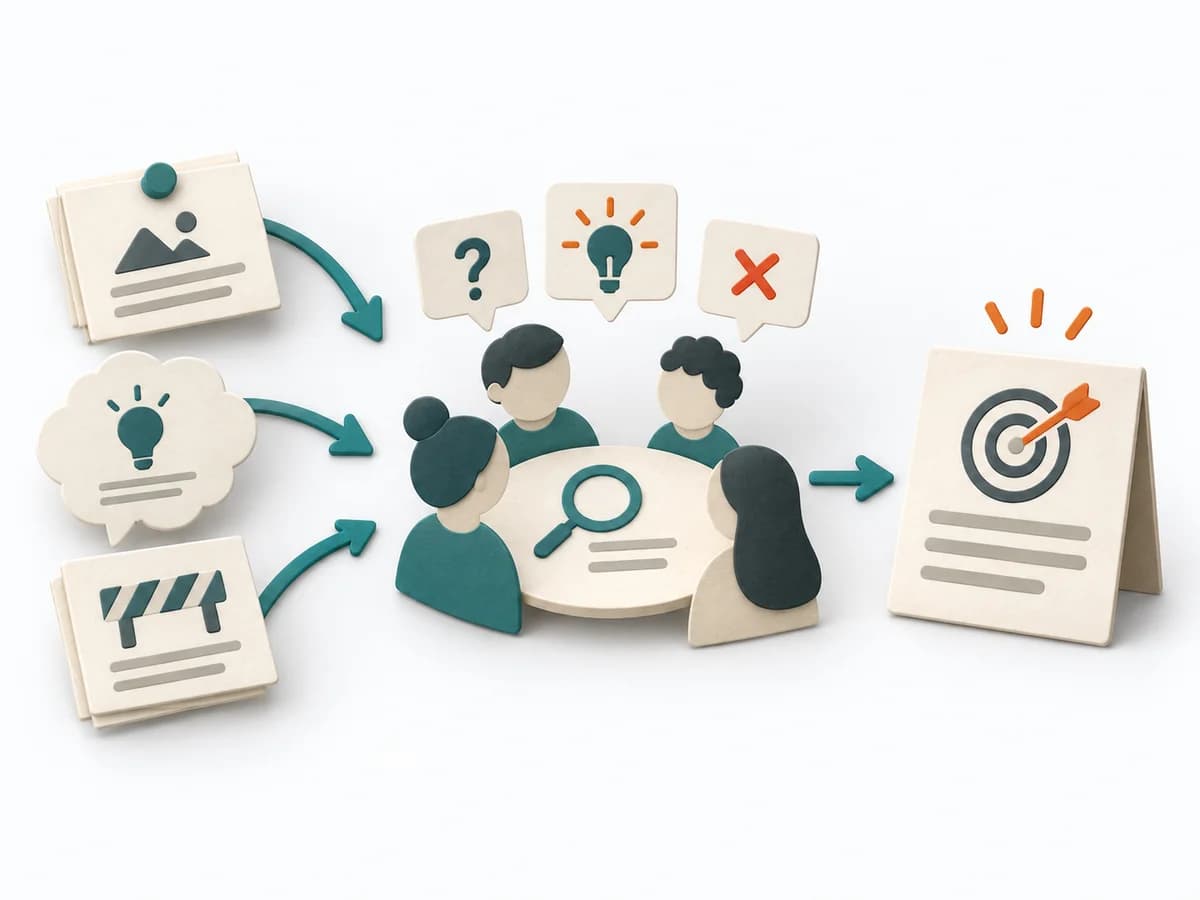
## Problem Framing Workshop · working structure

### Evidence view
Gather observations, data, and quotes; separate facts, interpretations, and solutions.

...

### Actor context
Describe affected people, context, desired progress, and current obstacles concretely.

...

### Problem core
State undesired outcome, significance, and observable impact without presuming cause or solution.

...

### Scope
Negotiate in-scope, out-of-scope, constraints, assumptions, and knowledge gaps.

...

### Working question
Translate the frame into an open How Might We question and test evidence, solution openness, and agency.

...

The blank worksheet contains prompts only.

[Reference · original teaching example](https://www.designcouncil.org.uk/our-resources/the-double-diamond/)


## Evidence: Evidence view
Expected artifact: Evidence view

Gather observations, data, and quotes; separate facts, interpretations, and solutions.

Entry:

...

- [ ] Can every finding be traced to a source or case?

## Actors: Actor context
Expected artifact: Actor context

Describe affected people, context, desired progress, and current obstacles concretely.

Entry:

...

- [ ] Is a concrete group in a situation named rather than a market segment?

## Impact: Problem core
Expected artifact: Problem core

State undesired outcome, significance, and observable impact without presuming cause or solution.

Entry:

...

- [ ] Does it describe outcome and impact rather than a symptom label or solution wish?

## Boundary: Scope
Expected artifact: Scope

Negotiate in-scope, out-of-scope, constraints, assumptions, and knowledge gaps.

Entry:

...

- [ ] Are boundary and exclusions relevant and traceable?

## Question: Working question
Expected artifact: Working question

Translate the frame into an open How Might We question and test evidence, solution openness, and agency.

Entry:

...

- [ ] Does it permit several paths while staying with the evidenced need?

## Open questions and next steps

...

Method guide: https://methodatlas.meierhoff-systems.de/en/methods/problem-framing-workshop/run-sheet
Opportunity Solution Tree: Worksheet
Plan the initial setup and ongoing rhythm for outcomes, opportunities, solutions and tests.
# Opportunity Solution Tree: Worksheet

## Question
To be confirmed

## Desired outcome
To be confirmed

## Scope
Structure continuous discovery
Time: Ongoing practice; no total timebox

Complete this worksheet on paper or in your own document during the work.

## Preparation for this scope

### Method setup
- **Materials:** Outcome definition, sourced research notes, opportunity clusters, a shared tree and space for solution hypotheses and experiment cards.
- **Roles:** A product trio or cross-functional team with product, design/research and engineering; discovery ownership keeps the tree and evidence current.
- **Advance information:** Gather the outcome, target user and current product or customer evidence. Separate customer statements from interpretation.
- **Overall time needed:** Not a one-off workshop. Allow about 1–2 hours to frame the first tree; interviews, tests and updates continue across discovery cycles.
- **Setup:** Place the outcome above opportunities, solutions under the selected opportunity and experiments against solution assumptions. Deepen one target opportunity at a time.

### Prepare for the work steps

#### Outcome: Define a team-controllable outcome
- Product strategy and target user
- Available metric or observable behavior indicator

#### Opportunities: Structure customer opportunities
- Story-based customer interviews or observations
- Outcome and existing opportunity notes

#### Focus: Choose a target opportunity
- Outcome
- Opportunity map and related customer notes

#### Solutions: Explore multiple solution paths
- Target opportunity and outcome signal
- Product, design and technical perspectives

#### Learn: Test assumptions and update the tree
- Solution options and explicit assumptions
- Access to suitable users or data


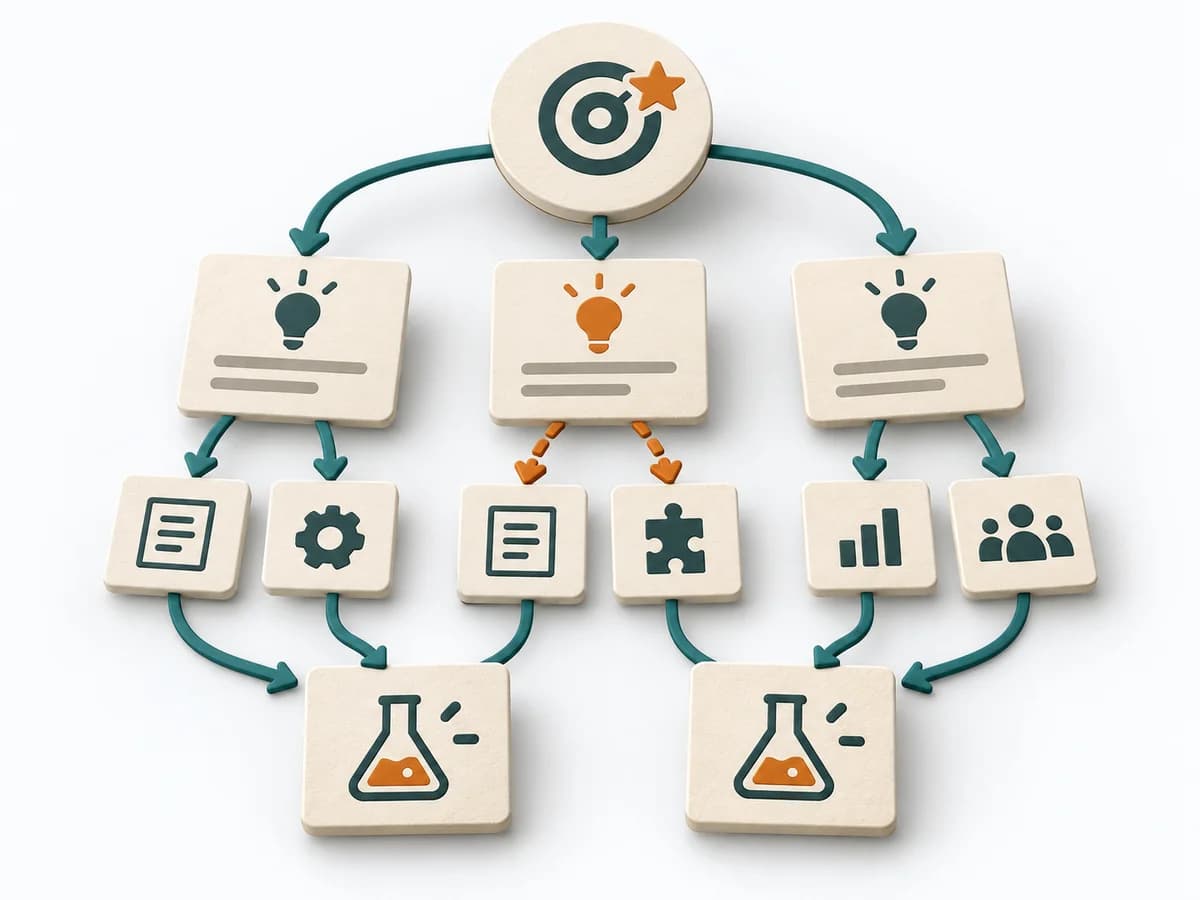
## Opportunity Solution Tree

### Outcome
Which team-controllable result should improve?

...

### Customer opportunities
Which needs, pain points or desires from concrete customer situations could influence the outcome?

...

### Target opportunity
Which opportunity will guide the next discovery cycle, and why?

...

### Solution options
What different approaches could address this opportunity?

...

### Assumptions and tests
Which risky assumption will each test examine, and what decision follows?

...

Blank worksheet: choose one outcome, connect opportunities to evidence, select a target opportunity, then record solution hypotheses and tests.

[Source: Teresa Torres, Product Talk](https://www.producttalk.org/opportunity-solution-trees/)


## Outcome: Define a team-controllable outcome
Expected artifact: Outcome as the root of the tree

Outcome · target user · signal

Entry:

...

- [ ] Can the team influence the outcome through product decisions?

## Opportunities: Structure customer opportunities
Expected artifact: Customer opportunities with evidence

Need or obstacle · source · open question

Entry:

...

- [ ] Is each opportunity grounded in customer learning?
- [ ] Does it still hide a solution?

## Focus: Choose a target opportunity
Expected artifact: Selected target opportunity with rationale

Opportunity · evidence · rationale

Entry:

...

- [ ] Is the opportunity relevant and understood well enough to explore ideas?

## Solutions: Explore multiple solution paths
Expected artifact: Solution options with assumptions

Option · opportunity addressed · key assumption

Entry:

...

- [ ] Are there different ways to address the opportunity?

## Learn: Test assumptions and update the tree
Expected artifact: Updated tree with tests and decisions

Assumption · test · evidence · decision

Entry:

...

- [ ] Does the test examine an important solution assumption?
- [ ] Is the next decision stated before the test?

## Open questions and next steps

...

Method guide: https://methodatlas.meierhoff-systems.de/en/methods/opportunity-solution-tree/run-sheet