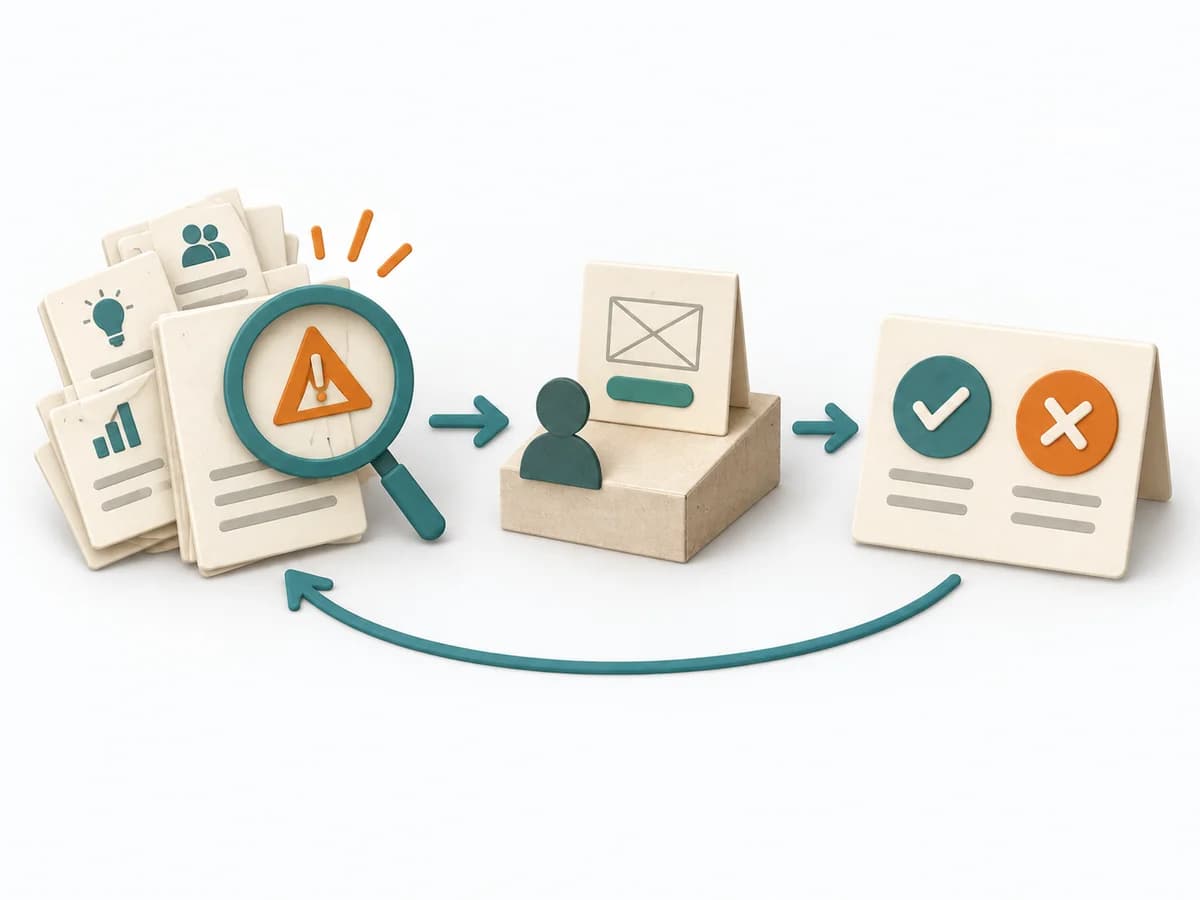
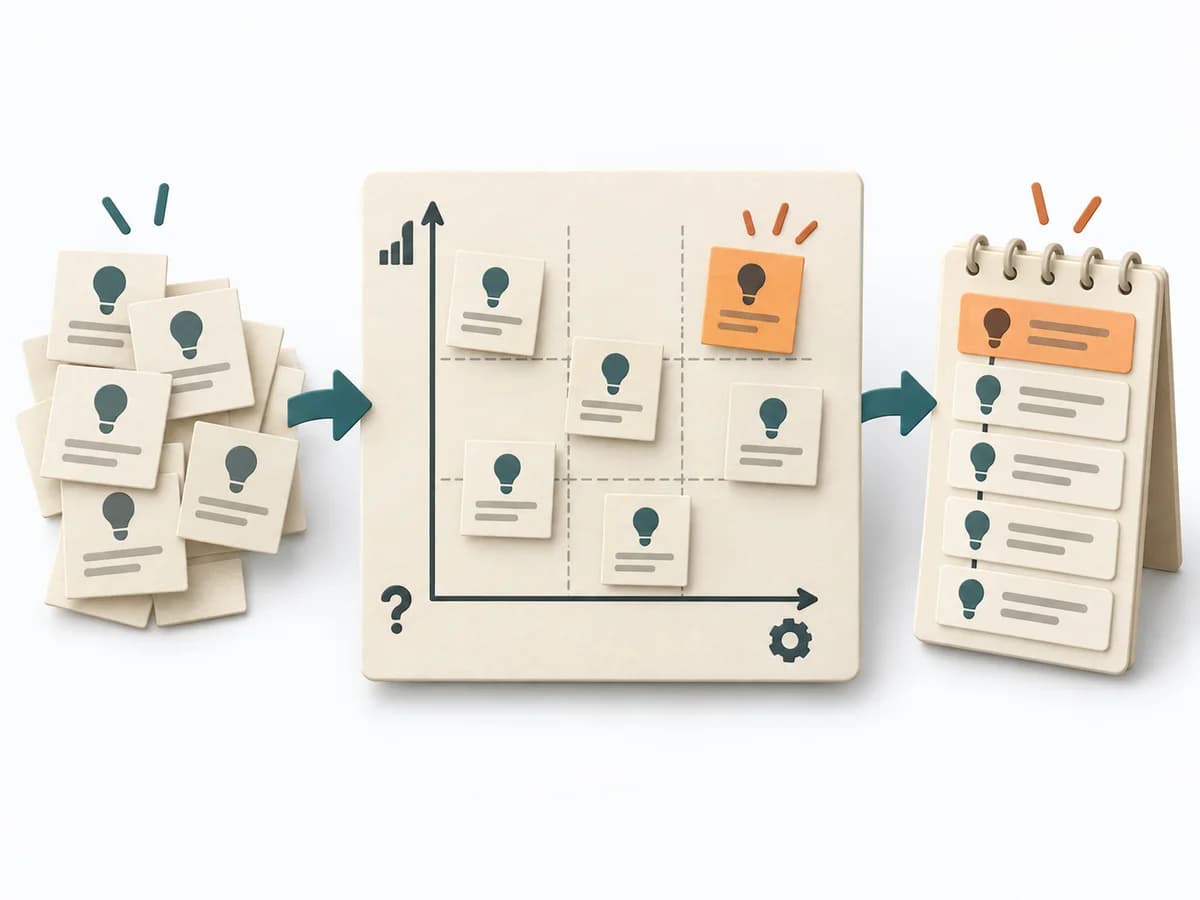
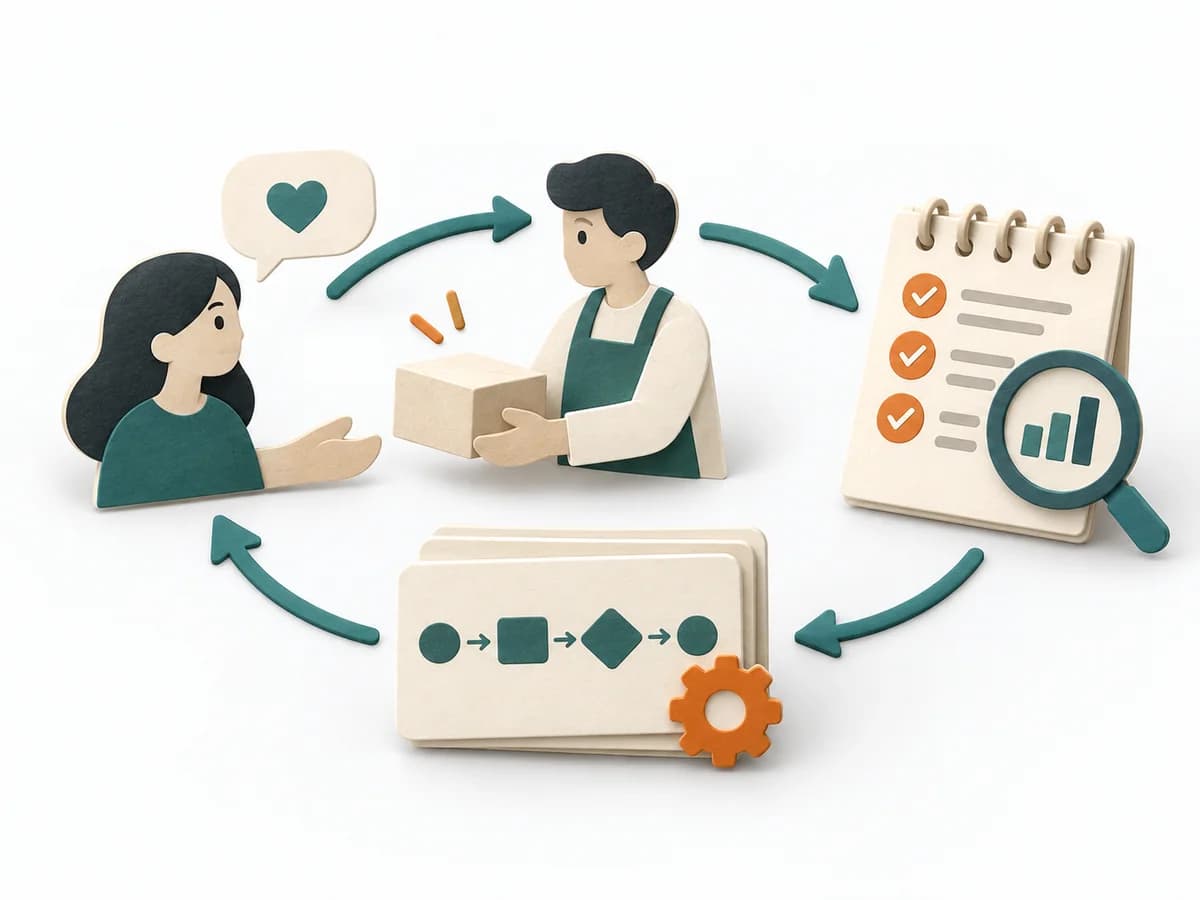
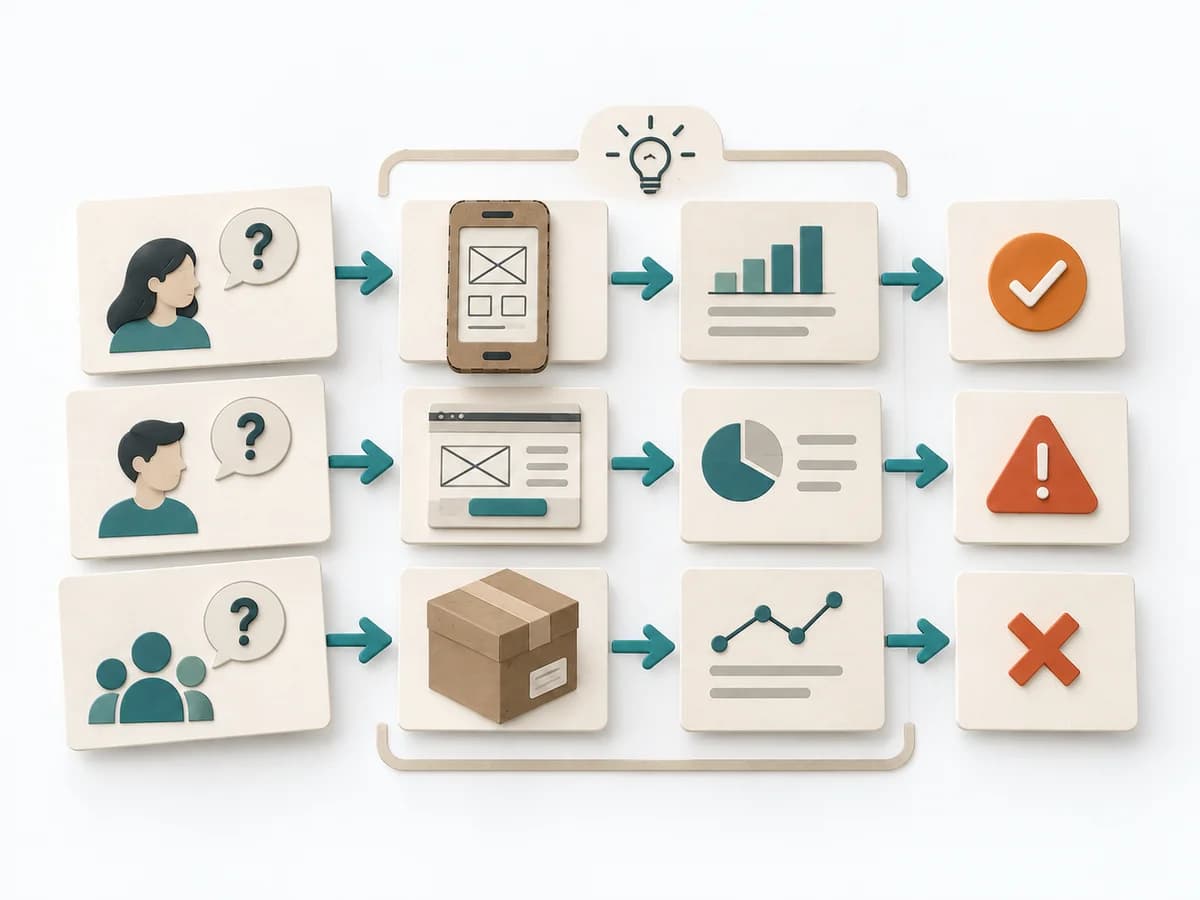
When an idea hinges on one critical unknown, it prioritizes testing that exact piece of uncertainty first. It separates problem, assumption, solution, and evidence. The result is captured as a prioritized list of assumptions, a test plan, and a result report.
Product Discovery Research method
Riskiest Assumption Test
Finds the success-critical assumption with the weakest evidence and tests it with the smallest decision-capable experiment.
A Riskiest Assumption Test starts from assumptions rather than a preferred MVP. Priority combines impact if wrong with current evidence. Thresholds, minimum data, and decision rules are set before testing; an interview count alone is not a validity criterion.
Which assumption would damage the idea most if false and currently has the weakest credible evidence?
- Participants
- 2-6
- Time
- 1-2 Wochen pro Iteration
Priority combines high impact if wrong with weak evidence. A fixed interview count is neither a threshold nor evidence of effect.

Assumptions
Break down critical assumptions
Decompose the idea into discrete desirability, viability, feasibility, and adaptability assumptions.
Prioritise
Select the riskiest assumption
Assess impact if wrong and current evidence separately, then justify one priority.
Test
Design the smallest decision-capable experiment
Set evidence source, metric, threshold, and minimum data before testing.
Decide
Evaluate evidence and reorder risk
Apply the pre-set rule, update evidence strength, and determine the next risk-reduction step.
After each test, update evidence strength and select the riskiest remaining assumption.
A good fit when
Useful before substantial investment in a solution or business model. Clarify assumptions or conduct discovery first when the core question is still open.
Ideal for
- Early-phase discovery
- Investment decisions
- Innovation programs
Not good for
- Already validated ideas
Outputs

Prioritised assumption map
Discrete assumptions with risk dimension, impact, evidence strength, and rationale.

RAT protocol and decision
Smallest suitable test with population, metric, threshold, result, and updated ranking.
Riskiest Assumption Test
Fictional worked example
Prioritise assumptions by impact and evidence, then connect the top item to a pre-set decision-capable test.
| Assumption | Assumption | Impact if wrong | Current evidence | Smallest suitable test | Metric, threshold, decision |
|---|---|---|---|---|---|
| A1 report exportUse in monthly review | Project leads use exported reports in their monthly review. | Very high: without review use, export misses its core value. | Weak: two internal opinions, no target-segment observation. | Concierge report for 12 suitable project leads with a real review date. | Pass: ≥8 bring it to review and ≥6 use a chart. Result 7/5: missed; revisit value and segment, stop build. |
1. Assumption
- A1 report export
- Project leads use exported reports in their monthly review.
2. Impact if wrong
- A1 report export
- Very high: without review use, export misses its core value.
3. Current evidence
- A1 report export
- Weak: two internal opinions, no target-segment observation.
4. Smallest suitable test
- A1 report export
- Concierge report for 12 suitable project leads with a real review date.
5. Metric, threshold, decision
- A1 report export
- Pass: ≥8 bring it to review and ≥6 use a chart. Result 7/5: missed; revisit value and segment, stop build.
Participant count is part of design, not a success criterion. Observable outcome, threshold, and evidence strength decide.
First step
Start with the core question: Which assumption would damage the idea most if false and currently has the weakest credible evidence?
Good to do first
Deep dive
It identifies the riskiest assumption and builds the smallest possible test around it. Learning energy is concentrated where a mistake would tip the venture over most strongly, instead of testing many comfortable side questions.
The Riskiest Assumption Test, often shortened to RAT, is a stricter version of the MVP idea. Popularized by Giff Constable, Rik Higham, and others, it asks for the one assumption whose falseness would most threaten the initiative. The right experiment is often smaller, cheaper, and faster than a classic MVP.
Collect all assumptions, sort them by uncertainty and leverage, then choose the top one. Define the experiment as small as possible.
The method guide walks execution through 4 phases, timing, 4 pitfalls, and clear stop criteria.
Open method guideYour perspective
Does this method help with your work?
Your feedback helps shape the next improvements to methodatlas.
Sources and topics
Assumption Map ChecklistChecklist for critical assumptions by risk and knowledge level.checklist
assumption-map-checklist.md
Checklist for critical assumptions by risk and knowledge level.
- Formulate assumption as a testable statement
- Assess risk
- Assess level of knowledge
- Add data source or test idea
- Mark riskiest assumption
- Define success criterion
- Set owner and date
Experiment PlanShort plan for hypothesis, test design, success criteria, and decision.markdown
experiment-plan-markdown.md
Short plan for hypothesis, test design, success criteria, and decision.
Experiment Plan
Hypothesis
We believe that ...
Target audience
Who are we testing for?
Test design
What exactly will participants or users do?
Success criterion
We count the test as positive if ...
Risks and limits
What can the test not prove?
Decision afterward
If positive: ... If negative: ...
Owner and date
...
Riskiest Assumption Test: WorksheetPlan Riskiest Assumption Test with real scope, suitable roles, and a clear decision objective.markdown
riskiest-assumption-test-working-template.md
Plan Riskiest Assumption Test with real scope, suitable roles, and a clear decision objective.
Riskiest Assumption Test: Worksheet
Question
To be confirmed
Desired outcome
To be confirmed
Scope
Full learning cycle Time: 45 minutes for prioritisation and design; execution is separate
Complete this worksheet on paper or in your own document during the work.
Preparation for this scope
Method setup
- Materials: Assumption cards, business or product model, evidence links, risk grid, Test Card, and Learning Card.
- Roles: Product/initiative owner · research/experiment lead · subject experts · decider
- Advance information: Collect the investment decision, known assumptions, and current behavioural or market evidence.
- Overall time needed: 45 minutes for prioritisation and design; execution is separate
- Setup: Define impact and evidence as separate axes; never derive a test threshold from the priority scale.
Prepare for the work steps
Assumptions: Break down critical assumptions
- Product or business model
- Audience and problem understanding
- Technical and operational conditions
Prioritise: Select the riskiest assumption
- Assumption map
- Decision and investment size
- Evidence sources
Test: Design the smallest decision-capable experiment
- Prioritised assumption
- Available test channels
- Time, cost, and ethical boundaries
Decide: Evaluate evidence and reorder risk
- Test data and deviation log
- Pre-set rule
- Assumption map
Riskiest Assumption Test
| Assumption | What must be true? | low/medium/high + rationale | source · strength · recency | test · population · duration | metric · threshold · if/then |
|---|---|---|---|---|---|
| A1 report export |
- A1 report export: Use in monthly review
Justify impact and evidence separately; freeze threshold before running.
Strategyzer: Test Your Business Assumptions
Assumptions: Break down critical assumptions
Expected artifact: Assumption map
Assumption · risk dimension · evidence source
Entry:
...
- Is each claim independently falsifiable?
Prioritise: Select the riskiest assumption
Expected artifact: Prioritised assumption
Impact · evidence strength · rationale
Entry:
...
- Are uncertainty and importance assessed separately?
Test: Design the smallest decision-capable experiment
Expected artifact: RAT protocol
Test · population · metric · threshold · decision
Entry:
...
- Would a failed result change the next investment?
Decide: Evaluate evidence and reorder risk
Expected artifact: Decision and new ranking
Result · evidence strength · decision · next assumption
Entry:
...
- Does an inconclusive test remain inconclusive?
Open questions and next steps
...
Method guide: https://methodatlas.meierhoff-systems.de/en/methods/riskiest-assumption-test/run-sheet
Alternatives and neighbors
Fitting alternatives with decision guidance, followed by other related methods.

Instead of Riskiest Assumption Test, choose Assumption Mapping when you want to order assumptions by uncertainty and risk and then test them in a targeted way.

Instead of Riskiest Assumption Test, choose Concierge MVP when you want to deliver the value manually and get learning signals before automating.

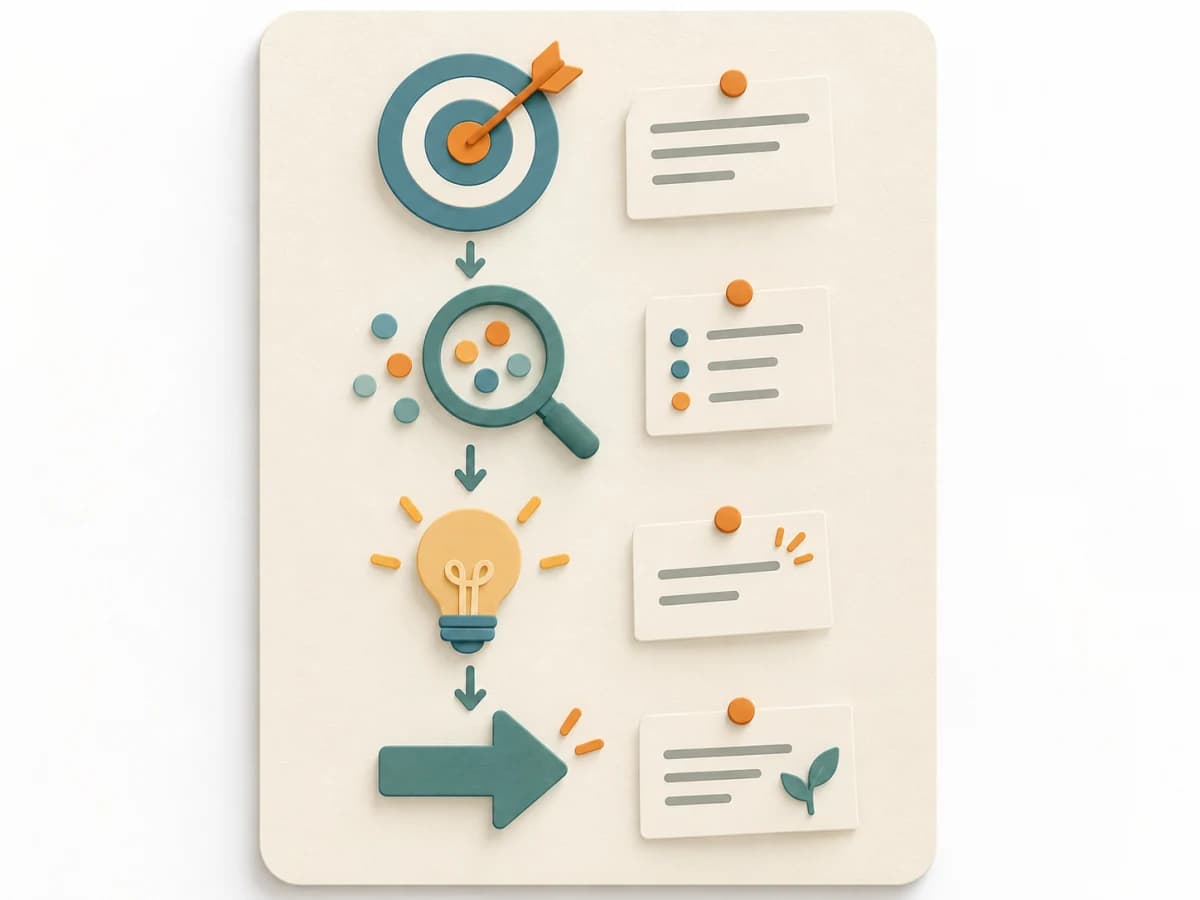
Moves customer problem, solution idea, and evidence toward a concrete result through "list assumptions", "map assumptions to dimensions", and "derive the test plan".

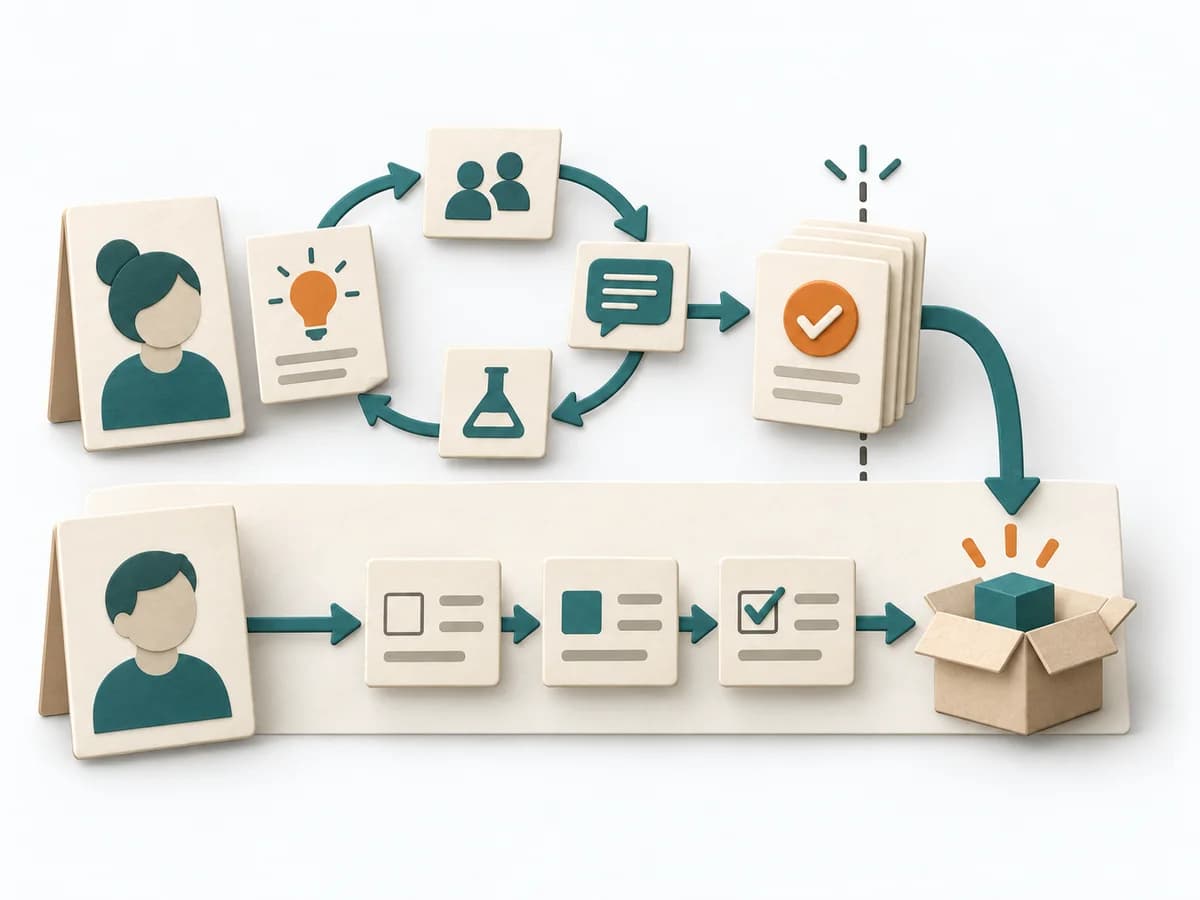
Separates discovery and delivery so that validated stories only move into implementation after learning loops.

Separates hypothesis, observation, insight, and next action into four fields after a test.

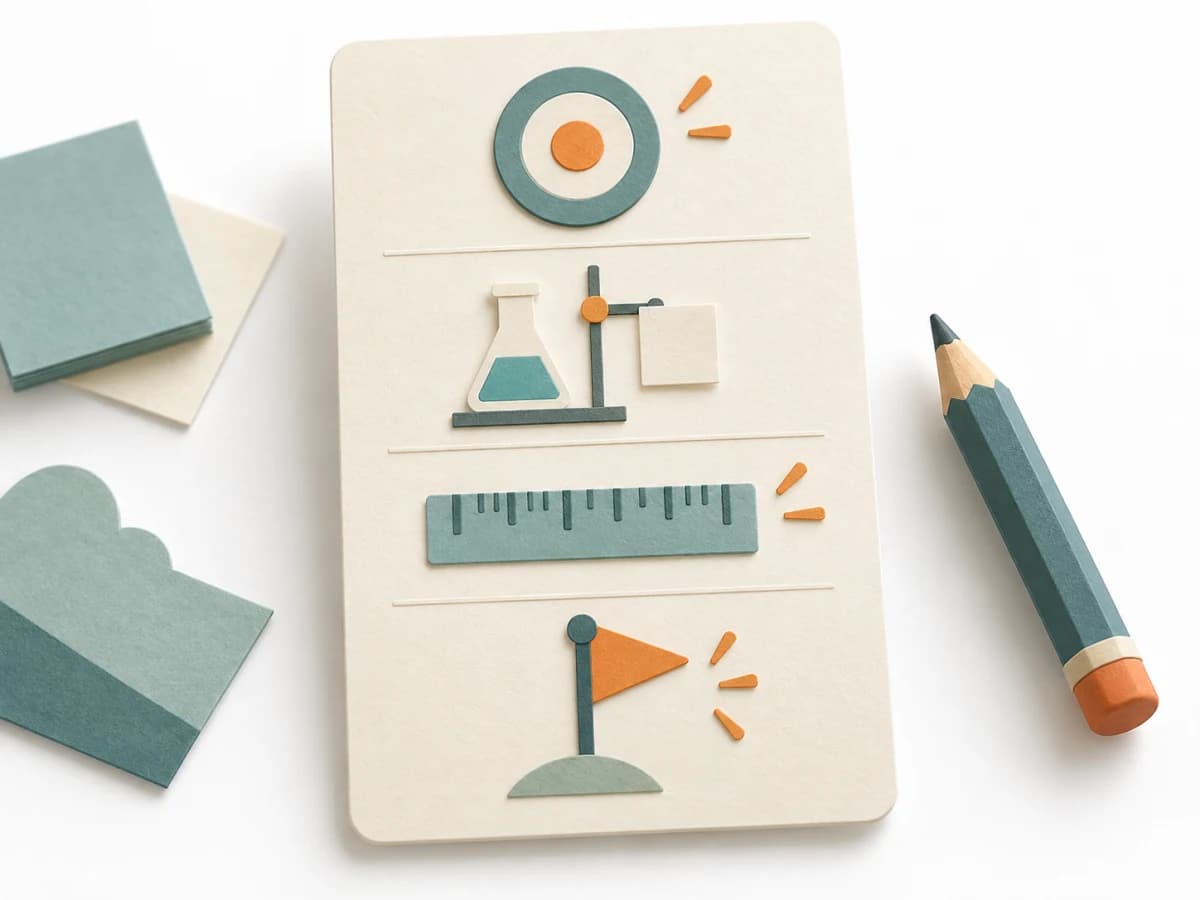
Condenses hypothesis, test, metric, and success threshold onto one card before execution.
Constraints and origin
Profile
- Method form
- Research method
- Participants
- 2-6
- Time
- 1-2 Wochen pro Iteration
- Maturity
- Established
- Origin
- Lean Startup Community