methodatlas
Session Builder

Plan my session

Plan a concrete work block with agenda, roles, preparation, and a copyable result artifact.

Method session1-2 weeks per iterationWorkshop or asyncListe priorisierter Annahmen

Session: Riskiest Assumption Test

The plan translates the method into a concrete facilitated work block. Your inputs flow directly into the session brief and work artifact.

Derived automatically

Method session with 2-6. The plan uses the existing method logic and the runsheet.

Runsheet
Participation logic
Team round, shared work and alignment

Use the session for shared understanding. Contributions are collected visibly, assumptions are aligned, and open differences remain traceable in the artifact.

Outcome logic
Finish artifact

The session works directly toward Liste priorisierter Annahmen. After the session, the artifact should be shareable, reviewable, or reusable.

  1. 1

    Phase 1: Collect and rate assumptions

    60-90 min

    Collect all assumptions critical for idea (value, usage, feasibility, market). Rate uncertainty (0-3) and leverage (0-3) per assumption. Place in quadrants. Hint: Anyone finding no assumptions is ignoring them. Common categories: will customers pay, will customers find us, can we build it, is market large enough.

    FacilitatorListe priorisierter Annahmen
  2. 2

    Phase 2: Choose top assumption

    15 min

    Choose one assumption from top-right quadrant (high uncertainty, high leverage) as RAT. Document rationale. Clear selection statement: "We test this assumption now." Hint: Maximum one assumption per test iteration. Parallel tests make causes inseparable. Other assumptions wait in pipeline.

    FacilitatorTest-Plan
  3. 3

    Phase 3: Design minimal test

    1-3 days

    Smallest working test (landing page, fake door, Wizard of Oz, concierge, survey). Fix threshold before build. Setup time under 3 days ideal, max 1 week. Hint: Temptation: too-large test design. Rule of thumb: if test needs more than 1 week, assumption is too large or design too fat. Cut smaller.

    FacilitatorErgebnisbericht
  4. 4

    Phase 4: Run test

    3-7 days

    Test live. Collect data. Daily short evaluation, final evaluation after period. Watch assumption-killer signals (stop early if clearly invalidated). Hint: Do not stop test earlier than planned unless assumption is clearly refuted (for example 0 signups at 1000 visits). Then early stop and pivot discussion.

    FacilitatorListe priorisierter Annahmen
  5. 5

    Phase 5: Pivot, persevere or stop

    30-60 min

    Result against threshold: success = Persevere (test next assumption), mixed = Re-Design, failure = Pivot (change value proposition) or Stop. Document decision. Hint: Pivot is victory, not defeat. Early invalidation saves months. Persevere without new tests is dangerous; keep processing assumption pipeline.

    OwnerTest-Plan
  6. 6

    Publish artifact

    10 min

    Check the artifact for completeness, define location, set version or status, and name review recipients.

    OwnerListe priorisierter Annahmen
Usable artifact

Session Brief

For invitations, boards, tickets, PR descriptions, or workshop notes.

session-brief.md

Session Brief: Riskiest Assumption Test

Goal

Artifact: Liste priorisierter Annahmen

Working Question

Which assumption, if false, would endanger the initiative most, and what is the smallest possible test to examine this in 1-2 weeks?

Context

Idea or initiative with value proposition; assumption map with top-3 candidates; target group and recruiting channel; available test tools; budget and iteration timeframe.

Setup

  • Format: Method session
  • Duration: 1-2 weeks per iteration
  • Mode: Workshop or async
  • Participants: One discovery lead (Product Manager or founder); one designer/builder for test setup; one engineer for technically complex tests; one data analyst for metric evaluation.
  • Owner: One discovery lead (Product Manager or founder)
  • Participation mode: Team round, shared work and alignment
  • Outcome logic: Finish artifact

Participation Logic

Use the session for shared understanding. Contributions are collected visibly, assumptions are aligned, and open differences remain traceable in the artifact.

Outcome Logic

The session works directly toward Liste priorisierter Annahmen. After the session, the artifact should be shareable, reviewable, or reusable.

Input

Assumption list with uncertainty/leverage scoring; Experiment Canvas for structure; minimal test setup (landing page builder, prototype tool, concierge script); tracking tool for metrics; budget approval.

Preparation

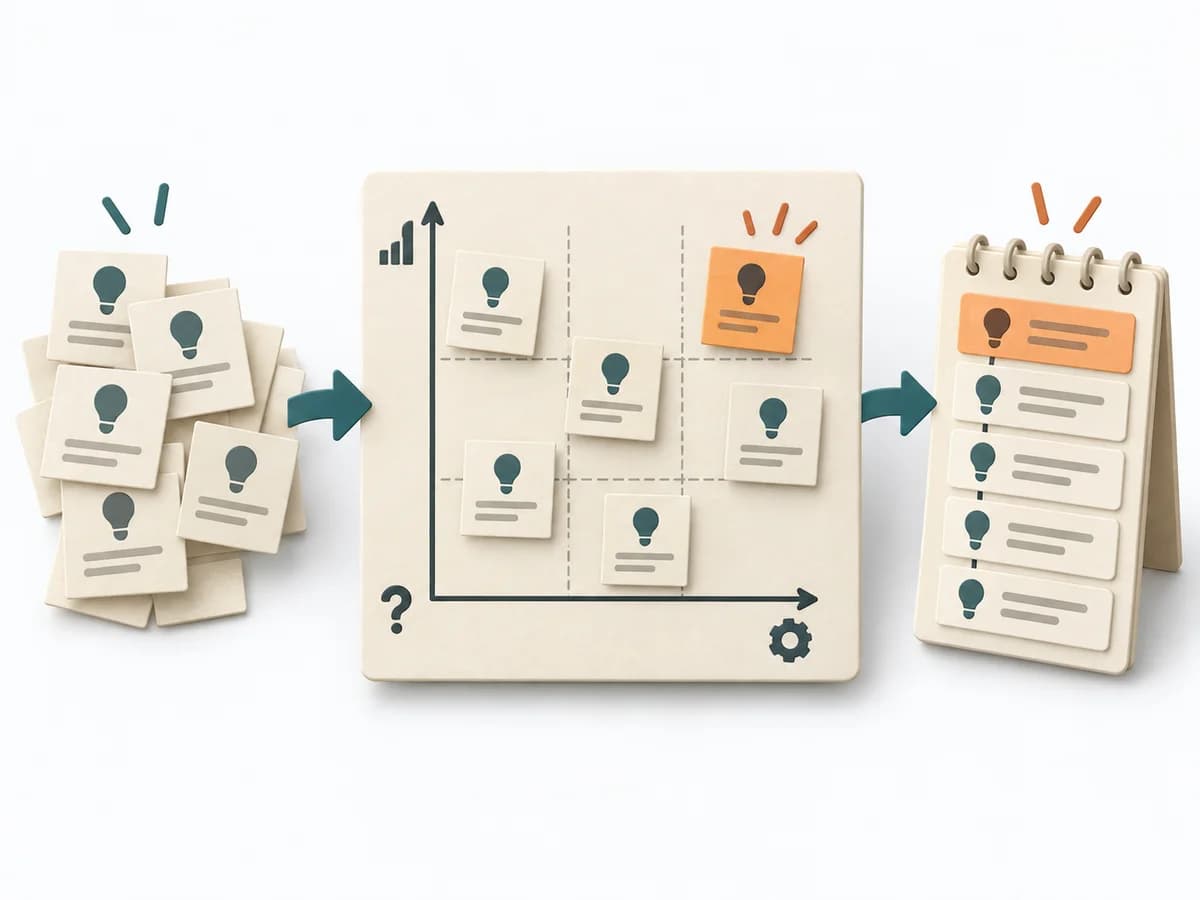
Assumption map as quadrant (axis uncertainty, axis leverage). Top-right (high uncertainty, high leverage) marked as RAT candidate. Experiment Canvas for selected assumption. Choose test tool according to assumption type (value, usage, technology, market).

Agenda

  1. Phase 1: Collect and rate assumptions (60-90 min) Owner: Facilitator Action: Collect all assumptions critical for idea (value, usage, feasibility, market). Rate uncertainty (0-3) and leverage (0-3) per assumption. Place in quadrants. Hint: Anyone finding no assumptions is ignoring them. Common categories: will customers pay, will customers find us, can we build it, is market large enough. Output: Liste priorisierter Annahmen

  2. Phase 2: Choose top assumption (15 min) Owner: Facilitator Action: Choose one assumption from top-right quadrant (high uncertainty, high leverage) as RAT. Document rationale. Clear selection statement: "We test this assumption now." Hint: Maximum one assumption per test iteration. Parallel tests make causes inseparable. Other assumptions wait in pipeline. Output: Test-Plan

  3. Phase 3: Design minimal test (1-3 days) Owner: Facilitator Action: Smallest working test (landing page, fake door, Wizard of Oz, concierge, survey). Fix threshold before build. Setup time under 3 days ideal, max 1 week. Hint: Temptation: too-large test design. Rule of thumb: if test needs more than 1 week, assumption is too large or design too fat. Cut smaller. Output: Ergebnisbericht

  4. Phase 4: Run test (3-7 days) Owner: Facilitator Action: Test live. Collect data. Daily short evaluation, final evaluation after period. Watch assumption-killer signals (stop early if clearly invalidated). Hint: Do not stop test earlier than planned unless assumption is clearly refuted (for example 0 signups at 1000 visits). Then early stop and pivot discussion. Output: Liste priorisierter Annahmen

  5. Phase 5: Pivot, persevere or stop (30-60 min) Owner: Owner Action: Result against threshold: success = Persevere (test next assumption), mixed = Re-Design, failure = Pivot (change value proposition) or Stop. Document decision. Hint: Pivot is victory, not defeat. Early invalidation saves months. Persevere without new tests is dangerous; keep processing assumption pipeline. Output: Test-Plan

  6. Publish artifact (10 min) Owner: Owner Action: Check the artifact for completeness, define location, set version or status, and name review recipients. Output: Liste priorisierter Annahmen

Closeout

  • Update result artifact: Liste priorisierter Annahmen
  • Define location, version, and review recipients.
  • Define owner, next step, and review date.
Usable artifact

Work artifact

Pre-filled starting point based on the matching template.

work-artifact.md

Liste priorisierter Annahmen: Riskiest Assumption Test

Working Question

Which assumption, if false, would endanger the initiative most, and what is the smallest possible test to examine this in 1-2 weeks?

Context

Idea or initiative with value proposition; assumption map with top-3 candidates; target group and recruiting channel; available test tools; budget and iteration timeframe.

Participants

  • Owner: One discovery lead (Product Manager or founder)
  • Participants: One discovery lead (Product Manager or founder); one designer/builder for test setup; one engineer for technically complex tests; one data analyst for metric evaluation.

Input

Assumption list with uncertainty/leverage scoring; Experiment Canvas for structure; minimal test setup (landing page builder, prototype tool, concierge script); tracking tool for metrics; budget approval.

Template

  • Formulate assumption as a testable statement
  • Assess risk
  • Assess level of knowledge
  • Add data source or test idea
  • Mark riskiest assumption
  • Define success criterion
  • Set owner and date

Completion Check

  • Liste priorisierter Annahmen is complete enough for review:
  • Location:
  • Version / status:
  • Review by:
  • Next step:

Next Step

  • Review result
  • Mark open questions
  • Schedule review or decision
Template base

Assumption Map Checklist

View templateChecklist for critical assumptions by risk and knowledge level.
checklist

assumption-map-checklist.md

Checklist for critical assumptions by risk and knowledge level.

  • Formulate assumption as a testable statement
  • Assess risk
  • Assess level of knowledge
  • Add data source or test idea
  • Mark riskiest assumption
  • Define success criterion
  • Set owner and date
Ready to use when
  • Working question, owner, and target artifact are visible.
  • The result fits Liste priorisierter Annahmen.
  • Own ID and date per RAT. Assumption map with version state, mark processed assumptions. Archive test result (do not delete) even on pivot, as later iterations need reference.
  • Open questions are noted as follow-ups.
  • The next review or decision point is scheduled.