Complete firstExplicit assumptions
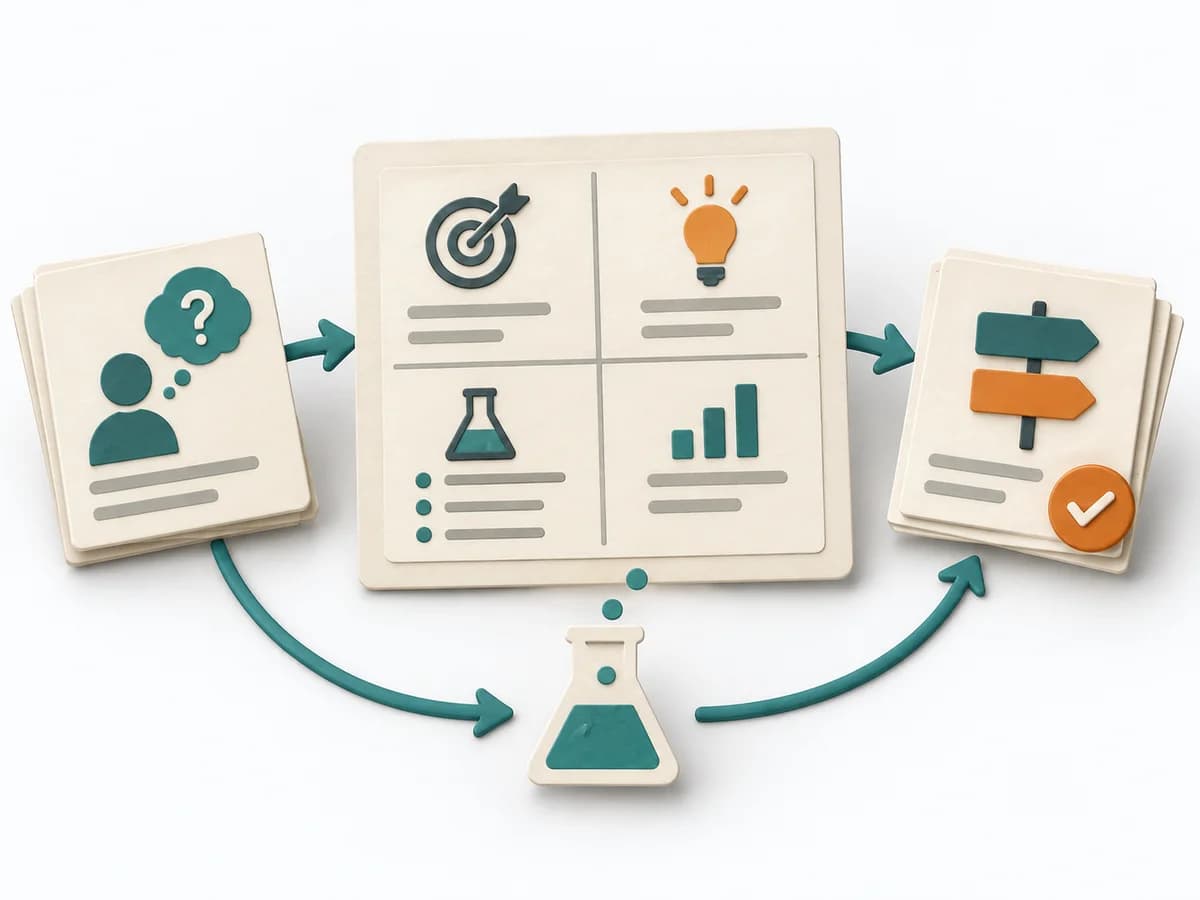
The idea is decomposed into desirability, viability, feasibility, and adaptability assumptions.
Without decomposition, an arbitrary MVP becomes the test object.
A practical method guide: clarify prerequisites and materials, understand the complete process, and look up outputs, pitfalls, and stop criteria.
What needs to be finished first
The idea is decomposed into desirability, viability, feasibility, and adaptability assumptions.
The cost or commitment exposed by a false assumption is clear.
What needs to be ready before start
Assumption cards, business or product model, evidence links, risk grid, Test Card, and Learning Card.
Product/initiative owner · research/experiment lead · subject experts · decider
Collect the investment decision, known assumptions, and current behavioural or market evidence.
45 minutes for prioritisation and design; execution is separate
Define impact and evidence as separate axes; never derive a test threshold from the priority scale.
The one question this method answers
Which assumption would damage the idea most if false and currently has the weakest credible evidence?
Phases with goal, actions, output and pitfall
A Riskiest Assumption Test starts from assumptions rather than a preferred MVP. Priority combines impact if wrong with current evidence. Thresholds, minimum data, and decision rules are set before testing; an interview count alone is not a validity criterion.
Fictional worked example
Prioritise assumptions by impact and evidence, then connect the top item to a pre-set decision-capable test.
| Assumption | Assumption | Impact if wrong | Current evidence | Smallest suitable test | Metric, threshold, decision |
|---|---|---|---|---|---|
| A1 report exportUse in monthly review | Project leads use exported reports in their monthly review. | Very high: without review use, export misses its core value. | Weak: two internal opinions, no target-segment observation. | Concierge report for 12 suitable project leads with a real review date. | Pass: ≥8 bring it to review and ≥6 use a chart. Result 7/5: missed; revisit value and segment, stop build. |
Participant count is part of design, not a success criterion. Observable outcome, threshold, and evidence strength decide.
Assumptions
Goal
Decompose the idea into discrete desirability, viability, feasibility, and adaptability assumptions.
Inputs for this step
Actions
Output
Assumption map
Assumption · risk dimension · evidence source
Quality check
Is each claim independently falsifiable?
Pitfall
Broad beliefs such as 'the market wants this' bundle several unknown mechanisms. Split by segment, behaviour, price, channel, and feasibility.
Timing: 10–15 minutes
Prioritise
Goal
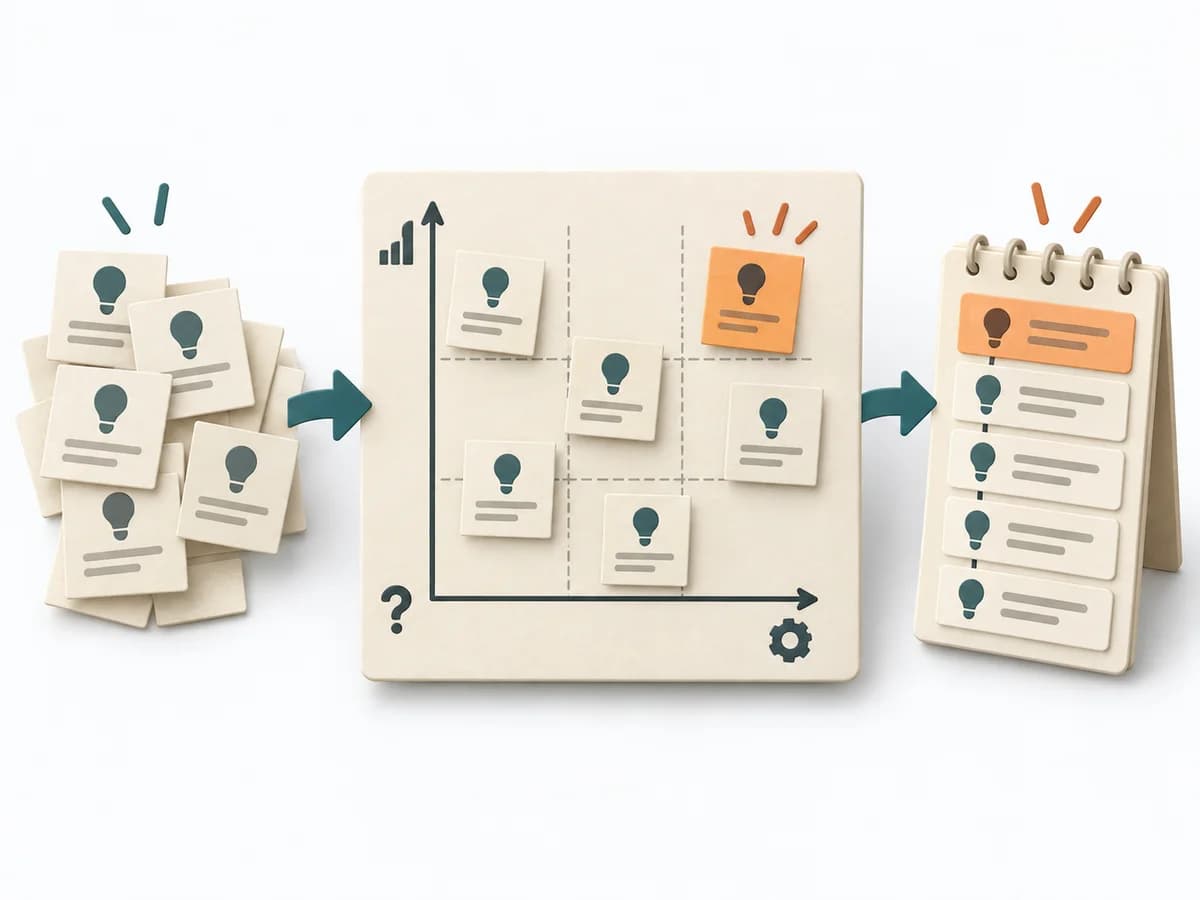
Assess impact if wrong and current evidence separately, then justify one priority.
Inputs for this step
Actions
Output
Prioritised assumption
Impact · evidence strength · rationale
Quality check
Are uncertainty and importance assessed separately?
Pitfall
The team selects the favourite idea or easiest assumption to test. Score independently, reveal evidence, and resolve differences against the investment decision.
Timing: 10–15 minutes
Test
Goal
Set evidence source, metric, threshold, and minimum data before testing.
Inputs for this step
Actions
Output
RAT protocol
Test · population · metric · threshold · decision
Quality check
Would a failed result change the next investment?
Pitfall
A fixed interview count is treated as success although statements do not test behaviour or a pre-set threshold. Define success through observable outcomes and a decision; size data to uncertainty and test type.
Timing: 15–20 minutes
Decide
Goal
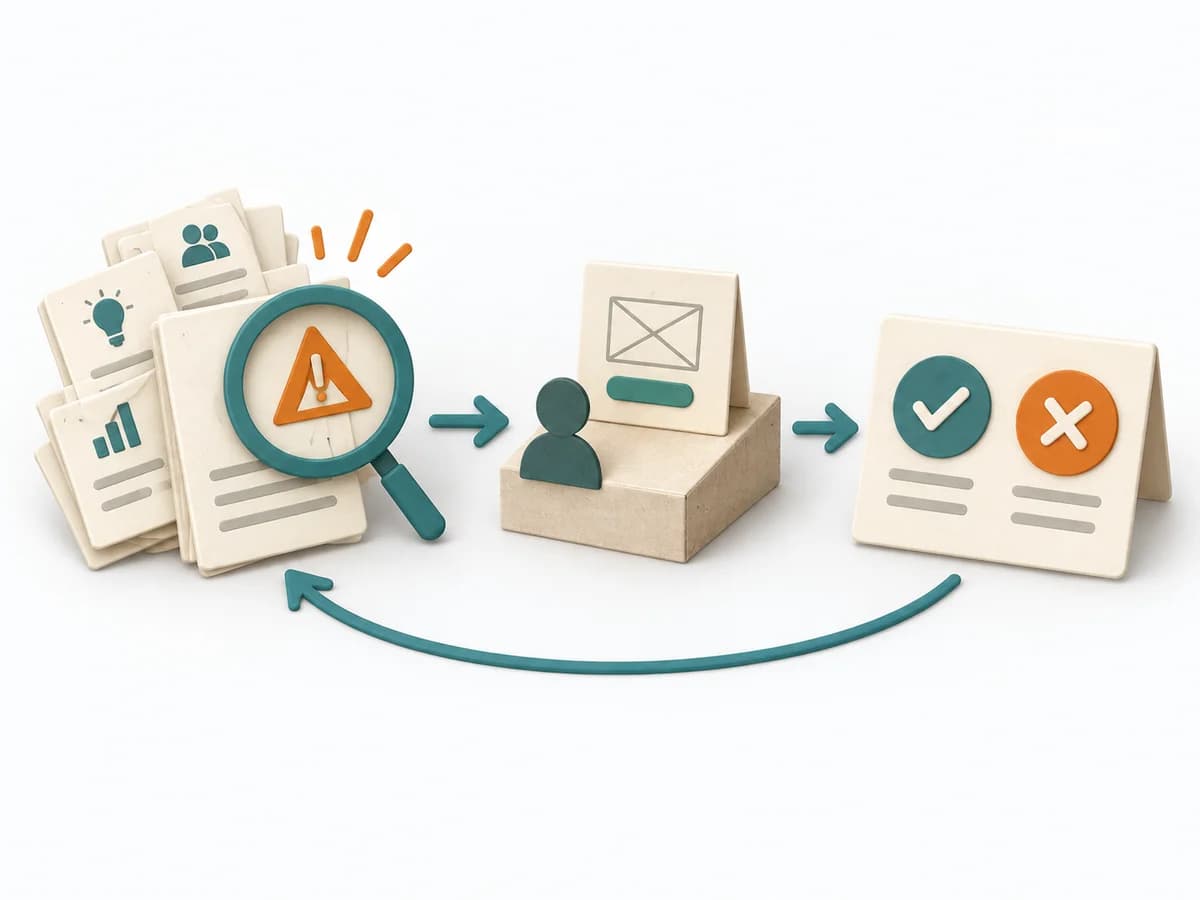
Apply the pre-set rule, update evidence strength, and determine the next risk-reduction step.
Inputs for this step
Actions
Output
Decision and new ranking
Result · evidence strength · decision · next assumption
Quality check
Does an inconclusive test remain inconclusive?
Pitfall
The threshold moves after the test to preserve the prior belief. Keep exploratory findings separate and create a new test version for new hypotheses.
Timing: 15–30 minutes analysis
What comes out at the end
Sketch: what the artifact looks like
Versioned assumption ranking with RAT protocol, raw data, decision, and next assumption.
Retain date, author, source state, and decision status for each revision; do not overwrite earlier results.
Checklist for critical assumptions by risk and knowledge level.
Short plan for hypothesis, test design, success criteria, and decision.
We believe that ...
Who are we testing for?
What exactly will participants or users do?
We count the test as positive if ...
What can the test not prove?
If positive: ... If negative: ...
...
Plan Riskiest Assumption Test with real scope, suitable roles, and a clear decision objective.
To be confirmed
To be confirmed
Full learning cycle Time: 45 minutes for prioritisation and design; execution is separate
Complete this worksheet on paper or in your own document during the work.
| Assumption | What must be true? | low/medium/high + rationale | source · strength · recency | test · population · duration | metric · threshold · if/then |
|---|---|---|---|---|---|
| A1 report export |
Justify impact and evidence separately; freeze threshold before running.
Strategyzer: Test Your Business Assumptions
Expected artifact: Assumption map
Assumption · risk dimension · evidence source
Entry:
...
Expected artifact: Prioritised assumption
Impact · evidence strength · rationale
Entry:
...
Expected artifact: RAT protocol
Test · population · metric · threshold · decision
Entry:
...
Expected artifact: Decision and new ranking
Result · evidence strength · decision · next assumption
Entry:
...
...
Method guide: https://methodatlas.meierhoff-systems.de/en/methods/riskiest-assumption-test/run-sheet
Concrete filled scenario, fictional example
Fictional example for orientation. Counts and timings describe this case and are not universal requirements.
Concrete filled scenario, fictional example
Fictional example: assumption A1: project leads use an exported report in their monthly review. Impact if wrong: very high; evidence: two internal opinions only. Test: concierge report for twelve suitable project leads with a real review date. Pre-set success: at least eight bring it into the review and at least six use an exported chart. Result 7 and 5: threshold missed; revise value proposition and segment, do not build export yet.
Recognize symptoms and steer against them
Quick overview, the full text is in the matching phase in the flow
Broad beliefs such as 'the market wants this' bundle several unknown mechanisms.
Split by segment, behaviour, price, channel, and feasibility.
The team selects the favourite idea or easiest assumption to test.
Score independently, reveal evidence, and resolve differences against the investment decision.
A fixed interview count is treated as success although statements do not test behaviour or a pre-set threshold.
Define success through observable outcomes and a decision; size data to uncertainty and test type.
The threshold moves after the test to preserve the prior belief.
Keep exploratory findings separate and create a new test version for new hypotheses.
When to pause, resolve prerequisites, or choose another approach
Go to the profile for purpose, similar methods, and sources or continue to the next method in the catalog.