Purpose
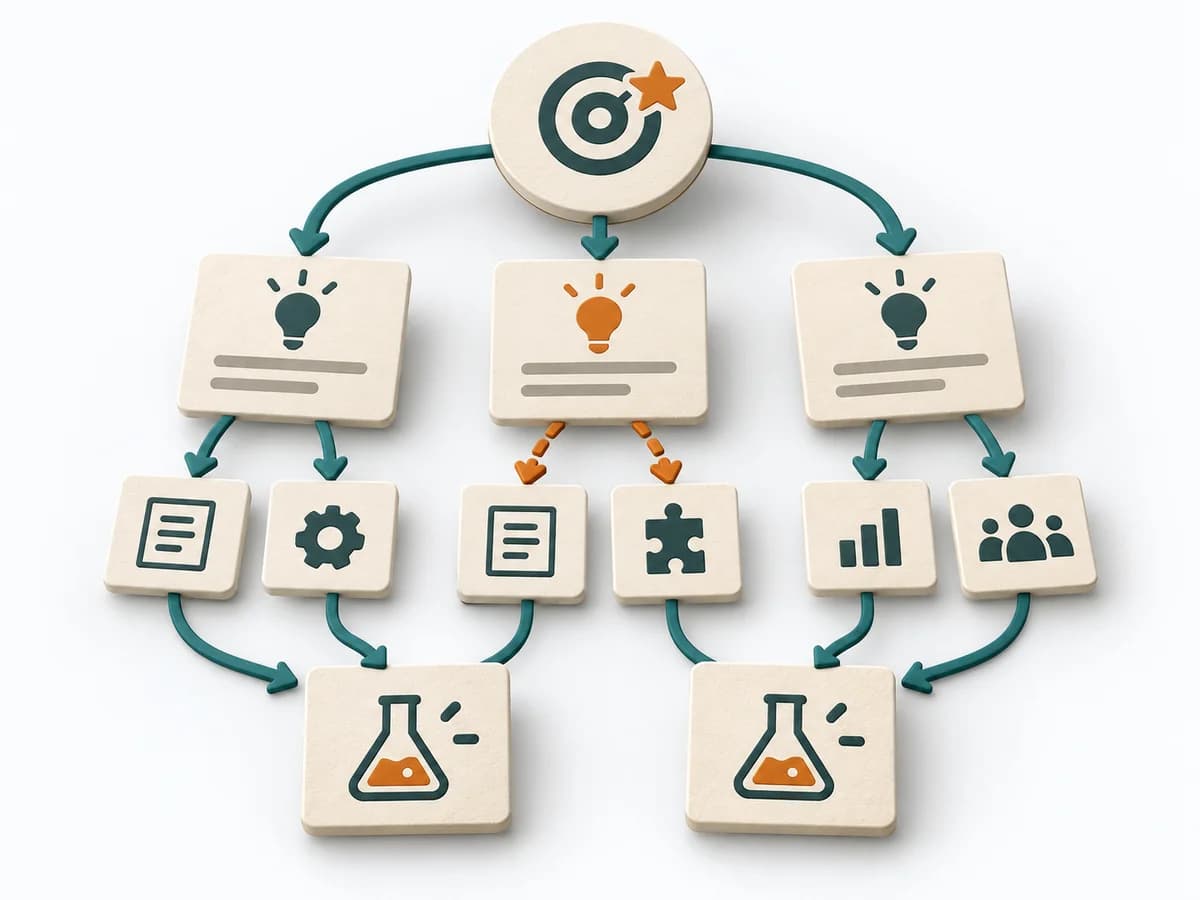
When opportunities need ranking by their effect, it makes importance and satisfaction directly comparable. It separates problem, assumption, solution, and evidence. The result is captured as an opportunity-score table and top outcomes.
Product Discovery Decision method
Prioritizes solution-neutral outcomes through importance and current satisfaction.
Opportunity Scoring evaluates desired outcomes, not features. Importance and satisfaction are collected as top-two-box percentages in the same segment; formula, sample, and uncertainty remain visible.
Which important user outcomes are currently underserved in the target segment?
Opportunity Scoring uses solution-neutral outcome statements plus separate importance and satisfaction ratings. Assessments remain justified and context-bound.

Define outcomes
Break the user job into solution-neutral measurable outcome statements.
Survey segment
Recruit the target segment and collect importance and satisfaction separately on the same scale and aggregate top-two-box percentages.
Calculate score
Apply the formula consistently and show uncertainty and segment effects.
Prioritise
Turn top outcomes into discovery questions without preselecting solutions.
Re-survey for a new segment or market and retain prior versions.
Useful with a validated user job and multiple outcomes; do not treat small convenience samples as market proof.
opportunity ranking with traceable sources, assumptions, and domain decisions.
Owners, dates, and next review for opportunity ranking.
Fictional worked example
solution-neutral outcome statements plus separate importance and satisfaction ratings as a precise working structure with a fictional example.
| Outcome | Outcome statement | Segment and sample | Importance | Satisfaction | Opportunity and next question |
|---|---|---|---|---|---|
| Find an actionWorked example | Minimise time until an action with owner can be found. | 86 project leads; ≥2 reviews/month. | 84% of 86 respondents. | 37% of 86 respondents. | 131; next interview on retrieval. |
The example demonstrates the domain logic of Opportunity Scoring; worksheets remain blank.
Start with the core question: Which important user outcomes are currently underserved in the target segment?
When opportunities need ranking by their effect, it makes importance and satisfaction directly comparable. It separates problem, assumption, solution, and evidence. The result is captured as an opportunity-score table and top outcomes.
It scores outcomes with a uniform scoring system and sorts the most interesting gaps to the top. Importance and satisfaction are read together so that underserved needs do not disappear behind louder ideas.
Opportunity Scoring, shaped by Anthony Ulwick in the context of Outcome-Driven Innovation, asks for each outcome how important it is to customers and how satisfied they are today. The gap between the two becomes the Opportunity Score. Areas with high importance and low satisfaction create the strongest leverage.
Write outcomes in customer language. Define the scale steps clearly. Base ratings on real interviews, not assumptions.
The method guide walks execution through 4 phases, timing, 4 pitfalls, and clear stop criteria.
Open method guideYour perspective
Your feedback helps shape the next improvements to methodatlas.
Plan Opportunity Scoring around its domain steps and the concrete decision question.
To be confirmed
To be confirmed
Full workshop Time: 60 minutes design; survey separate; 45 minutes analysis
Complete this worksheet on paper or in your own document during the work.
| Outcome | Direction · measure · context | Audience · n · recruitment | Top-two-box share · n · confidence interval | Top-two-box share · n · confidence interval | I + max(I−S,0) · score · uncertainty |
|---|---|---|---|---|---|
| Find an action |
Enter only real input, sources, and decisions.
Strategyn: Outcome-Driven Innovation
Expected artifact: outcome list
outcome list · source · uncertainty · next decision
Entry:
...
Expected artifact: survey data
survey data · source · uncertainty · next decision
Entry:
...
Expected artifact: opportunity scores
opportunity scores · source · uncertainty · next decision
Entry:
...
Expected artifact: opportunity backlog
opportunity backlog · source · uncertainty · next decision
Entry:
...
...
Method guide: https://methodatlas.meierhoff-systems.de/en/methods/opportunity-scoring/run-sheet
Fitting alternatives with decision guidance, followed by other related methods.

Instead of Opportunity Scoring, choose ICE Scoring when you want to quickly sort ideas by impact, confidence, and ease.

Quantifies customer desired outcomes for a job and identifies underserved needs as innovation opportunities.

Classifies features by their effect on satisfaction, showing which expectations create basic, performance, or delight response.

Clarifies customer problems, solution ideas, and evidence by framing an opportunity hypothesis, recruiting participants, and turning insights into opportunities.

Clarifies customer problems, solution ideas, and evidence by framing problem hypotheses, recruiting the target group, and assessing problem risk.
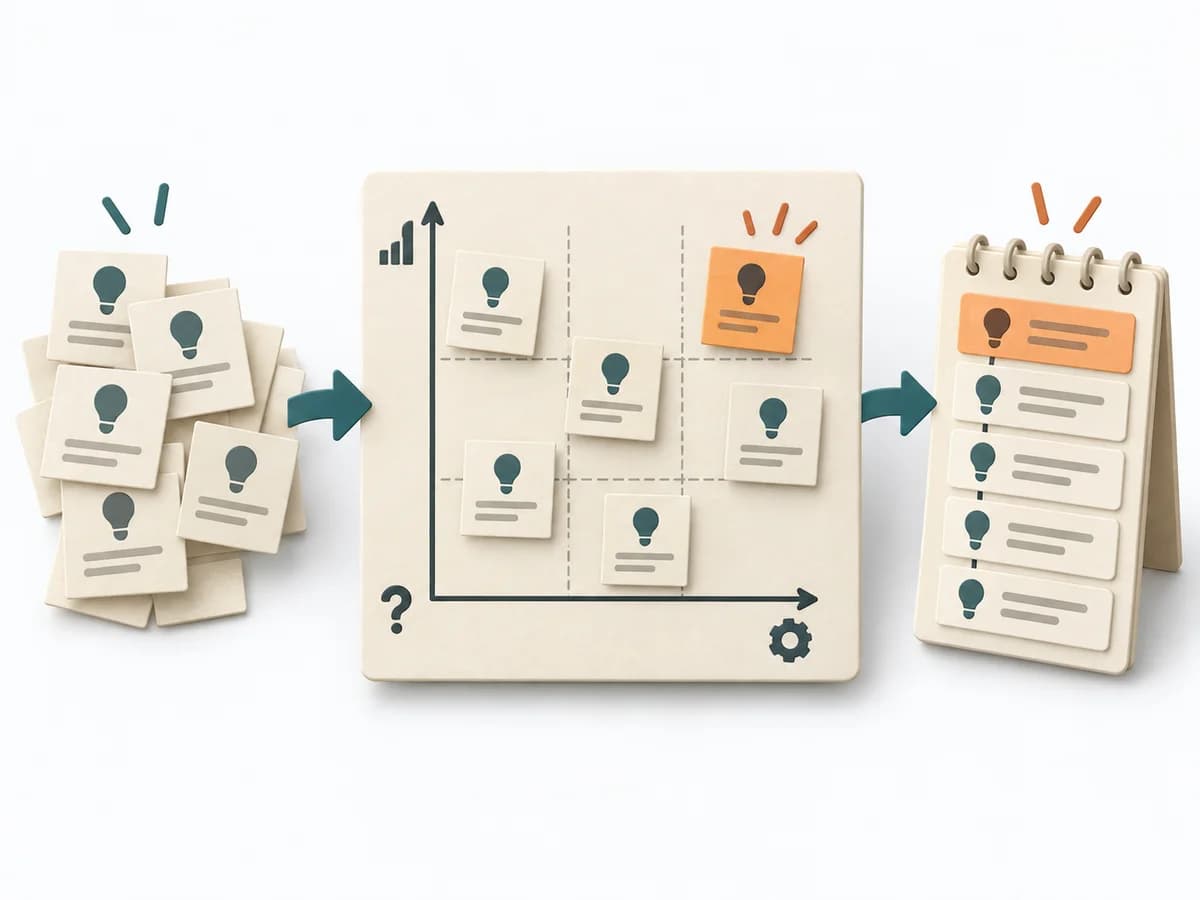
Moves customer problem, solution idea, and evidence toward a concrete result through "take over the hypothesis list", "define the risk scale", and "select the top hypotheses for the next tests".