Purpose
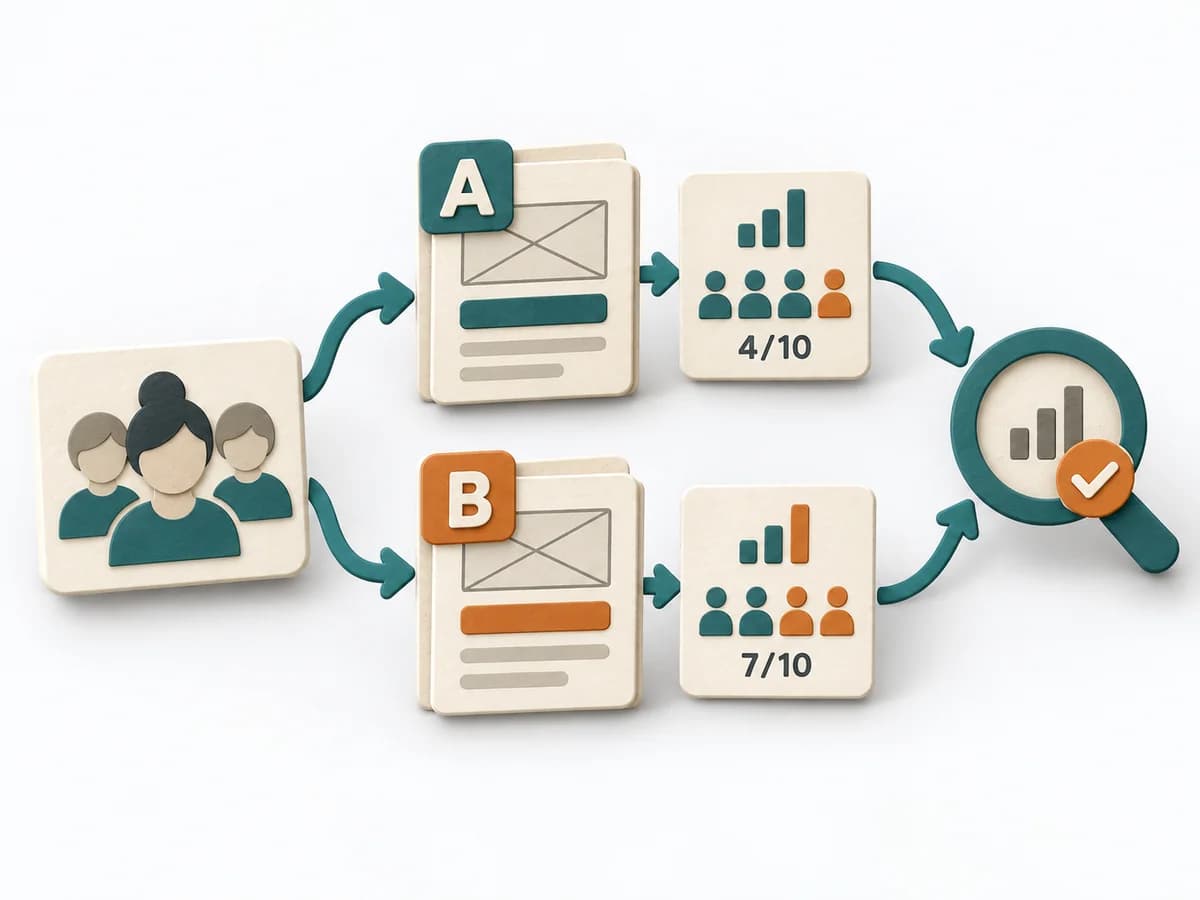
When demand only needs to be roughly verified, it tests interest with minimal effort. It measures whether people would take a next step at all.
Product Discovery Research method
Tests demand through a small observable behaviour before implementation cost grows.
A Smoke Test offers a credible pre-step and measures whether a defined audience chooses the next action. It tests interest, not complete product quality.
Does the defined audience choose the promised next action under realistic conditions?
The steps connect experiment design, real exposure, and analysis. Elapsed time depends on the required traffic.

Hypothesis
State an observable demand assumption with audience, problem, and desired action.
Signal
Provide a credible pre-step with exactly one next action.
Traffic
Document source and inclusion criterion; do not treat arbitrary reach as evidence.
Observation
Capture visits and qualified actions in the same period.
Decision
Record signal strength, uncertainty, and next test separately.
Change the hypothesis or setup deliberately after analysis; predefine threshold and observation window again for every new run.
Use it when a demand assumption needs a fast, bounded test of observable behavior.
Experiment report containing hypothesis, test setup, traffic source, observation window, visits, qualified actions, limitations, and next decision.
Fictional example
Fictional example for a pickup service. Each row connects assumption, test, observable signal, and decision.
| Experiment | Hypothesis | Test and audience | Signal and threshold | Observation and decision |
|---|---|---|---|---|
| Tool pickup slotDoes the defined audience choose the promised next action under realistic conditions? | Weekend customers reserve a Saturday pickup slot before the service is built. | Offer page sent to 80 previous weekend customers; one 'Reserve a slot' CTA. | Qualified: email plus preferred date. Pre-set rule: investigate further from 8 reservations. | 5 reservations. Threshold missed; interview people about reasons and revise the offer. |
The numbers are fictional and do not demonstrate real demand.
State the audience, problem assumption, desired action, and decision threshold.
When demand only needs to be roughly verified, it tests interest with minimal effort. It measures whether people would take a next step at all.
It provides a small preliminary step that makes reaction, click, or sign-up visible. Its informative value comes from observed behavior under realistic conditions, not from agreement in conversation or elaborate product development.
A Smoke Test works because it collects early market signals for an offering with little effort, limiting costly wrong assumptions early. Good application clearly defines what behavior counts as serious interest and which distortions could skew the signal. This makes it possible to check whether an idea creates resonance at all before the team develops or technically secures it further.
Phrase the offering concretely enough that reactions stem from a recognizable expectation rather than mere curiosity. Things tip most clearly where positive signals appear but their quality remains unclear. Close with a sober reading of the interest and a follow-up action that sharpens the signal specifically.
The method guide walks execution through 5 phases, timing, 5 pitfalls, and clear stop criteria.
Open method guideYour perspective
Your feedback helps shape the next improvements to methodatlas.
Short plan for hypothesis, test design, success criteria, and decision.
We believe that ...
Who are we testing for?
What exactly will participants or users do?
We count the test as positive if ...
What can the test not prove?
If positive: ... If negative: ...
...
Plan the hypothesis, setup, real run, and analysis with clear ownership.
To be confirmed
To be confirmed
Whole initiative Time: 2–5 days for setup, exposure, and analysis; design work alone usually takes 45–90 minutes.
Complete this worksheet on paper or in your own document during the work.
| Experiment | Hypothesis | Test and audience | Signal and threshold | Observation and decision |
|---|---|---|---|---|
| Tool pickup slot |
Complete the hypothesis and decision threshold before exposure.
Strategyzer · original teaching example
Expected artifact: Testable demand hypothesis
Testable demand hypothesis
Entry:
...
Expected artifact: Testable offer stub
Testable offer stub
Entry:
...
Expected artifact: Documented target-audience reach
Documented target-audience reach
Entry:
...
Expected artifact: Clean behavioural data
Clean behavioural data
Entry:
...
Expected artifact: Learning note with decision
Learning note with decision
Entry:
...
...
Method guide: https://methodatlas.meierhoff-systems.de/en/methods/smoke-test/run-sheet
Fitting alternatives with decision guidance, followed by other related methods.
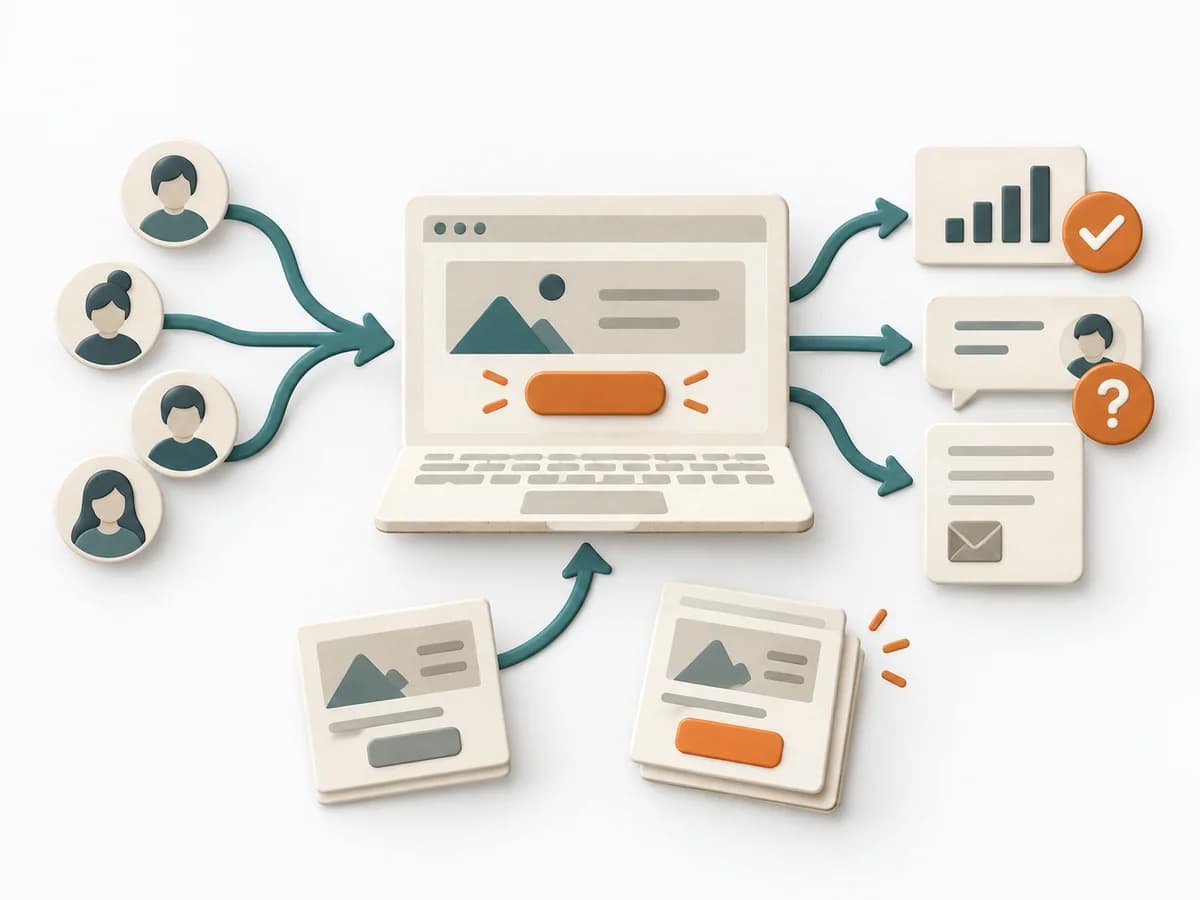
Instead of Smoke Test, choose Landing Page Test when you want to measure interest in an offer through a concrete offer page.

Tests a market claim with the smallest fitting precursor and makes real interest measurable.

Measures real interest in an idea that has not been built yet, through clicks, sign-ups, or other interest signals.
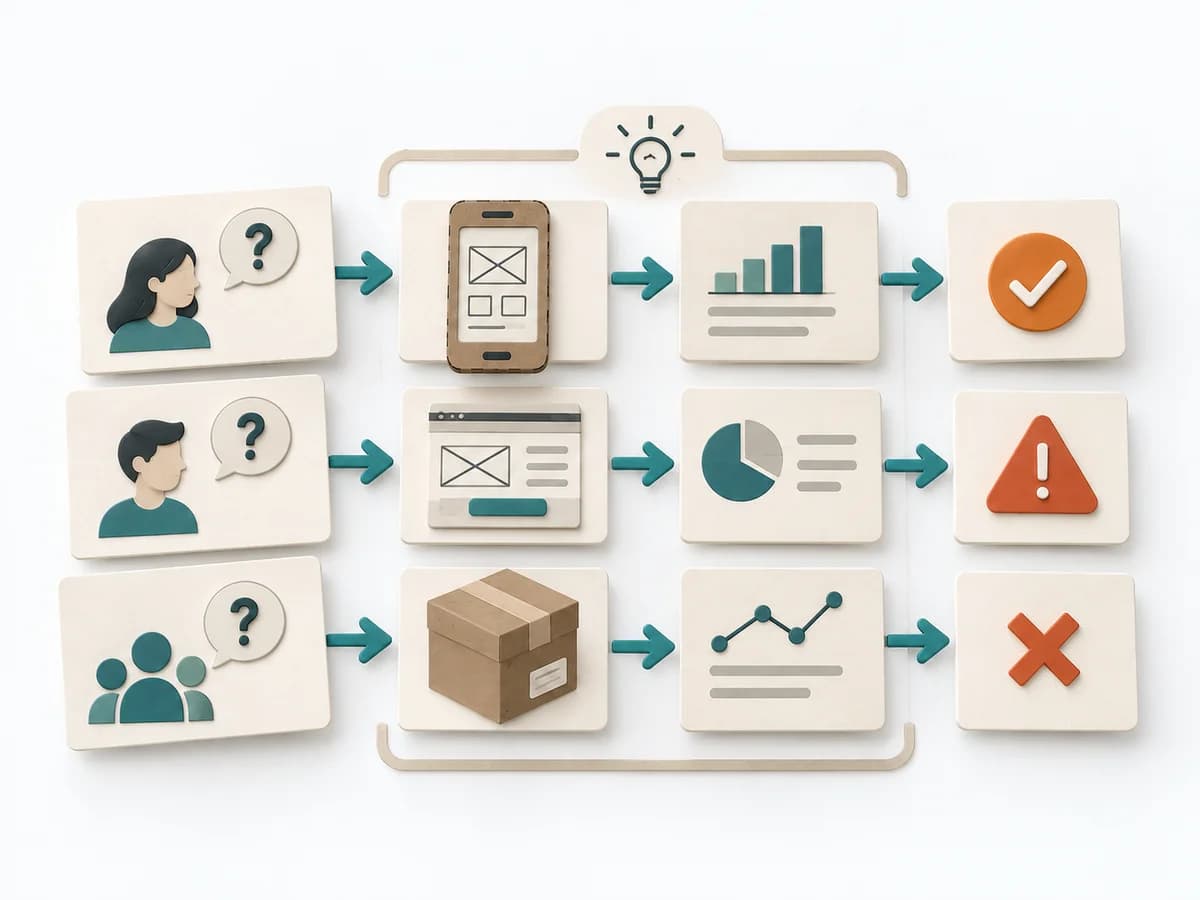
Moves customer problem, solution idea, and evidence toward a concrete result through "list assumptions", "map assumptions to dimensions", and "derive the test plan".

Moves customer problem, solution idea, and evidence toward a concrete result through "clarify the learning goal and the assumption to test", "formulate the hypothesis as an if-then statement", and "define the decision rule after the test".

Separates hypothesis, observation, insight, and next action into four fields after a test.