

Purpose
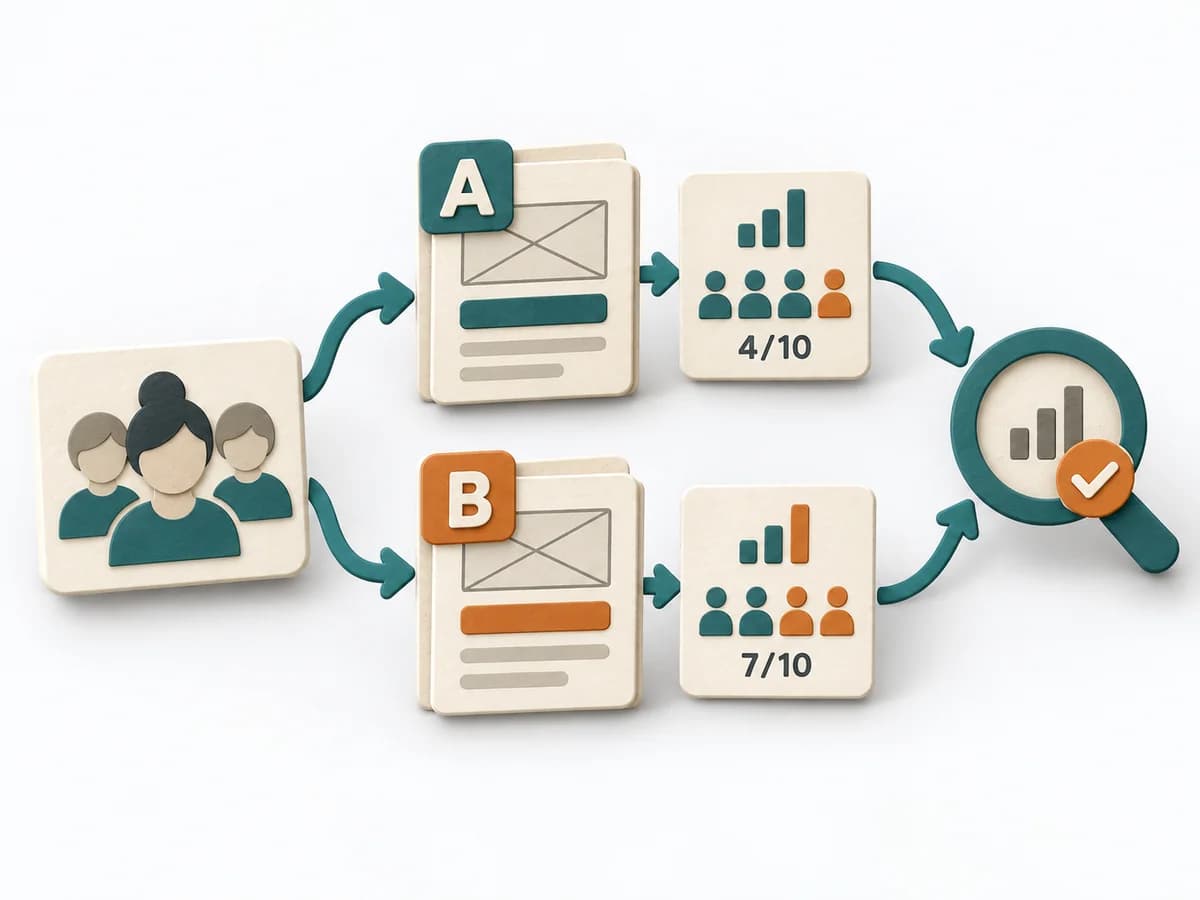
When growth ideas surface quickly, the temptation to build immediately instead of learning is high. A Growth Experiment frames an assumption so target group, lever, and measurement are clear before the first deployment.
Growth Research method
Tests a prioritized growth assumption with a small measurable intervention and shows whether the next step is justified.
A Growth Experiment tests a prioritized growth assumption with a small, measurable intervention. Comparing expectations with results supports the decision to test again, scale, or discard the idea.
Which uncertain growth assumption will we test, and what result changes our next decision?
Phases may be revisited; their order supports the work but does not replace domain judgment.

Assumption
Name bottleneck, audience, mechanism, and existing evidence.
Hypothesis
Specify intervention, expected behavior, signal, and possible harm.
Test
Predefine scope, safeguards, duration, and instrumentation; run the smallest useful test.
Learning
Compare results with expectation and choose follow-up test, scale, or stop.
Review the result and open assumptions at the next suitable checkpoint. Record changes, ownership, and new evidence.
Use when: One prioritized, testable assumption and an intervention whose signal can be attributed to the goal.

Named bottleneck, audience, mechanism, and existing evidence.

Predefined scope, safeguards, duration, and instrumentation for the smallest useful test.
The review compares results with expectations and explains the decision to test again, scale, or discard the idea.
Fictional worked example
Test a prioritized growth assumption with a small measurable intervention and learn whether the next step is justified.
Name bottleneck, goal, and uncertain assumption.
A sample lesson before sign-up makes the first course clearer.
Describe intervention, mechanism, and measurable behavior change.
Landing page shows one lesson; a random 50% of visits see it.
Record duration, audience, measurement, and harm mitigation.
Completion of lesson one within 7 days; support requests as guardrail.
Record observed signal, uncertainty, and follow-up decision.
More starts, no clear rise in completed lessons; cause unresolved.
Fictional learning platform: assumption that a sample lesson increases activation. Intervention: show a sample lesson before sign-up. Success measure: share of new landing-page visitors completing lesson one within 7 days. Guardrail: support requests. A bounded four-week test shows more starts but no clear change in completions; next step: interview about the barrier, no broad rollout.
Start with a bounded question, clarify access and participants, and collect available evidence. Test a prioritized growth assumption with a small measurable intervention and learn whether the next step is justified.
When growth ideas surface quickly, the temptation to build immediately instead of learning is high. A Growth Experiment frames an assumption so target group, lever, and measurement are clear before the first deployment.
A growth assumption is translated into a testable intervention with a clear success curve. This turns a loose idea into a learning process with visible effect and limited risk. The method treats growth as a consequence of validation, not hope.
A Growth Experiment makes growth ideas small enough to be checked quickly and honestly. Before starting, channel, target group, change, and measurement signal must be sharp enough that success or failure becomes legible. The difference from campaign activism is that even a negative result produces usable learning and makes the next bet more precise.
Before starting, define target group, channel, intervention, and expected signal concretely enough that the experiment answers a real learning question. The payoff rises noticeably once the group cleanly separates reach, activation, and retention. End the experiment with a keep, kill, or iterate decision and a short finding about the underlying assumption.
The method guide walks execution through 4 phases, timing, 4 pitfalls, and clear stop criteria.
Open method guideYour perspective
Your feedback helps shape the next improvements to methodatlas.
Short plan for hypothesis, test design, success criteria, and decision.
We believe that ...
Who are we testing for?
What exactly will participants or users do?
We count the test as positive if ...
What can the test not prove?
If positive: ... If negative: ...
...
Prepare Growth Experiment with a clear question, roles, and sources.
To be confirmed
To be confirmed
Plan the full method Time: Set according to scope and available evidence
Complete this worksheet on paper or in your own document during the work.
Name bottleneck, goal, and uncertain assumption.
...
Describe intervention, mechanism, and measurable behavior change.
...
Record duration, audience, measurement, and harm mitigation.
...
Record observed signal, uncertainty, and follow-up decision.
...
Blank worksheet: start with a bounded question. Enter observed facts only, mark assumptions, and record open questions and sources.
Configuring Experiments · Statsig Docs
Expected artifact: Prioritized growth assumption
Prioritized growth assumption
Entry:
...
Expected artifact: Intervention hypothesis with success signal
Intervention hypothesis with success signal
Entry:
...
Expected artifact: Bounded test with safety boundary
Bounded test with safety boundary
Entry:
...
Expected artifact: Learning decision and next test
Learning decision and next test
Entry:
...
...
Method guide: https://methodatlas.meierhoff-systems.de/en/methods/growth-experiment/run-sheet
Fitting alternatives with decision guidance, followed by other related methods.
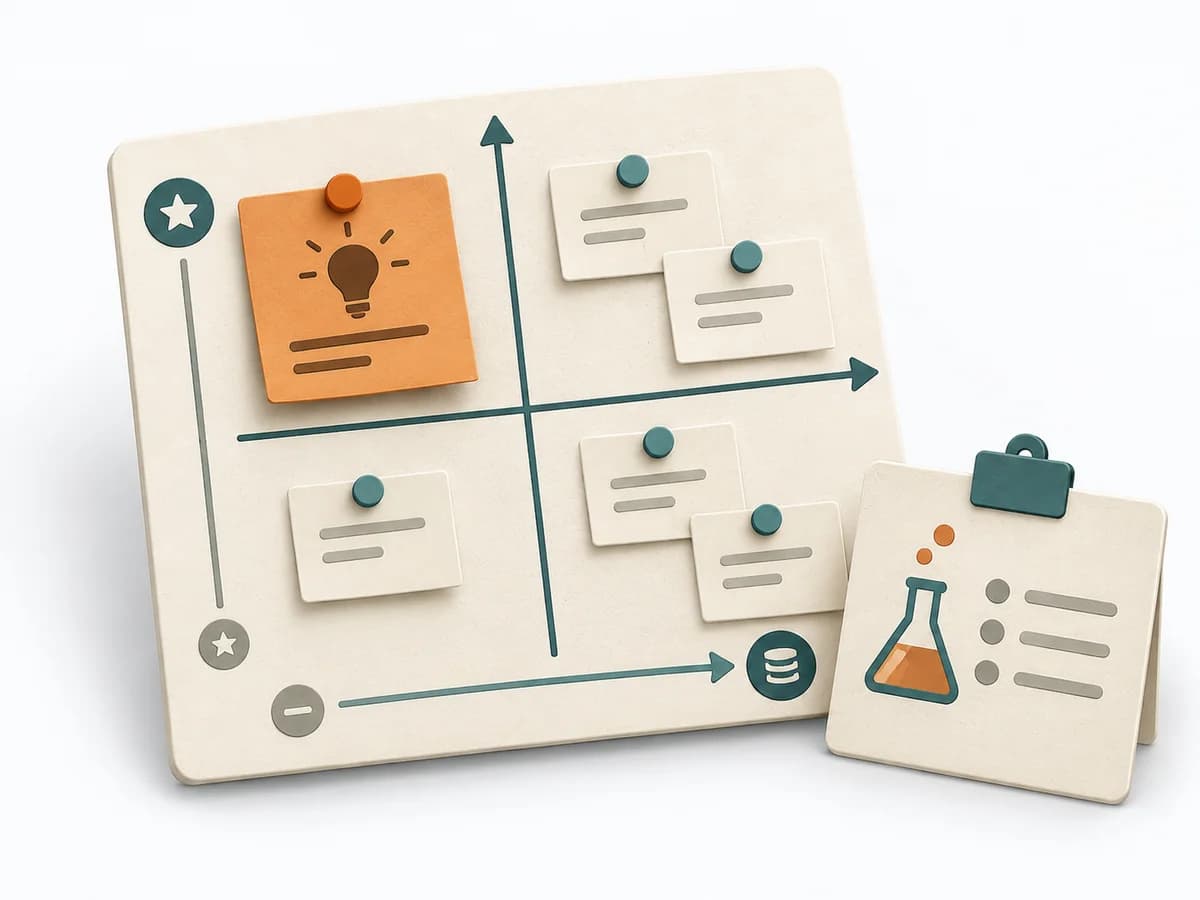
Instead of Growth Experiment, when you want to make assumptions visibly prioritized before starting with solutions.

Maps a recurring growth loop, marks friction points, and derives reinforcing levers.

Models trigger, action, variable reward, and investment loops to understand and design repeat usage responsibly.

Moves target group, value, goals, and priorities toward a concrete result through "name the main metric", "collect possible unintended side effects", and "use counter metrics alongside the main metric in reviews".

Sharpens why, how, and what into a message that holds messaging notes and a positioning draft together.

Tests demand with minimal effort, reads conversion signals, and turns them into a clear learning note.