

Purpose
When a value proposition first needs to be checked for resonance, it condenses the idea onto a focused entry page. It shows whether language and offering carry interest.
Product Discovery Research method
Tests a value proposition with a focused page and an observable call to action.
A Landing Page Test translates a concrete value assumption into a page, brings a relevant audience to it, and measures a predefined action. Evidence depends on audience, traffic source, offer, and measurement rule together.
Which variant produces the predefined action more often for the same audience?
The steps connect experiment design, real exposure, and analysis. Elapsed time depends on the required traffic.

Value
State one value proposition and audience precisely enough for a page to test.
Variant
Change only the tested variable; keep CTA, audience, and metric rule stable.
Exposure
Assign relevant visitors to variants randomly or by one predeclared rule.
Measurement
Record CTA clicks and qualified follow-up by source, period, and variant.
Readout
Review result, sample, uncertainty, and next hypothesis together.
Change one named variable and measure the new funnel again with a comparable traffic source.
Use it to compare a value proposition or variant with bounded, relevant traffic.
Versioned landing page plus experiment log containing hypothesis, screenshot, traffic, funnel, uncertainty, and decision.
Fictional example
Fictional test of a maintenance offer with one explicit funnel.
For which segment should which value proposition lead to which action?
Small workshops are more likely to book a 15-minute maintenance call when predictable downtime leads the message.
Which message, evidence, and primary CTA does the audience see?
Predictable-downtime headline, three proof points, 'Check a maintenance window' CTA; no purchase promise yet.
Which events, sources, and rules are measured?
LinkedIn campaign → page view → CTA → appointment request. Pre-set rule: at least 10 qualified requests from 500 relevant visits.
What was observed, what remains uncertain, and what follows?
480 visits, 31 CTA clicks, 7 requests. Threshold missed; interviews investigate pricing and timing barriers.
The numbers are fictional.
Define one value proposition, audience, call to action, and traffic source.
When a value proposition first needs to be checked for resonance, it condenses the idea onto a focused entry page. It shows whether language and offering carry interest.
It formulates the positioning lean enough to measure reaction to message and call to action. Traffic, conversion, and follow-up questions show which statement holds up and which value claim remains unclear.
Landing Page Tests help because value proposition, target group, and desired action come together in a realistic decision situation. Good use does not just evaluate traffic or clicks but the fit between message, expectation, and next step. The method is strong when it shows which phrasing or promise actually connects with a real need.
Prepare a page with a clear core message and a single primary follow-up action, so the signal is not diluted. The exercise becomes relevant when visitors arrive but do not move forward on the central statement or action. Close with an interpretation of resonance, friction, and the next variants you want to test against each other.
The method guide walks execution through 5 phases, timing, 5 pitfalls, and clear stop criteria.
Open method guideYour perspective
Your feedback helps shape the next improvements to methodatlas.
Plan the hypothesis, setup, real run, and analysis with clear ownership.
To be confirmed
To be confirmed
Whole initiative Time: 3–10 days for design, traffic collection, and analysis; 60–120 minutes for the hypothesis and measurement plan.
Complete this worksheet on paper or in your own document during the work.
For which segment should which value proposition lead to which action?
...
Which message, evidence, and primary CTA does the audience see?
...
Which events, sources, and rules are measured?
...
What was observed, what remains uncertain, and what follows?
...
Complete hypothesis, CTA, funnel, and threshold before publishing.
Strategyzer · original teaching example
Expected artifact: Value
Value
Entry:
...
Expected artifact: Published test page
Published test page
Entry:
...
Expected artifact: Traceable exposure
Traceable exposure
Entry:
...
Expected artifact: Verified conversion funnel
Verified conversion funnel
Entry:
...
Expected artifact: Experiment decision
Experiment decision
Entry:
...
...
Method guide: https://methodatlas.meierhoff-systems.de/en/methods/landing-page-test/run-sheet
Fitting alternatives with decision guidance, followed by other related methods.

Instead of Landing Page Test, choose Smoke Test when you want to validate interest with minimal effort and a clear message.

Tests a market claim with the smallest fitting precursor and makes real interest measurable.

Measures real interest in an idea that has not been built yet, through clicks, sign-ups, or other interest signals.
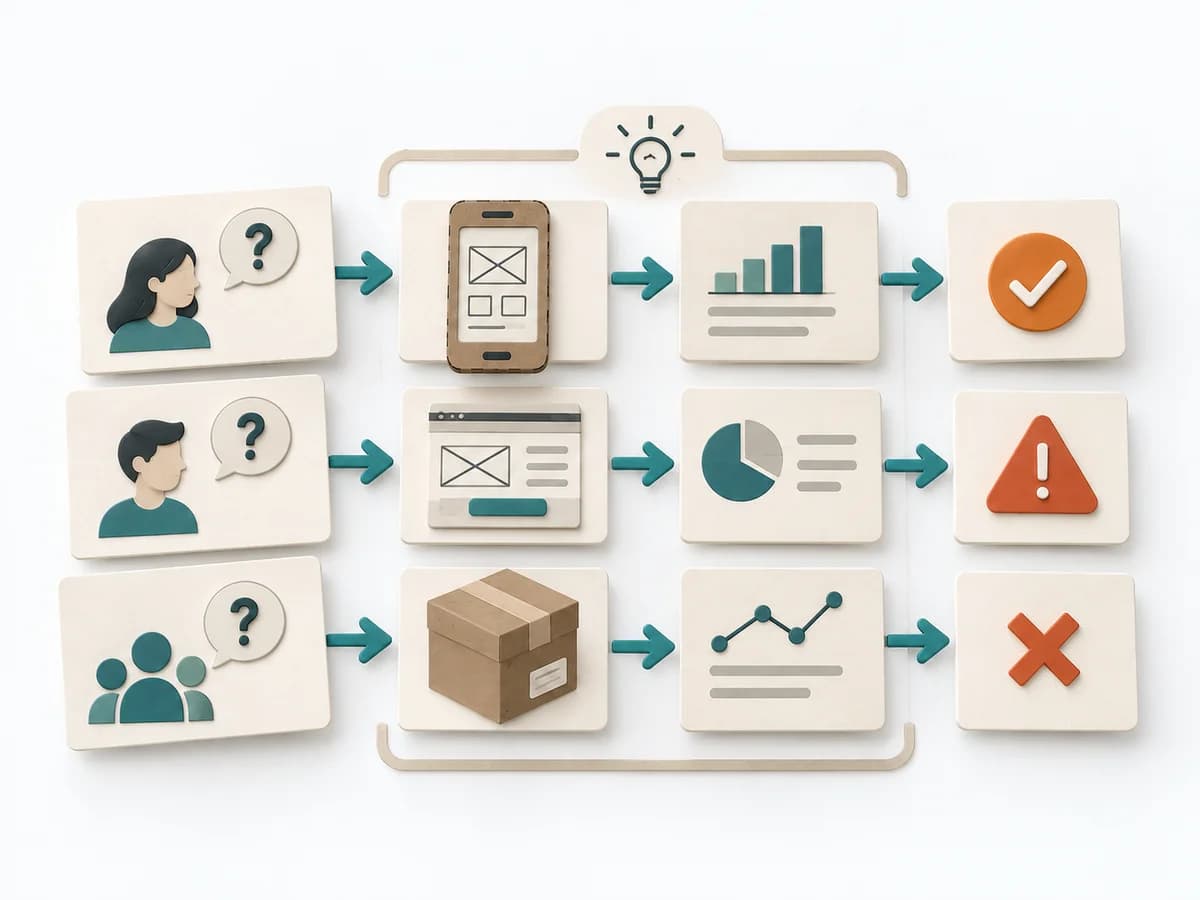
Moves customer problem, solution idea, and evidence toward a concrete result through "list assumptions", "map assumptions to dimensions", and "derive the test plan".

Clarifies customer problems, solution ideas, and evidence by preparing a solution concept, recruiting target customers, and deriving risks and next tests.

Reconstructs switching motives, progress, and desired outcomes so opportunities emerge from real customer situations.