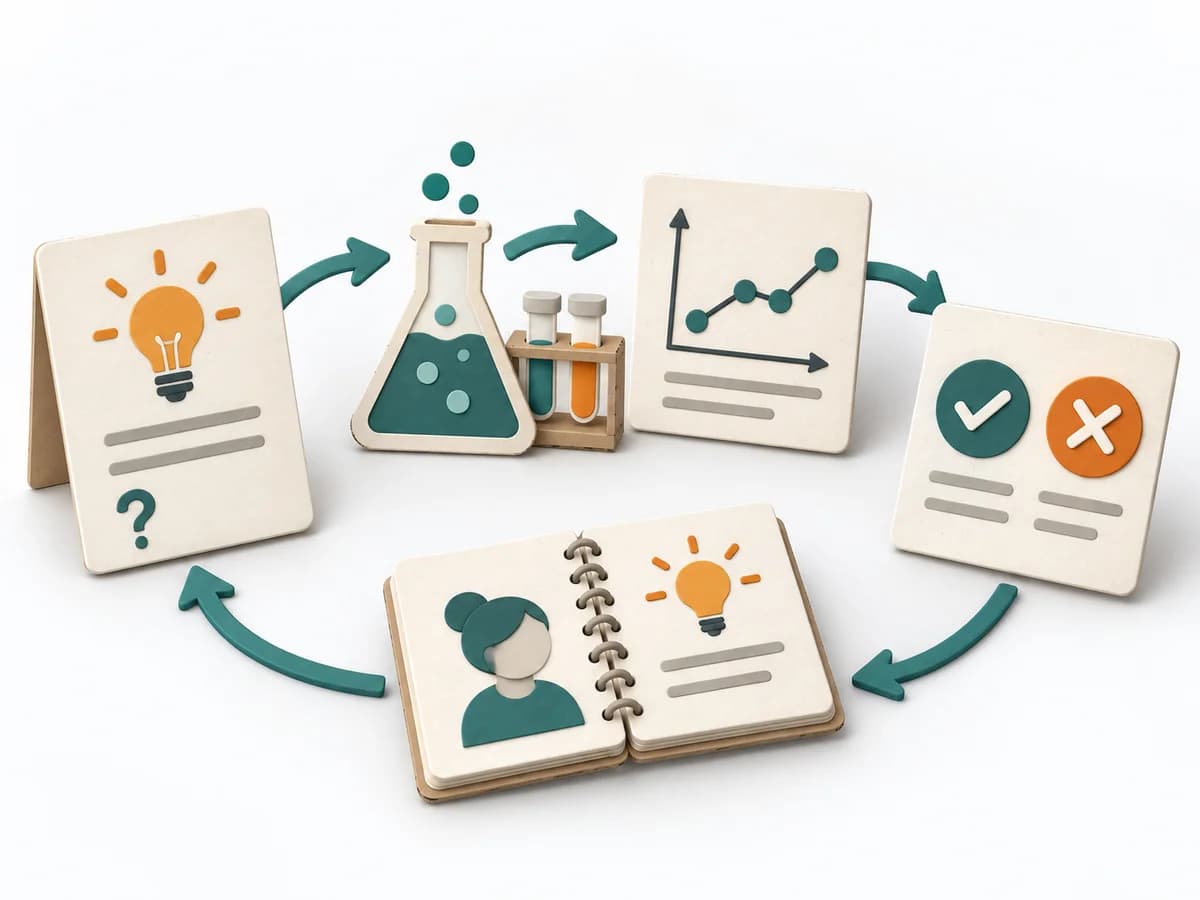
Complete firstExperiment design
Write down audience, problem, promised value, requested action, traffic source, observation window, and decision threshold before building.
Choose an action that requires real effort or willingness to be contacted.
A practical method guide: clarify prerequisites and materials, understand the complete process, and look up outputs, pitfalls, and stop criteria.
What needs to be finished first
Write down audience, problem, promised value, requested action, traffic source, observation window, and decision threshold before building.
Show only enough of the offer to enable a real behavioural choice. Test the CTA, counting rule, stop condition, and follow-up for interested people before launch.
What needs to be ready before start
Hypothesis sheet, credible offer stub, one clear call to action, defined audience or traffic source, tracking plan, and privacy notice.
Experiment owner · offer and copy owner · tracking and privacy owner · decision owner
Write down audience, problem, promised value, requested action, traffic source, observation window, and decision threshold before building.
2–5 days for setup, exposure, and analysis; design work alone usually takes 45–90 minutes.
Show only enough of the offer to enable a real behavioural choice. Test the CTA, counting rule, stop condition, and follow-up for interested people before launch.
The one question this method answers
Does the defined audience choose the promised next action under realistic conditions?
Phases with goal, actions, output and pitfall
A Smoke Test offers a credible pre-step and measures whether a defined audience chooses the next action. It tests interest, not complete product quality.
Fictional example
Fictional example for a pickup service. Each row connects assumption, test, observable signal, and decision.
| Experiment | Hypothesis | Test and audience | Signal and threshold | Observation and decision |
|---|---|---|---|---|
| Tool pickup slotDoes the defined audience choose the promised next action under realistic conditions? | Weekend customers reserve a Saturday pickup slot before the service is built. | Offer page sent to 80 previous weekend customers; one 'Reserve a slot' CTA. | Qualified: email plus preferred date. Pre-set rule: investigate further from 8 reservations. | 5 reservations. Threshold missed; interview people about reasons and revise the offer. |
The numbers are fictional and do not demonstrate real demand.
Hypothesis

Goal
Testable demand hypothesis: State an observable demand assumption with audience, problem, and desired action.
Inputs for this step
Actions
Output
Testable demand hypothesis
Testable demand hypothesis
Quality check
Are audience, problem, value, action, and threshold explicit before launch?
Pitfall
The hypothesis merely says that people are interested and omits both action and decision threshold. Return to “Define assumption and audience” and repeat this method step: State an observable demand assumption with audience, problem, and desired action.
Timing: 30–45 minutes
Signal
Goal
Testable offer stub: Provide a credible pre-step with exactly one next action.
Inputs for this step
Actions
Output
Testable offer stub
Testable offer stub
Quality check
Does the test promise only what the team can transparently fulfil or explain afterwards?
Pitfall
The offer stub has several CTAs or appears available although the service cannot yet be provided. Return to “Build minimal test” and repeat this method step: Provide a credible pre-step with exactly one next action.
Timing: 0.5–2 days
Traffic
Goal
Documented target-audience reach: Document source and inclusion criterion; do not treat arbitrary reach as evidence.
Inputs for this step
Actions
Output
Documented target-audience reach
Documented target-audience reach
Quality check
Does exposure reach the defined audience, with a traceable source?
Pitfall
Reach is purchased without documenting source, audience criteria, or repeat contacts. Return to “Reach relevant people” and repeat this method step: Document source and inclusion criterion; do not treat arbitrary reach as evidence.
Timing: 1–3 days
Observation
Goal
Clean behavioural data: Capture visits and qualified actions in the same period.
Inputs for this step
Actions
Output
Clean behavioural data
Clean behavioural data
Quality check
Are visits and qualified actions defined for the same observation window and technically verified?
Pitfall
Clicks, sign-ups, and conversations are mixed or counted across different windows. Return to “Measure behavior” and repeat this method step: Capture visits and qualified actions in the same period.
Timing: During exposure; 20 minutes for data checks
Decision
Goal
Learning note with decision: Record signal strength, uncertainty, and next test separately.
Inputs for this step
Actions
Output
Learning note with decision
Learning note with decision
Quality check
Does the analysis separate observed behaviour, possible bias, and the resulting decision?
Pitfall
A positive signal is reported as proven demand although sample and selection effects remain open. Return to “Turn learning into action” and repeat this method step: Record signal strength, uncertainty, and next test separately.
Timing: 30–45 minutes
What comes out at the end
Sketch: what the artifact looks like
Experiment report containing hypothesis, test setup, traffic source, observation window, visits, qualified actions, limitations, and next decision.
Version the learning note with decision with date, owner, source state, and review date. Preserve earlier observations and append changes with their reason.
Short plan for hypothesis, test design, success criteria, and decision.
We believe that ...
Who are we testing for?
What exactly will participants or users do?
We count the test as positive if ...
What can the test not prove?
If positive: ... If negative: ...
...
Plan the hypothesis, setup, real run, and analysis with clear ownership.
To be confirmed
To be confirmed
Whole initiative Time: 2–5 days for setup, exposure, and analysis; design work alone usually takes 45–90 minutes.
Complete this worksheet on paper or in your own document during the work.
| Experiment | Hypothesis | Test and audience | Signal and threshold | Observation and decision |
|---|---|---|---|---|
| Tool pickup slot |
Complete the hypothesis and decision threshold before exposure.
Strategyzer · original teaching example
Expected artifact: Testable demand hypothesis
Testable demand hypothesis
Entry:
...
Expected artifact: Testable offer stub
Testable offer stub
Entry:
...
Expected artifact: Documented target-audience reach
Documented target-audience reach
Entry:
...
Expected artifact: Clean behavioural data
Clean behavioural data
Entry:
...
Expected artifact: Learning note with decision
Learning note with decision
Entry:
...
...
Method guide: https://methodatlas.meierhoff-systems.de/en/methods/smoke-test/run-sheet
Concrete filled scenario, fictional example
Fictional example for orientation. Counts and timings describe this case and are not universal requirements.
Concrete filled scenario, fictional example
Guiding question: Does the defined audience choose the promised next action under realistic conditions?
| Hypothesis | Test and audience | Signal and threshold | Observation and decision |
|---|---|---|---|
| Weekend customers reserve a Saturday pickup slot before the service is built. | Offer page sent to 80 previous weekend customers; one 'Reserve a slot' CTA. | Qualified: email plus preferred date. Pre-set rule: investigate further from 8 reservations. | 5 reservations. Threshold missed; interview people about reasons and revise the offer. |
The numbers are fictional and do not demonstrate real demand.
Recognize symptoms and steer against them
Quick overview, the full text is in the matching phase in the flow
The hypothesis merely says that people are interested and omits both action and decision threshold.
Return to “Define assumption and audience” and repeat this method step: State an observable demand assumption with audience, problem, and desired action.
The offer stub has several CTAs or appears available although the service cannot yet be provided.
Return to “Build minimal test” and repeat this method step: Provide a credible pre-step with exactly one next action.
Reach is purchased without documenting source, audience criteria, or repeat contacts.
Return to “Reach relevant people” and repeat this method step: Document source and inclusion criterion; do not treat arbitrary reach as evidence.
Clicks, sign-ups, and conversations are mixed or counted across different windows.
Return to “Measure behavior” and repeat this method step: Capture visits and qualified actions in the same period.
A positive signal is reported as proven demand although sample and selection effects remain open.
Return to “Turn learning into action” and repeat this method step: Record signal strength, uncertainty, and next test separately.
When to pause, resolve prerequisites, or choose another approach
Go to the profile for purpose, similar methods, and sources or continue to the next method in the catalog.