

Purpose
When two variants compete, discussions quickly decide by taste rather than effect. A/B Testing checks behavior under controlled conditions and separates real improvement from chance or expectation effects.
Growth Research method
A/B testing compares variants under controlled allocation and connects effect, uncertainty, and guardrails to a pre-defined decision.
A/B testing compares variants under controlled allocation and connects effect, uncertainty, and guardrails to a pre-defined decision.
Does B produce the pre-defined meaningful effect over A without breaching guardrails?
Phases may be revisited; their order supports the work but does not replace domain judgment.
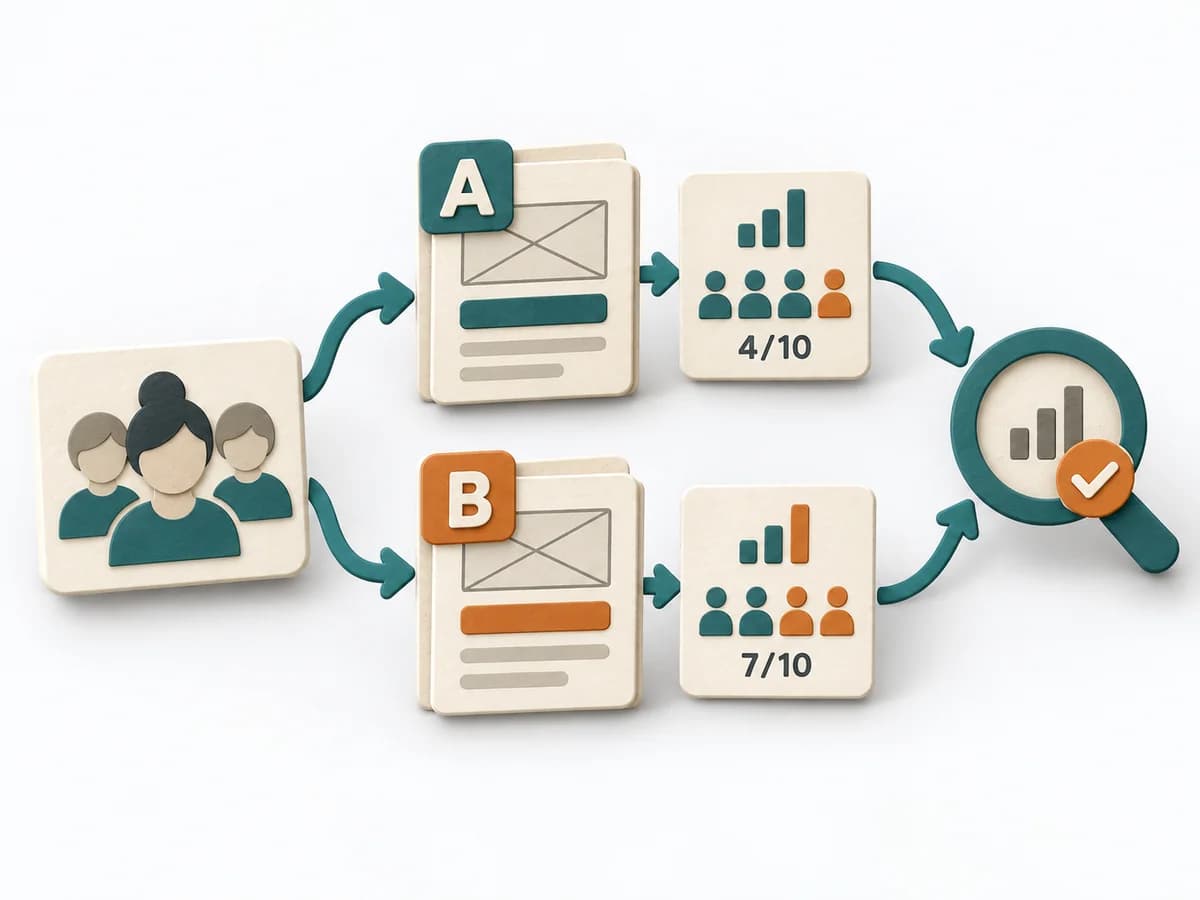
Decision
Write the hypothesis, primary metric, guardrails, MDE, and ship/hold/stop rule.
Design
Set randomization unit, 50/50 allocation, required sample, and minimum duration using baseline and MDE.
Launch
QA assignment and events; launch only after tracking and rollback checks.
Analysis
Analyze at the set horizon or under the preselected sequential rule; inspect effect interval and guardrails.
Review the result and open assumptions at the next suitable checkpoint. Record changes, ownership, and new evidence.
Use when: One targeted, randomizable change with reliable measurement and enough traffic for the planned horizon.
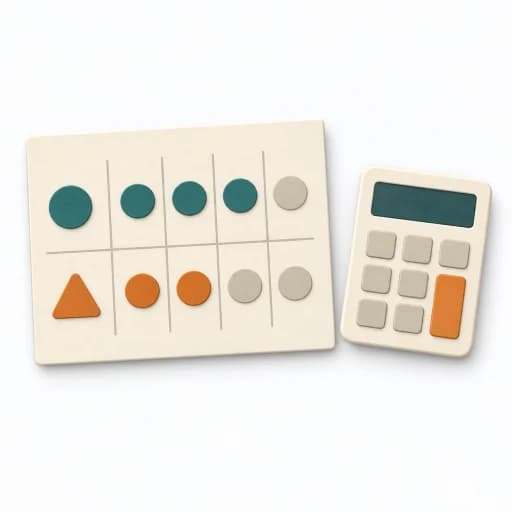
The artifact records the hypothesis, primary metric, guardrails, MDE, and ship/hold/stop rule.

QA assignment and events; launch only after tracking and rollback checks.

The analysis reports effect and uncertainty at the planned horizon, accounts for guardrails, and documents the decision.
Fictional worked example
Compare variants under controlled allocation and make a pre-defined decision using effect and guardrails.
Specify the primary outcome and its denominator before assignment.
Bookings per randomly assigned person.
Record allocation, planned sample, calendar horizon, and interference controls.
50/50 random assignment; 20,000 people per arm, at least 14 days; no concurrent checkout changes.
Enter the estimated effect and uncertainty, plus each guardrail.
Fictional: booking A 11.8%, B 12.3%, difference +0.5 percentage points; 95% interval −0.2 to +1.2. Error rate 0.8% for both.
Apply the decision rule chosen before the test; record uncertainty.
No clear advantage at the pre-set horizon; result is inconclusive. Do not extend because of interim results.
Fictional read at the pre-set horizon: 20,000 people per arm, at least 14 days. A 11.8%, B 12.3%, difference +0.5 percentage points, 95% interval −0.2 to +1.2; guardrail error rate 0.8% each. No clear advantage; inconclusive.
Start with a bounded question, clarify access and participants, and collect available evidence. Compare variants under controlled allocation and make a pre-defined decision using effect and guardrails.
When two variants compete, discussions quickly decide by taste rather than effect. A/B Testing checks behavior under controlled conditions and separates real improvement from chance or expectation effects.
A change is tested in isolation against a reference variant while a clear success measure runs in parallel. Only the observed difference in behavior decides whether the difference is robust enough to change product or communication.
A/B Testing grounds product or communication decisions in observed behavior. Quality comes from a clear hypothesis, clean randomization, sufficient runtime, and a decision threshold fixed in advance. As a pure numbers exercise the test stays shallow; it becomes solid when result, counter-metrics, and learning value are interpreted together.
Before starting, hypothesis, primary metric, guardrails, and stopping rules must be fixed in writing, or the analysis tips into wishful thinking. The decisive point is reached when the variant stays cleanly isolated and no one adjusts metrics along the way to fit. Close with a product decision and the learning points, even if the effect doesn't show up.
The method guide walks execution through 4 phases, timing, 4 pitfalls, and clear stop criteria.
Open method guideYour perspective
Your feedback helps shape the next improvements to methodatlas.
Prepare A/B Testing with a clear question, roles, and sources.
To be confirmed
To be confirmed
Plan the full method Time: Set according to scope and available evidence
Complete this worksheet on paper or in your own document during the work.
Specify the primary outcome and its denominator before assignment.
...
Record allocation, planned sample, calendar horizon, and interference controls.
...
Enter the estimated effect and uncertainty, plus each guardrail.
...
Apply the decision rule chosen before the test; record uncertainty.
...
Blank worksheet: start with a bounded question. Enter observed facts only, mark assumptions, and record open questions and sources.
Frequentist Sequential Testing · Statsig Docs
Expected artifact: Pre-registered experiment brief
Pre-registered experiment brief
Entry:
...
Expected artifact: Randomized design with sample and horizon
Randomized design with sample and horizon
Entry:
...
Expected artifact: QA-checked rollout and exposure data
QA-checked rollout and exposure data
Entry:
...
Expected artifact: Decision with effect interval and guardrail review
Decision with effect interval and guardrail review
Entry:
...
...
Method guide: https://methodatlas.meierhoff-systems.de/en/methods/ab-testing/run-sheet
Fitting alternatives with decision guidance, followed by other related methods.

Instead of A/B Testing, when you want to see direct usage behavior instead of discussing assumptions within the team.

Maps the AARRR funnel, sets baselines, and surfaces leaks that translate directly into experiments.

Maps a recurring growth loop, marks friction points, and derives reinforcing levers.

Tests demand with minimal effort, reads conversion signals, and turns them into a clear learning note.

Moves target group, value, goals, and priorities toward a concrete result through "name the main metric", "collect possible unintended side effects", and "use counter metrics alongside the main metric in reviews".

Moves customer problem, solution idea, and evidence toward a concrete result through "clarify the learning goal and the assumption to test", "formulate the hypothesis as an if-then statement", and "define the decision rule after the test".