
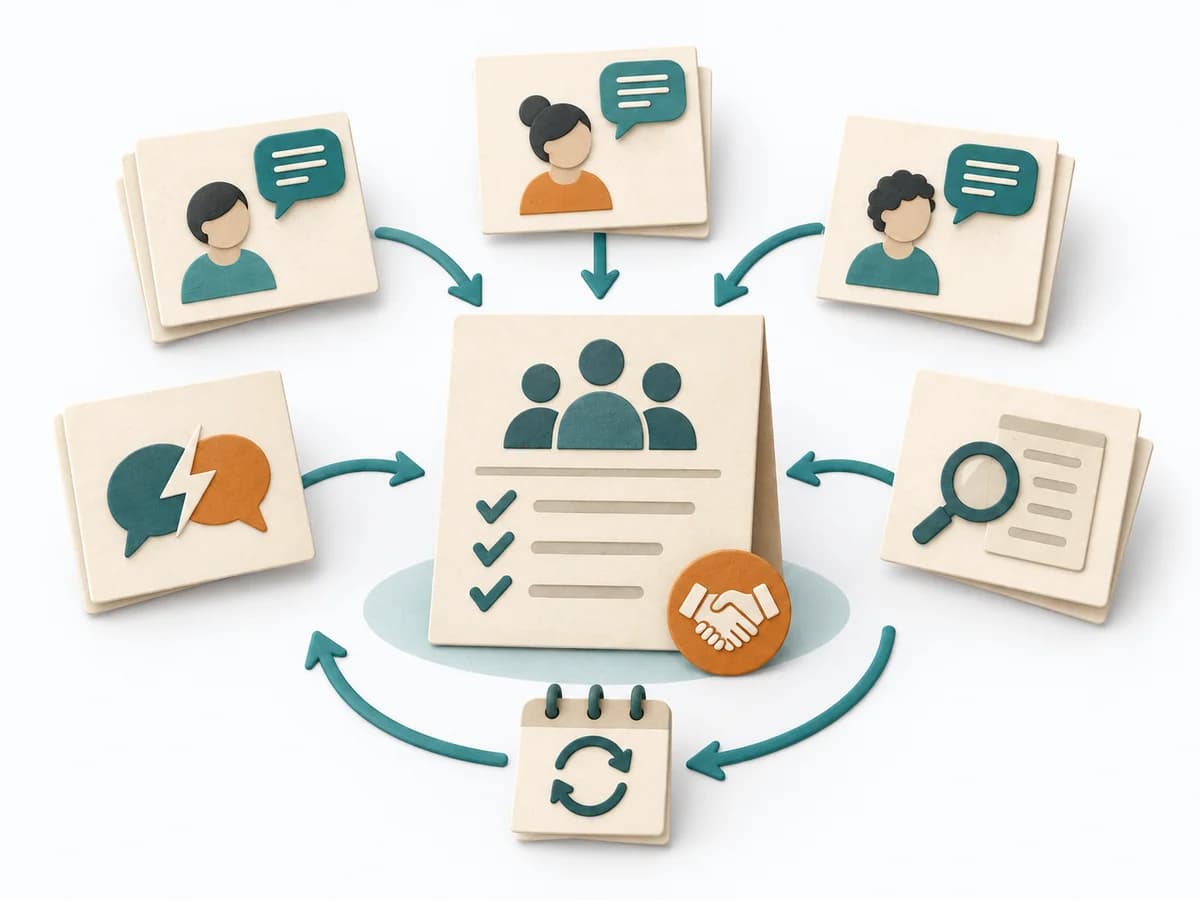
Purpose
When it stays unclear who carries responsibility and who only contributes, Responsibility Poker makes the distribution of responsibility explicit. It sharpens the boundaries between weighing in, deciding, and bearing consequences.
Facilitation Facilitation method
Makes responsibility for concrete work visible and clarifies it through simultaneous choices.
Responsibility Poker uses hidden role cards or equivalent simultaneous choices so participants reveal how they see responsibility. Differences are discussed and recorded in a visible assignment.
Who owns each concrete result, and where are participation or escalation needed?
Each step produces a concrete domain result for the complete run.

Outcomes
List concrete activities or outcomes with clear boundaries instead of abstract roles.
Cards
Explain cards for ownership, execution, advice, and information.
Reveal
Choose simultaneously face down; make assignment and uncertainty visible.
Dialogue
Discuss differences using examples, dependencies, and decision scope.
Assignment
Document the current assignment, gaps, and review date.
Test assignments in real handoffs and vote privately again when mandate, team, or outcome changes.
Use it when a team needs to resolve overlaps or gaps around concrete work results.
Responsibility matrix with outcome, accountable role, executing roles, contributing roles, unresolved mandate questions, and review date.
Fictional example
Fictional example for one concrete work case.
| Case | Outcome | Accountability | Execution | Consultation and information |
|---|---|---|---|---|
| Example caseWho owns each concrete result, and where are participation or escalation needed? | Release approval | Product Owner | Engineering Lead runs the checklist | Security is consulted; Support is informed |
The example is fictional and must be adapted to mandate and context.
List concrete activities or results, involved roles, and the decision depth to clarify.
When it stays unclear who carries responsibility and who only contributes, Responsibility Poker makes the distribution of responsibility explicit. It sharpens the boundaries between weighing in, deciding, and bearing consequences.
For a task or role, the group compares how much responsibility individual people should take on and calibrates this perception together. This reduces implicit expectation errors and helps spot overlapping responsibilities early.
Responsibility Poker works because differing expectations about roles and responsibilities become visible before they collide in everyday work. It is notably useful when task areas are ambiguous and those involved read their responsibility differently. Success depends on the reasoning behind the cards, on edge cases, and on organizational consequences, so the discussion produces genuine role clarity.
Choose concrete tasks or decisions that already create friction in daily work, and explain the meaning of the cards clearly. The important moment comes when the distributions differ strongly; that is exactly where the real need for clarification lies. Close with visible responsibility decisions and note where further alignment is needed outside the session.
The method guide walks execution through 5 phases, timing, 5 pitfalls, and clear stop criteria.
Open method guideYour perspective
Your feedback helps shape the next improvements to methodatlas.
Plan the question, inputs, complete run, and review with clear ownership.
To be confirmed
To be confirmed
Complete run Time: 60–90 minutes for 6–10 concrete outcomes; review after the first work cycle.
Complete this worksheet on paper or in your own document during the work.
| Case | Outcome | Accountability | Execution | Consultation and information |
|---|---|---|---|---|
| Example case |
Use one specifically bounded case per row.
Reference source · original teaching example
Expected artifact: List of concrete outcomes
List of concrete outcomes
Entry:
...
Expected artifact: Shared card meanings
Shared card meanings
Entry:
...
Expected artifact: Independent responsibility views
Independent responsibility views
Entry:
...
Expected artifact: Resolved differences
Resolved differences
Entry:
...
Expected artifact: Published responsibility matrix
Published responsibility matrix
Entry:
...
...
Method guide: https://methodatlas.meierhoff-systems.de/en/methods/responsibility-poker/run-sheet
Fitting alternatives with decision guidance, followed by other related methods.
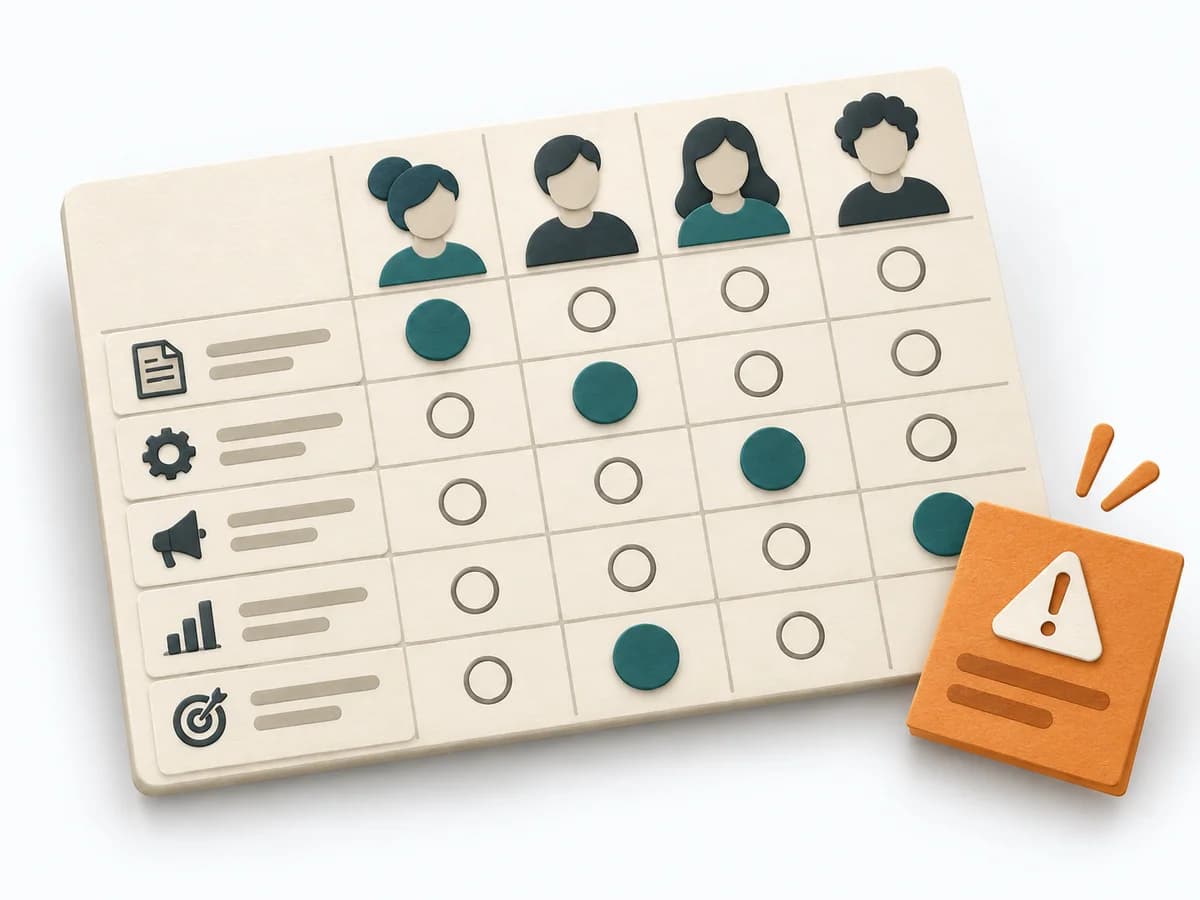
Instead of Responsibility Poker, choose RACI Matrix when you want to clearly clarify responsibilities along accountable, executing, and informed roles.
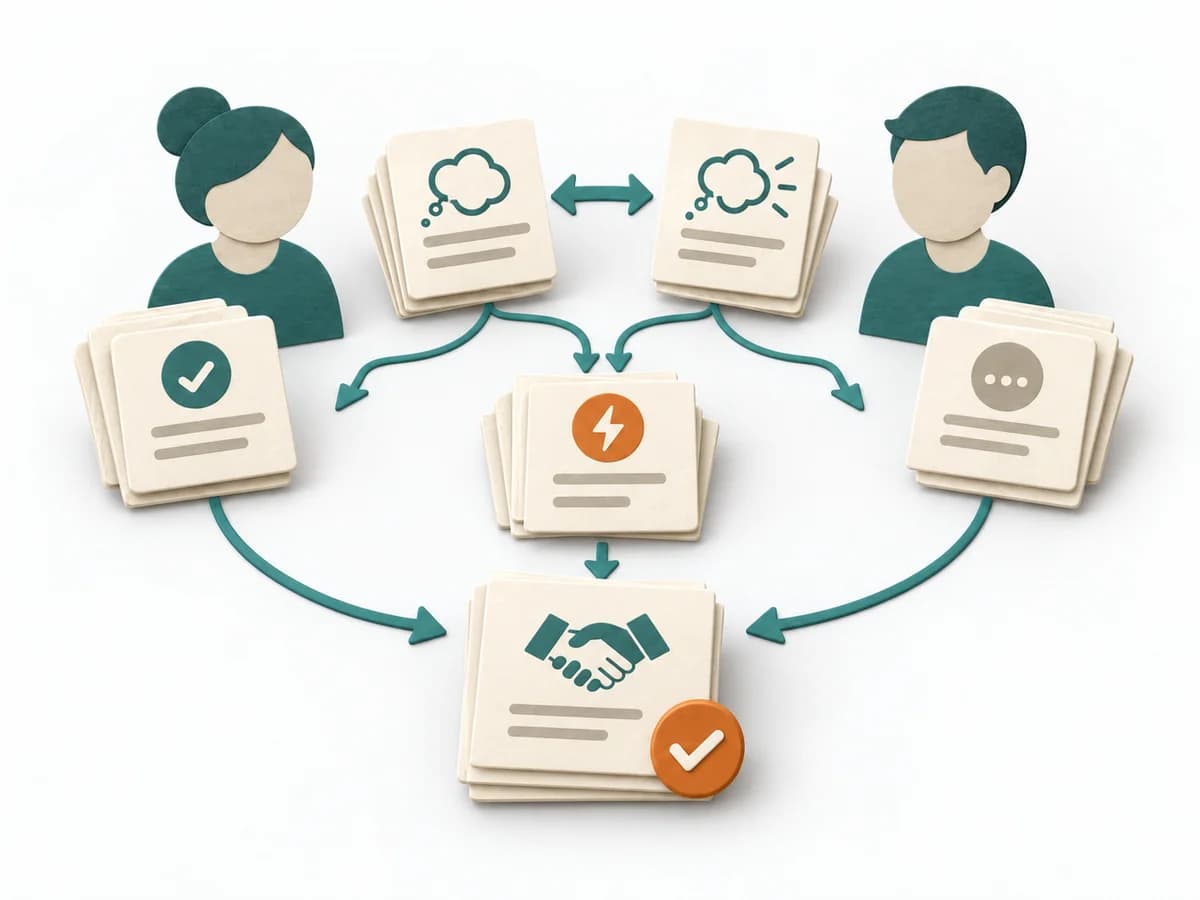
Surfaces stakeholder expectations, clusters conflicts, and turns them into concrete agreements.

Moves ideas from silent reflection through pair exchange into the group and condenses patterns.
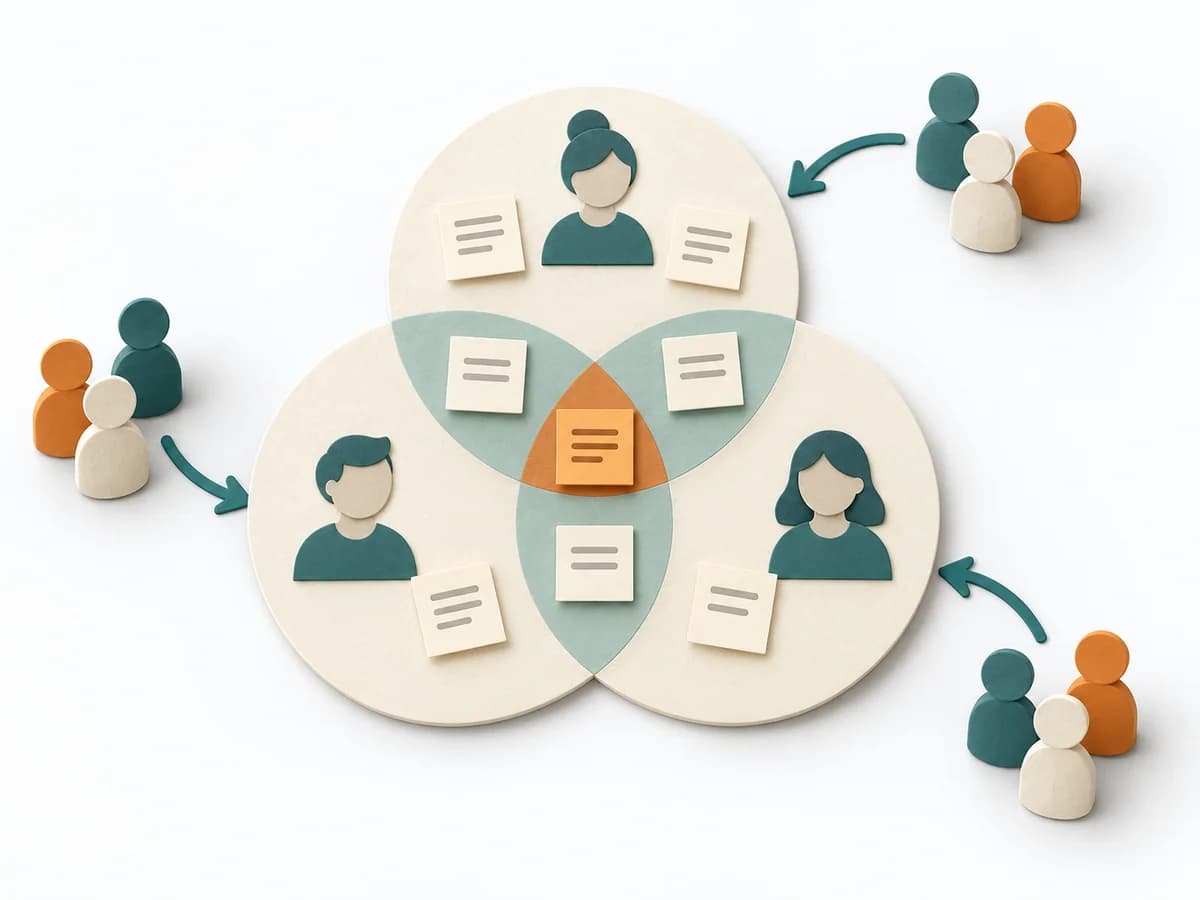
Compares three perspectives in a shared picture and makes overlaps as visible as differences.

Makes reaction patterns conscious and leads step by step to more ownership and concrete commitment.
Sorts problems, reframes the top issue, and derives experiments that quickly turn frustration into movement.