Complete firstPage
Document target segment, value proposition, primary CTA, qualified follow-up action, traffic source, observation window, and decision threshold in advance.
Test one value proposition or one clearly named variant at a time.
A practical method guide: clarify prerequisites and materials, understand the complete process, and look up outputs, pitfalls, and stop criteria.
What needs to be finished first
Document target segment, value proposition, primary CTA, qualified follow-up action, traffic source, observation window, and decision threshold in advance.
Reduce the page to one value proposition and one primary action. Trigger analytics in test mode, inspect mobile rendering, and preserve the source for each visit.
What needs to be ready before start
Value proposition hypothesis, landing-page draft, one primary CTA, analytics with tested events, documented traffic source, and privacy copy.
Experiment owner · content/design · analytics · channel owner · decision owner
Document target segment, value proposition, primary CTA, qualified follow-up action, traffic source, observation window, and decision threshold in advance.
3–10 days for design, traffic collection, and analysis; 60–120 minutes for the hypothesis and measurement plan.
Reduce the page to one value proposition and one primary action. Trigger analytics in test mode, inspect mobile rendering, and preserve the source for each visit.
The one question this method answers
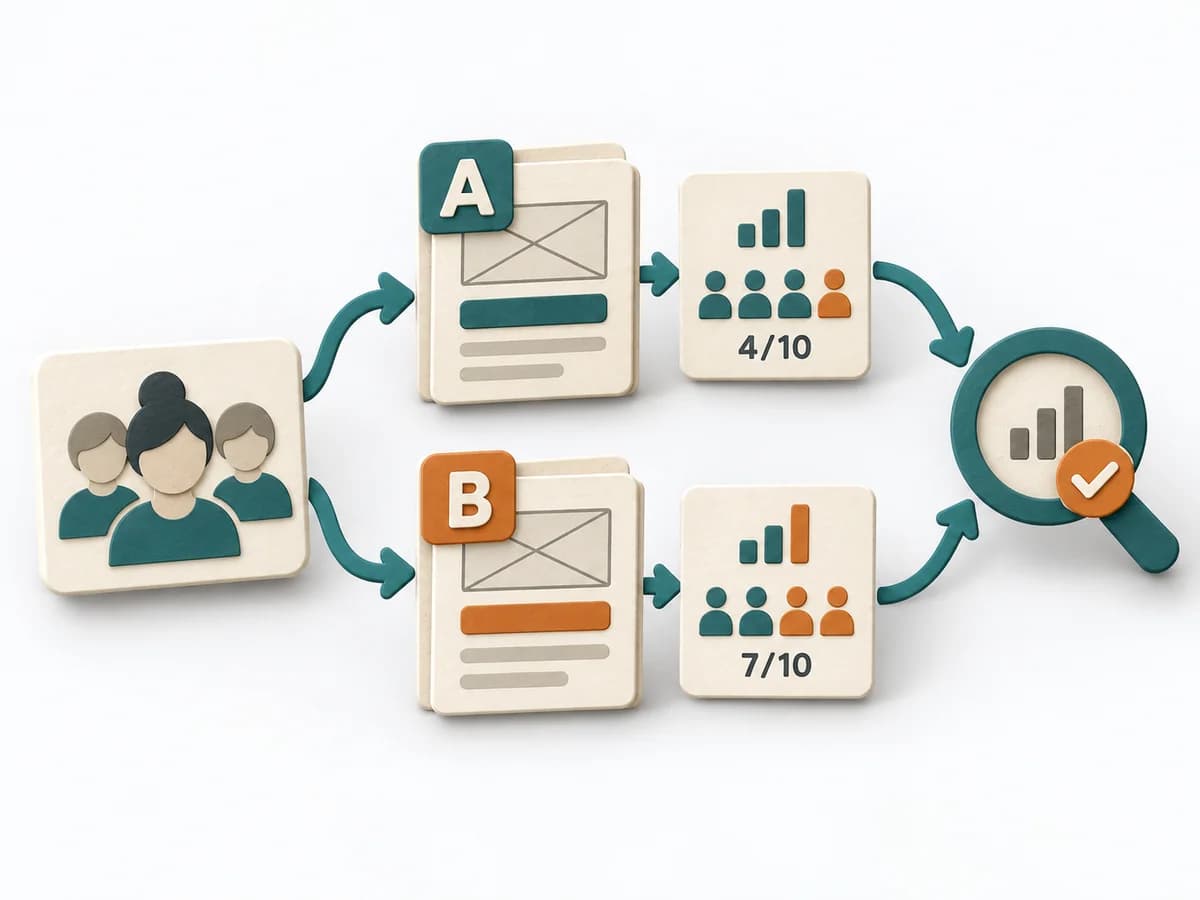
Which variant produces the predefined action more often for the same audience?
Phases with goal, actions, output and pitfall
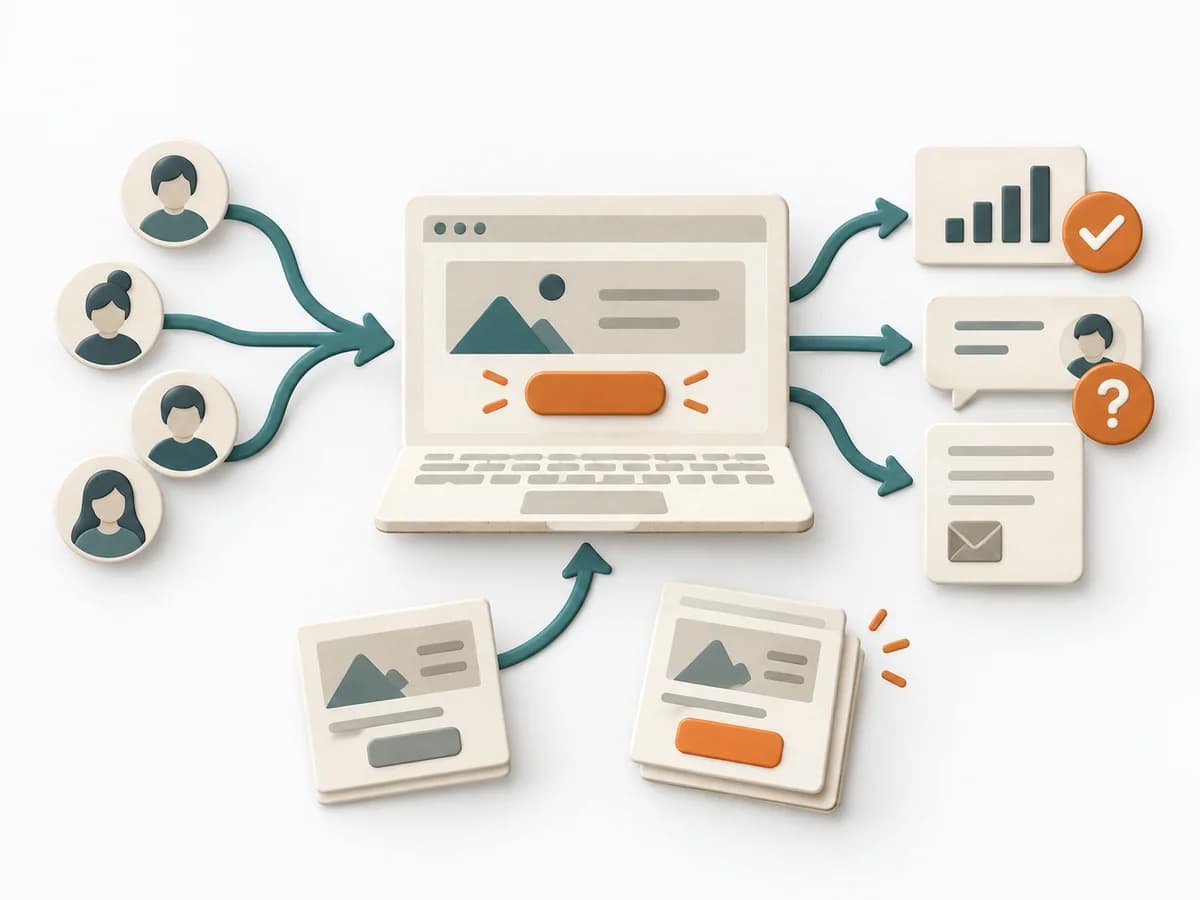
A Landing Page Test translates a concrete value assumption into a page, brings a relevant audience to it, and measures a predefined action. Evidence depends on audience, traffic source, offer, and measurement rule together.
Fictional example
Fictional test of a maintenance offer with one explicit funnel.
For which segment should which value proposition lead to which action?
Small workshops are more likely to book a 15-minute maintenance call when predictable downtime leads the message.
Which message, evidence, and primary CTA does the audience see?
Predictable-downtime headline, three proof points, 'Check a maintenance window' CTA; no purchase promise yet.
Which events, sources, and rules are measured?
LinkedIn campaign → page view → CTA → appointment request. Pre-set rule: at least 10 qualified requests from 500 relevant visits.
What was observed, what remains uncertain, and what follows?
480 visits, 31 CTA clicks, 7 requests. Threshold missed; interviews investigate pricing and timing barriers.
The numbers are fictional.
Value
Goal
Value: State one value proposition and audience precisely enough for a page to test.
Inputs for this step
Actions
Output
Value
Value
Quality check
Does the hypothesis name one segment, one value proposition, and an observable action?
Pitfall
The page tries to test problem, price, brand, and several audiences at once. Return to “Focus hypothesis” and repeat this method step: State one value proposition and audience precisely enough for a page to test.
Timing: 45–60 minutes
Variant
Goal
Published test page: Change only the tested variable; keep CTA, audience, and metric rule stable.
Inputs for this step
Actions
Output
Published test page
Published test page
Quality check
Is the primary CTA unambiguous and functional on desktop and mobile?
Pitfall
Variants change CTA, copy, and audience together, leaving no clear learning target. Return to “Build page” and repeat this method step: Change only the tested variable; keep CTA, audience, and metric rule stable.
Timing: 0.5–2 days
Exposure
Goal
Traceable exposure: Assign relevant visitors to variants randomly or by one predeclared rule.
Inputs for this step
Actions
Output
Traceable exposure
Traceable exposure
Quality check
Do audience, channel, and assignment rule remain stable during the observation window?
Pitfall
Organic, paid, and internal traffic are combined without labels. Return to “Assign traffic” and repeat this method step: Assign relevant visitors to variants randomly or by one predeclared rule.
Timing: 2–7 days
Measurement
Goal
Verified conversion funnel: Record CTA clicks and qualified follow-up by source, period, and variant.
Inputs for this step
Actions
Output
Verified conversion funnel
Verified conversion funnel
Quality check
Can page view, CTA, and qualified follow-up action be measured separately?
Pitfall
Analytics counts internal tests, bots, or repeated events as real conversions. Return to “Capture action” and repeat this method step: Record CTA clicks and qualified follow-up by source, period, and variant.
Timing: 30–60 minutes
Readout
Goal
Experiment decision: Review result, sample, uncertainty, and next hypothesis together.
Inputs for this step
Actions
Output
Experiment decision
Experiment decision
Quality check
Does the decision account for traffic quality, sample size, and plausible alternative explanations?
Pitfall
The higher click rate is declared the winner although qualified follow-up actions did not improve. Return to “Decide next experiment” and repeat this method step: Review result, sample, uncertainty, and next hypothesis together.
Timing: 30–45 minutes
What comes out at the end
Sketch: what the artifact looks like
Versioned landing page plus experiment log containing hypothesis, screenshot, traffic, funnel, uncertainty, and decision.
Version the experiment decision with date, owner, source state, and review date. Preserve earlier observations and append changes with their reason.
Plan the hypothesis, setup, real run, and analysis with clear ownership.
To be confirmed
To be confirmed
Whole initiative Time: 3–10 days for design, traffic collection, and analysis; 60–120 minutes for the hypothesis and measurement plan.
Complete this worksheet on paper or in your own document during the work.
For which segment should which value proposition lead to which action?
...
Which message, evidence, and primary CTA does the audience see?
...
Which events, sources, and rules are measured?
...
What was observed, what remains uncertain, and what follows?
...
Complete hypothesis, CTA, funnel, and threshold before publishing.
Strategyzer · original teaching example
Expected artifact: Value
Value
Entry:
...
Expected artifact: Published test page
Published test page
Entry:
...
Expected artifact: Traceable exposure
Traceable exposure
Entry:
...
Expected artifact: Verified conversion funnel
Verified conversion funnel
Entry:
...
Expected artifact: Experiment decision
Experiment decision
Entry:
...
...
Method guide: https://methodatlas.meierhoff-systems.de/en/methods/landing-page-test/run-sheet
Concrete filled scenario, fictional example
Fictional example for orientation. Counts and timings describe this case and are not universal requirements.
Concrete filled scenario, fictional example
Small workshops are more likely to book a 15-minute maintenance call when predictable downtime leads the message.
Predictable-downtime headline, three proof points, 'Check a maintenance window' CTA; no purchase promise yet.
LinkedIn campaign → page view → CTA → appointment request. Pre-set rule: at least 10 qualified requests from 500 relevant visits.
480 visits, 31 CTA clicks, 7 requests. Threshold missed; interviews investigate pricing and timing barriers.
The numbers are fictional.
Recognize symptoms and steer against them
Quick overview, the full text is in the matching phase in the flow
The page tries to test problem, price, brand, and several audiences at once.
Return to “Focus hypothesis” and repeat this method step: State one value proposition and audience precisely enough for a page to test.
Variants change CTA, copy, and audience together, leaving no clear learning target.
Return to “Build page” and repeat this method step: Change only the tested variable; keep CTA, audience, and metric rule stable.
Organic, paid, and internal traffic are combined without labels.
Return to “Assign traffic” and repeat this method step: Assign relevant visitors to variants randomly or by one predeclared rule.
Analytics counts internal tests, bots, or repeated events as real conversions.
Return to “Capture action” and repeat this method step: Record CTA clicks and qualified follow-up by source, period, and variant.
The higher click rate is declared the winner although qualified follow-up actions did not improve.
Return to “Decide next experiment” and repeat this method step: Review result, sample, uncertainty, and next hypothesis together.
When to pause, resolve prerequisites, or choose another approach
Go to the profile for purpose, similar methods, and sources or continue to the next method in the catalog.