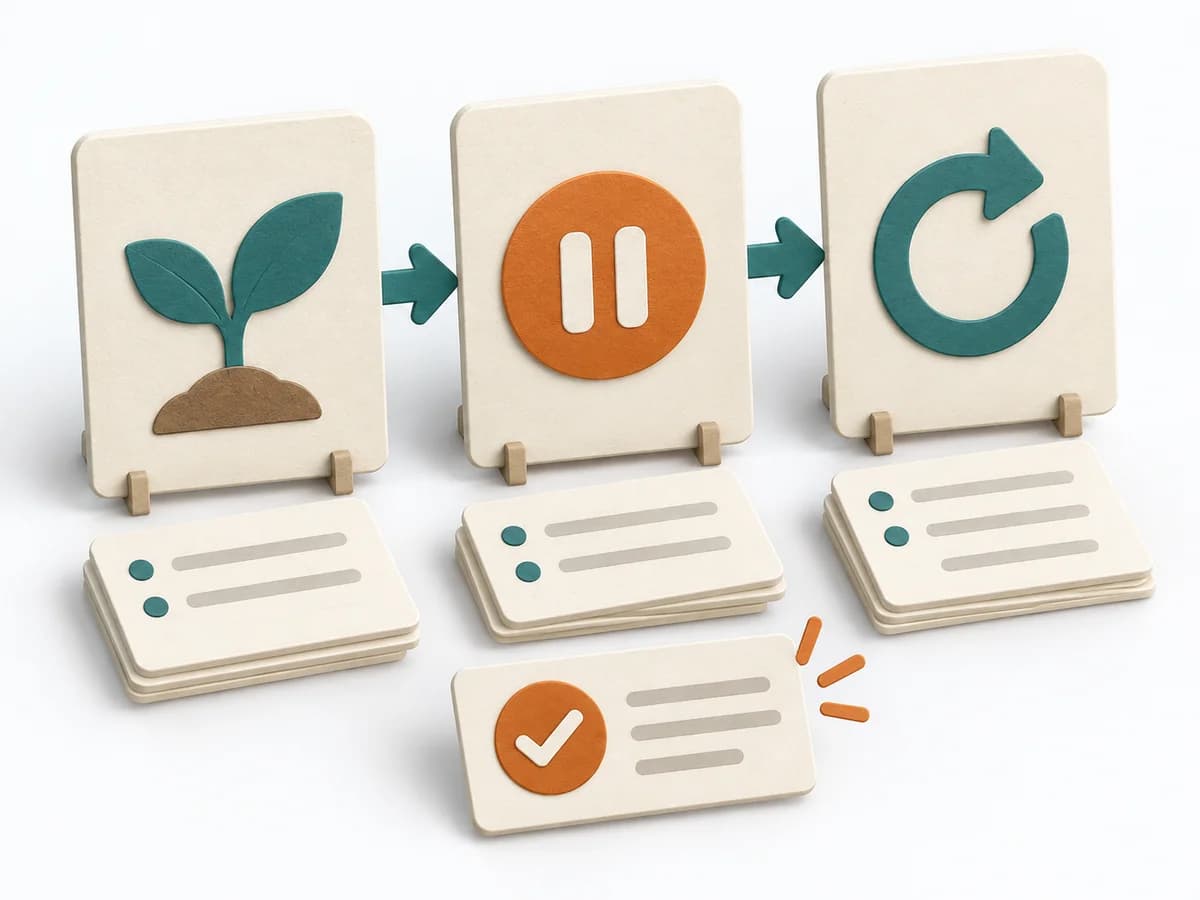
Identifies a team’s intrinsic, extraneous, and germane cognitive load and derives relief actions.
The assessment collects concrete work situations, classifies load types, and considers frequency, severity, and recovery time. It diagnoses the team system, not individual performance.
Core question
Which load currently blocks sustainable flow, and what system change will reduce it?
Team Cognitive Load Assessment uses classify concrete load episodes as intrinsic, extraneous, or germane load. Assessments remain justified and context-bound.
Collect episodes
Collect episodes
Collect concrete overload and flow situations from four weeks.
Classify load
Classify load
Distinguish intrinsic, extraneous, and germane load with rationale.
Test boundary
Test boundary
Test load against team purpose, service boundary, and dependencies.
Design relief
Design relief
Set a system action, owner, and success indicator.
Repeat after each relief action and when the team boundary changes.
A good fit when
For teams facing context switching, expanding domains, or recurring operational burden.
Ideal for
Platform strategy
Program reviews
Team health checks
Not good for
Early storming phase of a team
Outputs
cognitive load map
cognitive load map with traceable sources, assumptions, and domain decisions.
Decision and review trail
Owners, dates, and next review for cognitive load map.
cognitive load map
Fictional worked example
classify concrete load episodes as intrinsic, extraneous, or germane load as a precise working structure with a fictional example.
cognitive load map
Subject
Episode
Load type
System cause
Relief
cognitive load mapWorked example
Release: six hours preparation, three approvals.
Conflicting runbooks: extraneous.
Deployment path lacks platform service.
Golden path; platform team; under two hours preparation.
1. Episode
cognitive load map
Release: six hours preparation, three approvals.
2. Load type
cognitive load map
Conflicting runbooks: extraneous.
3. System cause
cognitive load map
Deployment path lacks platform service.
4. Relief
cognitive load map
Golden path; platform team; under two hours preparation.
The example demonstrates the domain logic of Team Cognitive Load Assessment; worksheets remain blank.
When a team juggles too many domains, systems, or handoffs, it measures mental overload as an organizational problem. It clarifies responsibility, interaction, and load between teams. The result is captured as a cognitive-load profile and action list.
How it works
The load is made visible through the structure of the work, not through personal resilience. This brings topic diversity, interfaces, and support pressure forward as the actual drivers. The conclusion aims at better scoping, less peripheral load, and clearer boundaries of responsibility.
In detail
The Cognitive Load Assessment from Team Topologies is based on Sweller's theory. Intrinsic load comes from the inherent complexity of the task, extraneous load from poor tools or processes, and germane load from building durable skills. The survey is often integrated into team health checks and shows whether measures such as a platform service or shifting responsibilities make sense.
Facilitation
Anonymize the survey when possible. Discuss results in a retrospective focused on structural causes.
The method guide walks execution through 4 phases, timing, 4 pitfalls, and clear stop criteria.
Plan Team Cognitive Load Assessment around its domain steps and the concrete decision question.
Team Cognitive Load Assessment: Worksheet
Question
To be confirmed
Desired outcome
To be confirmed
Scope
Establish and review the practice
Time: 75 minutes
Complete this worksheet on paper or in your own document during the work.
Preparation for this scope
Method setup
Materials: Examples from the last four weeks, interrupt and flow data, team boundaries and services, shared workspace, source links, and decision log.
Roles: Whole team · facilitator · platform or leadership role as needed
Advance information: Collect Examples from the last four weeks, interrupt and flow data, team boundaries and services in advance and mark open assumptions.
Overall time needed: 75 minutes
Setup: Prepare classify concrete load episodes as intrinsic, extraneous, or germane load visibly and calibrate assessment terms before starting.
MediumComplexity: medium. Estimates preparation, facilitation effort, and method confidence needed.Workshop + asyncFormat: workshop or async. Shows whether the method works in a workshop, asynchronously, or both.60-90 minTimebox: 60-90 min. Rough time frame for a typical run.