
Purpose
When effort only needs to be classified roughly, it makes comparability more important than false precision. It helps sort work quickly into manageable sizes.
Agile Decision method
Sorts backlog items roughly by reference sizes and flags topics that later need splitting or clarification.
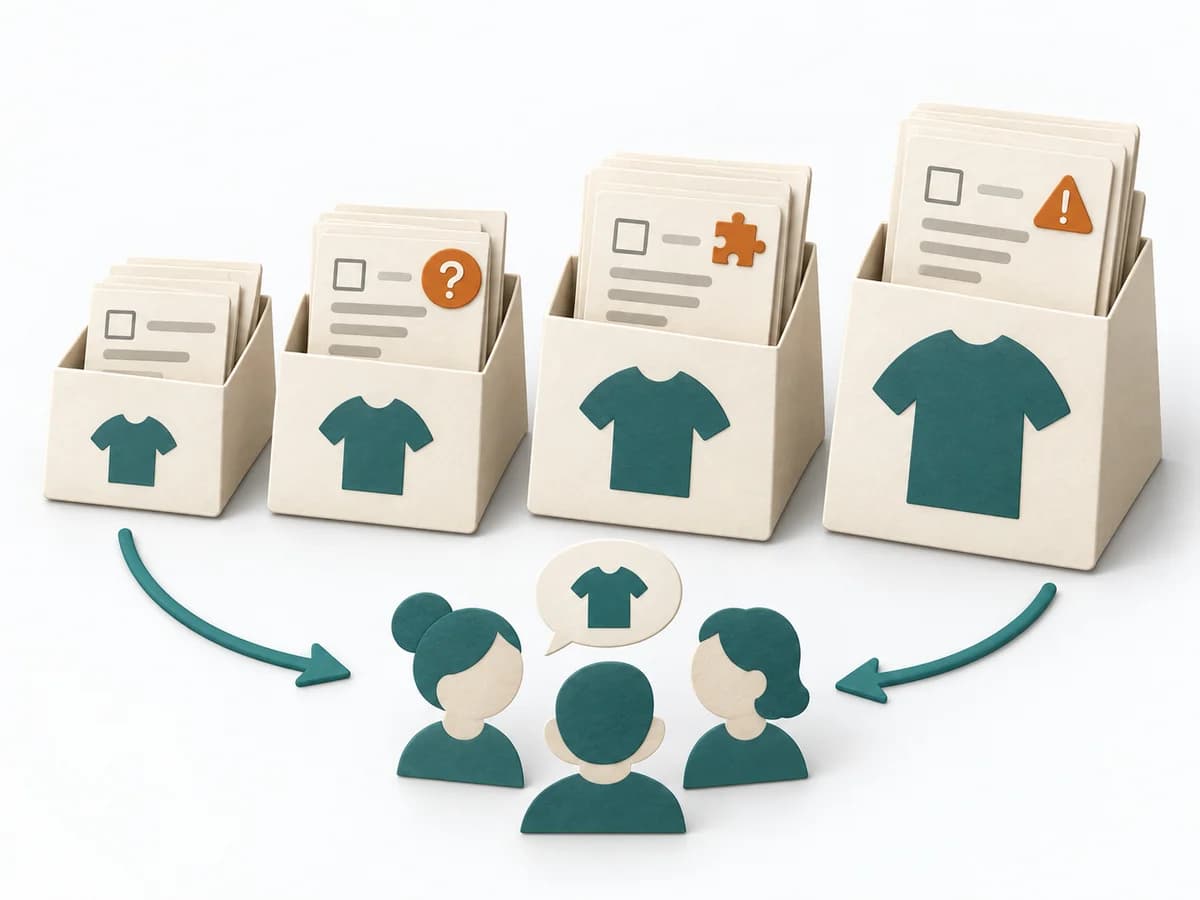
T-shirt sizing places work into a small number of size classes and focuses on relative scale rather than fine-grained precision. It creates a quick shared reference for planning and discussion while details are still emerging.
Which rough relative size class describes each comparable item using shared anchors without false precision or hidden point conversion?
The practice is repeated across comparable work items.
Scope
Set item set, sizing dimension, and Definition of Done across all sizes.
Anchors
Choose one known item per size and explain the order through actual work.
Sort
Place items silently relative to anchors; use XS/XL only for clear differences.
Clarify
Discuss boundary cases and different placements through scope, risk, and dependencies.
Close
Split or clarify oversized/unknown items; save sizes, anchors, and assumptions for later calibration.
Add new evidence at review and version decisions with the prior state.
Wenn Aufwand nur grob eingeordnet werden soll, macht sie Vergleichbarkeit wichtiger als Scheingenauigkeit. Sie hilft, Arbeit schnell in handliche Größen zu sortieren.
Relatively ordered items in XS/S/M/L/XL with anchors, boundary assumptions, clarification pile, and split rule for oversized work.
Fictional example
Fictional values show the actual method fields.
| Item | Included work | Comparison anchor | First placement | Boundary assumption | Final size | Follow-up |
|---|---|---|---|---|---|---|
| Delete tokenAdd evidence and rationale. | Build, test, security, rollout | S · validate billing address | S | Existing endpoint; no migration path | S | Ready |
| Save cardAdd evidence and rationale. | Build, test, security review, rollout | M · save provider token | M/L | M without guest users and migration; otherwise L | M | Fix scope in item |
| Card managementAdd evidence and rationale. | List, default card, delete, failure paths | L · new payment method | L | One provider; no migration | L | Ready |
| Provider migrationAdd evidence and rationale. | Auth, migration, fallback, certification | Larger than L anchor | XL | Several independent outcomes | XL | Split into three items |
All values are fictional.
Set a comparable item set and included work; select XS–XL scale and stable reference items from the team's own experience.
When effort only needs to be classified roughly, it makes comparability more important than false precision. It helps sort work quickly into manageable sizes.
It places tasks into a few size classes and directs attention to ratio rather than pinpoint precision. This creates a quick shared yardstick for planning and conversation, even though details only sharpen later.
T-Shirt Sizing uses familiar size classes to roughly order effort, complexity, or uncertainty. Teams compare items relative to one another instead of promising absolute hours or days. The method is especially useful when there is not yet enough detail for story points or concrete effort values. Large sizes signal that scope should be cut or discovery should continue.
Define the scale visibly and calibrate it with one or two reference items. Avoid direct conversion into hours or the method loses its purpose. Mark XL items as candidates for slicing or further clarification.
The method guide walks execution through 5 phases, timing, 5 pitfalls, and clear stop criteria.
Open method guideYour perspective
Your feedback helps shape the next improvements to methodatlas.
Set subject, evidence, roles, flow, and review.
To be confirmed
To be confirmed
Practice run Time: 30–60 minutes for 10–25 comparable items; recalibrate when work mix changes.
Complete this worksheet on paper or in your own document during the work.
| Item | Included work | Comparison anchor | First placement | Boundary assumption | Final size | Follow-up |
|---|---|---|---|---|---|---|
| Delete token | ||||||
| Save card | ||||||
| Card management | ||||||
| Provider migration |
The blank worksheet contains prompts only.
Reference · original teaching example
Expected artifact: Comparison frame
Set item set, sizing dimension, and Definition of Done across all sizes.
Entry:
...
Expected artifact: Size anchors
Choose one known item per size and explain the order through actual work.
Entry:
...
Expected artifact: First sort
Place items silently relative to anchors; use XS/XL only for clear differences.
Entry:
...
Expected artifact: Calibrated sizes
Discuss boundary cases and different placements through scope, risk, and dependencies.
Entry:
...
Expected artifact: Sizing view
Split or clarify oversized/unknown items; save sizes, anchors, and assumptions for later calibration.
Entry:
...
...
Method guide: https://methodatlas.meierhoff-systems.de/en/methods/t-shirt-sizing/run-sheet
Fitting alternatives with decision guidance, followed by other related methods.
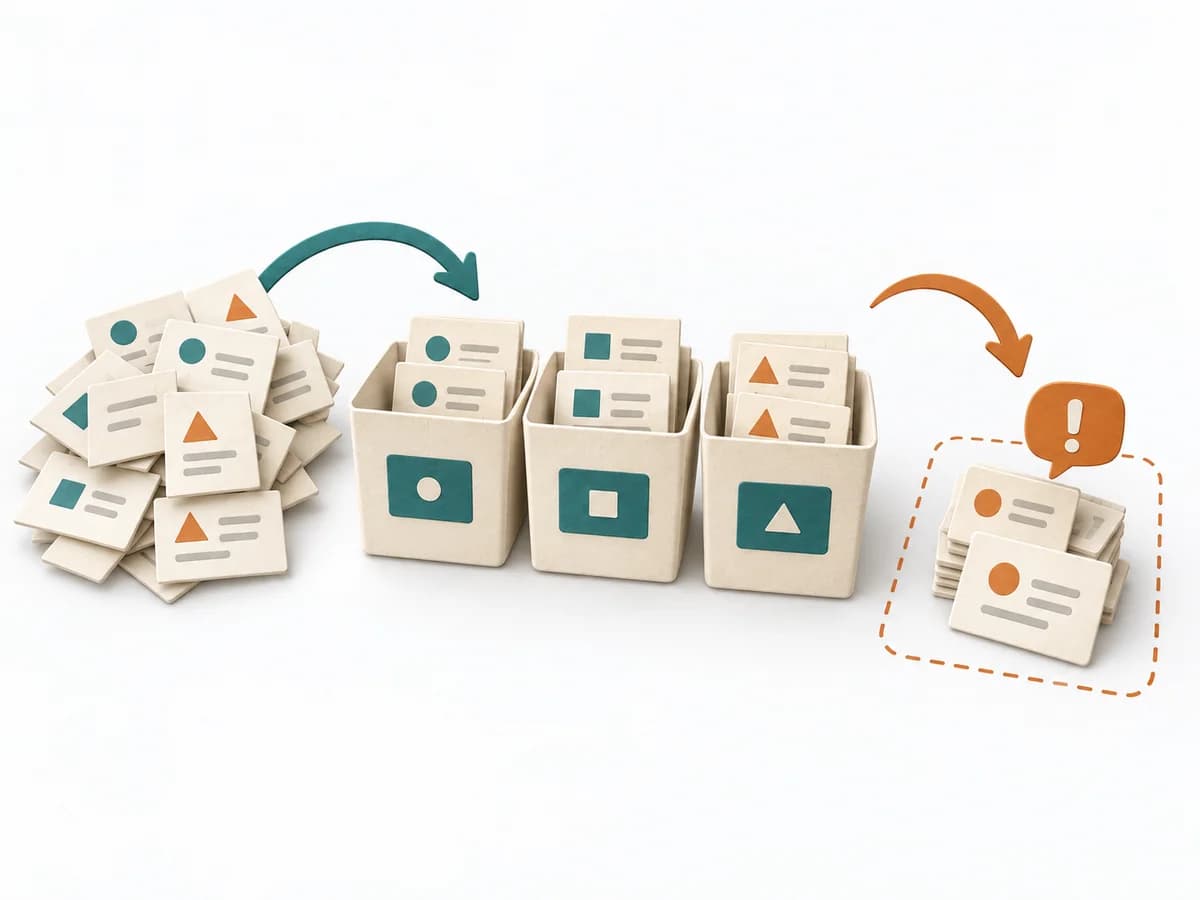
Instead of T-Shirt Sizing, choose Bucket System when you want to sort many items into rough size classes without estimating each one individually.

Instead of T-Shirt Sizing, choose Ideal Days when you want to express effort in pure working days and keep team calibration manageable.

Moves backlog, sprint work, and team flow toward a concrete result through "choose reference stories", "define the scale", and "interpret velocity only within the team".
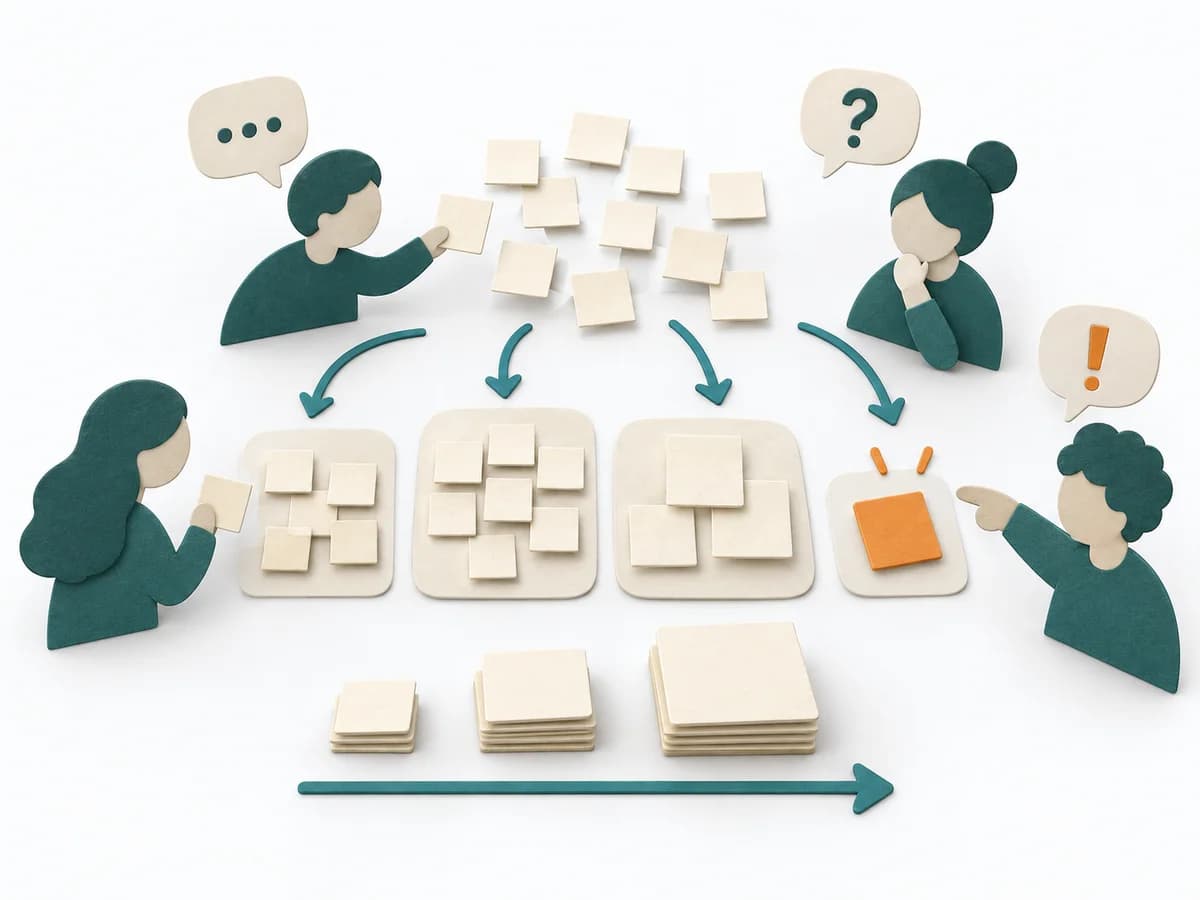
Has the team group items silently, discusses deviations, and produces consistent relative size pictures.
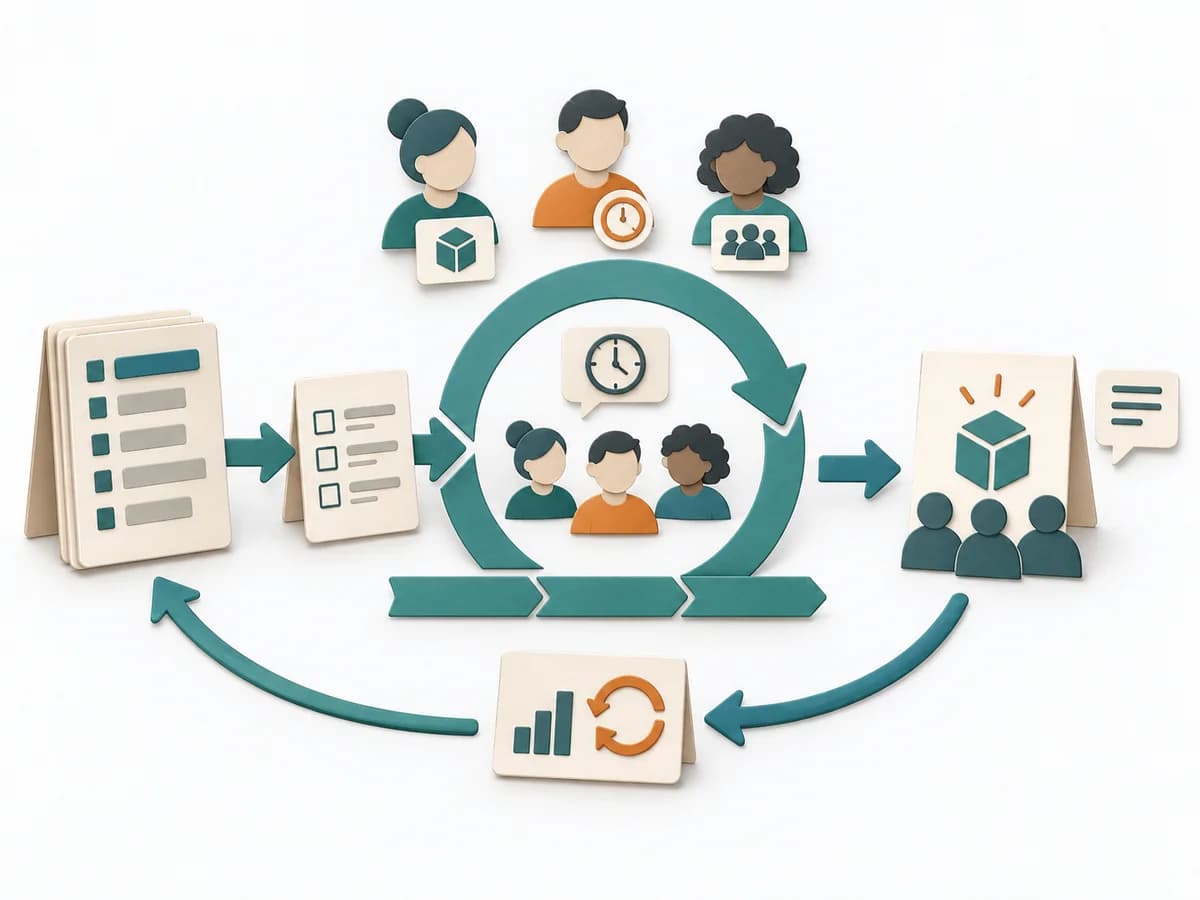
Product Backlog, Sprint Goal, Increment, and retrospective loops create a repeatable cadence for complex product work.
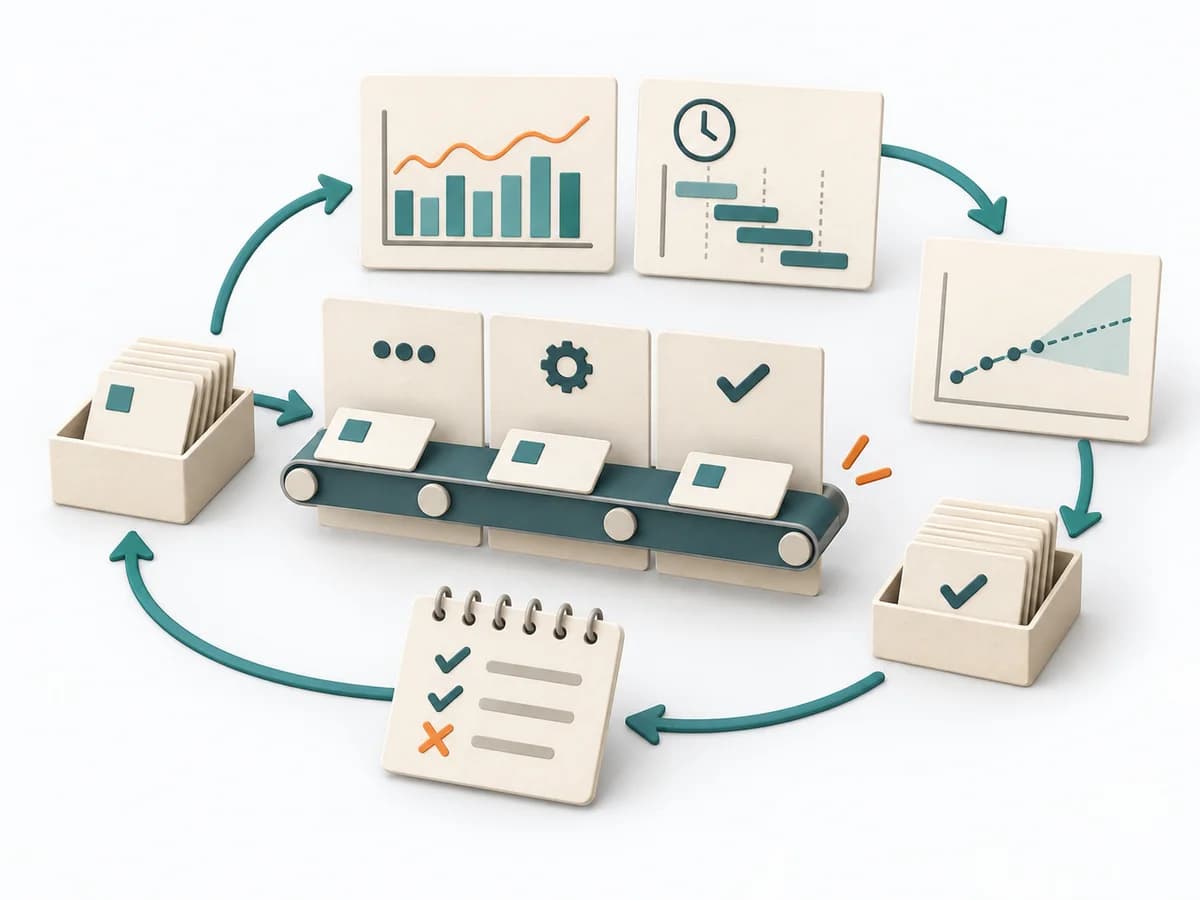
Moves backlog, sprint work, and team flow toward a concrete result through "clarify the planning question", "slice work smaller", and "calibrate regularly with reality".