Purpose
When a large batch of work needs a fast, rough estimate, it sorts items into predefined size buckets. It sorts work by value, risk, and delivery ability. The result is captured as a Bucketed Backlog, Relative Estimates, and Split Candidates.
Agile Decision method
The bucket system places work in fixed size ranges so relative estimates emerge quickly and disputed items remain visible.
The bucket system uses fixed buckets as a shared scale and places tasks relative to one another. It sorts a large set quickly while reserving detailed discussion for disputed or marginal items.
Which relative size bucket fits each item when the team places in parallel, corrects once, and separates genuine conflicts?
The practice is repeated across comparable work items.
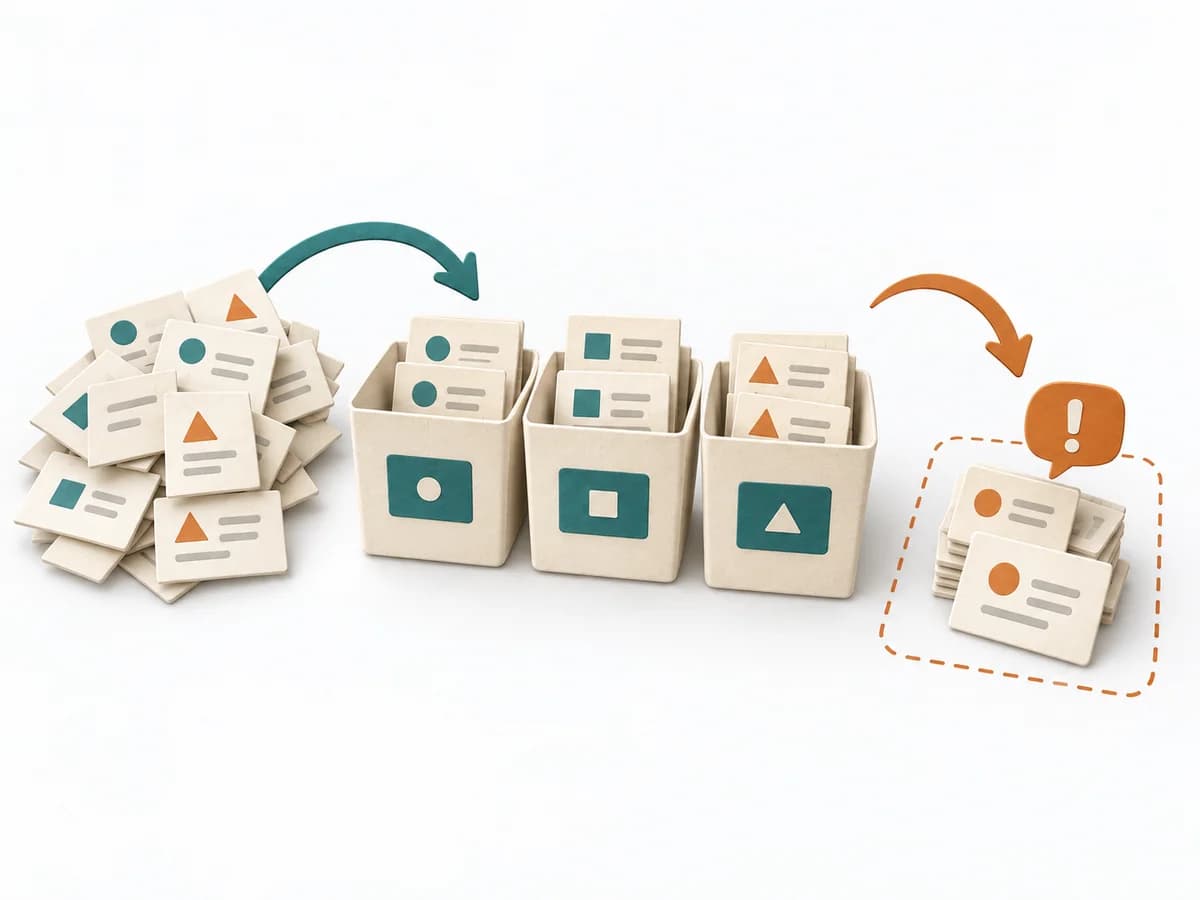
Buckets
Explain the ordered bucket scale and shared meaning of relative size.
Anchors
Place two known items together and calibrate remaining buckets relatively.
Place
Distribute items; team members silently place one item at a time in a bucket.
Correct
Others may move an item once; a second move request sends it to conflict.
Close
Resolve conflicts, split oversized items, and save anchors and assumptions.
Add new evidence at review and version estimates with the prior state.
Wenn eine größere Menge Arbeit schnell grob geschätzt werden soll, verteilt sie Items in vorgegebene Größenräume. Sie spart Diskussion, ohne die Vergleichbarkeit ganz aufzugeben.
Rapidly calibrated backlog in relative buckets with anchors, conflict items, assumptions, and split/clarification actions.
Fictional example
Fictional values show the actual method fields.
| Item | Included | Anchor | First bucket | Move | Final | Follow-up |
|---|---|---|---|---|---|---|
| Delete tokenAdd evidence and rationale. | Build, test, rollout | Validation rule=3 | 3 | None | 3 | Ready |
| Save cardAdd evidence and rationale. | Build, test, security, rollout | Between 3 and 13 | 5 | 5→8; guest scope disputed | 5 without guests | Scope recorded |
| Provider migrationAdd evidence and rationale. | Auth, migration, fallback | Larger than 13 | 40 | None | 40 | Split into three items |
All values are fictional.
Set a comparable item set and included work; prepare buckets 1, 2, 3, 5, 8, 13, 20, 40, 100 and two known anchors.
When a large batch of work needs a fast, rough estimate, it sorts items into predefined size buckets. It sorts work by value, risk, and delivery ability. The result is captured as a Bucketed Backlog, Relative Estimates, and Split Candidates.
It uses fixed buckets as a shared grid and places tasks relative to each other first. A large volume is sorted quickly, while only the contested or borderline items need to be discussed in more detail.
The Bucket System uses fixed size buckets, such as Fibonacci numbers or T-shirt sizes. After calibration with a few reference items, many more items are quickly placed into the appropriate buckets. Discussion focuses on items that are disputed between buckets or seem too large. The result is a broad, consistent estimate for many items with less fatigue than item-by-item estimation.
Prepare the buckets and a few reference items in advance. Prevent in-between values so the group stays deliberately coarse. Mark large-bucket items for splitting or further discovery.
The method guide walks execution through 5 phases, timing, 5 pitfalls, and clear stop criteria.
Open method guideYour perspective
Your feedback helps shape the next improvements to methodatlas.
Set subject, data, roles, flow, and review.
To be confirmed
To be confirmed
Practice run Time: 30–60 minutes for 20–50 comparable items.
Complete this worksheet on paper or in your own document during the work.
| Item | Included | Anchor | First bucket | Move | Final | Follow-up |
|---|---|---|---|---|---|---|
| Delete token | ||||||
| Save card | ||||||
| Provider migration |
The blank worksheet contains prompts only.
Reference · original teaching example
Expected artifact: Size lane
Explain the ordered bucket scale and shared meaning of relative size.
Entry:
...
Expected artifact: Bucket anchors
Place two known items together and calibrate remaining buckets relatively.
Entry:
...
Expected artifact: First placement
Distribute items; team members silently place one item at a time in a bucket.
Entry:
...
Expected artifact: Conflict pile
Others may move an item once; a second move request sends it to conflict.
Entry:
...
Expected artifact: Bucket estimate
Resolve conflicts, split oversized items, and save anchors and assumptions.
Entry:
...
...
Method guide: https://methodatlas.meierhoff-systems.de/en/methods/bucket-system/run-sheet
Fitting alternatives with decision guidance, followed by other related methods.

Instead of Bucket System, choose Planning Poker when you want to calibrate estimates relative to each other and surface shared assumptions.

Instead of Bucket System, choose Story Points when individual backlog items should be deliberately rated relative to each other instead of just falling into size classes.
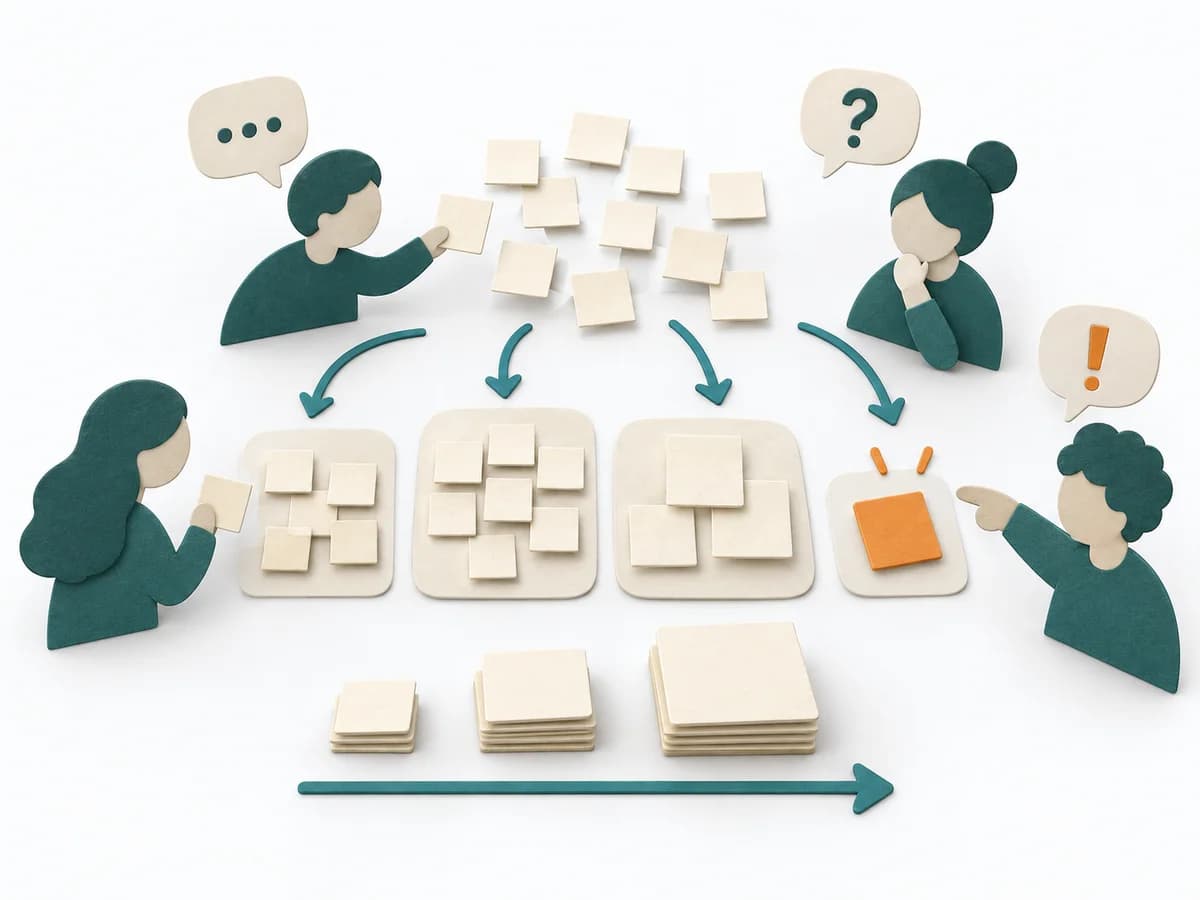
Has the team group items silently, discusses deviations, and produces consistent relative size pictures.

Sorts backlog items roughly by reference sizes and flags early on which items will later need splitting or clarification.

Moves backlog, sprint work, and team flow toward a concrete result through "explain the ideal day unit", "calibrate with a reference item", and "do not confuse it with calendar days".
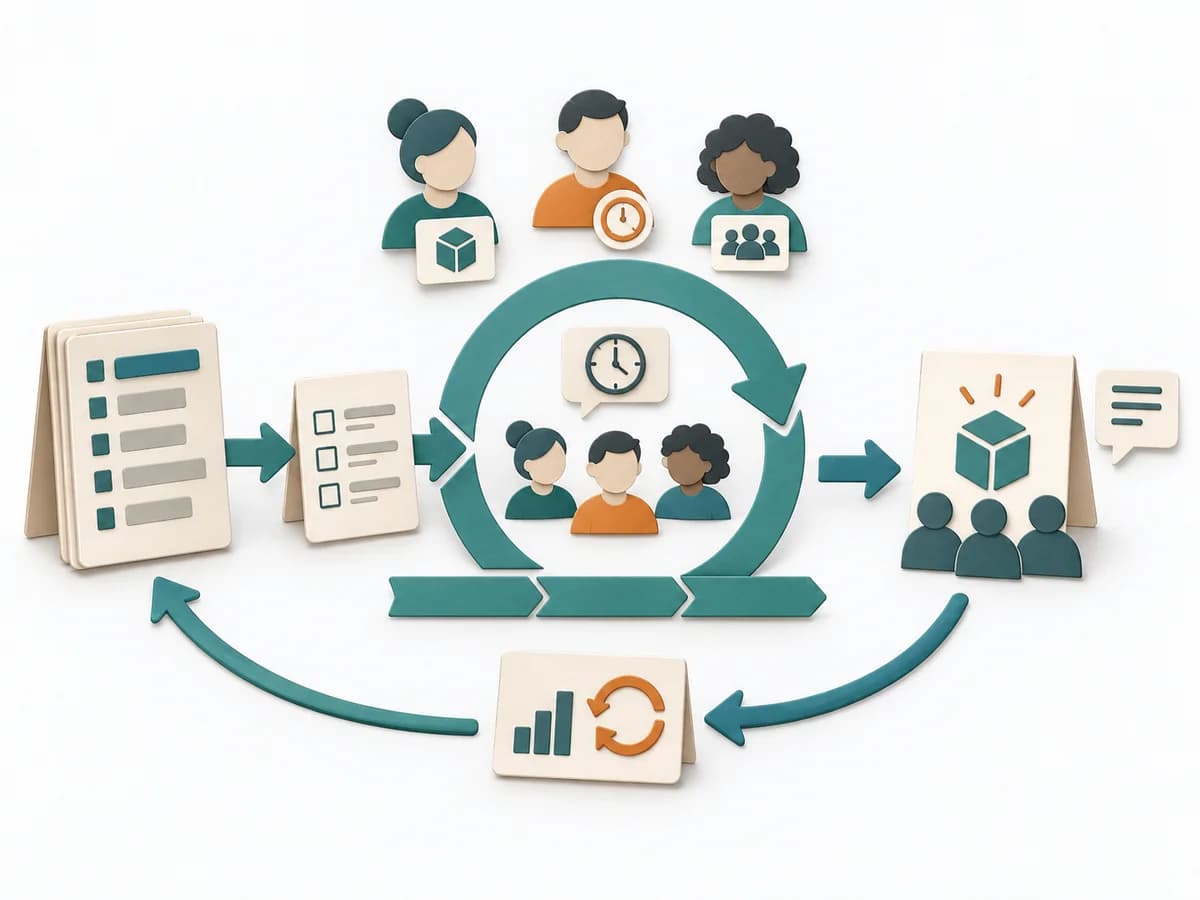
Product Backlog, Sprint Goal, Increment, and retrospective loops create a repeatable cadence for complex product work.