methodatlas
Session Builder

Plan my session

Plan a concrete work block with agenda, roles, preparation, and a copyable result artifact.

Method session15-45 minWorkshop or asyncSize Buckets

Session: T-Shirt Sizing

The plan translates the method into a concrete facilitated work block. Your inputs flow directly into the session brief and work artifact.

Derived automatically

Method session with 2-12. The plan uses the existing method logic and the runsheet.

Runsheet
Participation logic
Team round, shared work and alignment

Use the session for shared understanding. Contributions are collected visibly, assumptions are aligned, and open differences remain traceable in the artifact.

Outcome logic
Finish artifact

The session works directly toward Size Buckets. After the session, the artifact should be shareable, reviewable, or reusable.

  1. 1

    Phase 1: Calibrate references

    10 min

    Review reference items per size class together. Anyone with different understanding says so now. Re-sort references if needed until group has consensus. Hint: Without calibrated references, sorting is gut feeling. If no references from real releases exist, select some from roadmap history before workshop.

    FacilitatorSize Buckets
  2. 2

    Phase 2: Silent sorting

    15 min

    Items on wall in random order. Participants silently sort into columns, may move items placed by others. No discussion in this phase. Hint: If item moves back and forth between two people several times, it is a discussion candidate for phase 3. Mark items silently with dot.

    FacilitatorRough Backlog Map
  3. 3

    Phase 3: Clarify contested items

    15 min

    Max 2 min per contested item: highest and lowest estimate explain assumptions, then decision. Mark XL items as slicing candidates. Hint: With more than 5 contested items, group either lacks context or references do not fit. Pause workshop, add discovery.

    FacilitatorSplit Candidates
  4. 4

    Phase 4: Split or park XL items

    10 min

    For each XL item decide: split (which smaller items it breaks into), spike (discovery first) or park (does not currently fit). Document result in roadmap backlog. Hint: XL items without split remain wishful thinking. If no split proposal possible, solution understanding missing, item belongs in discovery.

    OwnerSize Buckets
  5. 5

    Publish artifact

    10 min

    Check the artifact for completeness, define location, set version or status, and name review recipients.

    OwnerSize Buckets
Usable artifact

Session Brief

For invitations, boards, tickets, PR descriptions, or workshop notes.

session-brief.md

Session Brief: T-Shirt Sizing

Goal

Artifact: Size Buckets

Working Question

Which size class does each item fall into relative to our references, and which items are so large that they must be cut before planning?

Context

List of epics or items to size with short description; list of reference items from past releases with their real size; known constraints (team capacity, external dependencies).

Setup

  • Format: Method session
  • Duration: 15-45 min
  • Mode: Workshop or async
  • Participants: One facilitator who guides sorting; one Product Owner for item context; implementing team (engineering, design depending on item type); optional tech lead for architecture assessment.
  • Owner: One facilitator who guides sorting
  • Participation mode: Team round, shared work and alignment
  • Outcome logic: Finish artifact

Participation Logic

Use the session for shared understanding. Contributions are collected visibly, assumptions are aligned, and open differences remain traceable in the artifact.

Outcome Logic

The session works directly toward Size Buckets. After the session, the artifact should be shareable, reviewable, or reusable.

Input

Whiteboard or Miro board with 5 columns (XS, S, M, L, XL); sticky notes or cards with one item each; two to three predefined reference items per size; timer; pen colors for markings.

Preparation

Five columns on wall: XS (<1 sprint), S (1 sprint), M (2-3 sprints), L (quarter), XL (half-year+). Put reference items into every column. State rule: no hour or point discussion, only comparison with references.

Agenda

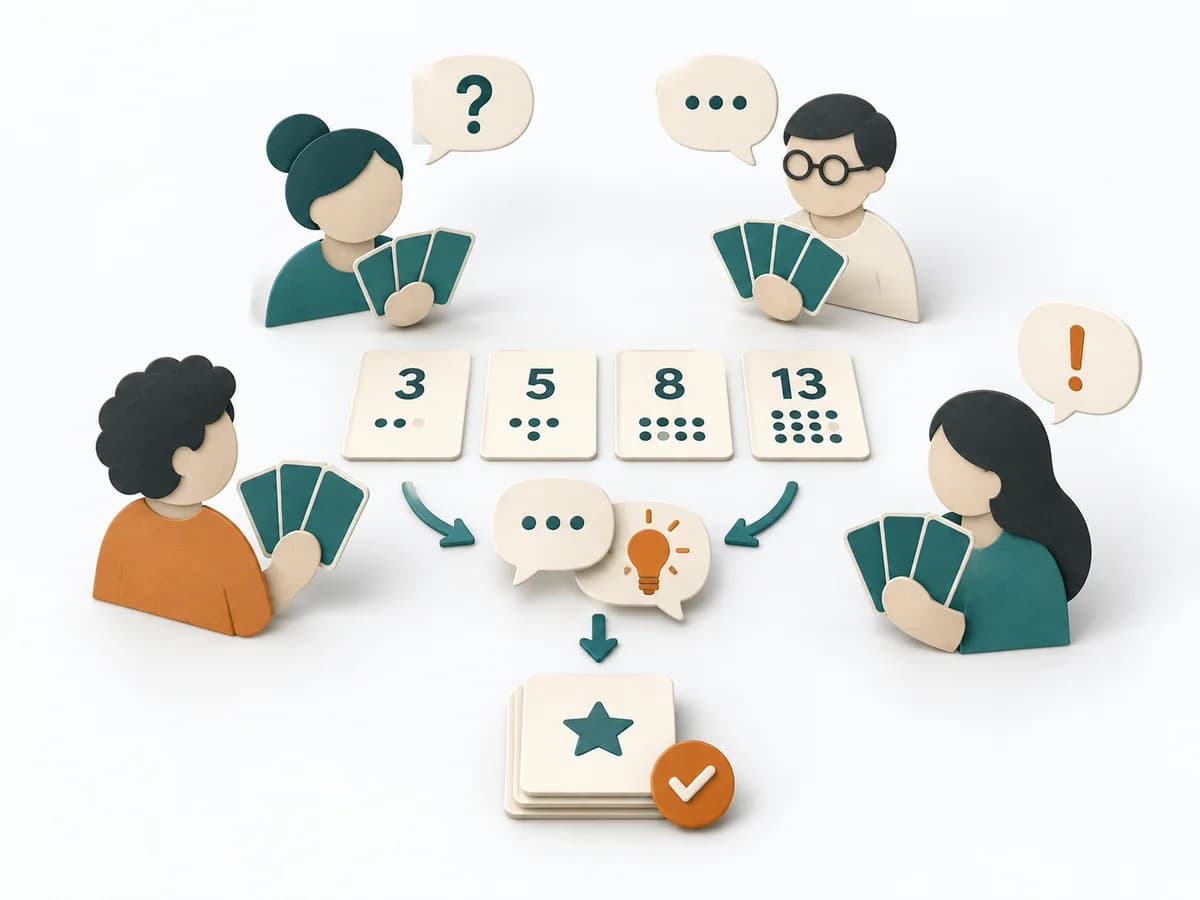
  1. Phase 1: Calibrate references (10 min) Owner: Facilitator Action: Review reference items per size class together. Anyone with different understanding says so now. Re-sort references if needed until group has consensus. Hint: Without calibrated references, sorting is gut feeling. If no references from real releases exist, select some from roadmap history before workshop. Output: Size Buckets

  2. Phase 2: Silent sorting (15 min) Owner: Facilitator Action: Items on wall in random order. Participants silently sort into columns, may move items placed by others. No discussion in this phase. Hint: If item moves back and forth between two people several times, it is a discussion candidate for phase 3. Mark items silently with dot. Output: Rough Backlog Map

  3. Phase 3: Clarify contested items (15 min) Owner: Facilitator Action: Max 2 min per contested item: highest and lowest estimate explain assumptions, then decision. Mark XL items as slicing candidates. Hint: With more than 5 contested items, group either lacks context or references do not fit. Pause workshop, add discovery. Output: Split Candidates

  4. Phase 4: Split or park XL items (10 min) Owner: Owner Action: For each XL item decide: split (which smaller items it breaks into), spike (discovery first) or park (does not currently fit). Document result in roadmap backlog. Hint: XL items without split remain wishful thinking. If no split proposal possible, solution understanding missing, item belongs in discovery. Output: Size Buckets

  5. Publish artifact (10 min) Owner: Owner Action: Check the artifact for completeness, define location, set version or status, and name review recipients. Output: Size Buckets

Closeout

  • Update result artifact: Size Buckets
  • Define location, version, and review recipients.
  • Define owner, next step, and review date.
Usable artifact

Work artifact

Pre-filled starting point based on the matching template.

work-artifact.md

Size Buckets: T-Shirt Sizing

Working Question

Which size class does each item fall into relative to our references, and which items are so large that they must be cut before planning?

Context

List of epics or items to size with short description; list of reference items from past releases with their real size; known constraints (team capacity, external dependencies).

Participants

  • Owner: One facilitator who guides sorting
  • Participants: One facilitator who guides sorting; one Product Owner for item context; implementing team (engineering, design depending on item type); optional tech lead for architecture assessment.

Input

Whiteboard or Miro board with 5 columns (XS, S, M, L, XL); sticky notes or cards with one item each; two to three predefined reference items per size; timer; pen colors for markings.

Template

T-Shirt Sizing Canvas

Context

What is this method used for?

Core question

Which question should be answered at the end?

Input

Which data, observations, or materials are available?

Working area

  • Area 1:
  • Area 2:
  • Area 3:
  • Relationships / patterns:

Output artifacts

  • Size Buckets:
  • Rough Backlog Map:
  • Split Candidates:

Open questions

  • ...

Next step

Owner, date, success signal.

Completion Check

  • Size Buckets is complete enough for review:
  • Location:
  • Version / status:
  • Review by:
  • Next step:

Next Step

  • Review result
  • Mark open questions
  • Schedule review or decision
Template base

T-Shirt Sizing Working Template

View templateCompact working template for T-Shirt Sizing with context, input, output artifacts, and next step.
canvas

t-shirt-sizing-working-template.md

Compact working template for T-Shirt Sizing with context, input, output artifacts, and next step.

T-Shirt Sizing Canvas

Context

What is this method used for?

Core question

Which question should be answered at the end?

Input

Which data, observations, or materials are available?

Working area

  • Area 1:
  • Area 2:
  • Area 3:
  • Relationships / patterns:

Output artifacts

  • Size Buckets:
  • Rough Backlog Map:
  • Split Candidates:

Open questions

  • ...

Next step

Owner, date, success signal.

Ready to use when
  • Working question, owner, and target artifact are visible.
  • The result fits Size Buckets.
  • New version per roadmap review (usually quarterly). Document size changes with date and rationale in item, do not overwrite old values. On item split: mark old ID as "resolved into X, Y, Z".
  • Open questions are noted as follow-ups.
  • The next review or decision point is scheduled.