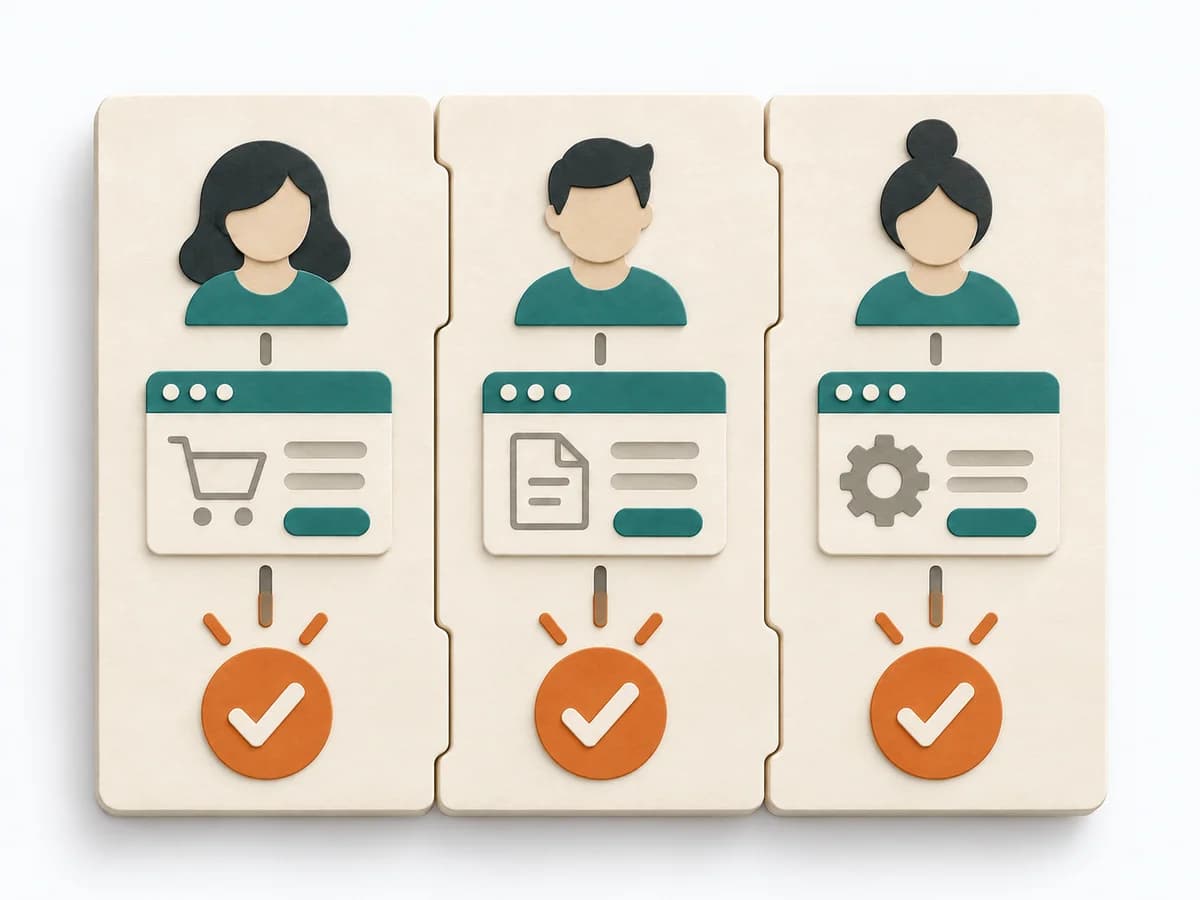
Complete firstClear boundary
Set a comparable item set and included work; select XS–XL scale and stable reference items from the team's own experience.
Without a boundary, cases, periods, or variables become mixed.
A practical method guide: clarify prerequisites and materials, understand the complete process, and look up outputs, pitfalls, and stop criteria.
What needs to be finished first
Set a comparable item set and included work; select XS–XL scale and stable reference items from the team's own experience.
Comparable items, shared Definition of Done, XS/S/M/L/XL sizes, one reference item per size, and clarification pile
What needs to be ready before start
Comparable items, shared Definition of Done, XS/S/M/L/XL sizes, one reference item per size, and clarification pile
Delivery team estimates · product owner clarifies · facilitator calibrates · experts answer questions
Set a comparable item set and included work; select XS–XL scale and stable reference items from the team's own experience.
30–60 minutes for 10–25 comparable items; recalibrate when work mix changes.
Prepare a workspace with Scope · Anchors · Sort · Clarify · Close; separate example from live data.
The one question this method answers
Which rough relative size class describes each comparable item using shared anchors without false precision or hidden point conversion?
Phases with goal, actions, output and pitfall
T-shirt sizing places work into a small number of size classes and focuses on relative scale rather than fine-grained precision. It creates a quick shared reference for planning and discussion while details are still emerging.
Fictional example
Fictional values show the actual method fields.
| Item | Included work | Comparison anchor | First placement | Boundary assumption | Final size | Follow-up |
|---|---|---|---|---|---|---|
| Delete tokenAdd evidence and rationale. | Build, test, security, rollout | S · validate billing address | S | Existing endpoint; no migration path | S | Ready |
| Save cardAdd evidence and rationale. | Build, test, security review, rollout | M · save provider token | M/L | M without guest users and migration; otherwise L | M | Fix scope in item |
| Card managementAdd evidence and rationale. | List, default card, delete, failure paths | L · new payment method | L | One provider; no migration | L | Ready |
| Provider migrationAdd evidence and rationale. | Auth, migration, fallback, certification | Larger than L anchor | XL | Several independent outcomes | XL | Split into three items |
All values are fictional.
Scope

Goal
Comparison frame: Set item set, sizing dimension, and Definition of Done across all sizes.
Inputs for this step
Actions
Output
Comparison frame
Set item set, sizing dimension, and Definition of Done across all sizes.
Quality check
Are items comparable and does size include the same work types?
Pitfall
Features, research, and operations projects are sorted together. Split the item set or establish one shared sizing dimension.
Timing: 5–10 minutes
Anchors
Goal
Size anchors: Choose one known item per size and explain the order through actual work.
Inputs for this step
Actions
Output
Size anchors
Choose one known item per size and explain the order through actual work.
Quality check
Are anchors from the same context and clearly ordered?
Pitfall
Sizes are converted into days or points. Describe anchors as relative work and do not convert them numerically.
Timing: 5–10 minutes
Sort
Goal
First sort: Place items silently relative to anchors; use XS/XL only for clear differences.
Inputs for this step
Actions
Output
First sort
Place items silently relative to anchors; use XS/XL only for clear differences.
Quality check
Does every item sit between understandable neighbours?
Pitfall
The group debates every item before first placement. Place independently first; mark conflicts afterwards.
Timing: 10–20 minutes
Clarify
Goal
Calibrated sizes: Discuss boundary cases and different placements through scope, risk, and dependencies.
Inputs for this step
Actions
Output
Calibrated sizes
Discuss boundary cases and different placements through scope, risk, and dependencies.
Quality check
Was a size change explained by a different work model?
Pitfall
Majority vote hides different assumptions. The differing person explains first; then update scope or size together.
Timing: 10–15 minutes
Close
Goal
Sizing view: Split or clarify oversized/unknown items; save sizes, anchors, and assumptions for later calibration.
Inputs for this step
Actions
Output
Sizing view
Split or clarify oversized/unknown items; save sizes, anchors, and assumptions for later calibration.
Quality check
Does every XL item have a split question and every unclear item an owner?
Pitfall
XL is accepted as a plannable work package. Split XL; place unknown work in clarification rather than forcing a size.
Timing: 5–10 minutes
What comes out at the end
Sketch: what the artifact looks like
Relatively ordered items in XS/S/M/L/XL with anchors, boundary assumptions, clarification pile, and split rule for oversized work.
Record date, owner, source state, and review date; preserve prior versions.
Set subject, evidence, roles, flow, and review.
To be confirmed
To be confirmed
Practice run Time: 30–60 minutes for 10–25 comparable items; recalibrate when work mix changes.
Complete this worksheet on paper or in your own document during the work.
| Item | Included work | Comparison anchor | First placement | Boundary assumption | Final size | Follow-up |
|---|---|---|---|---|---|---|
| Delete token | ||||||
| Save card | ||||||
| Card management | ||||||
| Provider migration |
The blank worksheet contains prompts only.
Reference · original teaching example
Expected artifact: Comparison frame
Set item set, sizing dimension, and Definition of Done across all sizes.
Entry:
...
Expected artifact: Size anchors
Choose one known item per size and explain the order through actual work.
Entry:
...
Expected artifact: First sort
Place items silently relative to anchors; use XS/XL only for clear differences.
Entry:
...
Expected artifact: Calibrated sizes
Discuss boundary cases and different placements through scope, risk, and dependencies.
Entry:
...
Expected artifact: Sizing view
Split or clarify oversized/unknown items; save sizes, anchors, and assumptions for later calibration.
Entry:
...
...
Method guide: https://methodatlas.meierhoff-systems.de/en/methods/t-shirt-sizing/run-sheet
Concrete filled scenario, fictional example
Fictional example for orientation. Counts and timings describe this case and are not universal requirements.
Concrete filled scenario, fictional example
| Item | Included work | Comparison anchor | First placement | Boundary assumption | Final size | Follow-up |
|---|---|---|---|---|---|---|
| Delete token | Build, test, security, rollout | S · validate billing address | S | Existing endpoint; no migration path | S | Ready |
| Save card | Build, test, security review, rollout | M · save provider token | M/L | M without guest users and migration; otherwise L | M | Fix scope in item |
| Card management | List, default card, delete, failure paths | L · new payment method | L | One provider; no migration | L | Ready |
| Provider migration | Auth, migration, fallback, certification | Larger than L anchor | XL | Several independent outcomes | XL | Split into three items |
Recognize symptoms and steer against them
Quick overview, the full text is in the matching phase in the flow
Features, research, and operations projects are sorted together.
Split the item set or establish one shared sizing dimension.
Sizes are converted into days or points.
Describe anchors as relative work and do not convert them numerically.
The group debates every item before first placement.
Place independently first; mark conflicts afterwards.
Majority vote hides different assumptions.
The differing person explains first; then update scope or size together.
XL is accepted as a plannable work package.
Split XL; place unknown work in clarification rather than forcing a size.
When to pause, resolve prerequisites, or choose another approach
Go to the profile for purpose, similar methods, and sources or continue to the next method in the catalog.