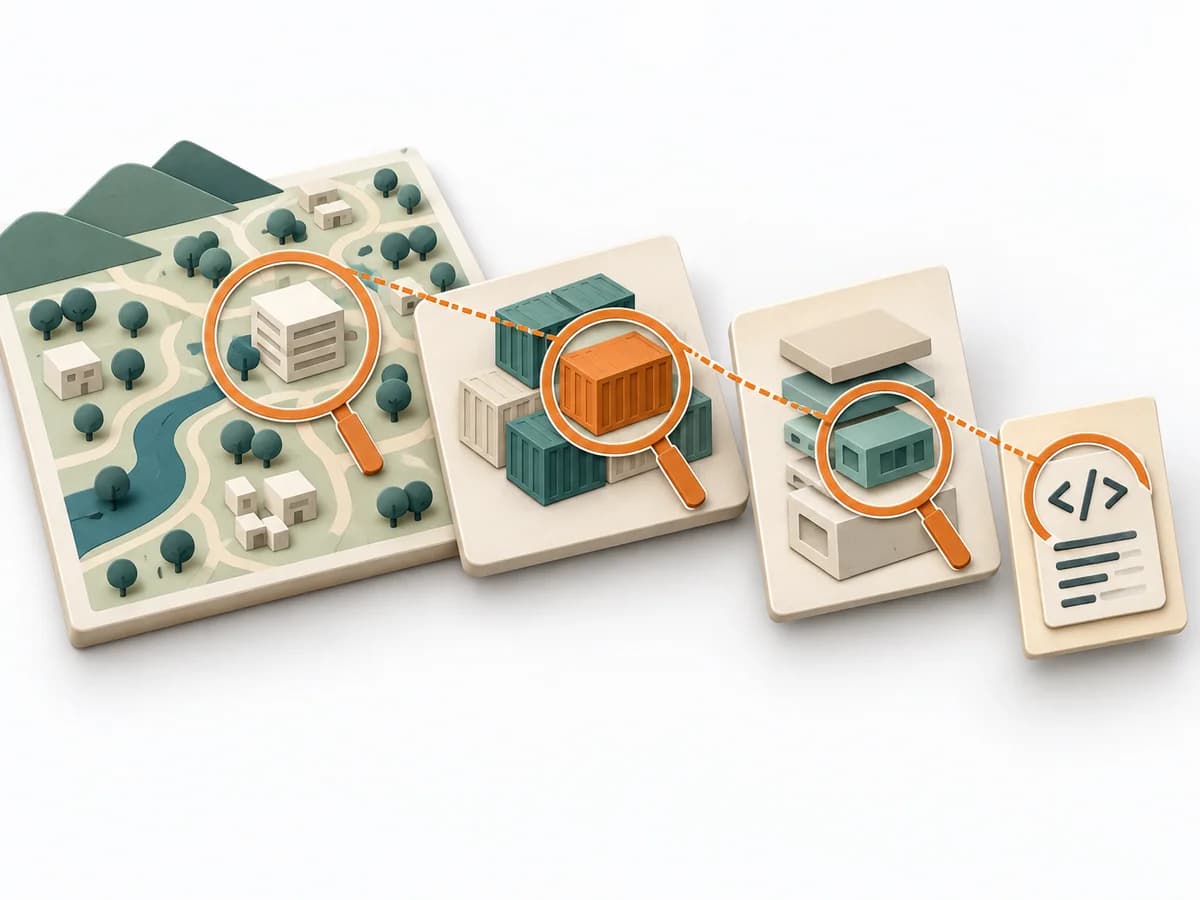
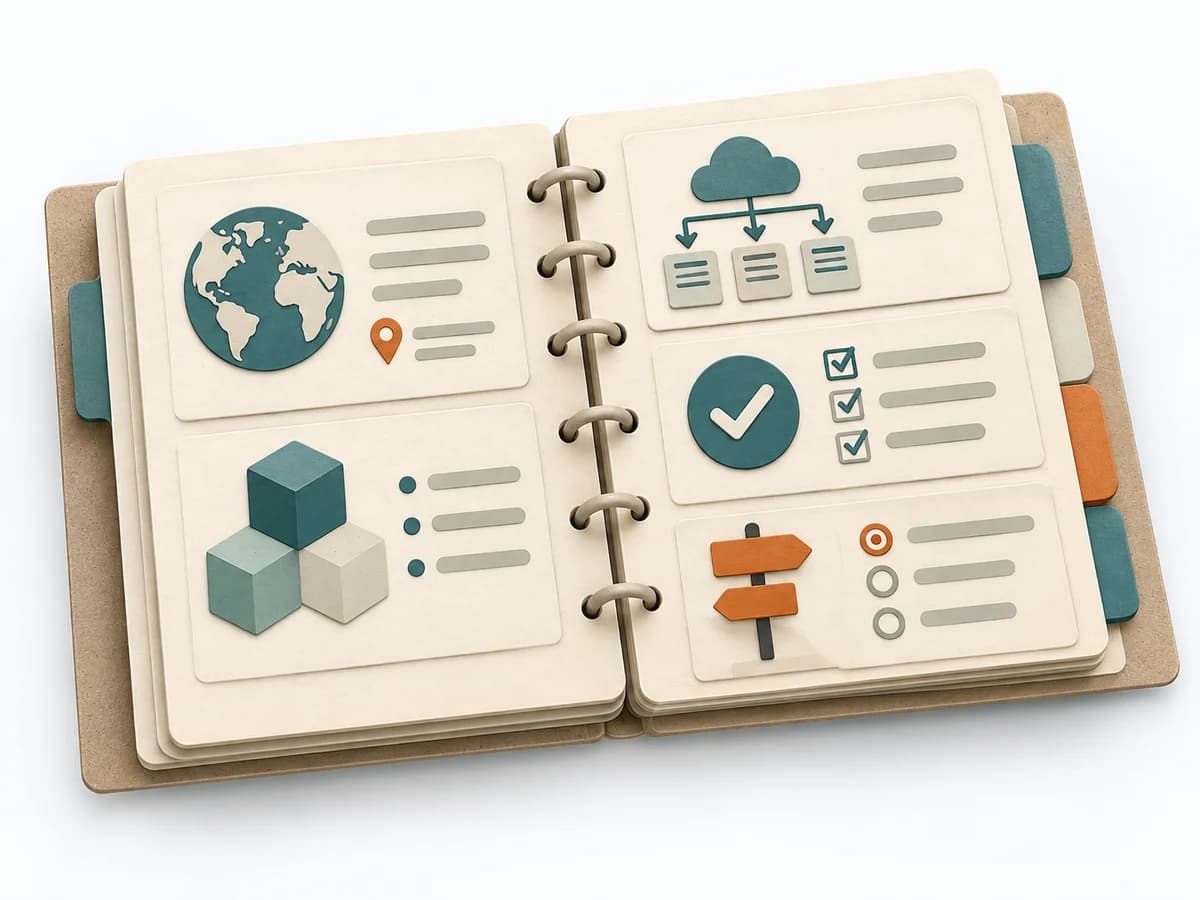
Purpose
SAAM helps teams judge an architecture’s suitability for selected tasks and changes. It is particularly useful for examining modifiability and comparing architecture alternatives with clear reasoning.
Architecture Analysis method
Uses concrete change tasks to examine how well an architecture supports future development.
SAAM shows which parts of a system would need to change for a planned requirement. It maps business functions to responsible components, assesses concrete changes, and supports comparison of architecture alternatives on the same basis.
What changes do our planned tasks require, and how do the architecture alternatives differ?
The five sections follow the original SAAM version. This guide uses modifiability as an example. Allow time for preparation, joint discussion and technical analysis.

Functions
Describe what the system needs to do for its users and business. This functional partition provides a common basis for all architectures under review.
Allocation
Show which components implement each function and how they are connected.
Qualities
Choose properties that matter for using and developing the system. Modifiability is a particularly useful focus for this analysis.
Tasks
Concrete scenario tasks make a quality goal examinable. For modifiability, an example is adding another shipping provider.
Evaluation
Work through the agreed evaluation cases. Record the changes each architecture would require.
When requirements or the architecture change, update the evaluation cases and their mapping to components. Retain earlier assessments and their assumptions.
Useful for planned or existing architectures, especially questions about modifiability and moving software to other technical environments (portability). Comparing alternatives requires comparable architecture descriptions and the same evaluation cases.
An overview shows which components implement the business functions and how they are connected. Alternatives are described at comparable depth.
Each evaluation case records the expected changes and the basis of the assessment. Assumptions and open questions show where further investigation is needed. Additional analysis establishes costs and runtime behaviour.
The next steps contain specific investigations and decisions with a responsible person and date.
Fictional worked example
Document the business functions, affected components and assessed change impacts.
Describe the analysis question, system boundary and goals for future development. List the business functions as a shared basis.
Add shipping providers; prepare order, book shipment, map status.
Describe components and connections for each alternative. Map business functions to them and record sources and information still needed.
A: The order module calls providers directly. B: Adapters handle communication and map status codes. The shared interface still needs checking.
Name the relevant quality goals. Explain the criteria you will use and which conclusions they support.
Modifiability: affected components and interfaces and required tests. Effort will be estimated later.
Record concrete tasks, context, desired outcome, priority and selection rationale.
T1: add second parcel provider. T2: grouped shipments with multiple parcel IDs. Both from fictional growth plans.
For each task and alternative, record the required changes, evidence, assumptions and assessment. Agree next steps and owners.
With a suitable interface, T1 in B affects the new adapter and status mapping. T2 requires further changes in both alternatives. Development examines the interface and tests.
The example is fictional. It illustrates possible change impacts; open assumptions and pending checks are marked.
Clarify the analysis question and the business domain in scope. Gather architecture documents and agree relevant change tasks with people who know the system and how it is used.
SAAM helps teams judge an architecture’s suitability for selected tasks and changes. It is particularly useful for examining modifiability and comparing architecture alternatives with clear reasoning.
Describe the system’s domain functions and map them to architecture components and connections. Select important quality attributes, such as modifiability. Define typical tasks as scenarios and examine how the architecture supports each task.
This guide follows the original five-step SAAM version. The team first describes domain functions and maps them to components and connections. This shared basis makes architectures comparable. Concrete tasks then show how well the architecture supports the selected quality attributes. These include modifiability and portability, meaning the ability to move to other technical environments. Experienced practitioners examine the affected structures and explain their judgments. The strength of the conclusions depends on the selected tasks, the precision of the architecture description, and the documented assumptions. Reliable implementation costs require additional evidence.
Agree which changes or alternatives to examine and prepare an architecture overview. Gather typical usage tasks and realistic changes with the participants. Ask experienced developers to explain the effects on the system and label estimates. One specialist can perform the analysis. Confirm the scenario selection and weighting together with the participants. Allow time for research, analysis, and a joint review of the findings.
The method guide walks execution through 5 phases, timing, 5 pitfalls, and clear stop criteria.
Open method guideYour perspective
Your feedback helps shape the next improvements to methodatlas.
Prepare the overall initiative or a selected analysis block with a concrete question, documents and participants.
To be confirmed
To be confirmed
Whole analysis initiative Time: Multiple meetings and interim work, to be agreed according to scope
Complete this worksheet on paper or in your own document during the work.
Describe the analysis question, system boundary and goals for future development. List the business functions as a shared basis.
...
Describe components and connections for each alternative. Map business functions to them and record sources and information still needed.
...
Name the relevant quality goals. Explain the criteria you will use and which conclusions they support.
...
Record concrete tasks, context, desired outcome, priority and selection rationale.
...
For each task and alternative, record the required changes, evidence, assumptions and assessment. Agree next steps and owners.
...
Enter your own information, sources and assumptions in the blank worksheet.
SEI: Software Architecture Analysis Method
Expected artifact: Shared list of business functions
Functions describe responsibilities; components are mapped in the next step.
Entry:
...
Expected artifact: Functions and responsible components
Describe each component’s responsibility and connections so you can trace the effects of a change later.
Entry:
...
Expected artifact: Quality goals and evaluation criteria
The number of affected components shows how far a change reaches. An effort estimate also needs information about implementation and testing.
Entry:
...
Expected artifact: Evaluation cases with selection rationale
Start with the desired change. Record possible technical solutions as options for the subsequent analysis.
Entry:
...
Expected artifact: Evaluation and change impact
The analysis shows which changes the architecture is expected to require. Further investigations establish code quality, precise effort and actual runtime behavior.
Entry:
...
...
Method guide: https://methodatlas.meierhoff-systems.de/en/methods/saam/run-sheet
Fitting alternatives with decision guidance, followed by other related methods.

Choose ATAM to evaluate several competing quality goals and their trade-offs.

Helps a small team assess the main quality risks in its software and choose where to investigate further.

Documents an architecture decision with context, alternatives, and consequences so later reviews remain traceable.
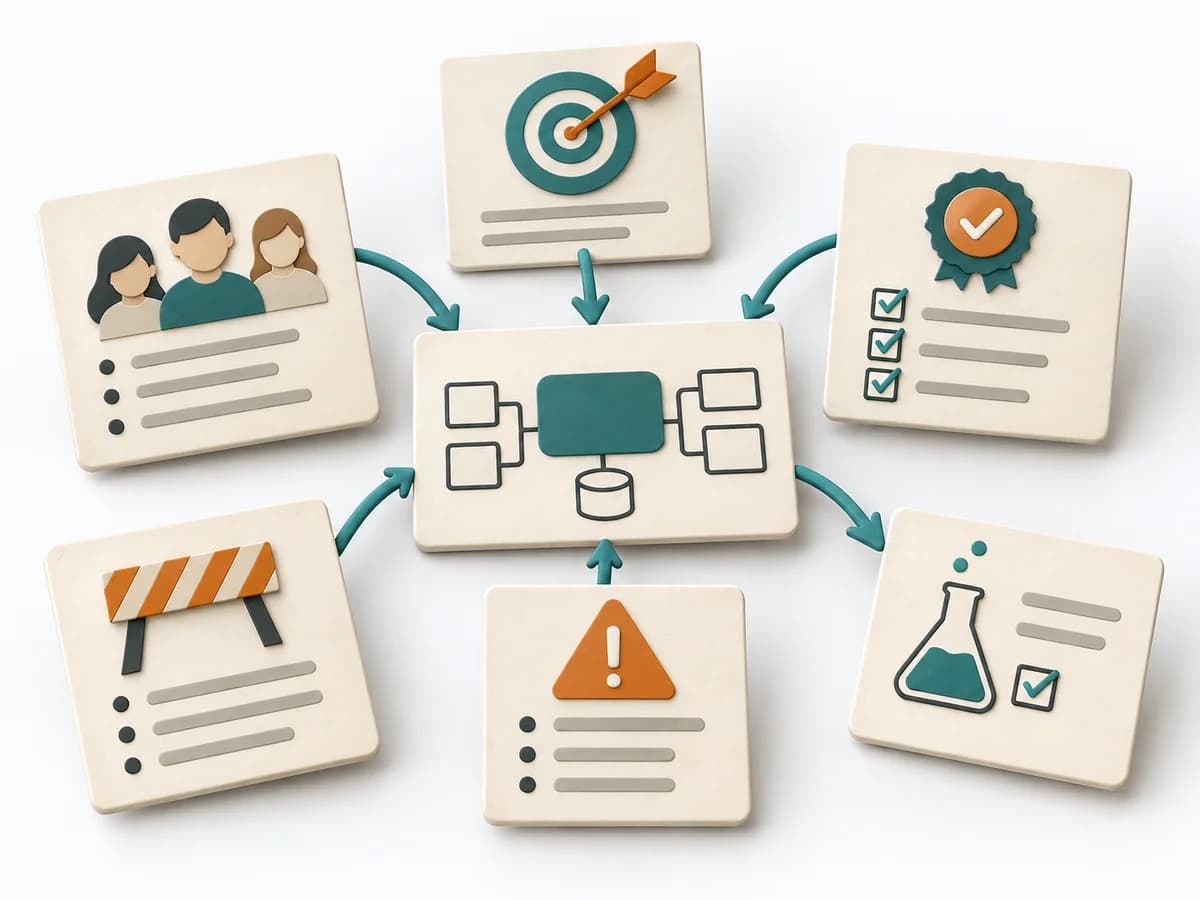
Bundles problem, goals, stakeholders, and risks into a starting picture that sorts early architecture questions.

Developers try a preliminary technical design through typical tasks, showing what makes it easy or difficult to use.

Gathers quality goals, prioritizes risks, and turns them into architecture topics evaluated together.
