Purpose
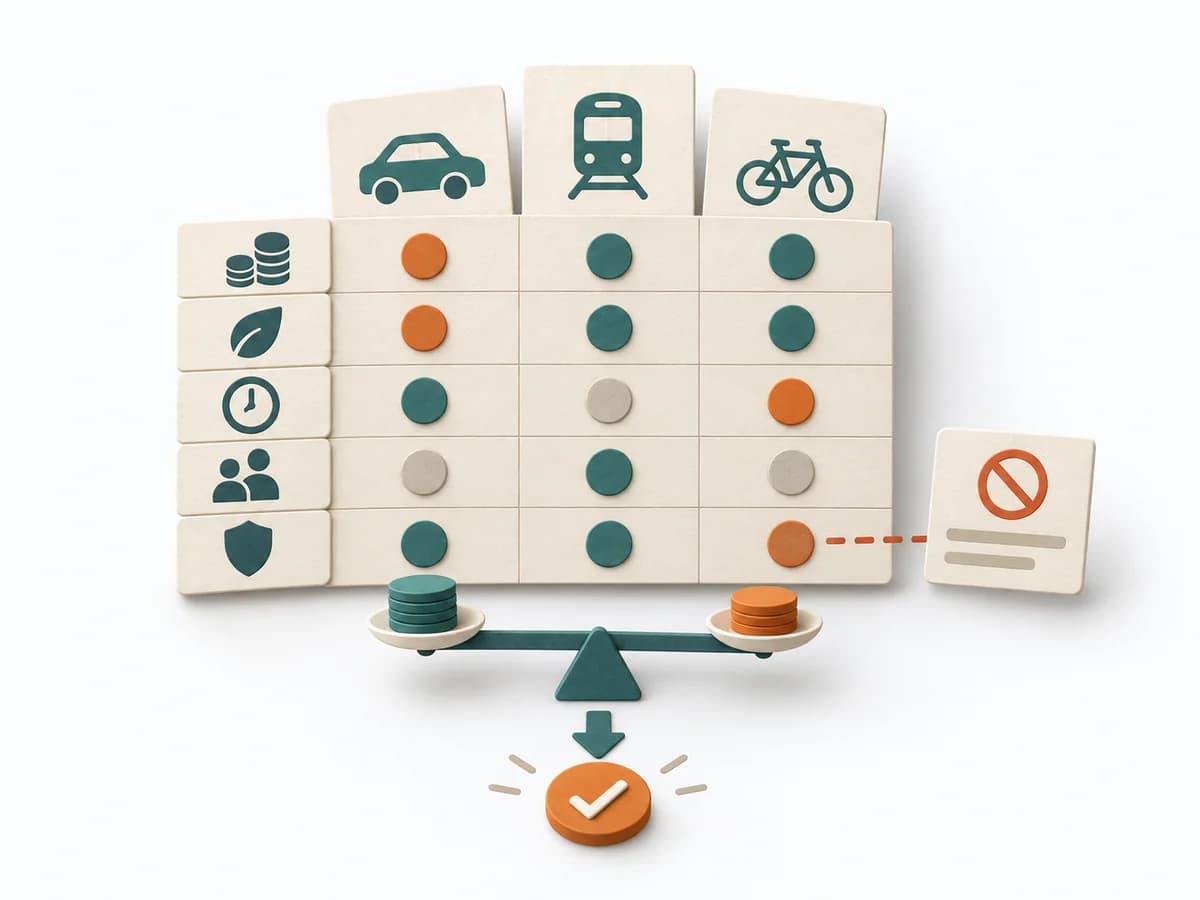
In early decisions, alternatives are often still vague, incomplete, or blended together. Option Framing brings every possibility into a comparable form and makes visible which variant actually fits the question.
Decision Making Decision method
Turns rough options into comparable descriptions with assumptions and consequences for a meaningful shortlist.
Jede Option wird so beschrieben, dass Annahmen, Konsequenzen und Vergleichbarkeit klar werden. Dadurch schrumpfen Rohideen zu prüfbaren Entscheidungsräumen statt zu losen Einfällen. Die Methode verbessert nicht nur Auswahl, sondern auch die Qualität dessen, was überhaupt als Option gilt.
Which genuinely distinct and feasible courses of action cover the decision space without mixing solutions, objectives, and assumptions?
The steps form one complete method run.
Frame
Phrase the decision as a choice with owner, timing, scope, and boundaries.
Objectives
Capture fundamental objectives and red lines without disguising solution features as objectives.
Options
Build status quo, discrete mechanisms, and useful hybrids from independent design dimensions.
Consequences
Describe expected effects, side effects, reversibility, and dependencies per option.
Gaps
Check duplicates, infeasible options, and information gaps; set next analysis step.
Add new evidence at review and version decisions with the prior state.
Bei frühen Entscheidungen sind Alternativen oft noch unscharf, unvollständig oder vermischt. Option Framing bringt jede Möglichkeit in eine vergleichbare Form und macht sichtbar, welche Variante wirklich zur Frage passt.
Option frame with status quo, discrete and hybrid options, mechanism, expected consequences, reversibility, and open evidence questions.
Fictional example
Fictional values show the actual method fields.
| Option | Mechanism | Required capability | Expected consequences | Reversibility | Tipping question |
|---|---|---|---|---|---|
| A · Status quoAdd evidence and rationale. | Unmanaged arrival | No new capability | p80 18–24 min; emergencies immediate | Fully | Is current variation seasonal? |
| B · Fixed slotsAdd evidence and rationale. | 30-minute windows smooth arrivals | Booking and slot discipline | p80 12–14 min; predictable load | Reversible pilot | Do workshops keep slots? |
| C · Dynamic slotsAdd evidence and rationale. | Forecast adjusts capacity continuously | Forecast and live inventory | p80 9–13 min; high flexibility | Partly reversible | Does forecast reach needed quality? |
| D · Slots plus bufferAdd evidence and rationale. | Fixed slots reserve 10% for emergencies | Release rule 60 min before | Predictability plus emergency access | Reversible pilot | How often is buffer unused? |
All values are fictional.
Set decision, owner, deadline, scope, and non-negotiable boundaries; defer evaluation until the option set is complete.
In early decisions, alternatives are often still vague, incomplete, or blended together. Option Framing brings every possibility into a comparable form and makes visible which variant actually fits the question.
Each option is described so that assumptions, consequences, and comparability become clear. This shrinks raw ideas into testable decision spaces instead of loose notions. The method improves not just selection but also the quality of what counts as an option in the first place.
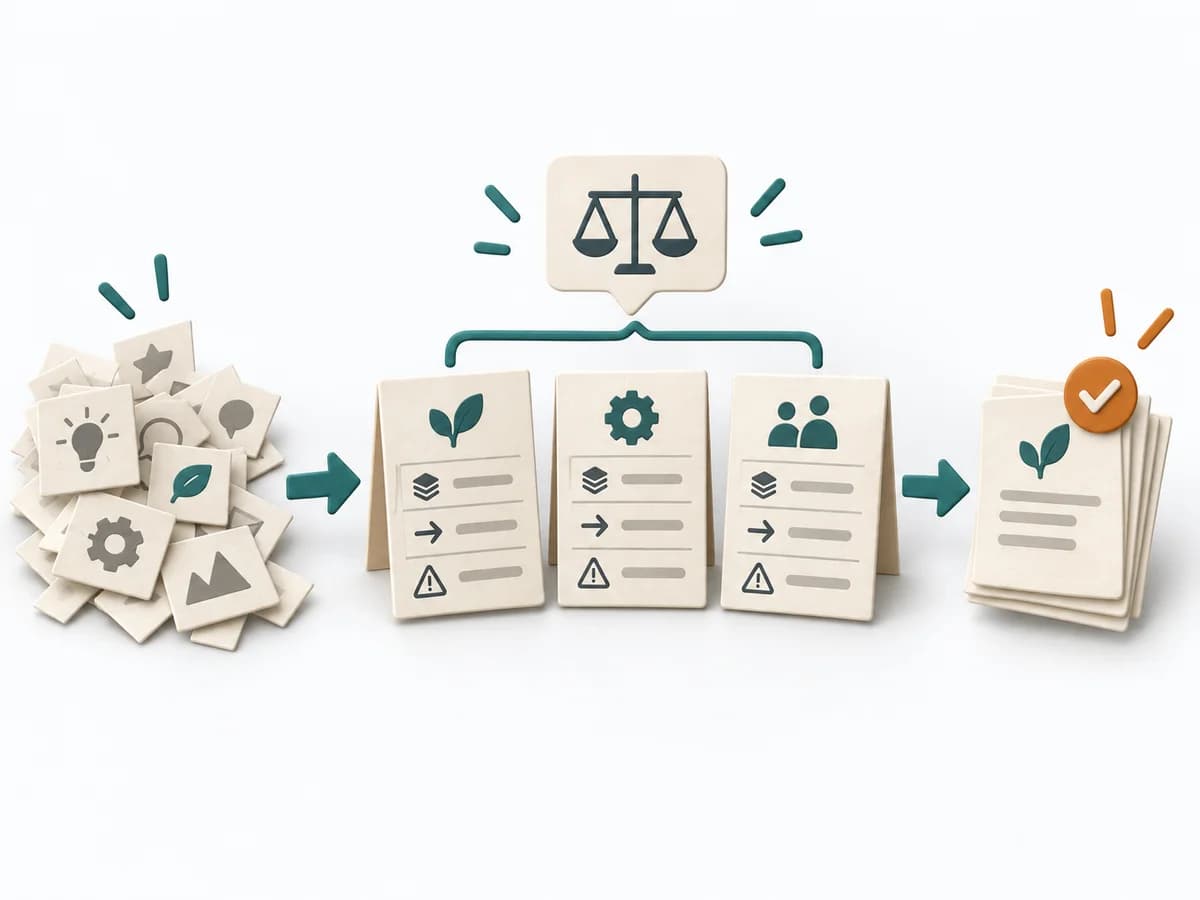
Option Framing sits between idea collection and decision. The method prevents immature ideas from being judged too early by translating each option into comparable parts. These include contribution to the goal, assumptions, effort, risks, dependencies, reversibility, and consequences. Only then are the options truly ready to be compared.
Use one consistent template for all options and give teams short timeboxes to work them out. Make sure options are not made unfairly attractive or unattractive through wording. End with a shortlist that can be carried into trade-off analysis or a decision matrix.
The method guide walks execution through 5 phases, timing, 5 pitfalls, and clear stop criteria.
Open method guideYour perspective
Your feedback helps shape the next improvements to methodatlas.
Set subject, evidence, roles, flow, and review.
To be confirmed
To be confirmed
Complete run Time: 75–120 minutes for one decision; evidence work and evaluation follow separately.
Complete this worksheet on paper or in your own document during the work.
| Option | Mechanism | Required capability | Expected consequences | Reversibility | Tipping question |
|---|---|---|---|---|---|
| A · Status quo | |||||
| B · Fixed slots | |||||
| C · Dynamic slots | |||||
| D · Slots plus buffer |
The blank worksheet contains prompts only.
Reference · original teaching example
Expected artifact: Choice frame
Phrase the decision as a choice with owner, timing, scope, and boundaries.
Entry:
...
Expected artifact: Objective view
Capture fundamental objectives and red lines without disguising solution features as objectives.
Entry:
...
Expected artifact: Option space
Build status quo, discrete mechanisms, and useful hybrids from independent design dimensions.
Entry:
...
Expected artifact: Option cards
Describe expected effects, side effects, reversibility, and dependencies per option.
Entry:
...
Expected artifact: Testable frame
Check duplicates, infeasible options, and information gaps; set next analysis step.
Entry:
...
...
Method guide: https://methodatlas.meierhoff-systems.de/en/methods/option-framing/run-sheet
Fitting alternatives with decision guidance, followed by other related methods.

Instead of Option Framing, choose RICE Scoring when you already have comparable options and need a concise scoring logic for priority.

Instead of Option Framing, choose Impact Filter when you want to pre-sort options by impact, effort, and strategic relevance.
Sharpens the decision question, options, criteria, and evidence needs down to the right decision format.

Draws decisions as branching paths so options, conditions, and consequences become clearer in comparison.

Clarifies options, criteria, and risks by framing the central question, recording the main claim, and marking weak spots.

Makes hard and soft boundaries visible and turns them into decision rules and option impact notes.