Purpose
When statements, evidence, and counterarguments get mixed up, a debate quickly loses its structure. Argument Mapping breaks a thesis down into its reasoning and makes visible what it really rests on.
Decision Making Mapping tool
Argument mapping shows which reasons support a claim, which objections weaken it, and what evidence is missing.
Argument mapping represents claims and their reasoning relationships. Reasons can support independently or only jointly; objections target a claim or its inference, while evidence supports specific premises.
Which reasons support the claim, which objections weaken it and what evidence is missing?

Claim
State a precise main claim with scope and clarify ambiguous terms.
Reasons
Capture reasons as individual statements and link each to the claim it supports.
Objections
Add strong objections to claims or inferences and attach rebuttals to their targets.
Judgement
Attach sources to specific premises; assess reliability and inference separately.
Reassess the affected premise and dependent conclusions when evidence changes; keep counterarguments visible.
For contested conclusions or decisions involving multiple reasons and objections.
Argument map with claim, reasons, joint premises, objections, rebuttals and source status.
The judgement is stated as supported, qualified, or open and includes assigned checks for missing evidence.
Fictional example
Argument mapping represents claims and their reasoning relationships. Reasons can support independently or only jointly; objections target a claim or its inference, while evidence supports specific premises.
Which precise claim are we assessing?
Fictional, C: we should first test course launch with a small pilot group.
Which premises support which statement independently or jointly?
P1: the flow contains untested steps. P2: early trials can reveal such failures before broad use. P1 AND P2 support C. P3: a pilot group is available, supporting feasibility of C.
Which claim or inference is attacked by which objection?
O1 attacks C: a pilot could jeopardise the launch date. O2 weakens P2: the pilot group might not cover important usage situations.
Which response addresses which specific objection?
R1 to O1: a two-day pilot fits the existing buffer if the team confirms capacity. O2 remains open.
Which source supports which premise and what assumptions remain open?
Fictional test plan E1 supports P1; schedule E2 supports P3. R1 lacks capacity confirmation. C remains conditionally recommended; investigate representative scenarios for O2.
All example details are fictional and illustrate the application.
Collect one clear main claim and relevant statements with sources; define terms and scope.
When statements, evidence, and counterarguments get mixed up, a debate quickly loses its structure. Argument Mapping breaks a thesis down into its reasoning and makes visible what it really rests on.
Claims are linked hierarchically with support, objections, and evidence. This reveals which parts hold together logically and where the evidence is thin or merely asserted. The method sharpens not volume but argumentative soundness.
Argument Mapping separates claims, reasons, evidence, and objections, making the reasoning testable as a result. Weak transitions, unsupported premises, and genuine counterarguments are meant to stay recognizable. The diagram pays off when discussions shift from social pressure to traceable argument quality.
Lay out the main thesis, counterclaims, and available evidence on a shared surface before wrestling over conclusions. The work becomes fruitful when the quality of support and objections becomes visible and rhetoric loses weight. Close with the strongest supporting argument, the weakest points, and the need for further evidence.
The method guide walks execution through 4 phases, timing, 4 pitfalls, and clear stop criteria.
Open method guideYour perspective
Your feedback helps shape the next improvements to methodatlas.
Collect one clear main claim and relevant statements with sources; define terms and scope.
To be confirmed
To be confirmed
Complete cycle Time: 45–90 minutes initial mapping; evidence checking separately
Complete this worksheet on paper or in your own document during the work.
Which precise claim are we assessing?
...
Which premises support which statement independently or jointly?
...
Which claim or inference is attacked by which objection?
...
Which response addresses which specific objection?
...
Which source supports which premise and what assumptions remain open?
...
Answer the prompts with your own information. Explicitly mark unknowns and assumptions.
ReasoningLab: Argument Mapping
Expected artifact: Main claim
Can the claim meaningfully be challenged or supported?
Entry:
...
Expected artifact: Reasoning structure
Is it clear which reasons work only jointly?
Entry:
...
Expected artifact: Objections and rebuttals
Does the objection address the actual claim?
Entry:
...
Expected artifact: Reasoned judgement
Are source quality and inference checked separately?
Entry:
...
...
Method guide: https://methodatlas.meierhoff-systems.de/en/methods/argument-mapping/run-sheet
Fitting alternatives with decision guidance, followed by other related methods.

Instead of Argument Mapping, when you want to structurally link arguments and reasons for decisions.

Draws decisions as branching paths so options, conditions, and consequences become clearer in comparison.
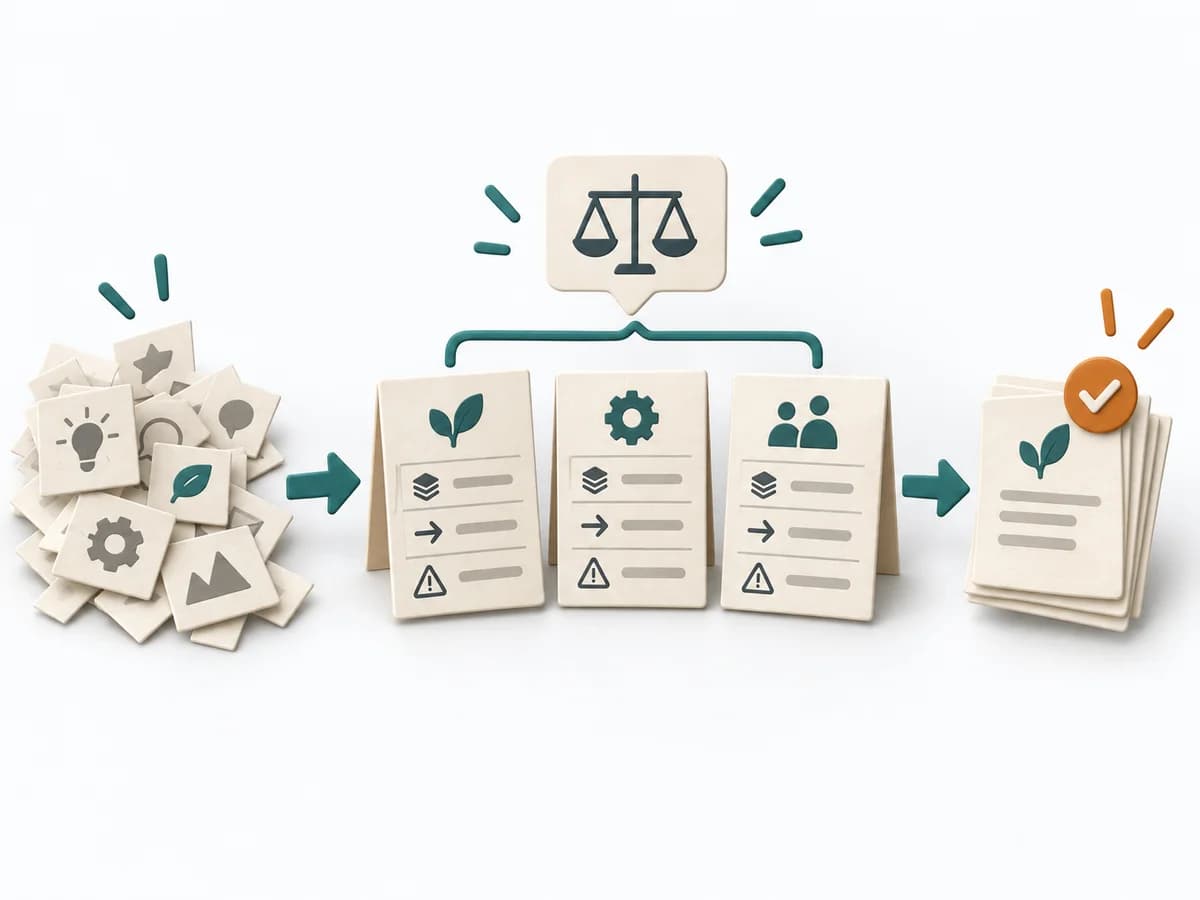
Shapes raw options into comparable descriptions with assumptions and consequences for a real shortlist.

Examines an initiative from an opposing perspective, collects weaknesses, and derives prioritized mitigations.

Arranges decision responsibility across five roles and makes recommendation, input, and follow-up unambiguous.

Sorts cases into the fitting domain and derives actions that match the degree of clarity or complexity.