Decision Framing Workshop: Worksheet
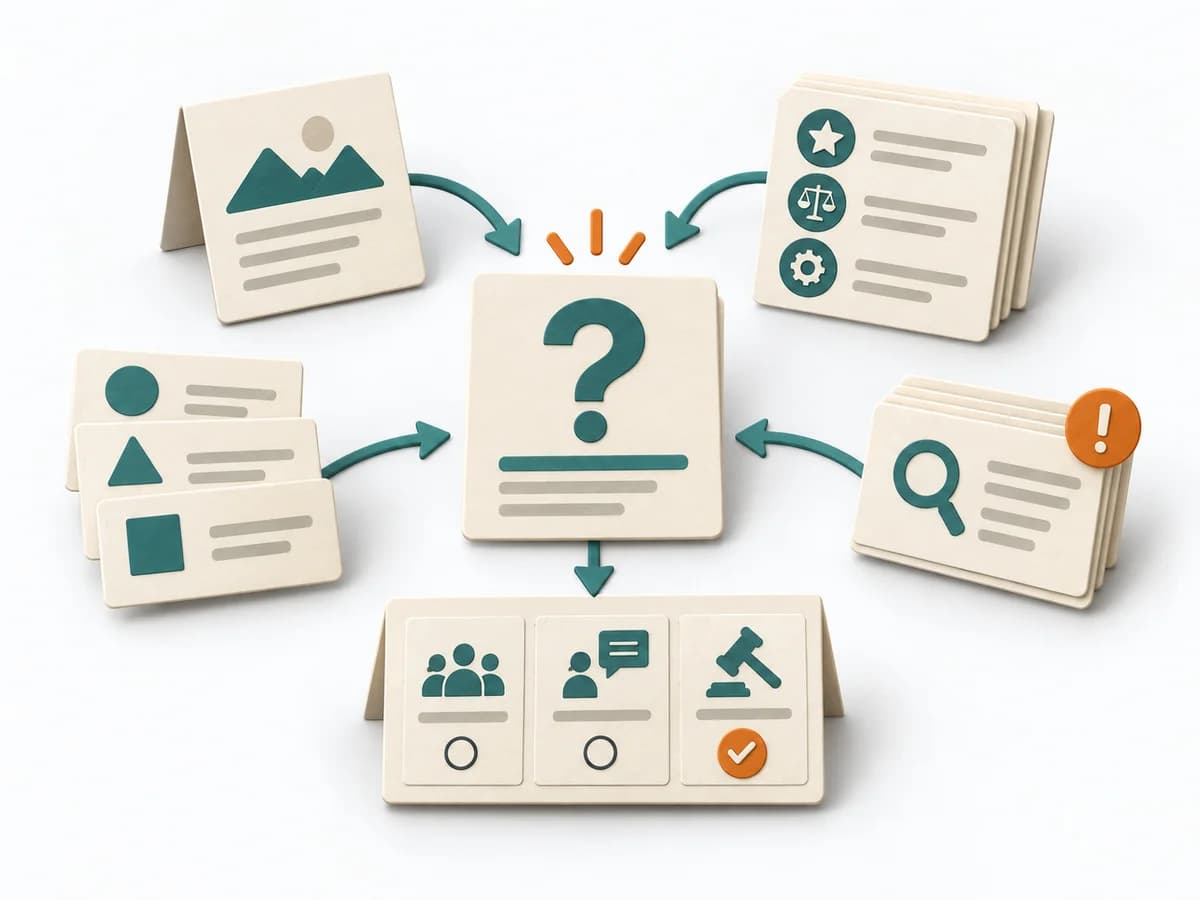
Set subject, evidence, roles, flow, and review.
# Decision Framing Workshop: Worksheet

## Question
To be confirmed

## Desired outcome
To be confirmed

## Scope
Complete run
Time: 120–180 minutes plus pre-interviews where scope is contested.

Complete this worksheet on paper or in your own document during the work.

## Preparation for this scope

### Method setup
- **Materials:** Decision mandate, stakeholder and scope map, objectives, alternatives, uncertainties, evidence sources, and decision log
- **Roles:** Decision owner · key stakeholders · domain/data experts · facilitator · scribe
- **Advance information:** Clarify mandate and decision owner; interview stakeholders about the decision, boundaries, interests, and contested assumptions.
- **Overall time needed:** 120–180 minutes plus pre-interviews where scope is contested.
- **Setup:** Prepare a workspace with Decision · Scope · Objectives · Options · Evidence; separate example from live data.

### Prepare for the work steps

#### Decision: Decision statement
- Clarify mandate and decision owner; interview stakeholders about the decision, boundaries, interests, and contested assumptions.
- Decision mandate, stakeholder and scope map, objectives, alternatives, uncertainties, evidence sources, and decision log

#### Scope: Scope map
- Decision statement

#### Objectives: Objective hierarchy
- Scope map

#### Options: Alternative space
- Objective hierarchy

#### Evidence: Evidence plan
- Alternative space


## Decision Framing Workshop · working structure

| Frame field | Working question | Fictional content | Owner/source | Status |
| --- | --- | --- | --- | --- |
| Decision |   |   |   |   |
| Scope |   |   |   |   |
| Objectives |   |   |   |   |
| Alternatives |   |   |   |   |
| Uncertainty |   |   |   |   |

- **Decision:** Add evidence and rationale.
- **Scope:** Add evidence and rationale.
- **Objectives:** Add evidence and rationale.
- **Alternatives:** Add evidence and rationale.
- **Uncertainty:** Add evidence and rationale.

The blank worksheet contains prompts only.

[Reference · original teaching example](https://www.sdg.org/en/decision-quality)


## Decision: Decision statement
Expected artifact: Decision statement

Clarify decision owner, choice statement, date, and downstream decision it enables.

Entry:

...

- [ ] Does the statement contain a concrete choice and empowered owner?

## Scope: Scope map
Expected artifact: Scope map

Mark in/out, horizon, affected groups, fixed boundaries, and interfaces.

Entry:

...

- [ ] Are contested boundaries visible as decisions or assumptions?

## Objectives: Objective hierarchy
Expected artifact: Objective hierarchy

Derive fundamental objectives, measures, and red lines from stakeholder perspectives.

Entry:

...

- [ ] Are objectives independent of preferred solutions and free of double counting?

## Options: Alternative space
Expected artifact: Alternative space

Phrase status quo and distinct feasible alternatives at the right decision level.

Entry:

...

- [ ] Are at least two real actions and status quo comparable?

## Evidence: Evidence plan
Expected artifact: Evidence plan

Set key uncertainties, tipping values, sources, owners, and decision process; approve frame.

Entry:

...

- [ ] Is it clear which uncertainty can change the choice and who resolves it by when?

## Open questions and next steps

...

Method guide: https://methodatlas.meierhoff-systems.de/en/methods/decision-framing-workshop/run-sheet
Option Framing: Worksheet
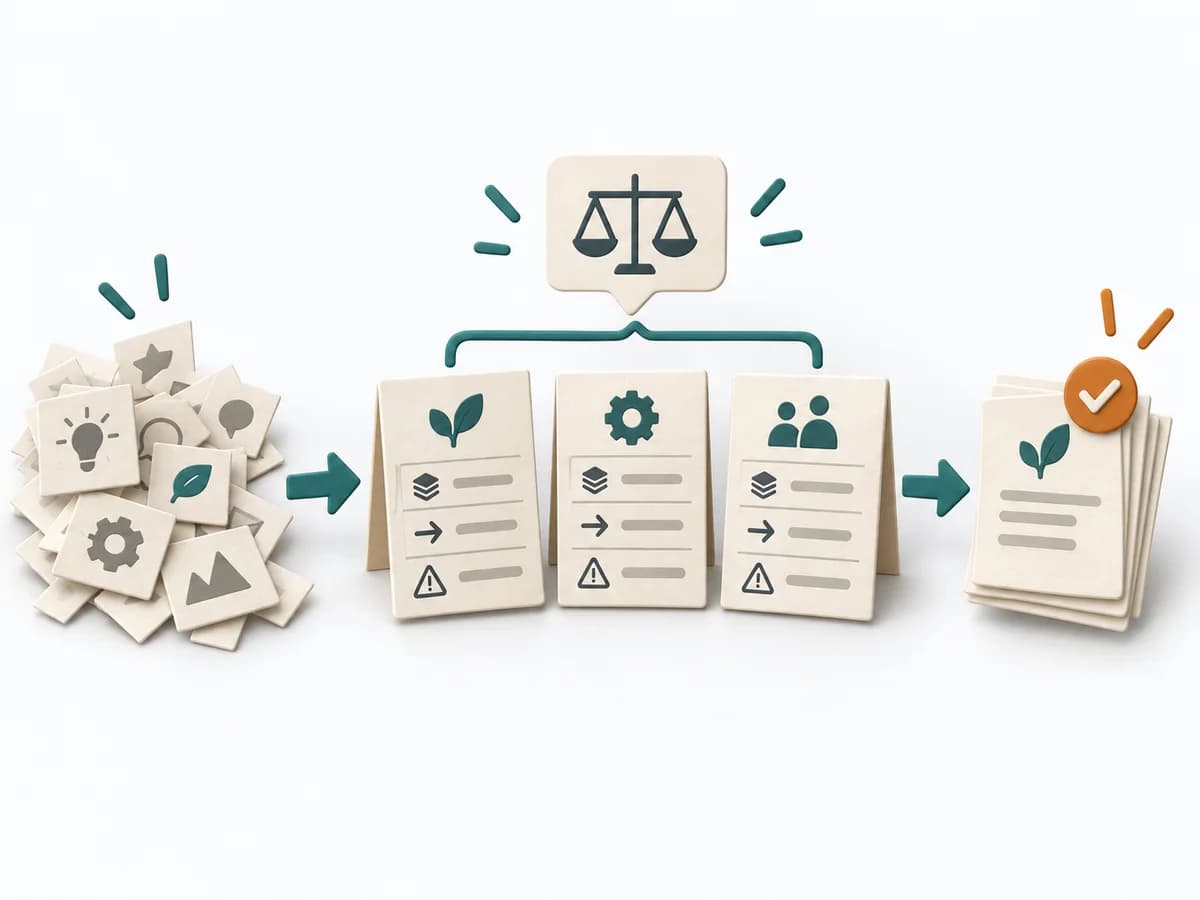
Set subject, evidence, roles, flow, and review.
# Option Framing: Worksheet

## Question
To be confirmed

## Desired outcome
To be confirmed

## Scope
Complete run
Time: 75–120 minutes for one decision; evidence work and evaluation follow separately.

Complete this worksheet on paper or in your own document during the work.

## Preparation for this scope

### Method setup
- **Materials:** Decision statement, objectives and boundaries, status quo, option cards, consequence hypotheses, and assumption log
- **Roles:** Decision owner · affected stakeholders · domain perspectives · facilitator
- **Advance information:** Set decision, owner, deadline, scope, and non-negotiable boundaries; defer evaluation until the option set is complete.
- **Overall time needed:** 75–120 minutes for one decision; evidence work and evaluation follow separately.
- **Setup:** Prepare a workspace with Frame · Objectives · Options · Consequences · Gaps; separate example from live data.

### Prepare for the work steps

#### Frame: Choice frame
- Set decision, owner, deadline, scope, and non-negotiable boundaries; defer evaluation until the option set is complete.
- Decision statement, objectives and boundaries, status quo, option cards, consequence hypotheses, and assumption log

#### Objectives: Objective view
- Choice frame

#### Options: Option space
- Objective view

#### Consequences: Option cards
- Option space

#### Gaps: Testable frame
- Option cards


## Option Framing · working structure

| Option | Mechanism | Required capability | Expected consequences | Reversibility | Tipping question |
| --- | --- | --- | --- | --- | --- |
| A · Status quo |   |   |   |   |   |
| B · Fixed slots |   |   |   |   |   |
| C · Dynamic slots |   |   |   |   |   |
| D · Slots plus buffer |   |   |   |   |   |

- **A · Status quo:** Add evidence and rationale.
- **B · Fixed slots:** Add evidence and rationale.
- **C · Dynamic slots:** Add evidence and rationale.
- **D · Slots plus buffer:** Add evidence and rationale.

The blank worksheet contains prompts only.

[Reference · original teaching example](https://www.sdg.org/en/decision-quality)


## Frame: Choice frame
Expected artifact: Choice frame

Phrase the decision as a choice with owner, timing, scope, and boundaries.

Entry:

...

- [ ] Can the owner choose among named actions by a date?

## Objectives: Objective view
Expected artifact: Objective view

Capture fundamental objectives and red lines without disguising solution features as objectives.

Entry:

...

- [ ] Does each objective state a desired consequence for affected people?

## Options: Option space
Expected artifact: Option space

Build status quo, discrete mechanisms, and useful hybrids from independent design dimensions.

Entry:

...

- [ ] Do options differ in mechanism and remain feasible?

## Consequences: Option cards
Expected artifact: Option cards

Describe expected effects, side effects, reversibility, and dependencies per option.

Entry:

...

- [ ] Are effects causally tied to the mechanism and marked as hypotheses?

## Gaps: Testable frame
Expected artifact: Testable frame

Check duplicates, infeasible options, and information gaps; set next analysis step.

Entry:

...

- [ ] Does a real choice with clear evidence questions remain?

## Open questions and next steps

...

Method guide: https://methodatlas.meierhoff-systems.de/en/methods/option-framing/run-sheet
Trade-off Matrix
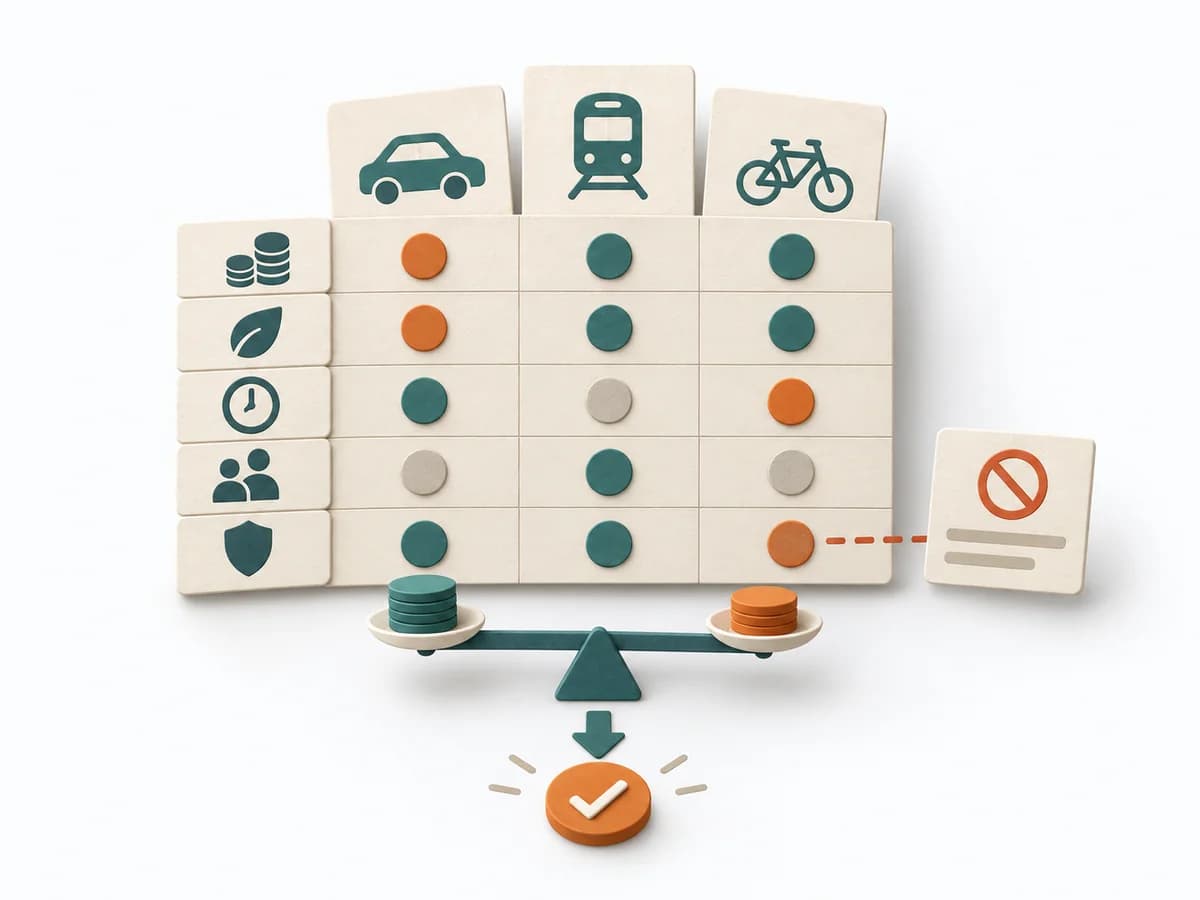
Markdown matrix for comparing options across competing criteria and accepted trade-offs.
# Trade-off Matrix: Decision

| Criterion | Weight | Option A | Option B | Option C |
|---|---:|---|---|---|
| Benefit | 30 | | | |
| Cost | 20 | | | |
| Risk | 20 | | | |
| Time-to-Learn | 15 | | | |
| Reversibility | 15 | | | |

## Accepted trade-offs

- Option A accepts:
- Option B accepts:
- Option C accepts:

## Recommendation

Which option is recommended and why?

## Sensitivity

Which small change in weighting or assumption would flip the recommendation?
Architecture Decision Record: Worksheet
Plan work on an ADR from context through trade-offs to the agreed review.
# Architecture Decision Record: Worksheet

## Question
To be confirmed

## Desired outcome
To be confirmed

## Scope
Prepare and review an ADR
Time: Arrange drafting and review separately

Complete this worksheet on paper or in your own document during the work.

## Preparation for this scope

### Method setup
- **Materials:** A short text template, relevant architecture context, sources for considered options and a versioned location accessible to contributors.
- **Roles:** An owner writes the draft. Relevant engineering, architecture, product or operations contributors review its consequences. The agreed decision owner explicitly accepts the decision.
- **Advance information:** Gather the question, current architecture, affected quality requirements and known constraints. Link relevant earlier ADRs and sources.
- **Overall time needed:** Allow roughly 15 to 45 minutes for a focused draft. Investigation, discussion and review are additional and may be asynchronous. Agree on a suitable review point together.
- **Setup:** Assign a stable ID and short title, set status to proposed and create the record in the shared location. Agree on the decision and review process with contributors.

### Prepare for the work steps

#### Frame: Clarify decision and context
- Architecture question and current system context

#### Compare: Compare relevant options
- Decision context and realistic options

#### Decide: Review and record the decision
- Draft, trade-offs and affected perspectives

#### Maintain: Follow consequences and preserve history
- ADR with explicit status and follow-up tasks


## ADR structure

### ID, title and status
Record a stable ID, decision question, date, contributors, owner and current status.

...

### Context and decision drivers
Why is this decision needed? Which requirements and constraints shape it?

...

### Considered options
Briefly compare relevant options, decisive differences, sources and uncertainties.

...

### Decision and rationale
Record the chosen option and its decisive rationale. Label a draft as a proposal.

...

### Consequences and follow-up
Describe relevant favorable and unfavorable consequences, uncertainties and concrete follow-up work.

...

### Review, status changes and links
Document review, explicit decision and date. Link sources and any predecessor or successor.

...

Begin with proposed status. Record acceptance explicitly. Link a changed decision as a new ADR and preserve its original rationale.

[Based on Michael Nygard, with options and review added](https://cognitect.com/blog/2011/11/15/documenting-architecture-decisions)


## Frame: Clarify decision and context
Expected artifact: Decision context

Question · significance · constraints · ownership

Entry:

...

- [ ] Can a future reader understand the starting point?

## Compare: Compare relevant options
Expected artifact: Traceable trade-offs

Option · relevant impact · uncertainty · source

Entry:

...

- [ ] Are realistic options evaluated against the same context?

## Decide: Review and record the decision
Expected artifact: ADR with an explicit status

Choice · rationale · consequences · status · date

Entry:

...

- [ ] Is the decision explicitly confirmed and recorded?
- [ ] Are relevant consequences and open tasks understandable?

## Maintain: Follow consequences and preserve history
Expected artifact: Linked decision history

Follow-up · trigger · predecessor · successor

Entry:

...

- [ ] Can the earlier rationale and current status be found?

## Open questions and next steps

...

Method guide: https://methodatlas.meierhoff-systems.de/en/methods/adr/run-sheet