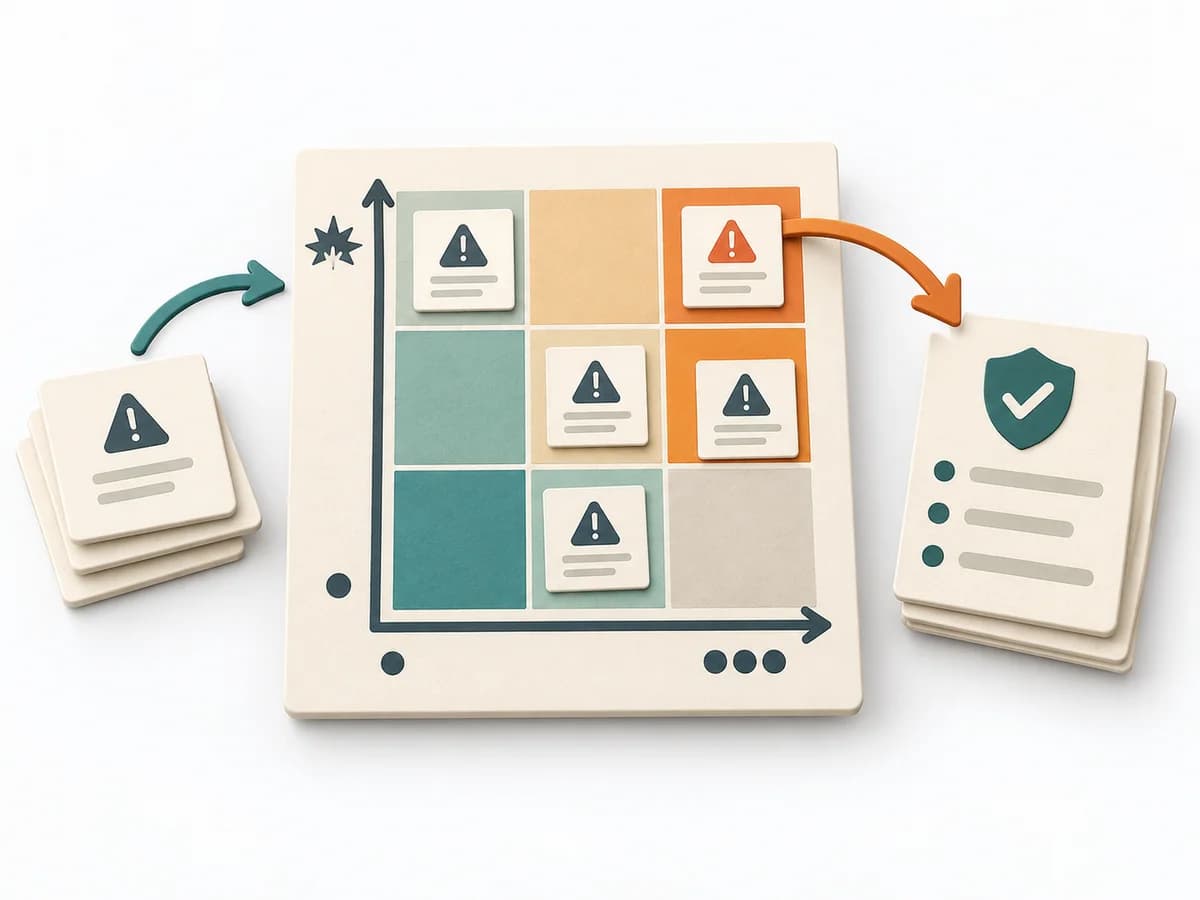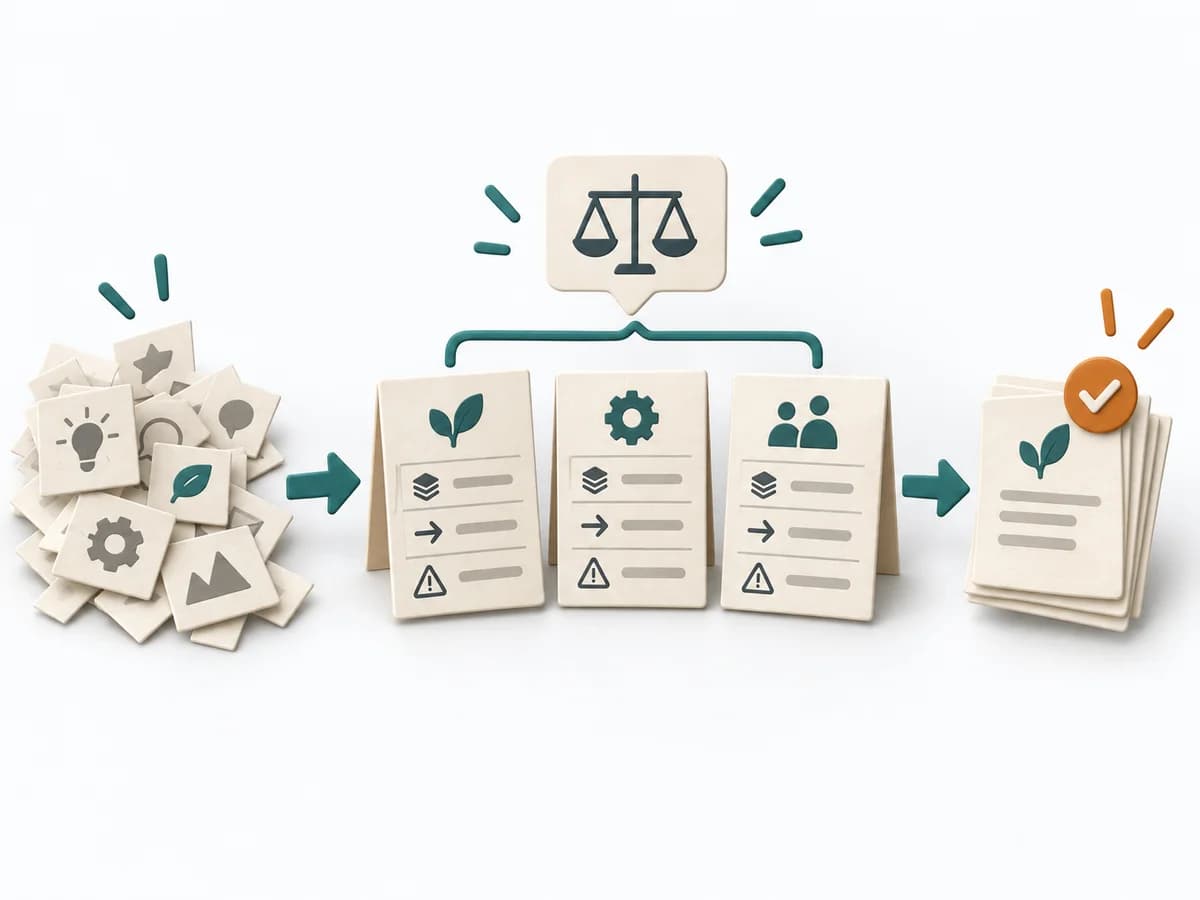

Purpose
With limited resources, quality, speed, cost, and risk almost always compete with each other. Trade-off Analysis makes these tensions explicit and prevents decisions from producing hidden side effects.
Decision Making Decision method
Compares options with criteria and accepted disadvantages so decisions remain transparently justifiable.
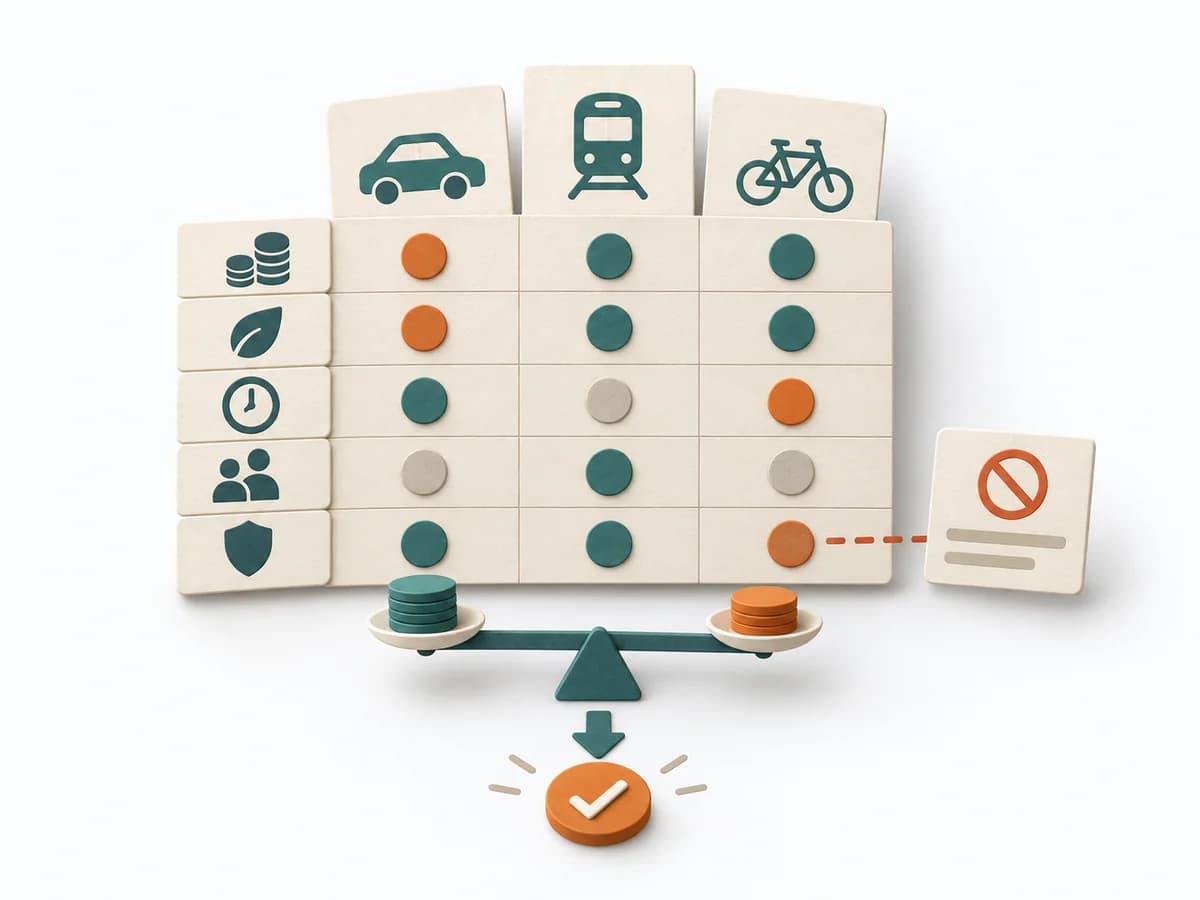
Options are compared across competing criteria instead of being optimised in isolation. The comparison makes accepted compromises and red lines explicit. It creates a clear decision space.
Which alternative offers the best justified value across conflicting objectives, and under which assumptions does the choice change?
The steps form one complete method run.
Frame
Define decision, owner, scope, horizon, and alternatives including status quo.
Objectives
Separate fundamental objectives from means and avoid double counting.
Consequences
Set scales and evidence; assess each alternative on every objective with uncertainty.
Trade-offs
Remove dominated options and negotiate relevant conflicts; use weights only with rationale.
Robustness
Test sensitivity to uncertain values, weights, and scenarios; document choice and review.
Add new evidence at review and version decisions with the prior state.
Bei begrenzten Ressourcen konkurrieren Qualität, Geschwindigkeit, Kosten und Risiko fast immer miteinander. Trade-off Analysis macht diese Gegensätze explizit und verhindert, dass Entscheidungen verdeckte Nebenwirkungen produzieren.
Consequence and trade-off matrix with objective hierarchy, scales, evidence, dominance, sensitivity, and rationale.
Fictional example
Fictional values show the actual method fields.
| Alternative | p80 wait | Predictability | Emergency access | Implementation effort | Uncertainty |
|---|---|---|---|---|---|
| A · Status quoAdd evidence and rationale. | 18–24 minutes | Low | Immediate but unmanaged | 0 PT | Load variation ±6 minutes |
| B · Fixed slotsAdd evidence and rationale. | 12–14 minutes | High | Medium; reserve window | 20 PT | Four-Saturday pilot |
| C · Dynamic slotsAdd evidence and rationale. | 9–13 minutes | Medium to high | High | 55 PT | Forecast quality unclear |
All values are fictional.
Set decision, owner, horizon, boundaries, and real choices; include status quo.
With limited resources, quality, speed, cost, and risk almost always compete with each other. Trade-off Analysis makes these tensions explicit and prevents decisions from producing hidden side effects.
Options are set against each other along competing criteria rather than optimized individually. The comparison makes clear which compromises are accepted and where the red lines lie. This produces a clear decision space instead of a wish list.
Trade-off Analysis makes visible that one option is rarely better in every dimension. The method opens up criteria such as value, risk, cost, speed, quality, or reversibility. Then it shows which option strengthens which target and which one it weakens. That turns the decision into a conscious compromise instead of a gut feeling.
Clarify the decision, the options, and the must-have criteria before scoring. Avoid false precision from numbers that look exact but are not. Record explicitly which downsides the chosen option accepts on purpose.
The method guide walks execution through 5 phases, timing, 5 pitfalls, and clear stop criteria.
Open method guideYour perspective
Your feedback helps shape the next improvements to methodatlas.
Markdown matrix for comparing options across competing criteria and accepted trade-offs.
| Criterion | Weight | Option A | Option B | Option C |
|---|---|---|---|---|
| Benefit | 30 | |||
| Cost | 20 | |||
| Risk | 20 | |||
| Time-to-Learn | 15 | |||
| Reversibility | 15 |
Which option is recommended and why?
Which small change in weighting or assumption would flip the recommendation?
Set subject, evidence, roles, flow, and review.
To be confirmed
To be confirmed
Complete run Time: 90–180 minutes for 3–6 alternatives; evidence work beforehand.
Complete this worksheet on paper or in your own document during the work.
| Alternative | p80 wait | Predictability | Emergency access | Implementation effort | Uncertainty |
|---|---|---|---|---|---|
| A · Status quo | |||||
| B · Fixed slots | |||||
| C · Dynamic slots |
The blank worksheet contains prompts only.
Reference · original teaching example
Expected artifact: Decision frame
Define decision, owner, scope, horizon, and alternatives including status quo.
Entry:
...
Expected artifact: Objective hierarchy
Separate fundamental objectives from means and avoid double counting.
Entry:
...
Expected artifact: Consequence matrix
Set scales and evidence; assess each alternative on every objective with uncertainty.
Entry:
...
Expected artifact: Trade-off view
Remove dominated options and negotiate relevant conflicts; use weights only with rationale.
Entry:
...
Expected artifact: Robust decision
Test sensitivity to uncertain values, weights, and scenarios; document choice and review.
Entry:
...
...
Method guide: https://methodatlas.meierhoff-systems.de/en/methods/trade-off-analysis/run-sheet
Fitting alternatives with decision guidance, followed by other related methods.
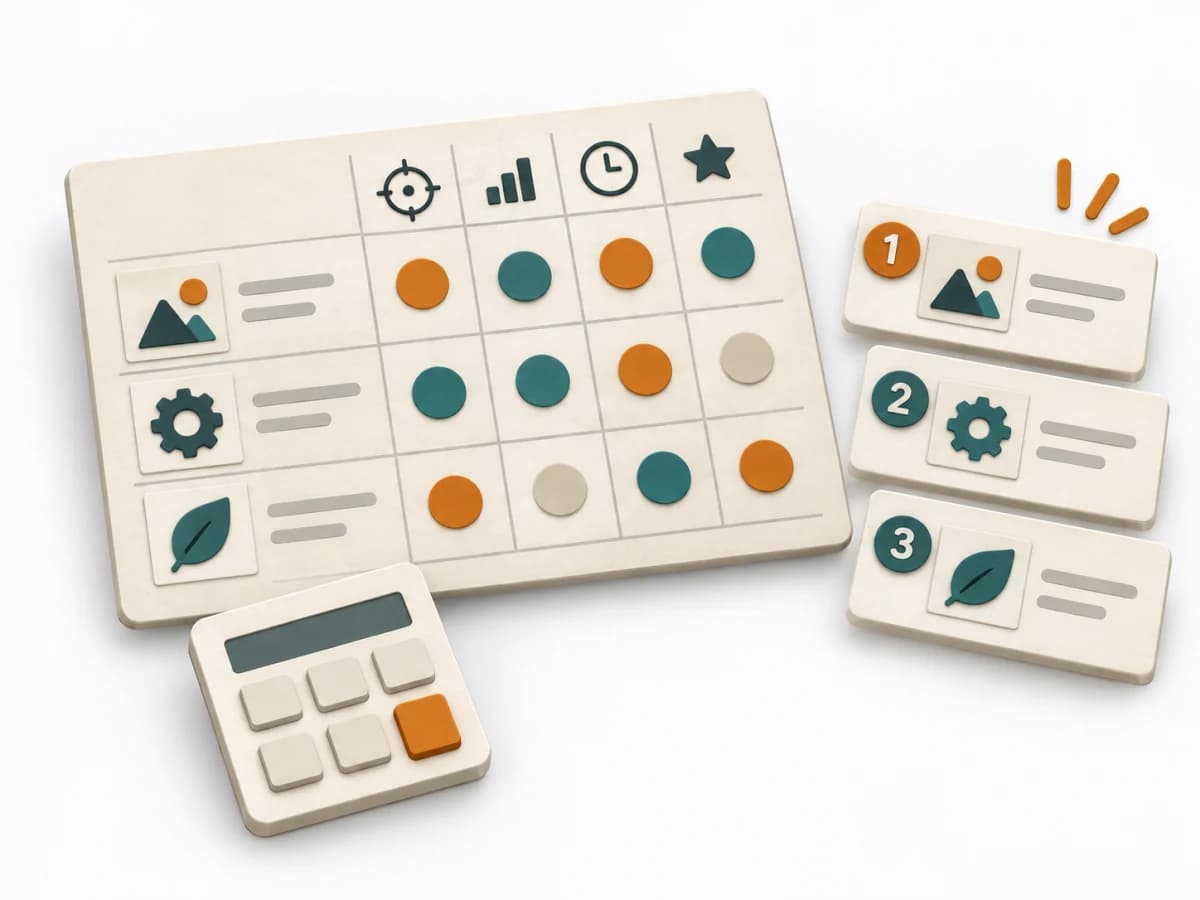
Instead of Trade-off Analysis, choose RICE Scoring when you want to align product impact, benefit, and priority along a clear target picture.

Instead of Trade-off Analysis, choose WSJF when you want to balance priorities through cost of delay and job size.

Draws decisions as branching paths so options, conditions, and consequences become clearer in comparison.
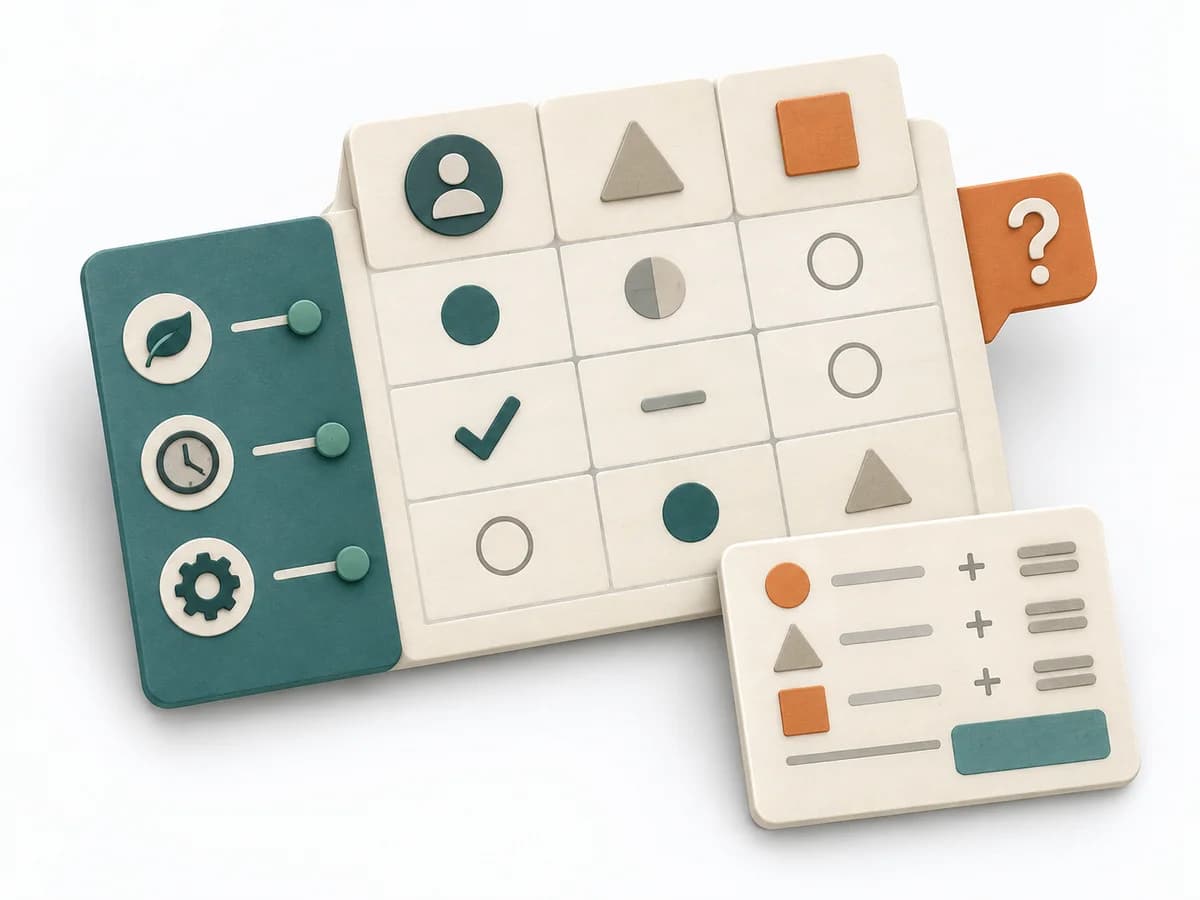
Weighs options against criteria so comparison, scoring rationale, and selection are documented traceably.

Clarifies options, criteria, and risks by framing the central question, recording the main claim, and marking weak spots.

Sharpens the decision question, options, criteria, and evidence needs down to the right decision format.