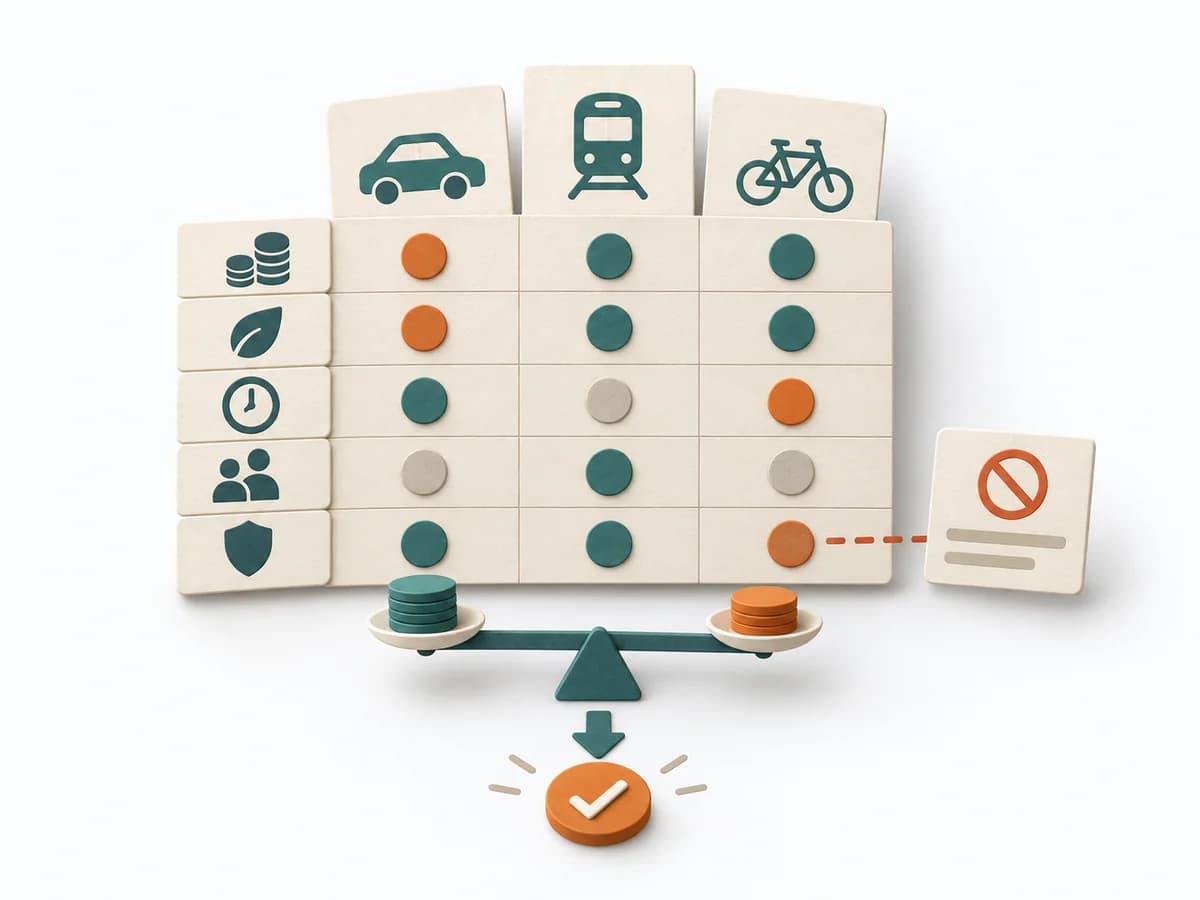
Complete firstClear boundary
Set decision, owner, deadline, scope, and non-negotiable boundaries; defer evaluation until the option set is complete.
Without a boundary, cases, periods, or variables become mixed.
A practical method guide: clarify prerequisites and materials, understand the complete process, and look up outputs, pitfalls, and stop criteria.
What needs to be finished first
Set decision, owner, deadline, scope, and non-negotiable boundaries; defer evaluation until the option set is complete.
Decision statement, objectives and boundaries, status quo, option cards, consequence hypotheses, and assumption log
What needs to be ready before start
Decision statement, objectives and boundaries, status quo, option cards, consequence hypotheses, and assumption log
Decision owner · affected stakeholders · domain perspectives · facilitator
Set decision, owner, deadline, scope, and non-negotiable boundaries; defer evaluation until the option set is complete.
75–120 minutes for one decision; evidence work and evaluation follow separately.
Prepare a workspace with Frame · Objectives · Options · Consequences · Gaps; separate example from live data.
The one question this method answers
Which genuinely distinct and feasible courses of action cover the decision space without mixing solutions, objectives, and assumptions?
Phases with goal, actions, output and pitfall
Jede Option wird so beschrieben, dass Annahmen, Konsequenzen und Vergleichbarkeit klar werden. Dadurch schrumpfen Rohideen zu prüfbaren Entscheidungsräumen statt zu losen Einfällen. Die Methode verbessert nicht nur Auswahl, sondern auch die Qualität dessen, was überhaupt als Option gilt.
Fictional example
Fictional values show the actual method fields.
| Option | Mechanism | Required capability | Expected consequences | Reversibility | Tipping question |
|---|---|---|---|---|---|
| A · Status quoAdd evidence and rationale. | Unmanaged arrival | No new capability | p80 18–24 min; emergencies immediate | Fully | Is current variation seasonal? |
| B · Fixed slotsAdd evidence and rationale. | 30-minute windows smooth arrivals | Booking and slot discipline | p80 12–14 min; predictable load | Reversible pilot | Do workshops keep slots? |
| C · Dynamic slotsAdd evidence and rationale. | Forecast adjusts capacity continuously | Forecast and live inventory | p80 9–13 min; high flexibility | Partly reversible | Does forecast reach needed quality? |
| D · Slots plus bufferAdd evidence and rationale. | Fixed slots reserve 10% for emergencies | Release rule 60 min before | Predictability plus emergency access | Reversible pilot | How often is buffer unused? |
All values are fictional.
Frame
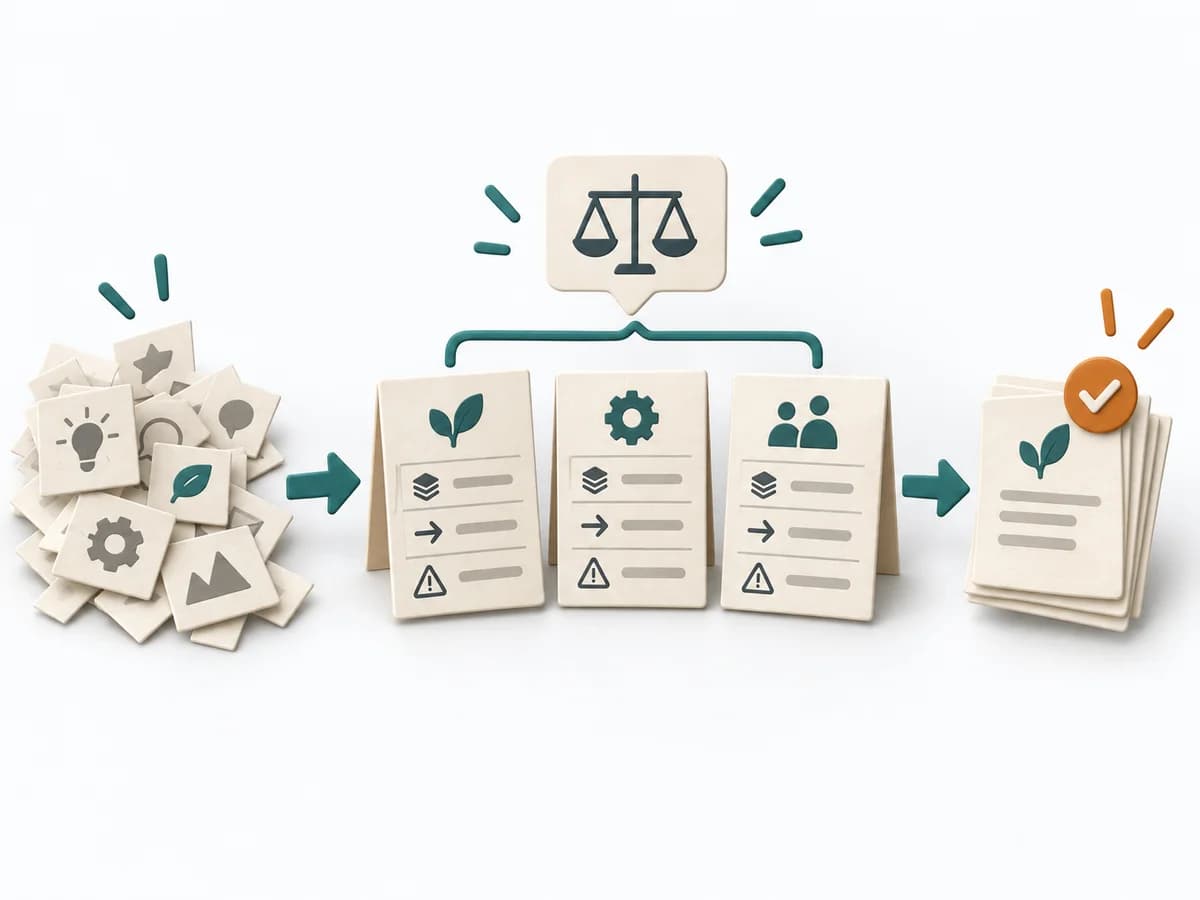
Goal
Choice frame: Phrase the decision as a choice with owner, timing, scope, and boundaries.
Inputs for this step
Actions
Output
Choice frame
Phrase the decision as a choice with owner, timing, scope, and boundaries.
Quality check
Can the owner choose among named actions by a date?
Pitfall
A problem statement replaces the pending choice. Close the sentence as who decides what actions by when.
Timing: 15–20 minutes
Objectives
Goal
Objective view: Capture fundamental objectives and red lines without disguising solution features as objectives.
Inputs for this step
Actions
Output
Objective view
Capture fundamental objectives and red lines without disguising solution features as objectives.
Quality check
Does each objective state a desired consequence for affected people?
Pitfall
Automation is listed as an objective. Ask for the desired value behind each proposed objective.
Timing: 15–20 minutes
Options
Goal
Option space: Build status quo, discrete mechanisms, and useful hybrids from independent design dimensions.
Inputs for this step
Actions
Output
Option space
Build status quo, discrete mechanisms, and useful hybrids from independent design dimensions.
Quality check
Do options differ in mechanism and remain feasible?
Pitfall
The same solution appears under different wording. State mechanism, required capability, and distinction for every option.
Timing: 20–30 minutes
Consequences
Goal
Option cards: Describe expected effects, side effects, reversibility, and dependencies per option.
Inputs for this step
Actions
Output
Option cards
Describe expected effects, side effects, reversibility, and dependencies per option.
Quality check
Are effects causally tied to the mechanism and marked as hypotheses?
Pitfall
Options contain names and benefits only. Add mechanism → consequence → evidence question for each option.
Timing: 15–25 minutes
Gaps
Goal
Testable frame: Check duplicates, infeasible options, and information gaps; set next analysis step.
Inputs for this step
Actions
Output
Testable frame
Check duplicates, infeasible options, and information gaps; set next analysis step.
Quality check
Does a real choice with clear evidence questions remain?
Pitfall
A favourite is selected before consequences are evidenced. Defer choice, prioritise tipping questions, and name evidence owners.
Timing: 10–20 minutes
What comes out at the end
Sketch: what the artifact looks like
Option frame with status quo, discrete and hybrid options, mechanism, expected consequences, reversibility, and open evidence questions.
Record date, owner, source state, and review date; preserve prior versions.
Set subject, evidence, roles, flow, and review.
To be confirmed
To be confirmed
Complete run Time: 75–120 minutes for one decision; evidence work and evaluation follow separately.
Complete this worksheet on paper or in your own document during the work.
| Option | Mechanism | Required capability | Expected consequences | Reversibility | Tipping question |
|---|---|---|---|---|---|
| A · Status quo | |||||
| B · Fixed slots | |||||
| C · Dynamic slots | |||||
| D · Slots plus buffer |
The blank worksheet contains prompts only.
Reference · original teaching example
Expected artifact: Choice frame
Phrase the decision as a choice with owner, timing, scope, and boundaries.
Entry:
...
Expected artifact: Objective view
Capture fundamental objectives and red lines without disguising solution features as objectives.
Entry:
...
Expected artifact: Option space
Build status quo, discrete mechanisms, and useful hybrids from independent design dimensions.
Entry:
...
Expected artifact: Option cards
Describe expected effects, side effects, reversibility, and dependencies per option.
Entry:
...
Expected artifact: Testable frame
Check duplicates, infeasible options, and information gaps; set next analysis step.
Entry:
...
...
Method guide: https://methodatlas.meierhoff-systems.de/en/methods/option-framing/run-sheet
Concrete filled scenario, fictional example
Fictional example for orientation. Counts and timings describe this case and are not universal requirements.
Concrete filled scenario, fictional example
| Option | Mechanism | Required capability | Expected consequences | Reversibility | Tipping question |
|---|---|---|---|---|---|
| A · Status quo | Unmanaged arrival | No new capability | p80 18–24 min; emergencies immediate | Fully | Is current variation seasonal? |
| B · Fixed slots | 30-minute windows smooth arrivals | Booking and slot discipline | p80 12–14 min; predictable load | Reversible pilot | Do workshops keep slots? |
| C · Dynamic slots | Forecast adjusts capacity continuously | Forecast and live inventory | p80 9–13 min; high flexibility | Partly reversible | Does forecast reach needed quality? |
| D · Slots plus buffer | Fixed slots reserve 10% for emergencies | Release rule 60 min before | Predictability plus emergency access | Reversible pilot | How often is buffer unused? |
Recognize symptoms and steer against them
Quick overview, the full text is in the matching phase in the flow
A problem statement replaces the pending choice.
Close the sentence as who decides what actions by when.
Automation is listed as an objective.
Ask for the desired value behind each proposed objective.
The same solution appears under different wording.
State mechanism, required capability, and distinction for every option.
Options contain names and benefits only.
Add mechanism → consequence → evidence question for each option.
A favourite is selected before consequences are evidenced.
Defer choice, prioritise tipping questions, and name evidence owners.
When to pause, resolve prerequisites, or choose another approach
Go to the profile for purpose, similar methods, and sources or continue to the next method in the catalog.