

Purpose
In organizations with many stakeholders, it often blurs who actually decides and who is merely consulted. It separates options, evaluation criteria, and open risks. The result is captured as a Decision Rights matrix and an agreement.
Decision Making Decision method
Decision rights mapping assigns Recommend, Input, Agree, Decide, and Perform for critical decisions and connects roles to process and timing.
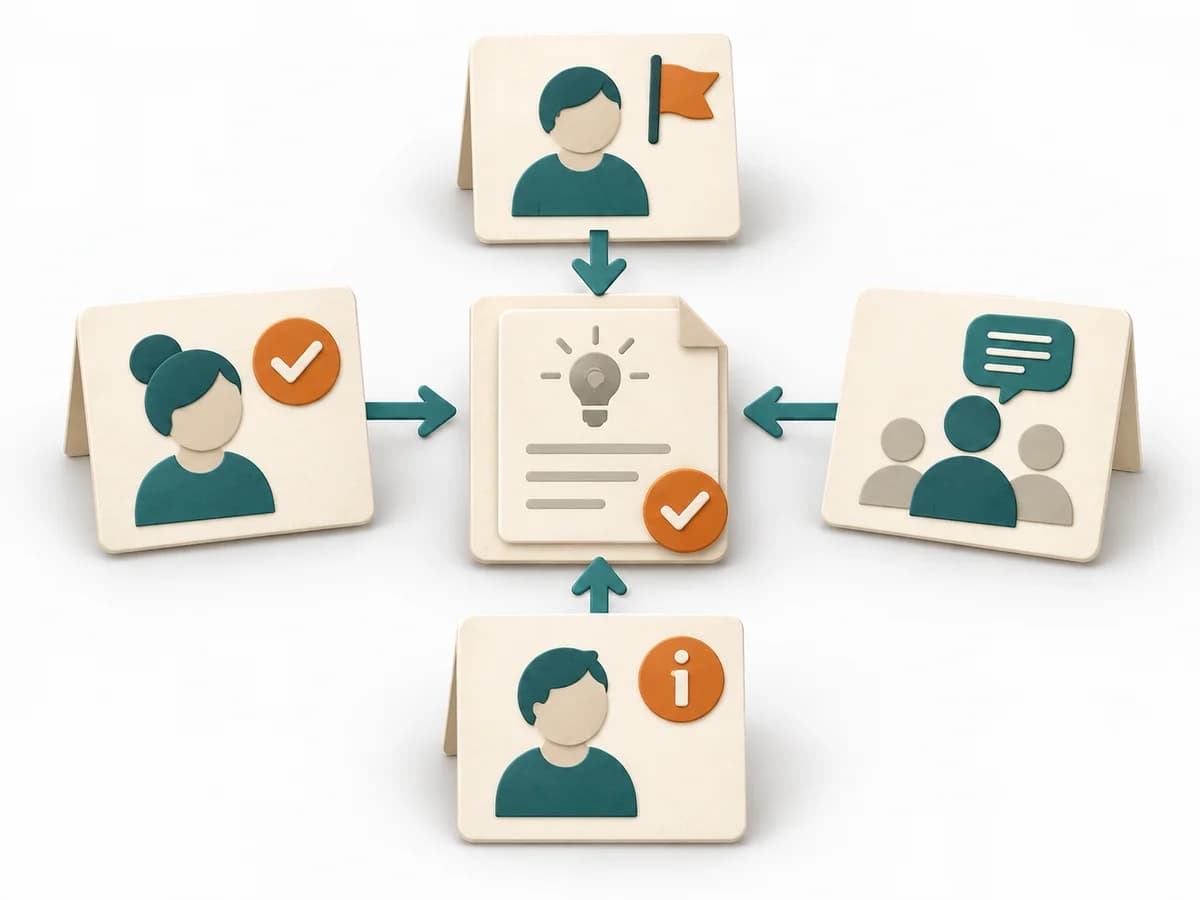
RAPID clarifies decision roles. A decision has exactly one D and generally one lead R. Agree is used sparingly for genuine approval obligations; Input contributes relevant knowledge and Perform executes the decision.
Who recommends, provides input, must agree, decides once, and performs this specific decision?
Decision Rights Mapping uses a RAPID matrix per clearly framed decision with exactly one D role. Assessments remain justified and context-bound.

Select decisions
Frame the 3–5 value-critical decisions as explicit choices.
Assign RAPID
Assign R, I, A, D, and P; ensure exactly one D and only genuine A roles.
Install process
Set inputs, milestones, decision forum, communication, and reopening rule.
After real decisions, review cycle time, rework, and missing input; update roles when governance changes.
Useful for recurring or high-value decisions with friction. RACI is better for general task responsibility.
RAPID decision map with traceable sources, assumptions, and domain decisions.
Owners, dates, and next review for RAPID decision map.
Fictional worked example
a RAPID matrix per clearly framed decision with exactly one D role as a precise working structure with a fictional example.
| Decision | Decision | R: Recommend | I/A: Input and Agree | D: Decide | P: Perform and transition |
|---|---|---|---|---|---|
| Enterprise pricingRAPID assignment | Approve enterprise price for 1 October launch; decide 15 August. | Product Lead with Finance model. | I: Sales, CS; A: Legal for contract clauses only. | GM Product. | Billing and Sales Ops; reopen at >10% cost variance. |
The example demonstrates the domain logic of Decision Rights Mapping; worksheets remain blank.
Start with the core question: Who recommends, provides input, must agree, decides once, and performs this specific decision?
In organizations with many stakeholders, it often blurs who actually decides and who is merely consulted. It separates options, evaluation criteria, and open risks. The result is captured as a Decision Rights matrix and an agreement.
For relevant decision types, rights and duties are made visible across roles. This clarifies where domain input ends and governance begins, and duplicate decisions can be spotted early. This creates reliability in complex, multi-level structures.
Decision Rights Mapping extends frameworks such as RACI, RAPID, or DACI with a deliberate inventory of the most important decision types in an organization or team. It makes implicit assumptions about authority visible and reduces recurring escalations. It is often used in organizational design and transformation programs.
Start with concrete decisions, not with roles. Avoid vague pseudo-agreements. Ask for explicit consent at the end.
The method guide walks execution through 3 phases, timing, 3 pitfalls, and clear stop criteria.
Open method guideYour perspective
Your feedback helps shape the next improvements to methodatlas.
Plan Decision Rights Mapping around its domain steps and the concrete decision question.
To be confirmed
To be confirmed
Full workshop Time: 45–75 minutes for 3–5 decisions
Complete this worksheet on paper or in your own document during the work.
| Decision | Verb + subject + scope + date | Who develops the evidence-based recommendation? | Relevant inputs · genuine approval obligations | Exactly one role with final authority | Performers · start · communication · reopen trigger |
|---|---|---|---|---|---|
| Enterprise pricing |
Enter only real input, sources, and decisions.
Bain & Company: The Five Steps to Better Decisions
Expected artifact: decision list
decision list · source · uncertainty · next decision
Entry:
...
Expected artifact: RAPID assignment
RAPID assignment · source · uncertainty · next decision
Entry:
...
Expected artifact: decision process
decision process · source · uncertainty · next decision
Entry:
...
...
Method guide: https://methodatlas.meierhoff-systems.de/en/methods/decision-rights-mapping/run-sheet
Fitting alternatives with decision guidance, followed by other related methods.

Instead of Decision Rights Mapping, choose RACI Matrix when you want to clearly clarify responsibilities along accountable, executing, and informed roles.
Clarifies roles for driver, approver, contributors, and informed and records the decision in a solid matrix.

Arranges decision responsibility across five roles and makes recommendation, input, and follow-up unambiguous.

Sharpens the decision question, options, criteria, and evidence needs down to the right decision format.

Clarifies options, criteria, and risks by framing the central question, recording the main claim, and marking weak spots.

Sorts cases into the fitting domain and derives actions that match the degree of clarity or complexity.