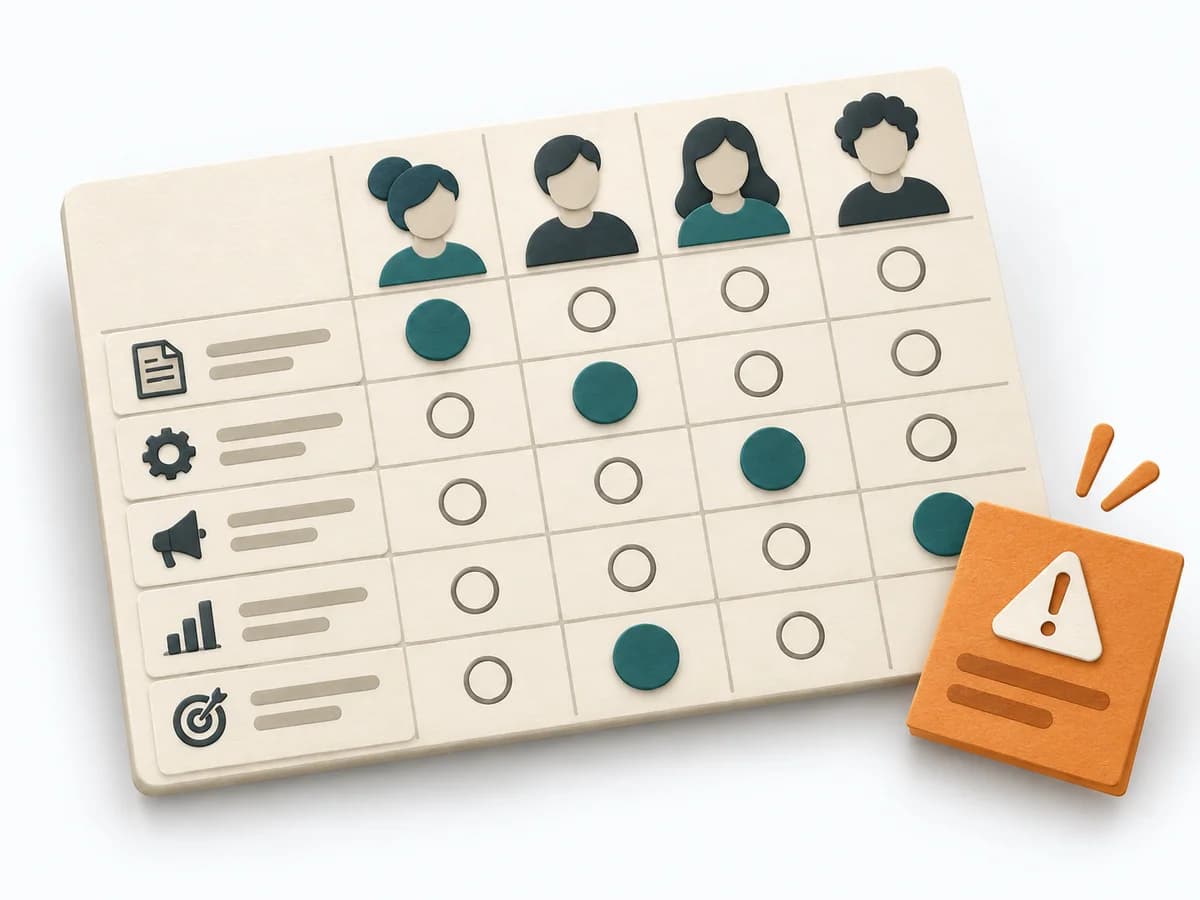
Complete firstBounded subject
The scope and purpose of Decision Rights Mapping are stated as a concrete question.
Without scope, RAPID decision map becomes arbitrary.
A practical method guide: clarify prerequisites and materials, understand the complete process, and look up outputs, pitfalls, and stop criteria.
What needs to be finished first
The scope and purpose of Decision Rights Mapping are stated as a concrete question.
Critical decision list, Involved roles, Governance and approval obligations and domain decision makers are available.
What needs to be ready before start
Critical decision list, Involved roles, Governance and approval obligations, shared workspace, source links, and decision log.
Facilitator · process owner · current decision makers · affected performers
Collect Critical decision list, Involved roles, Governance and approval obligations in advance and mark open assumptions.
45–75 minutes for 3–5 decisions
Prepare a RAPID matrix per clearly framed decision with exactly one D role visibly and calibrate assessment terms before starting.
The one question this method answers
Who recommends, provides input, must agree, decides once, and performs this specific decision?
Phases with goal, actions, output and pitfall
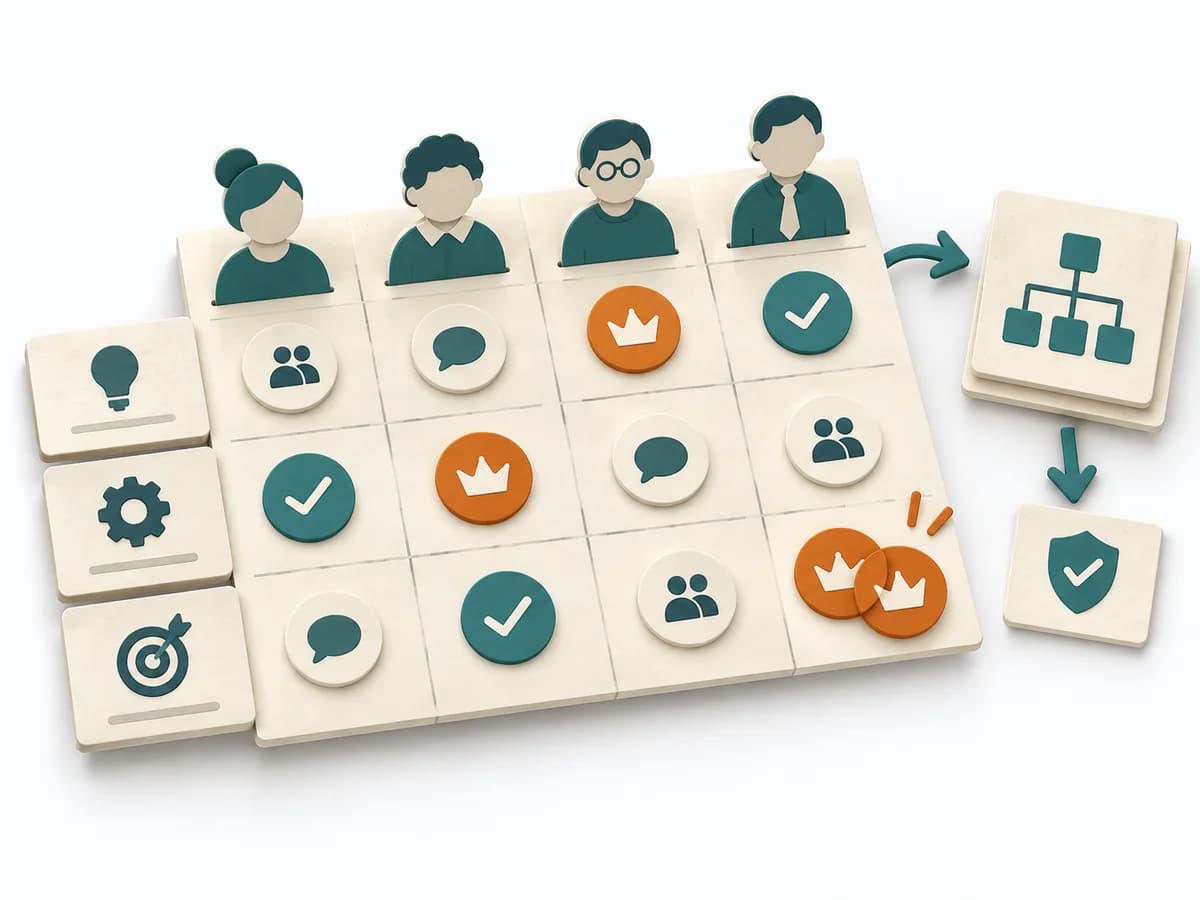
RAPID clarifies decision roles. A decision has exactly one D and generally one lead R. Agree is used sparingly for genuine approval obligations; Input contributes relevant knowledge and Perform executes the decision.
Fictional worked example
a RAPID matrix per clearly framed decision with exactly one D role as a precise working structure with a fictional example.
| Decision | Decision | R: Recommend | I/A: Input and Agree | D: Decide | P: Perform and transition |
|---|---|---|---|---|---|
| Enterprise pricingRAPID assignment | Approve enterprise price for 1 October launch; decide 15 August. | Product Lead with Finance model. | I: Sales, CS; A: Legal for contract clauses only. | GM Product. | Billing and Sales Ops; reopen at >10% cost variance. |
The example demonstrates the domain logic of Decision Rights Mapping; worksheets remain blank.
Select decisions
Goal
Produce decision list so the core question “Who recommends, provides input, must agree, decides once, and performs this specific decision?” can be answered with stronger support.
Inputs for this step
Actions
Output
decision list
decision list · source · uncertainty · next decision
Quality check
Does each row have a clear subject, decision date, and scope?
Pitfall
Broad topics such as strategy or pricing are entered instead of concrete decisions. Restore the missing basis, correct the claim, and repeat the step with visible rationale.
Timing: 10–20 minutes
Assign RAPID
Goal
Produce RAPID assignment so the core question “Who recommends, provides input, must agree, decides once, and performs this specific decision?” can be answered with stronger support.
Inputs for this step
Actions
Output
RAPID assignment
RAPID assignment · source · uncertainty · next decision
Quality check
Is there exactly one D and a clear lead R?
Pitfall
Multiple D or A roles create de facto vetoes and extend the decision. Restore the missing basis, correct the claim, and repeat the step with visible rationale.
Timing: 10–20 minutes
Install process
Goal
Produce decision process so the core question “Who recommends, provides input, must agree, decides once, and performs this specific decision?” can be answered with stronger support.
Inputs for this step
Actions
Output
decision process
decision process · source · uncertainty · next decision
Quality check
Is it clear when input closes, D decides, and P begins?
Pitfall
The letters are mapped, but no date or binding transition to execution exists. Restore the missing basis, correct the claim, and repeat the step with visible rationale.
Timing: 10–20 minutes
What comes out at the end
Sketch: what the artifact looks like
Versioned RAPID decision map with date, sources, owners, and next review.
Retain date, source, assumption state, and decision for every version of RAPID decision map.
Plan Decision Rights Mapping around its domain steps and the concrete decision question.
To be confirmed
To be confirmed
Full workshop Time: 45–75 minutes for 3–5 decisions
Complete this worksheet on paper or in your own document during the work.
| Decision | Verb + subject + scope + date | Who develops the evidence-based recommendation? | Relevant inputs · genuine approval obligations | Exactly one role with final authority | Performers · start · communication · reopen trigger |
|---|---|---|---|---|---|
| Enterprise pricing |
Enter only real input, sources, and decisions.
Bain & Company: The Five Steps to Better Decisions
Expected artifact: decision list
decision list · source · uncertainty · next decision
Entry:
...
Expected artifact: RAPID assignment
RAPID assignment · source · uncertainty · next decision
Entry:
...
Expected artifact: decision process
decision process · source · uncertainty · next decision
Entry:
...
...
Method guide: https://methodatlas.meierhoff-systems.de/en/methods/decision-rights-mapping/run-sheet
Concrete filled scenario, fictional example
Fictional example for orientation. Counts and timings describe this case and are not universal requirements.
Concrete filled scenario, fictional example
Fictional example: decision 'Approve enterprise price for 1 October'. R: Product Lead prepares the recommendation with Finance input. I: Sales and Customer Success. A: Legal only for contract clauses. D: GM Product. P: Billing and Sales Operations. Decision date 15 August; reopen only for >10% cost variance or new regulation.
Recognize symptoms and steer against them
Quick overview, the full text is in the matching phase in the flow
Broad topics such as strategy or pricing are entered instead of concrete decisions.
Restore the missing basis, correct the claim, and repeat the step with visible rationale.
Multiple D or A roles create de facto vetoes and extend the decision.
Restore the missing basis, correct the claim, and repeat the step with visible rationale.
The letters are mapped, but no date or binding transition to execution exists.
Restore the missing basis, correct the claim, and repeat the step with visible rationale.
When to pause, resolve prerequisites, or choose another approach
Go to the profile for purpose, similar methods, and sources or continue to the next method in the catalog.