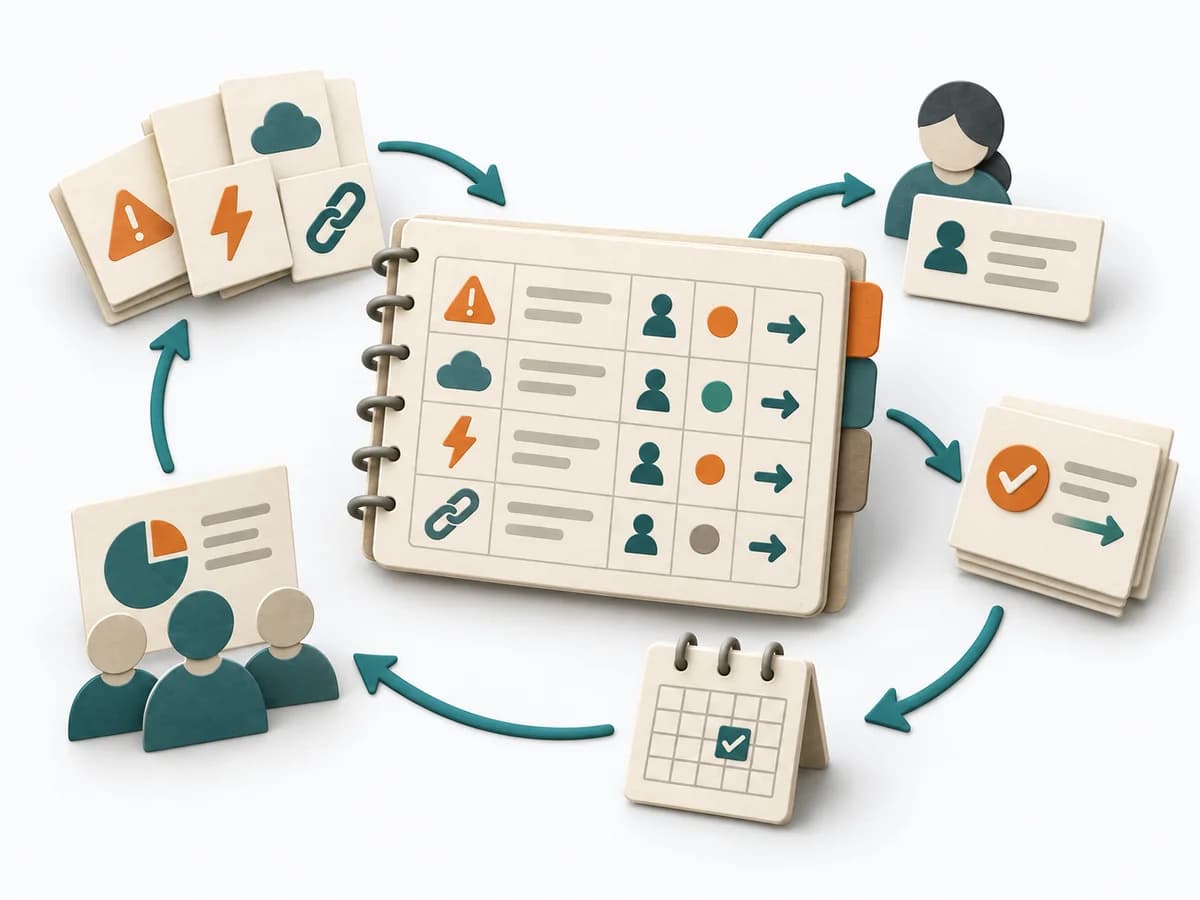
Decision Framing Workshop: Worksheet
Set subject, evidence, roles, flow, and review.
# Decision Framing Workshop: Worksheet

## Question
To be confirmed

## Desired outcome
To be confirmed

## Scope
Complete run
Time: 120–180 minutes plus pre-interviews where scope is contested.

Complete this worksheet on paper or in your own document during the work.

## Preparation for this scope

### Method setup
- **Materials:** Decision mandate, stakeholder and scope map, objectives, alternatives, uncertainties, evidence sources, and decision log
- **Roles:** Decision owner · key stakeholders · domain/data experts · facilitator · scribe
- **Advance information:** Clarify mandate and decision owner; interview stakeholders about the decision, boundaries, interests, and contested assumptions.
- **Overall time needed:** 120–180 minutes plus pre-interviews where scope is contested.
- **Setup:** Prepare a workspace with Decision · Scope · Objectives · Options · Evidence; separate example from live data.

### Prepare for the work steps

#### Decision: Decision statement
- Clarify mandate and decision owner; interview stakeholders about the decision, boundaries, interests, and contested assumptions.
- Decision mandate, stakeholder and scope map, objectives, alternatives, uncertainties, evidence sources, and decision log

#### Scope: Scope map
- Decision statement

#### Objectives: Objective hierarchy
- Scope map

#### Options: Alternative space
- Objective hierarchy

#### Evidence: Evidence plan
- Alternative space


## Decision Framing Workshop · working structure

| Frame field | Working question | Fictional content | Owner/source | Status |
| --- | --- | --- | --- | --- |
| Decision |   |   |   |   |
| Scope |   |   |   |   |
| Objectives |   |   |   |   |
| Alternatives |   |   |   |   |
| Uncertainty |   |   |   |   |

- **Decision:** Add evidence and rationale.
- **Scope:** Add evidence and rationale.
- **Objectives:** Add evidence and rationale.
- **Alternatives:** Add evidence and rationale.
- **Uncertainty:** Add evidence and rationale.

The blank worksheet contains prompts only.

[Reference · original teaching example](https://www.sdg.org/en/decision-quality)


## Decision: Decision statement
Expected artifact: Decision statement

Clarify decision owner, choice statement, date, and downstream decision it enables.

Entry:

...

- [ ] Does the statement contain a concrete choice and empowered owner?

## Scope: Scope map
Expected artifact: Scope map

Mark in/out, horizon, affected groups, fixed boundaries, and interfaces.

Entry:

...

- [ ] Are contested boundaries visible as decisions or assumptions?

## Objectives: Objective hierarchy
Expected artifact: Objective hierarchy

Derive fundamental objectives, measures, and red lines from stakeholder perspectives.

Entry:

...

- [ ] Are objectives independent of preferred solutions and free of double counting?

## Options: Alternative space
Expected artifact: Alternative space

Phrase status quo and distinct feasible alternatives at the right decision level.

Entry:

...

- [ ] Are at least two real actions and status quo comparable?

## Evidence: Evidence plan
Expected artifact: Evidence plan

Set key uncertainties, tipping values, sources, owners, and decision process; approve frame.

Entry:

...

- [ ] Is it clear which uncertainty can change the choice and who resolves it by when?

## Open questions and next steps

...

Method guide: https://methodatlas.meierhoff-systems.de/en/methods/decision-framing-workshop/run-sheet
RAID Log: Worksheet
Plan RAID Log with real scope, suitable roles, and a clear decision objective.
# RAID Log: Worksheet

## Question
To be confirmed

## Desired outcome
To be confirmed

## Scope
Establish and review the practice
Time: 45 minutes initially; 15–30 minutes per review

Complete this worksheet on paper or in your own document during the work.

## Preparation for this scope

### Method setup
- **Materials:** RAID table with stable IDs, initiative plan, risk register, discovery assumptions, issue list, dependency commitments, and escalation calendar.
- **Roles:** Delivery lead · scribe · item owners · escalation decision maker
- **Advance information:** Consolidate existing lists, mark duplicates, and highlight overdue items before review.
- **Overall time needed:** 45 minutes initially; 15–30 minutes per review
- **Setup:** Display four type definitions and required fields: ID, statement, consequence, owner, action, date, and status.

### Prepare for the work steps

#### Rules: Define RAID types and required fields
- Initiative scope
- Governance and escalation rules
- Existing lists

#### Capture: Write precise entries
- Discovery, planning, and delivery findings
- Risks, open assumptions, current problems
- External commitments and interfaces

#### Control: Assign owner and next action
- Qualified entries
- Responsibilities
- Decision and escalation paths

#### Review: Review changes and transitions
- Current RAID log
- New evidence and delivery status
- Review decisions


## RAID Log

| RAID ID | R/A/I/D | Statement · consequence | Owner · date | Action · evidence | Status · trigger |
| --- | --- | --- | --- | --- | --- |
| D-07 |   |   |   |   |   |

- **D-07:** External sandbox

Choose exactly one type per item and set a verifiable next step.

[UK Government Gate 2 Review: Delivery Strategy](https://www.gov.uk/government/publications/gate-review-2-delivery-strategy/gate-2-review-delivery-strategy)


## Rules: Define RAID types and required fields
Expected artifact: RAID convention

Type rules · required fields · status · cadence

Entry:

...

- [ ] Can every item be assigned to exactly one type?

## Capture: Write precise entries
Expected artifact: Qualified entries

ID · type · statement · consequence · source

Entry:

...

- [ ] Do grammar and follow-up fit the type?

## Control: Assign owner and next action
Expected artifact: Controllable log

Action · owner · date · status · escalation

Entry:

...

- [ ] Does each type have the correct follow-up?

## Review: Review changes and transitions
Expected artifact: Updated RAID log

Status · transition · decision · closure evidence

Entry:

...

- [ ] Is every change dated and justified?

## Open questions and next steps

...

Method guide: https://methodatlas.meierhoff-systems.de/en/methods/raid-log/run-sheet