Plan my session
Plan a concrete work block with agenda, roles, preparation, and a copyable result artifact.
Session: Decision Rights Mapping
The plan translates the method into a concrete facilitated work block. Your inputs flow directly into the session brief and work artifact.
Method session with 4-12. The plan uses the existing method logic and the runsheet.
RunsheetUse the session for shared understanding. Contributions are collected visibly, assumptions are aligned, and open differences remain traceable in the artifact.
The session works directly toward Decision-Rights-Matrix. After the session, the artifact should be shareable, reviewable, or reusable.
- 1
Phase 1: Collect decision types
20-30 minEach participant names 3-5 recurring decisions with friction. Consolidate duplicates. Create a list of 10-25 types, sorted by frequency or friction. Hint: Use concrete decisions, not abstract categories. "Who decides sprint scope changes mid-sprint" is more concrete than "scope decisions".
FacilitatorDecision-Rights-Matrix - 2
Phase 2: Clarify roles
15 minConsolidate role list (PO, Tech Lead, Engineering Manager, Architect, CTO, etc.). Resolve role overlaps and clarify intended role. Hint: Person is not the same as role. A person can hold several roles, but mapping is done to roles. With person changes, the agreement remains valid.
FacilitatorVereinbarung - 3
Phase 3: Assign notation per decision
30-60 minDetermine one Decide role per decision type, Recommend roles, Input roles, and Informed roles. Discuss duplicates or conflicts. Hint: Exactly one decider per decision. Duplicate deciders are a common root of escalations. Negotiate conflicts rather than parking them.
FacilitatorDecision-Rights-Matrix - 4
Phase 4: Conflicts and exceptions
20-30 minDiscuss disputed decisions individually. For irreconcilable conflicts, define an escalation rule (for example "on a tie: sponsor decides within 48h"). Hint: Avoid pseudo-consensus. Prefer explicit escalation rules to ambiguous agreements.
FacilitatorVereinbarung - 5
Phase 5: Document and communicate agreement
10-15 minMatrix becomes the final artifact. All participants confirm (digital confirmation or email). Share with broader org and set review date in 3 months. Hint: Without explicit sign-off per person, agreement dissipates. Signing is symbolically important. Review cadence prevents drift.
OwnerDecision-Rights-Matrix - 6
Publish artifact
10 minCheck the artifact for completeness, define location, set version or status, and name review recipients.
OwnerDecision-Rights-Matrix
Session Brief
For invitations, boards, tickets, PR descriptions, or workshop notes.
session-brief.md
Session Brief: Decision Rights Mapping
Goal
Artifact: Decision-Rights-Matrix
Working Question
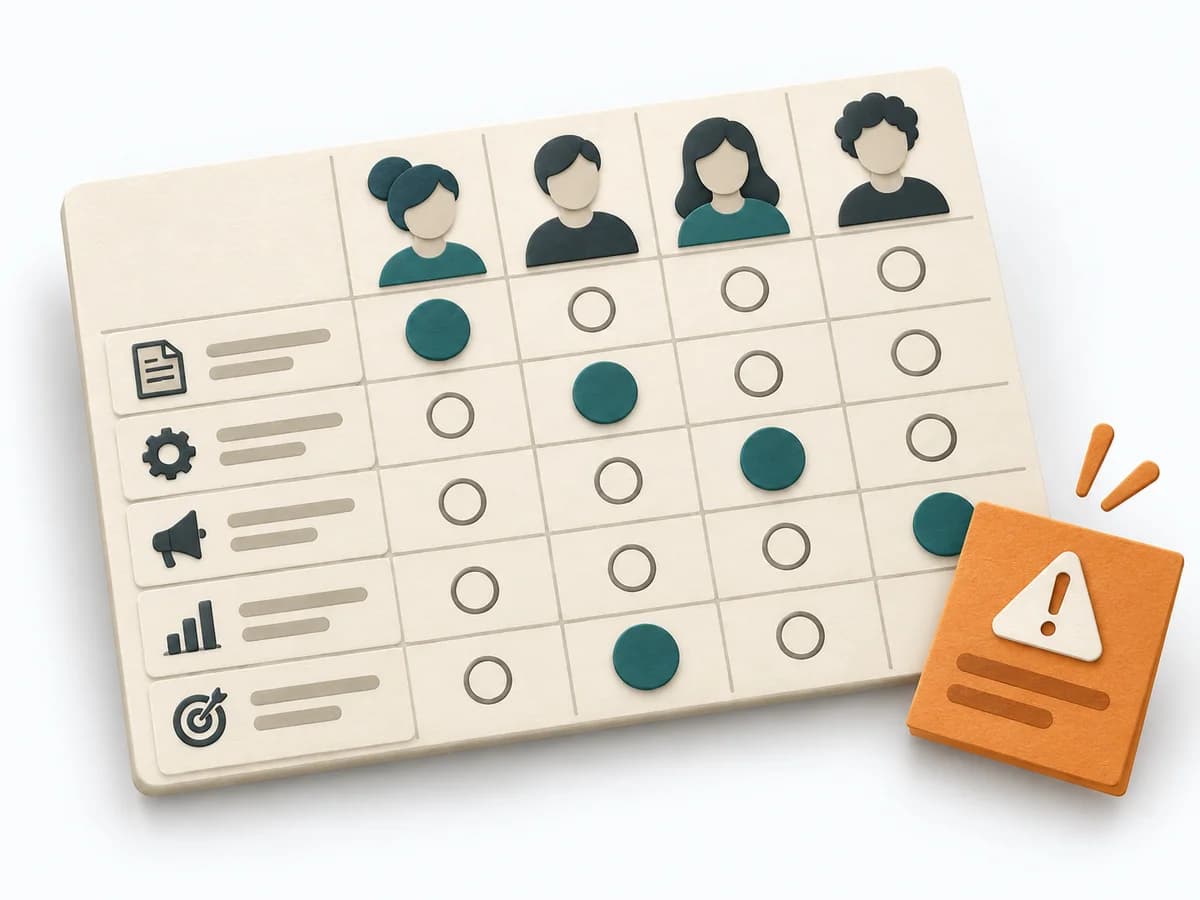
Which role decides which type of decision, which roles are consulted before it, which are informed afterwards, and how do we make that binding?
Context
List of recurring decision types (typically 10-25); current friction points or escalations; existing implicit rules; org chart and formal responsibilities.
Setup
- Format: Method session
- Duration: 90-180 min
- Mode: Workshop
- Participants: A facilitator (coach, org designer, HR partner); all involved role owners or their representatives; a sponsor with authority for commitments; a scribe for agreements.
- Owner: A facilitator (coach, org designer, HR partner)
- Participation mode: Team round, shared work and alignment
- Outcome logic: Finish artifact
Participation Logic
Use the session for shared understanding. Contributions are collected visibly, assumptions are aligned, and open differences remain traceable in the artifact.
Outcome Logic
The session works directly toward Decision-Rights-Matrix. After the session, the artifact should be shareable, reviewable, or reusable.
Input
Whiteboard or Miro board with a matrix (rows: decision types, columns: roles); RACI or RAPID notation shown as a banner; list of decisions to clarify; org chart as a reference; tool for documentation of agreements.
Preparation
Prepare matrix: vertically decision types (for example hiring, budget reallocation, tech stack choice, release approval). Horizontally roles. Define notation: D (Decide), R (Recommend), I (Input), F (Informed). Sponsor confirms authority.
Agenda
-
Phase 1: Collect decision types (20-30 min) Owner: Facilitator Action: Each participant names 3-5 recurring decisions with friction. Consolidate duplicates. Create a list of 10-25 types, sorted by frequency or friction. Hint: Use concrete decisions, not abstract categories. "Who decides sprint scope changes mid-sprint" is more concrete than "scope decisions". Output: Decision-Rights-Matrix
-
Phase 2: Clarify roles (15 min) Owner: Facilitator Action: Consolidate role list (PO, Tech Lead, Engineering Manager, Architect, CTO, etc.). Resolve role overlaps and clarify intended role. Hint: Person is not the same as role. A person can hold several roles, but mapping is done to roles. With person changes, the agreement remains valid. Output: Vereinbarung
-
Phase 3: Assign notation per decision (30-60 min) Owner: Facilitator Action: Determine one Decide role per decision type, Recommend roles, Input roles, and Informed roles. Discuss duplicates or conflicts. Hint: Exactly one decider per decision. Duplicate deciders are a common root of escalations. Negotiate conflicts rather than parking them. Output: Decision-Rights-Matrix
-
Phase 4: Conflicts and exceptions (20-30 min) Owner: Facilitator Action: Discuss disputed decisions individually. For irreconcilable conflicts, define an escalation rule (for example "on a tie: sponsor decides within 48h"). Hint: Avoid pseudo-consensus. Prefer explicit escalation rules to ambiguous agreements. Output: Vereinbarung
-
Phase 5: Document and communicate agreement (10-15 min) Owner: Owner Action: Matrix becomes the final artifact. All participants confirm (digital confirmation or email). Share with broader org and set review date in 3 months. Hint: Without explicit sign-off per person, agreement dissipates. Signing is symbolically important. Review cadence prevents drift. Output: Decision-Rights-Matrix
-
Publish artifact (10 min) Owner: Owner Action: Check the artifact for completeness, define location, set version or status, and name review recipients. Output: Decision-Rights-Matrix
Closeout
- Update result artifact: Decision-Rights-Matrix
- Define location, version, and review recipients.
- Define owner, next step, and review date.
Work artifact
Pre-filled starting point based on the matching template.
work-artifact.md
Decision-Rights-Matrix: Decision Rights Mapping
Working Question
Which role decides which type of decision, which roles are consulted before it, which are informed afterwards, and how do we make that binding?
Context
List of recurring decision types (typically 10-25); current friction points or escalations; existing implicit rules; org chart and formal responsibilities.
Participants
- Owner: A facilitator (coach, org designer, HR partner)
- Participants: A facilitator (coach, org designer, HR partner); all involved role owners or their representatives; a sponsor with authority for commitments; a scribe for agreements.
Input
Whiteboard or Miro board with a matrix (rows: decision types, columns: roles); RACI or RAPID notation shown as a banner; list of decisions to clarify; org chart as a reference; tool for documentation of agreements.
Template
Decision Rights Mapping Working Matrix
| Element | Description | Rating | Evidence | Owner | Next step |
|---|---|---|---|---|---|
| 1 | |||||
| 2 | |||||
| 3 |
Output artifacts
- Decision-Rights Matrix:
- Agreement:
Decision or recommendation
What consequence follows from the matrix?
Completion Check
- Decision-Rights-Matrix is complete enough for review:
- Location:
- Version / status:
- Review by:
- Next step:
Next Step
- Review result
- Mark open questions
- Schedule review or decision
Decision Rights Mapping Working Template
View templateCompact working template for Decision Rights Mapping with context, input, output artifacts, and next step.spreadsheet
decision-rights-mapping-working-template.md
Compact working template for Decision Rights Mapping with context, input, output artifacts, and next step.
Decision Rights Mapping Working Matrix
| Element | Description | Rating | Evidence | Owner | Next step |
|---|---|---|---|---|---|
| 1 | |||||
| 2 | |||||
| 3 |
Output artifacts
- Decision-Rights Matrix:
- Agreement:
Decision or recommendation
What consequence follows from the matrix?
- Working question, owner, and target artifact are visible.
- The result fits Decision-Rights-Matrix.
- Record agreement date in the header. Document updates with new date and rationale. Archive old versions. Reconfirm when org or sponsor changes.
- Open questions are noted as follow-ups.
- The next review or decision point is scheduled.