
Purpose
A Current Reality Tree condenses many symptoms into a few causal chains. The method makes visible which core problems drive several negative effects at once.
Systems Thinking Mapping tool
The Current Reality Tree shows which common causes can sufficiently explain observed undesirable effects.
The Theory of Constraints Current Reality Tree connects observed undesirable effects (UDEs) through sufficient cause-and-effect logic. Joint prerequisites use AND; the tree helps examine influential common causes.
Which common causes can sufficiently explain the observed undesirable effects?

UDEs
State concrete undesirable effects as full sentences with evidence and system boundary.
Causal chains
Connect causes and intermediate effects to UDEs using if-then statements.
Logic review
Check clarity, existence, causality and sufficiency of every link.
Core causes
Trace causes explaining several important UDEs and examine their actual influence.
Review logic with affected people and counterevidence; separately examine future effects of solution hypotheses afterwards.
For several connected system problems whose common drivers are unclear.
Reviewed causal tree with UDEs, intermediate effects, AND conditions, assumptions and a justified change focus.
The change focus keeps unexplained effects and model limits visible.
Fictional example
The Theory of Constraints Current Reality Tree connects observed undesirable effects (UDEs) through sufficient cause-and-effect logic. Joint prerequisites use AND; the tree helps examine influential common causes.
Which observed undesirable effects and evidence belong to the system?
Fictional: U1 jobs wait a long time; U2 commitments are missed; U3 staff frequently switch between open jobs.
Which complete statements describe causes and intermediate effects?
C1 All incoming jobs start immediately. C2 Arrivals temporarily exceed completions. C3 Many jobs are open simultaneously. C4 A few people split their work across all open jobs.
Which conditions operate jointly and what effect follows?
C1 AND C2 → C3. C3 AND C4 → U3. U3 AND measurable switching overhead → lower completion rate. That rate AND high open volume → U1. U1 AND unchanged short commitments → U2.
Which arrows are evidenced, what assumptions remain and which counterexamples are checked?
Fictional board history supports high open volume and switching. The effect of switching cost remains a hypothesis; sample times. Check material shortages as another cause.
Which confirmed cause warrants further change analysis and where does the claim end?
Starting every job immediately is a testable policy candidate. Next examine limiting parallel work as a solution hypothesis; do not claim its effect yet.
All example details are fictional and illustrate the application.
Collect system boundary and verifiable UDEs; keep observations, causal assumptions and possible solutions separate.
A Current Reality Tree condenses many symptoms into a few causal chains. The method makes visible which core problems drive several negative effects at once.
First, undesired effects are collected and condensed without judgment. Then the team links them through cause-and-effect logic until solid causal chains emerge. In the end, a few causes remain where change pays off the most.
The Current Reality Tree helps because several undesired effects can be traced back to underlying causes instead of being treated in isolation. Good application checks every connection strictly for plausibility and avoids jumping from symptom to favorite cause. This creates a causal condensation that shows which few core problems repeatedly produce a whole field of disturbances.
At the start, collect only actually observed undesired effects, not pre-sorted explanations. The process shows its quality when different symptoms trace back to the same underlying cause for the first time. Close with a tree whose critical links are named and a decision on which core cause gets investigated further first.
The method guide walks execution through 4 phases, timing, 4 pitfalls, and clear stop criteria.
Open method guideYour perspective
Your feedback helps shape the next improvements to methodatlas.
Collect system boundary and verifiable UDEs; keep observations, causal assumptions and possible solutions separate.
To be confirmed
To be confirmed
Complete cycle Time: Several sessions; 60–120 minutes per logic block
Complete this worksheet on paper or in your own document during the work.
Which observed undesirable effects and evidence belong to the system?
...
Which complete statements describe causes and intermediate effects?
...
Which conditions operate jointly and what effect follows?
...
Which arrows are evidenced, what assumptions remain and which counterexamples are checked?
...
Which confirmed cause warrants further change analysis and where does the claim end?
...
Answer the prompts with your own information. Explicitly mark unknowns and assumptions.
Flying Logic: Current Reality Tree
Expected artifact: UDE list
Is every UDE verifiably observed?
Entry:
...
Expected artifact: Causal skeleton
Are the named conditions sufficient for the effect?
Entry:
...
Expected artifact: Reviewed logic
Does the link withstand a concrete counterexample?
Entry:
...
Expected artifact: Change focus
Does the driver explain multiple UDEs through checked paths?
Entry:
...
...
Method guide: https://methodatlas.meierhoff-systems.de/en/methods/current-reality-tree/run-sheet
Fitting alternatives with decision guidance, followed by other related methods.

Instead of Current Reality Tree, when a system of effects with loops needs to become understandable and no TOC logic is needed.
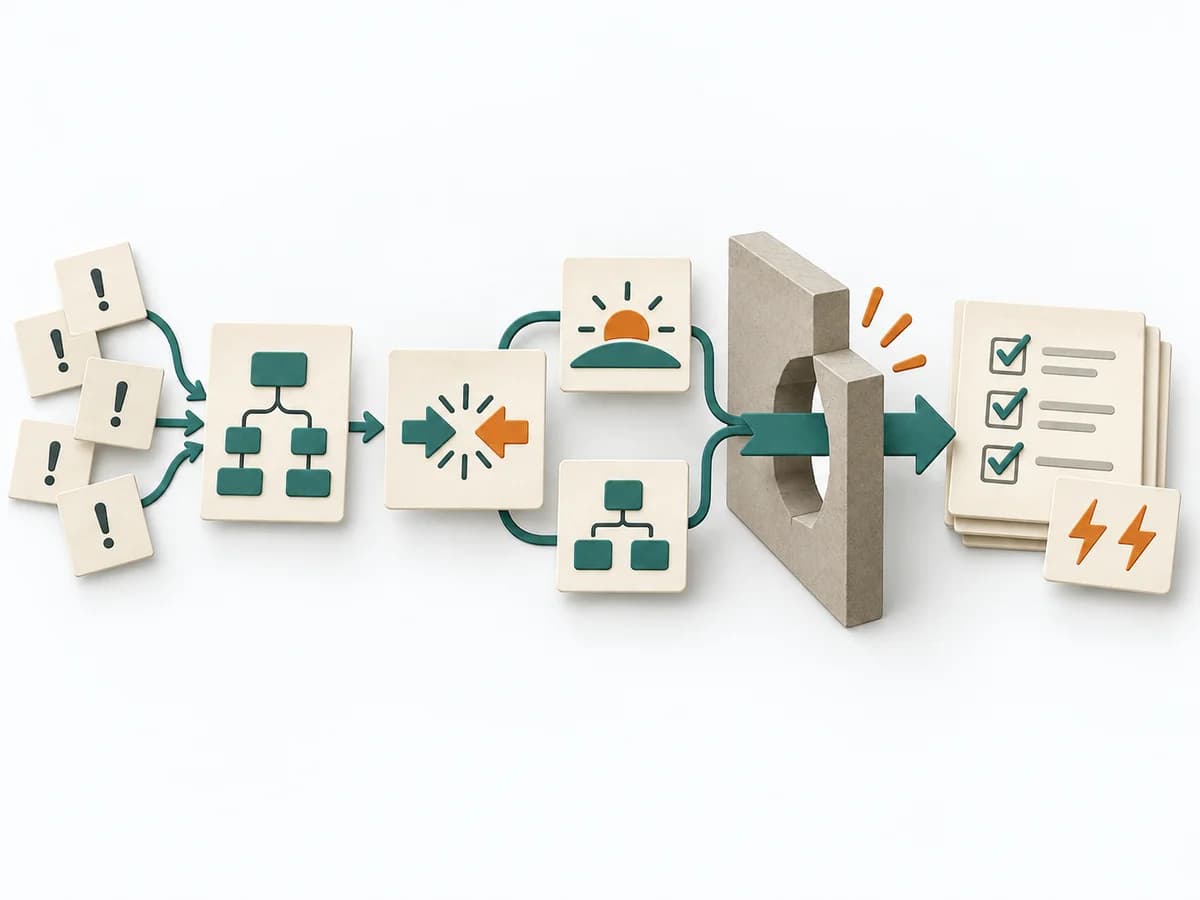
Moves from current problems through core conflicts and future logic to a viable path through a bottleneck.

Layers events, patterns, structures, and mental models to find deeper causes and interventions.

Links problem, target group, determinants, and actions into an actionable change program with evaluation.

Moves relationships, patterns, and leverage toward a concrete result through "introduce the twelve leverage points", "collect planned actions", and "formulate a strategy across multiple levers".

Models stocks, inflows and outflows, and delays to understand dynamics, bottlenecks, and capacity.