

Purpose
The TOWS Matrix connects internal strengths and weaknesses with external opportunities and threats into action-oriented strategies. It goes a step further than a pure stocktaking.
Business Strategy Decision method
Derives concrete strategies from SWOT factors by connecting strengths, opportunities, weaknesses, and threats.
SWOT factors are first consolidated. The team then combines them into S-O, W-O, S-T, and W-T strategies and prioritises the most viable options. The result is a set of concrete strategic directions rather than observations alone.
Which strategic options emerge from concrete combinations of internal and external factors?
The steps express the method mechanics; feedback may reopen an earlier step.
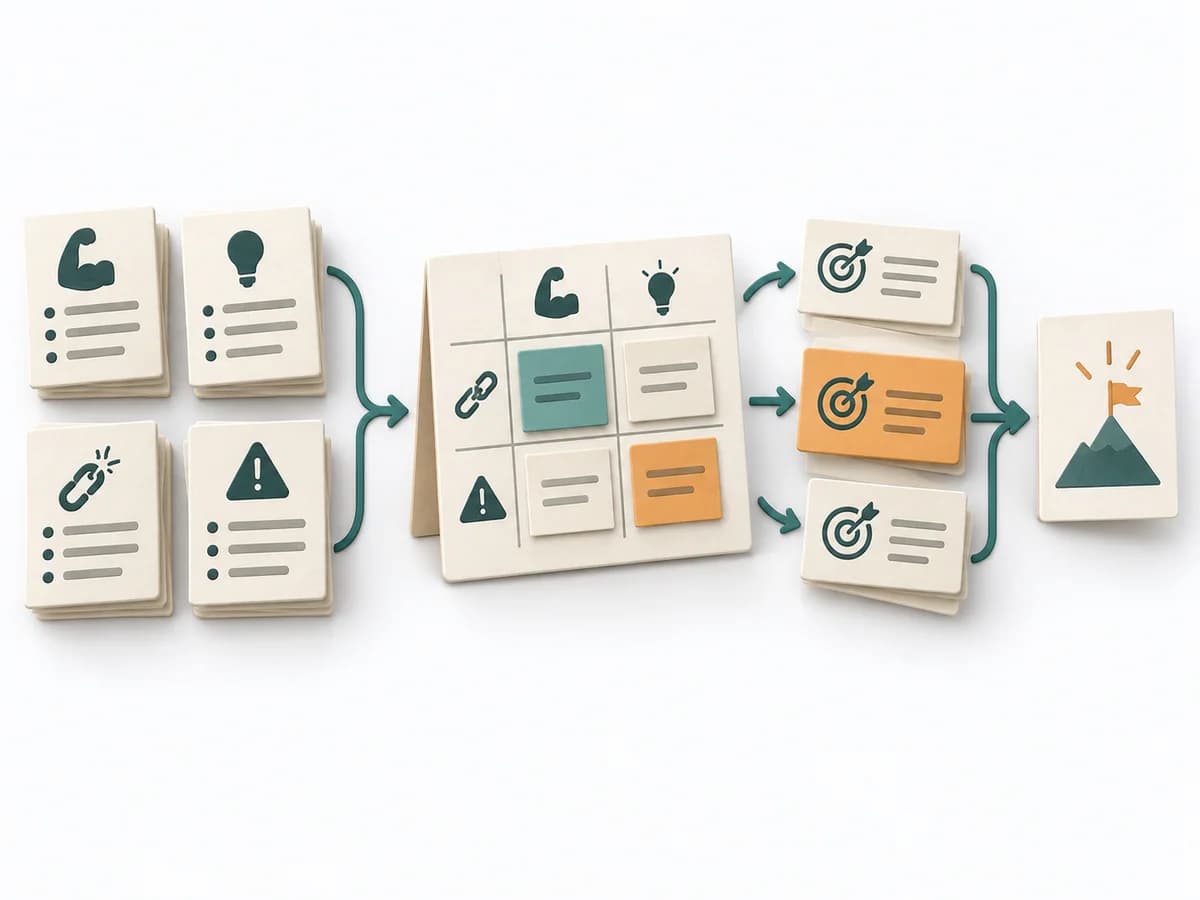
Factors
Record strengths and weaknesses as internal attributes and opportunities and threats as external developments, each with a source.
Prioritise
Limit factors by relevance to the focal decision and evidence strength; merge duplicates.
Combine
Pair SO, WO, ST, and WT systematically and turn each relevant pairing into an active option.
Refine
Check options for contradictions, dependencies, risks, and mutual exclusion; discard or combine weak variants.
Test
Assess options by effect, feasibility, risk, and learning value; choose a first test with owner and review.
At review, add evidence, update assumptions, and version the next cycle.
Die TOWS Matrix verbindet interne Stärken und Schwächen mit externen Chancen und Risiken zu handlungsnahen Strategien. Sie geht damit einen Schritt weiter als eine reine Bestandsaufnahme.
TOWS matrix with prioritised factors, SO, WO, ST, and WT options, plus selection rationale.
Fictional example
Fictional values demonstrate the method-specific fields.
| Strategy type | Factor pair | Strategic option | Rationale | Risk | First test |
|---|---|---|---|---|---|
| SOAdd rationale and evidence. | S1 repeat booking + O1 subsidy | Pilot subsidy-eligible maintenance plan | Existing loyalty uses external incentive | Approval delayed | 30 repeat customers by 28 Feb |
| WOAdd rationale and evidence. | W1 single holder + O1 subsidy | Use subsidy budget for knowledge transfer | External funds close internal gap | Transfer stays theoretical | Fourth case handled by Kim alone |
| STAdd rationale and evidence. | S1 repeat booking + T1 24h competitor | Test predictable handoff as counter-position | Loyalty supports value over speed | Customers still demand 24h | 10 interviews |
| WTAdd rationale and evidence. | W1 single holder + T1 24h competitor | Bound 24h promise and secure knowledge | Avoids overload around a vulnerable capability | Demand loss | Measure rejection reasons for four weeks |
All values are fictional.
Set one strategic decision, time horizon, and market or service boundary.
The TOWS Matrix connects internal strengths and weaknesses with external opportunities and threats into action-oriented strategies. It goes a step further than a pure stocktaking.
First, the SWOT factors are condensed. The team then combines them into S-O, W-O, S-T, and W-T strategies and prioritizes the most viable options. In the end, concrete strategic directions emerge instead of mere observations.
The TOWS Matrix starts where SWOT often stops: with turning analysis into strategy. Factors are combined in pairs, such as strengths with opportunities or weaknesses with threats. That creates concrete strategic directions instead of plain lists. The method forces internal capabilities and the external situation to be considered together.
Prepare the SWOT factors visibly and reduce them to the most important points before combining them. Work quadrant by quadrant and formulate options as active actions. Finish with prioritization, otherwise the matrix stays an idea list.
The method guide walks execution through 5 phases, timing, 5 pitfalls, and clear stop criteria.
Open method guideYour perspective
Your feedback helps shape the next improvements to methodatlas.
Set subject, evidence, roles, flow, and review.
To be confirmed
To be confirmed
Complete run Time: 120–180 minutes; factor validation beforehand and option assessment afterwards.
Complete this worksheet on paper or in your own document during the work.
| Strategy type | Factor pair | Strategic option | Rationale | Risk | First test |
|---|---|---|---|---|---|
| SO | |||||
| WO | |||||
| ST | |||||
| WT |
The blank worksheet contains prompts only.
Reference · original teaching example
Expected artifact: Evidence-backed SWOT register
Record strengths and weaknesses as internal attributes and opportunities and threats as external developments, each with a source.
Entry:
...
Expected artifact: Prioritised factors
Limit factors by relevance to the focal decision and evidence strength; merge duplicates.
Entry:
...
Expected artifact: TOWS options
Pair SO, WO, ST, and WT systematically and turn each relevant pairing into an active option.
Entry:
...
Expected artifact: Coherent option portfolio
Check options for contradictions, dependencies, risks, and mutual exclusion; discard or combine weak variants.
Entry:
...
Expected artifact: Decision and test plan
Assess options by effect, feasibility, risk, and learning value; choose a first test with owner and review.
Entry:
...
...
Method guide: https://methodatlas.meierhoff-systems.de/en/methods/tows-matrix/run-sheet
Fitting alternatives with decision guidance, followed by other related methods.

Instead of TOWS Matrix, choose SWOT Analysis when you first need a simple overview of the situation and do not yet want to derive strategies from the fields.

Clarifies starting point, opportunities, and strategic options by defining the industry scope, analyzing the five forces, and formulating strategic options.
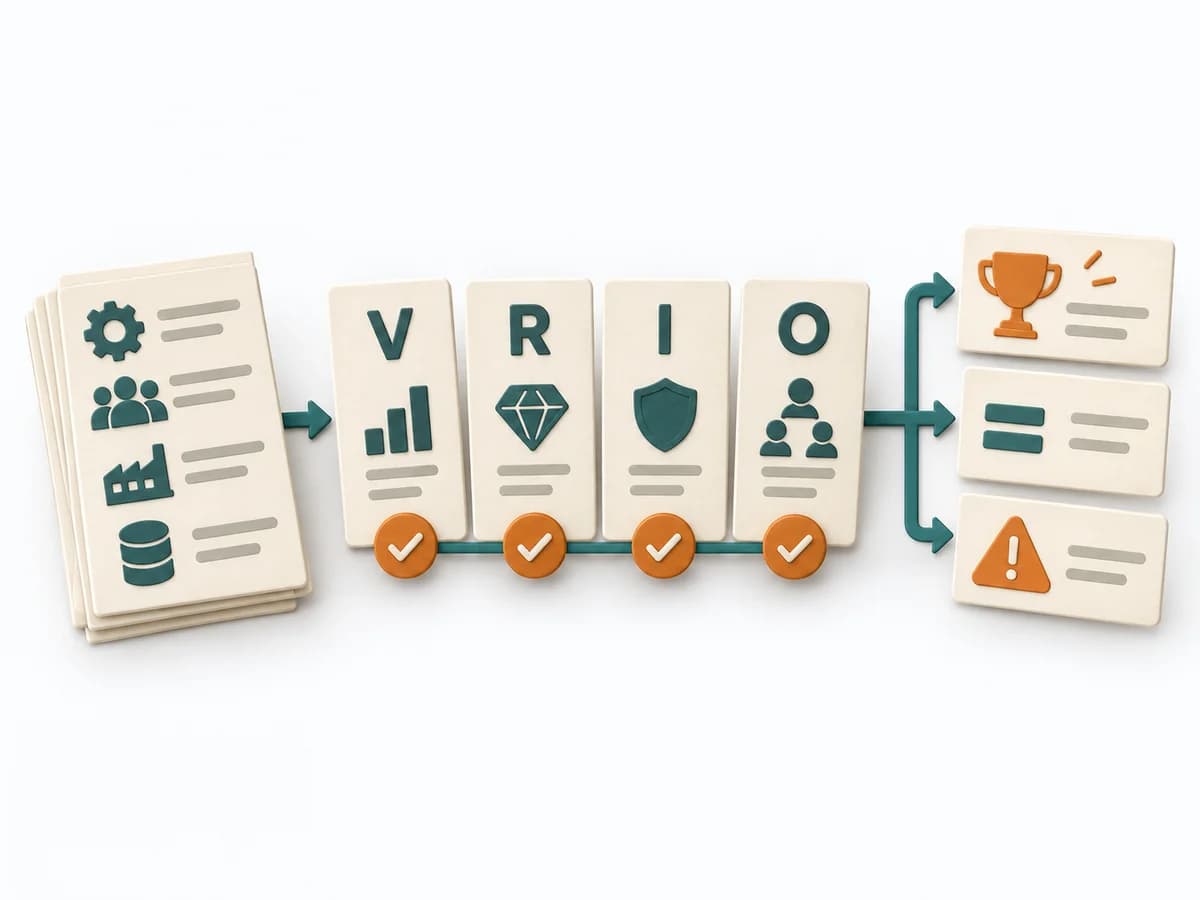
Moves the current situation, opportunities, and strategic options toward a concrete result through "collect resources and capabilities", "answer question V for each resource", and "derive strategic actions".

Compares target and actual state, exposes gaps, and derives prioritized measures with clear risks.

Moves the current situation, opportunities, and strategic options toward a concrete result through "explain the nine-activity template", "describe primary activities", and "derive levers and weaknesses".

Clarifies starting point, opportunities, and strategic options by defining the competitive factors, drawing the current value curve, and testing a new value curve.