

Purpose
For a problem with several suspected causes, the method builds a causal structure instead of a mere list. It makes visible how causes connect and where the strongest points of leverage lie.
Operations Mapping tool
Maps evidenced conditions that explain the problem and shows which can be changed.
A cause tree decomposes an observed problem into possible contributing conditions and checks each branch against evidence. This is a general cause-tree analysis, not a proprietary diagnostic system or a decision-selection tree.
Which evidenced conditions explain the problem and which can we usefully change?
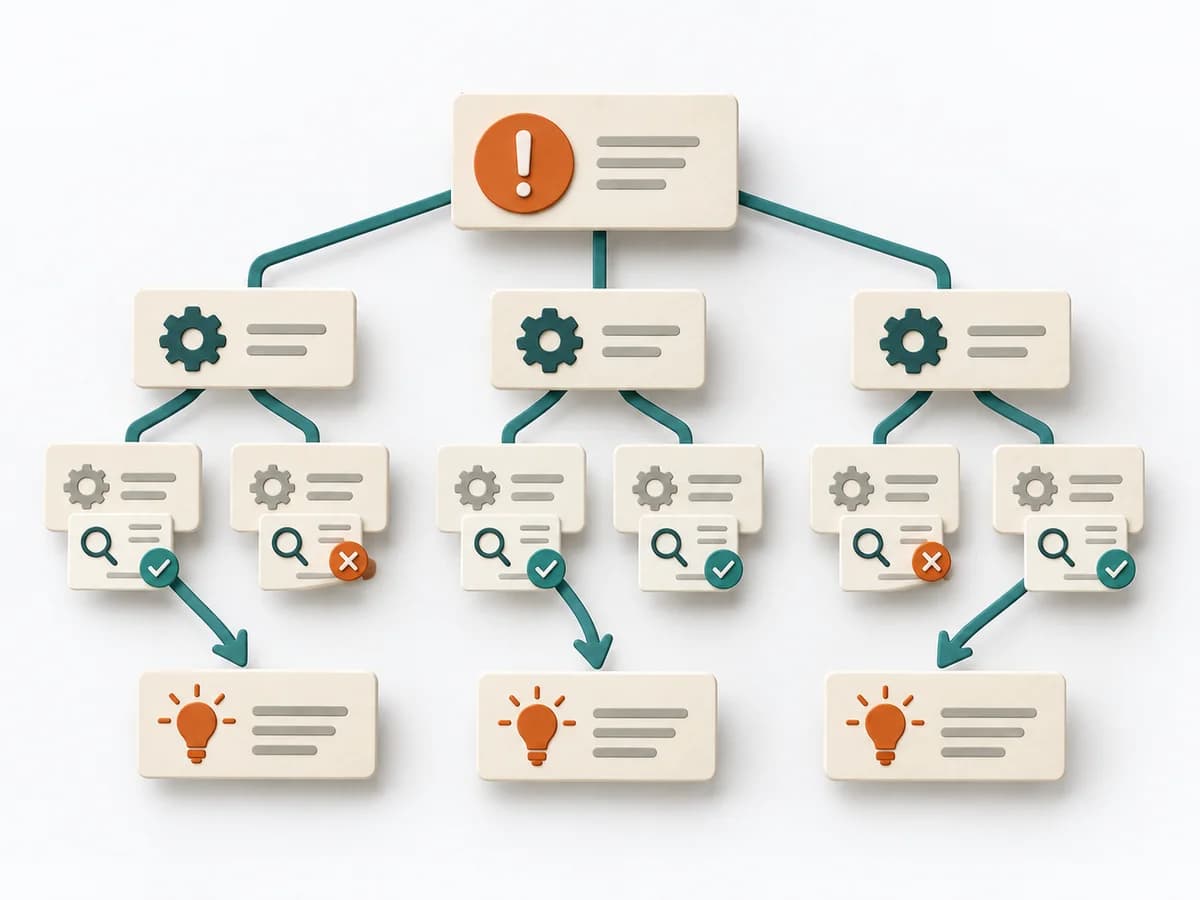
Problem
Record expected state, actual state, period and extent.
Causal branches
Branch possible direct conditions and ask how they arose.
Branch review
Check each causal claim using logs, documents, observations or a targeted test.
Actions
Act on confirmed influenceable conditions and distinguish prevention from immediate correction.
New evidence changes branch status; judge countermeasures only after implementation and suitable observation time.
For recurring or bounded failures with accessible event data.
Cause tree with supported, rejected and open branches plus actions on confirmed influenceable conditions.
The action plan names owners, a date, and the later effectiveness check. Open branches of the cause tree remain visible for further investigation.
Fictional example
A cause tree decomposes an observed problem into possible contributing conditions and checks each branch against evidence. This is a general cause-tree analysis, not a proprietary diagnostic system or a decision-selection tree.
Which concrete deviation is being explained?
Fictional: 12 course registrations received no confirmation within ten minutes on Tuesday.
Record direct conditions, subcauses and joint prerequisites with IDs.
E0 missing confirmation ← H1 sending fails OR H2 message is discarded. H1 ← H1a token expired AND H1b sending uses that token. H1a ← H1a1 expiry reached AND H1a2 no timely renewal.
Which source supports or rejects each branch?
Fictional logs confirm expiry and use of the old token. Stored queue entries reject H2. The operating plan lacks a renewal process, supporting H1a2.
What corrects the event and what prevents recurrence?
Renew token and resend twelve confirmations in a controlled way. Jan adds expiry alerting and renewal ownership; simulate the next expiry in a test.
All example details are fictional and illustrate the application.
Specify problem, period and deviation from expectation; preserve timeline, logs and affected people as sources.
For a problem with several suspected causes, the method builds a causal structure instead of a mere list. It makes visible how causes connect and where the strongest points of leverage lie.
Branches are built out from the visible effect until the deeper conditions become recognizable. Every link stays testable, so hypothesis and evidence don't drift apart. The tree structure sharpens the view on paths with high impact and high plausibility.
Root Cause Tree Analysis structures causes as a branching landscape of hypotheses instead of forcing a linear explanation. Every branch needs a connection to evidence, uncertainty, and testability. A tree becomes cause work once the strongest paths lead to targeted tests and countermeasures. Weak branches stay marked instead of being smoothed over.
Put the visible symptom at the top and only allow branches whose causal link is justified or testable. The tree gives the most when unknown connections stay openly marked instead of being prematurely smoothed over. End the session with tests for the strongest branches and a plan for missing evidence.
The method guide walks execution through 4 phases, timing, 4 pitfalls, and clear stop criteria.
Open method guideYour perspective
Your feedback helps shape the next improvements to methodatlas.
Specify problem, period and deviation from expectation; preserve timeline, logs and affected people as sources.
To be confirmed
To be confirmed
Complete cycle Time: 60–120 minutes initial tree; evidence checks separately
Complete this worksheet on paper or in your own document during the work.
Which concrete deviation is being explained?
...
Record direct conditions, subcauses and joint prerequisites with IDs.
...
Which source supports or rejects each branch?
...
What corrects the event and what prevents recurrence?
...
Answer the prompts with your own information. Explicitly mark unknowns and assumptions.
US Department of Energy: Root Cause Analysis Guidance
Expected artifact: Problem definition
Is the problem separate from its assumed cause?
Entry:
...
Expected artifact: Hypothesis tree
Does each branch explain a causal mechanism?
Entry:
...
Expected artifact: Reviewed cause tree
Are open hypotheses visibly unresolved?
Entry:
...
Expected artifact: Action with impact review
Does the action change an evidenced condition?
Entry:
...
...
Method guide: https://methodatlas.meierhoff-systems.de/en/methods/root-cause-tree-analysis/run-sheet
Fitting alternatives with decision guidance, followed by other related methods.

Instead of Root Cause Tree Analysis, when you want to collect causes in clear categories and keep discussions structured.

Separates events, evidence, confirmed causes, and fitting actions so analysis does not turn into blame-finding.

A recurring incident pattern links related cases across time so systemic causes become visible beyond one event.
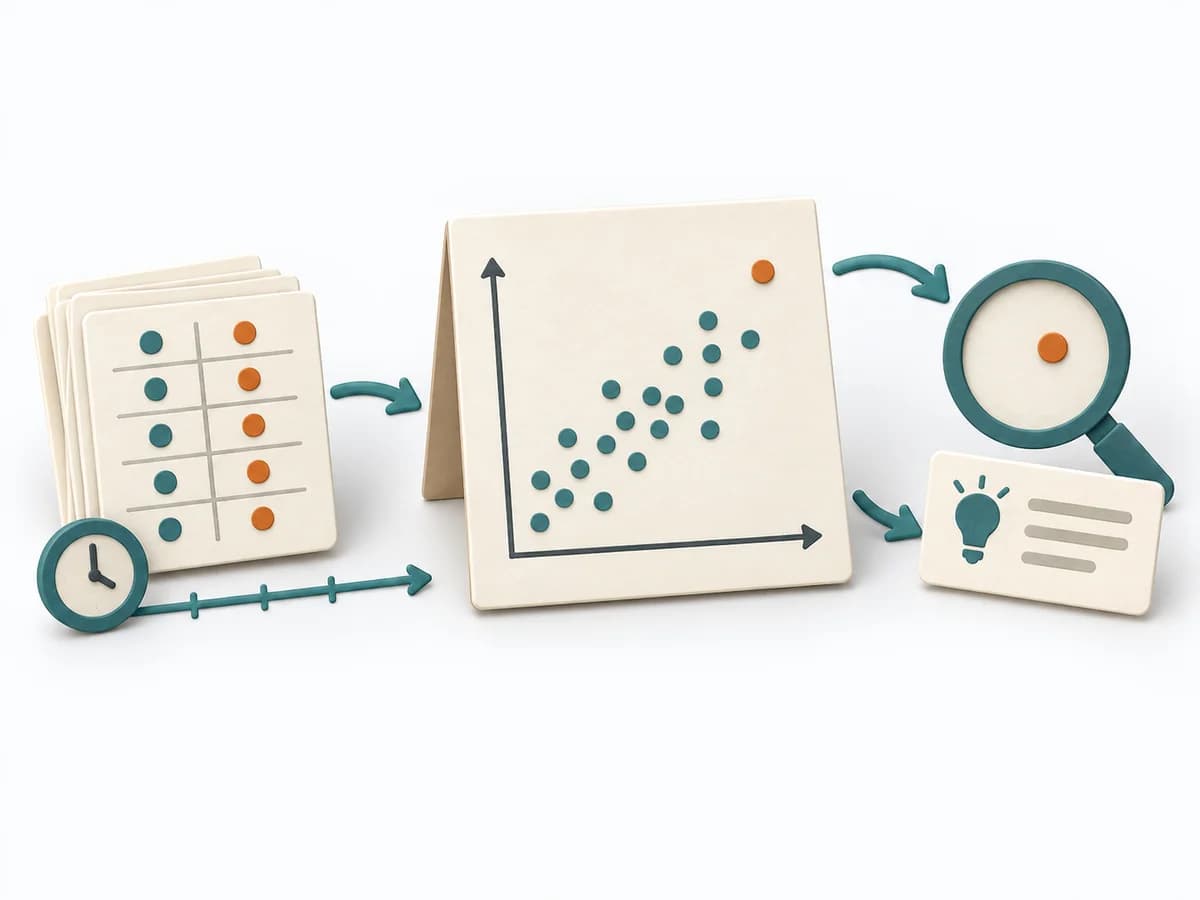
Paired data points reveal whether two variables move together and where a suspected relationship needs deeper proof.

Clarifies workflows, data, causes, and improvements by framing the situation, analyzing the problem with is/is not, and planning risks and actions.

Asks its way step by step to a controllable cause and stops only once an effective countermeasure is within reach.