Purpose
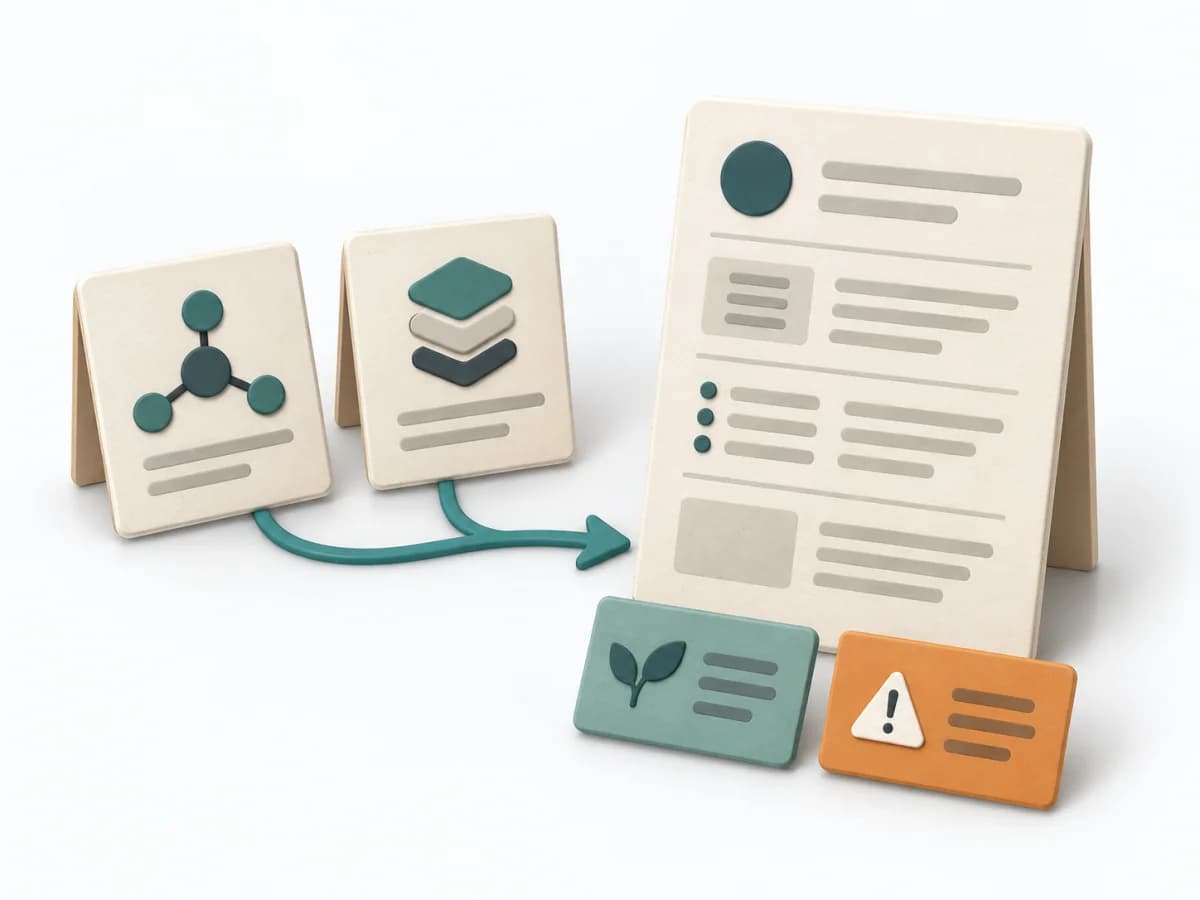
Helps clarify architecture context, options, and consequences in concrete terms. It organizes technical context, alternatives, and consequences. The result is captured as an Annotated Diagram, a Prioritized Risk List, and an Action Backlog.
Architecture Workshop method
Collects risks directly on an architecture diagram and makes priority, impact, and next steps visible.
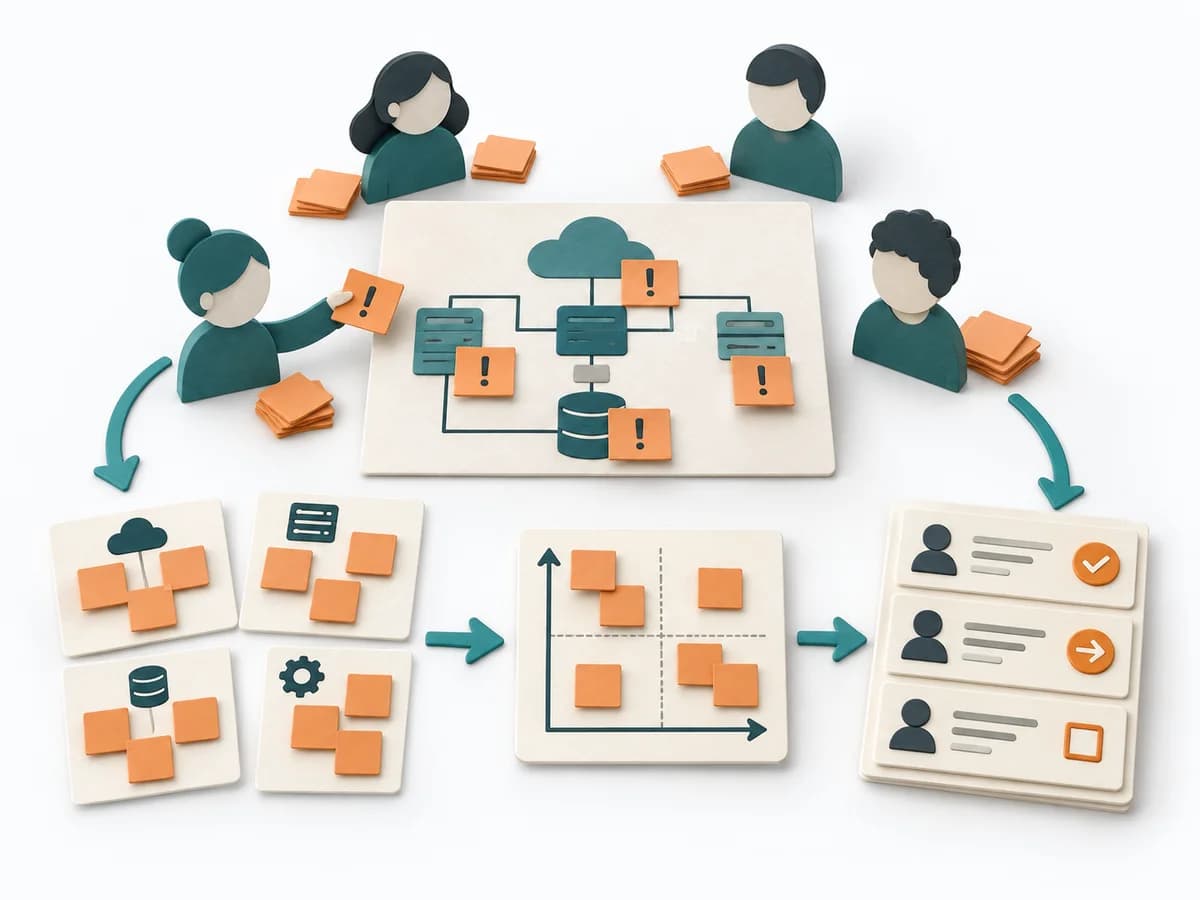
The team places the architecture picture at the centre and gathers risks in a silent phase. The cards are then clustered, prioritised, and given owners or next steps. The review becomes a concrete action plan around the architecture.
Which concrete failure scenarios sit where in the architecture, which matter collectively, and how will we reduce or test them?
The steps form one complete method run.
Context
Read diagram, scope, quality goals, and assumptions together; resolve comprehension questions.
Solo
Each person silently identifies concrete risk scenarios and locates them on an element or relationship.
Share
Explain notes in turn, cluster duplicates, and preserve different perspectives.
Assess
Justify qualitative exposure from plausible occurrence and consequence; mark evidence and unknowns.
Treat
For material risks avoid, reduce, transfer, or accept; assign experiment/ADR and owner.
Review
Approve residual risk, update diagram/ADR, and set trigger for another risk storm.
Add new evidence at review and version estimates with the prior state.
Risk Storming macht Risiken direkt am Architekturartefakt sichtbar und verbindet sie mit Priorität und Handlungsbedarf. Es eignet sich für frühe Reviews, wenn Unsicherheiten neben der Struktur stehen sollen.
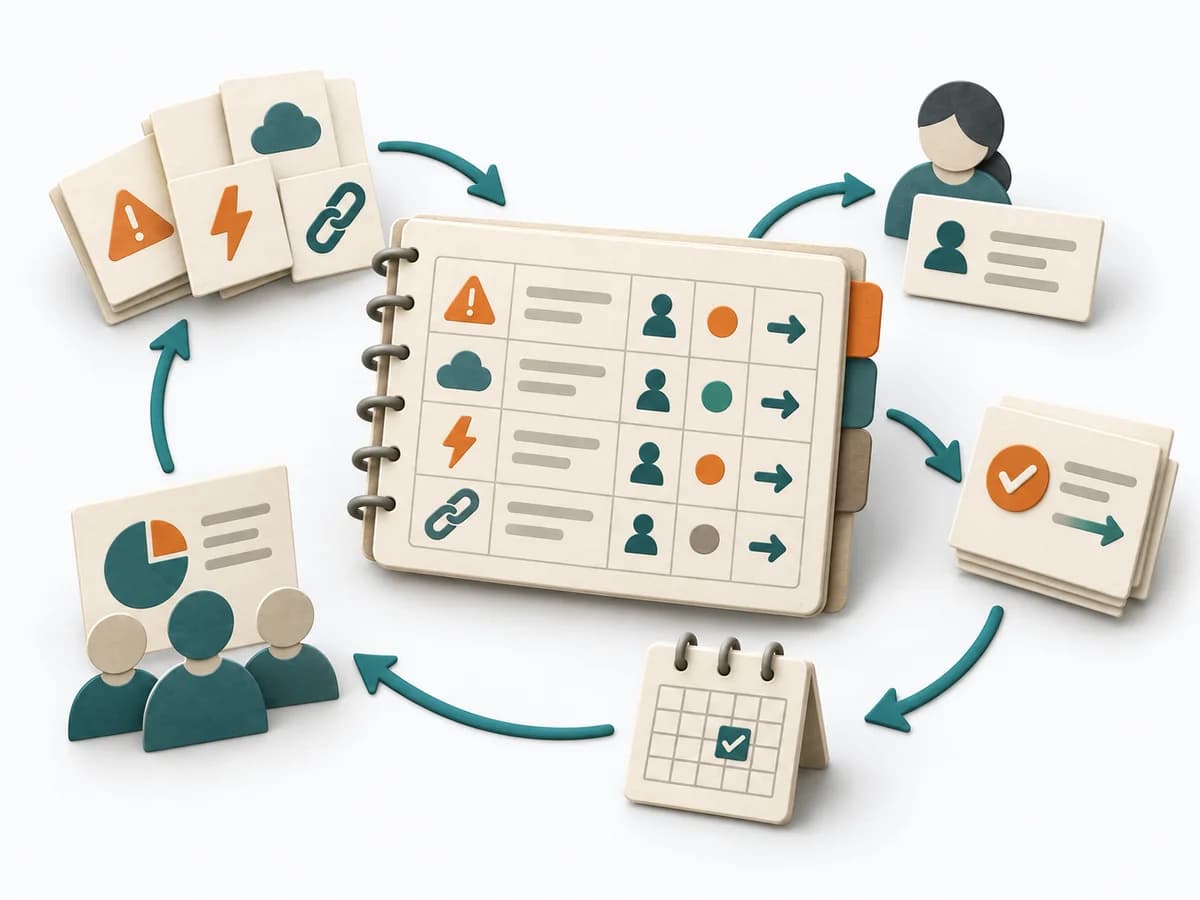
Annotated architecture risk map with scenarios, affected elements/relationships, evidence, qualitative exposure, actions, owners, and review.
Fictional example
Fictional values show the actual method fields.
| Risk | Location | Scenario | Quality goal | Evidence | Exposure | Treatment | Owner/review |
|---|---|---|---|---|---|---|---|
| R1 · Payment latencyAdd evidence and rationale. | Payment API → checkout pool | API slows → threads wait → pool exhausts → pickup fails | Availability; p80 wait | Load test: pool95%, errors 8% | High | Separate pool; GameDay ≤5% | Noor · 15 Nov |
| R2 · Retry stormAdd evidence and rationale. | Checkout → Payment API | Timeout → unbounded retries → partner overload | Resilience; partner limit | Retry limit untested | Medium/unknown | Retry budget and chaos test | Lea · 22 Nov |
All values are fictional.
Set architecture boundary, current diagram version, quality goals, and operating condition; invite required perspectives.
Helps clarify architecture context, options, and consequences in concrete terms. It organizes technical context, alternatives, and consequences. The result is captured as an Annotated Diagram, a Prioritized Risk List, and an Action Backlog.
The team places the architecture diagram at the center and gathers risks in a silent phase. The cards are then clustered, prioritized, and given owners or next steps. This turns a review into a concrete action plan around the architecture.
Risk Storming is a silent, group-based method in which each person first writes risks on sticky notes individually and places them on the relevant spot of an architecture sketch. Only after that does the group discuss, cluster, and rate the notes by impact and likelihood. The method comes from the software architecture space and works for any visual plan.
Provide enough working surface. Keep the sticky-note phase silent and free of discussion so all voices appear without bias. Only then start the moderated discussion.
The method guide walks execution through 6 phases, timing, 6 pitfalls, and clear stop criteria.
Open method guideYour perspective
Your feedback helps shape the next improvements to methodatlas.
Set subject, data, roles, flow, and review.
To be confirmed
To be confirmed
Complete run Time: 90–150 minutes for one architecture view; action tracking separate.
Complete this worksheet on paper or in your own document during the work.
| Risk | Location | Scenario | Quality goal | Evidence | Exposure | Treatment | Owner/review |
|---|---|---|---|---|---|---|---|
| R1 · Payment latency | |||||||
| R2 · Retry storm |
The blank worksheet contains prompts only.
Reference · original teaching example
Expected artifact: Shared map
Read diagram, scope, quality goals, and assumptions together; resolve comprehension questions.
Entry:
...
Expected artifact: Risk stickies
Each person silently identifies concrete risk scenarios and locates them on an element or relationship.
Entry:
...
Expected artifact: Risk clusters
Explain notes in turn, cluster duplicates, and preserve different perspectives.
Entry:
...
Expected artifact: Priority view
Justify qualitative exposure from plausible occurrence and consequence; mark evidence and unknowns.
Entry:
...
Expected artifact: Treatment plan
For material risks avoid, reduce, transfer, or accept; assign experiment/ADR and owner.
Entry:
...
Expected artifact: Risk decision
Approve residual risk, update diagram/ADR, and set trigger for another risk storm.
Entry:
...
...
Method guide: https://methodatlas.meierhoff-systems.de/en/methods/risk-storming/run-sheet
Fitting alternatives with decision guidance, followed by other related methods.
Instead of Risk Storming, choose Pre-Mortem when you want to think ahead from failure and surface risks early.

Instead of Risk Storming, choose Failure Mode and Effects Analysis when you want to systematically think through failure modes, effects, and prevention in advance.
Examines how architecture decisions support important quality goals and makes risks and trade-offs visible.
Helps a small team assess the main quality risks in its software and choose where to investigate further.
Bundles problem, goals, stakeholders, and risks into a starting picture that sorts early architecture questions.
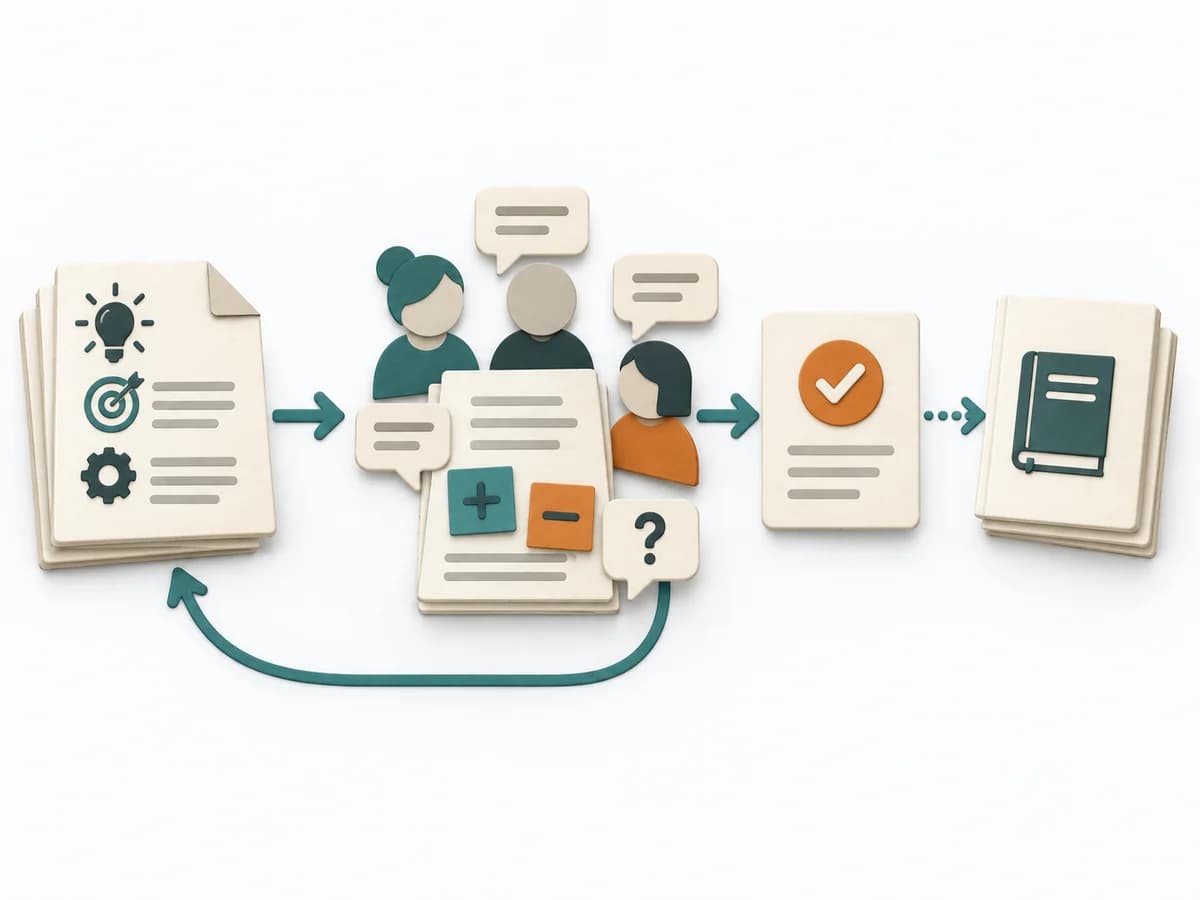
Uses a structured proposal and review process to make non-trivial technical or product changes discussable and decidable.