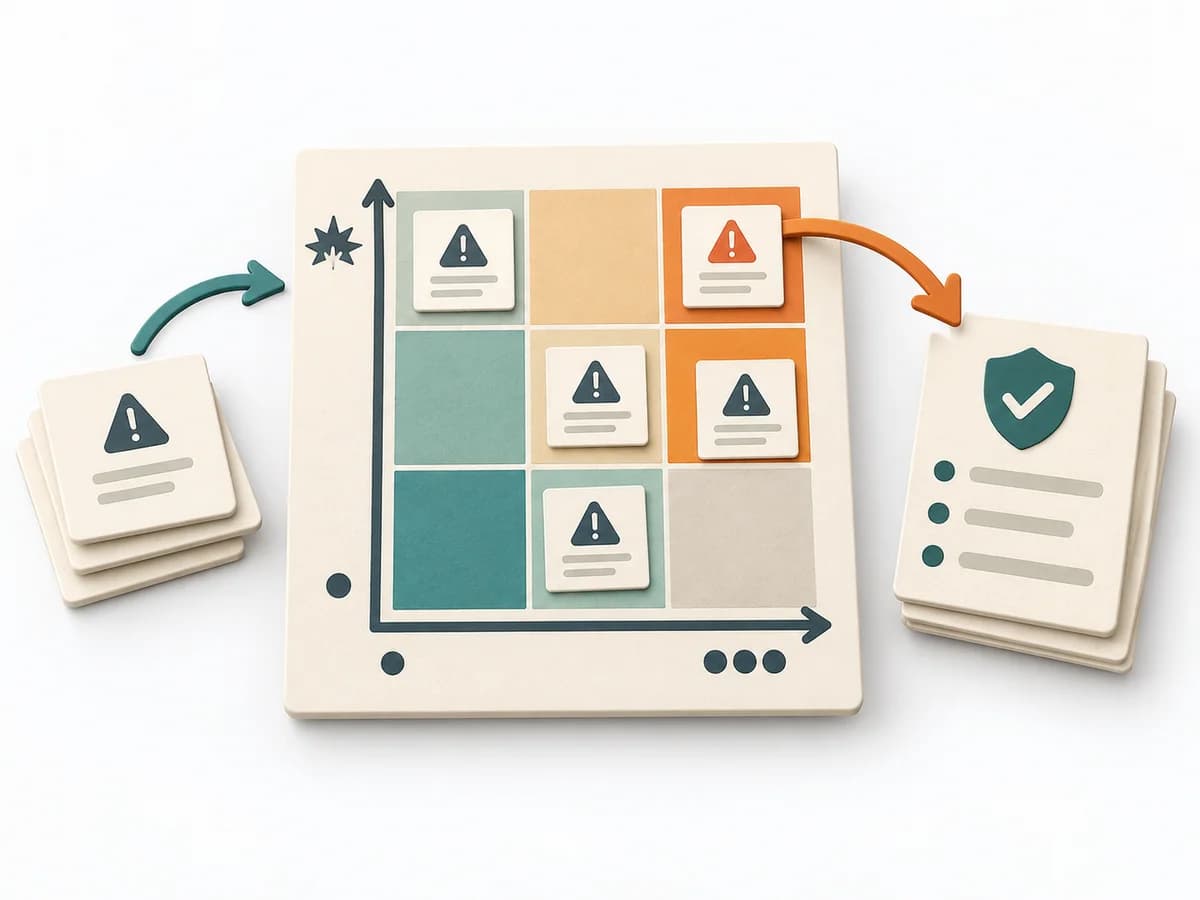

Purpose
Helps clarify scope, sequence, and delivery flow in concrete terms. It makes work, boundaries, and order steerable. The result is captured as a RAID Log and a source for status reporting.
Delivery Planning tool
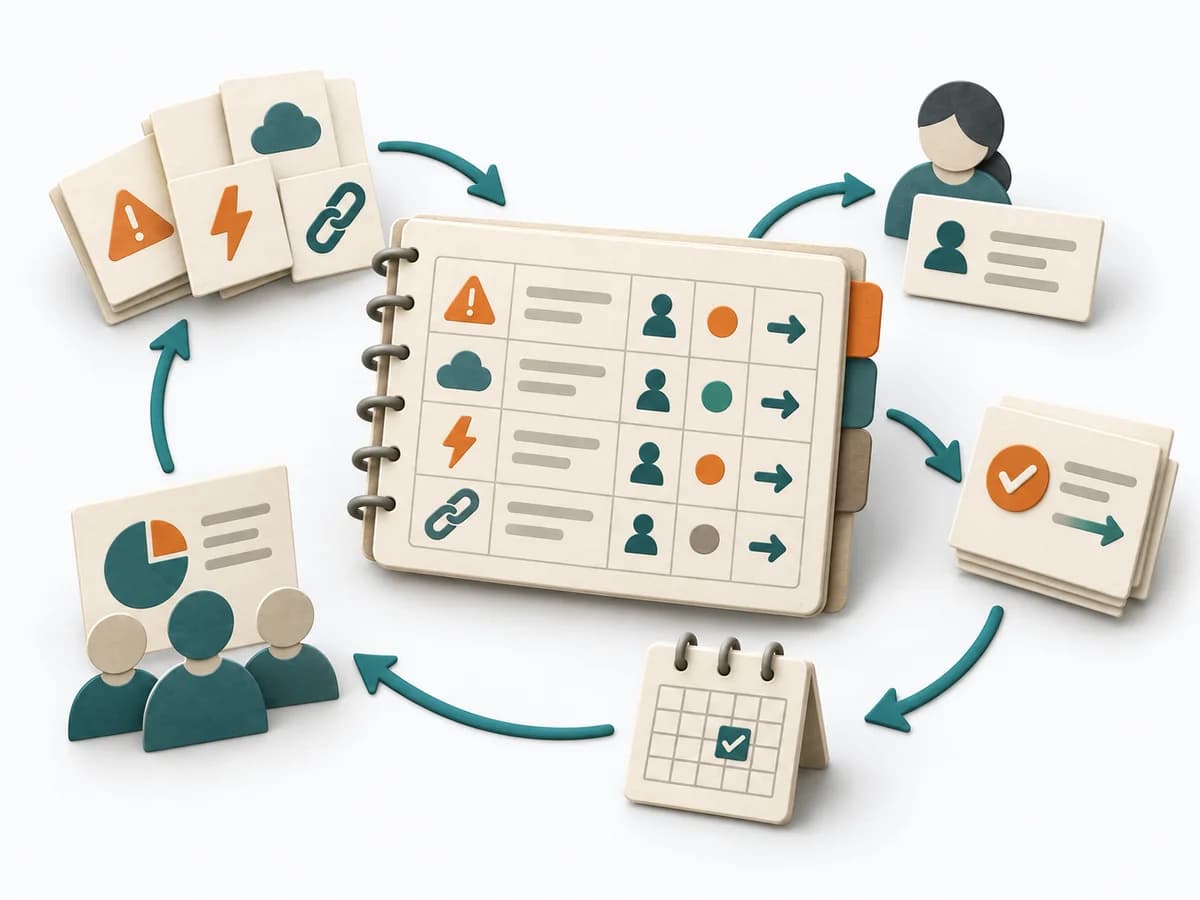
Manages Risks, Assumptions, Issues, and Dependencies in one living control source with clear type rules, owners, and actions.
A RAID Log combines four different control objects without confusing them: a risk is a possible event, an assumption is a provisional claim, an issue has already occurred, and a dependency is an external prerequisite. Its value comes from regular review and type-specific follow-up.
Which open Risks, Assumptions, Issues, and Dependencies threaten the next commitment, and who will do what by when?
Risk, assumption, issue, and dependency use different grammar, transitions, and follow-up actions.
Rules
Create a shared understanding of the four types and their follow-up.
Capture
Record every item with a type-specific statement, consequence, and source.
Control
Connect every open item to the right action, owner, date, and escalation rule.
Review
Maintain the log as the current control source and record transitions traceably.
Update at least weekly and before gates; retain type transitions, status changes, and decisions.
Useful for multi-team initiatives with external dependencies and governance reviews. Detailed causal analysis and full risk management need additional artefacts.
Typed items with consequence, source, status, owner, and next action.
Overdue items, type changes, decisions, and closure evidence with dates.
Fictional worked example
A living table with type-specific statements and actions.
| RAID ID | Type | Statement and consequence | Owner and date | Next action or evidence | Status and escalation |
|---|---|---|---|---|---|
| D-07External sandbox | Dependency | Payment provider supplies the new sandbox by 24 June; without it, no end-to-end test. | Partner Manager · 24 June | Prove delivery with a successful API health check. | Open; if late, reconsider release scope on 25 June. |
Each type has a different follow-up: treat, validate, resolve, or secure delivery.
Start with the core question: Which open Risks, Assumptions, Issues, and Dependencies threaten the next commitment, and who will do what by when?
Helps clarify scope, sequence, and delivery flow in concrete terms. It makes work, boundaries, and order steerable. The result is captured as a RAID Log and a source for status reporting.
Every entry carries an owner, a status, and a next move so that nothing is merely documented but also tracked. Ongoing maintenance keeps the picture current and creates a reliable source for reviews, escalations, and stakeholder updates.
The RAID Log is a project management classic that combines risks, assumptions, open issues, and dependencies in one living list. Each entry gets an owner, status, date, and next step. It works well as an asynchronous backbone artifact and briefing source for stakeholders.
Set aside a fixed 15-minute slot once a week to keep it current. Close stale items decisively or move them to a different category.
The method guide walks execution through 4 phases, timing, 4 pitfalls, and clear stop criteria.
Open method guideYour perspective
Your feedback helps shape the next improvements to methodatlas.
Plan RAID Log with real scope, suitable roles, and a clear decision objective.
To be confirmed
To be confirmed
Establish and review the practice Time: 45 minutes initially; 15–30 minutes per review
Complete this worksheet on paper or in your own document during the work.
| RAID ID | R/A/I/D | Statement · consequence | Owner · date | Action · evidence | Status · trigger |
|---|---|---|---|---|---|
| D-07 |
Choose exactly one type per item and set a verifiable next step.
UK Government Gate 2 Review: Delivery Strategy
Expected artifact: RAID convention
Type rules · required fields · status · cadence
Entry:
...
Expected artifact: Qualified entries
ID · type · statement · consequence · source
Entry:
...
Expected artifact: Controllable log
Action · owner · date · status · escalation
Entry:
...
Expected artifact: Updated RAID log
Status · transition · decision · closure evidence
Entry:
...
...
Method guide: https://methodatlas.meierhoff-systems.de/en/methods/raid-log/run-sheet
Fitting alternatives with decision guidance, followed by other related methods.
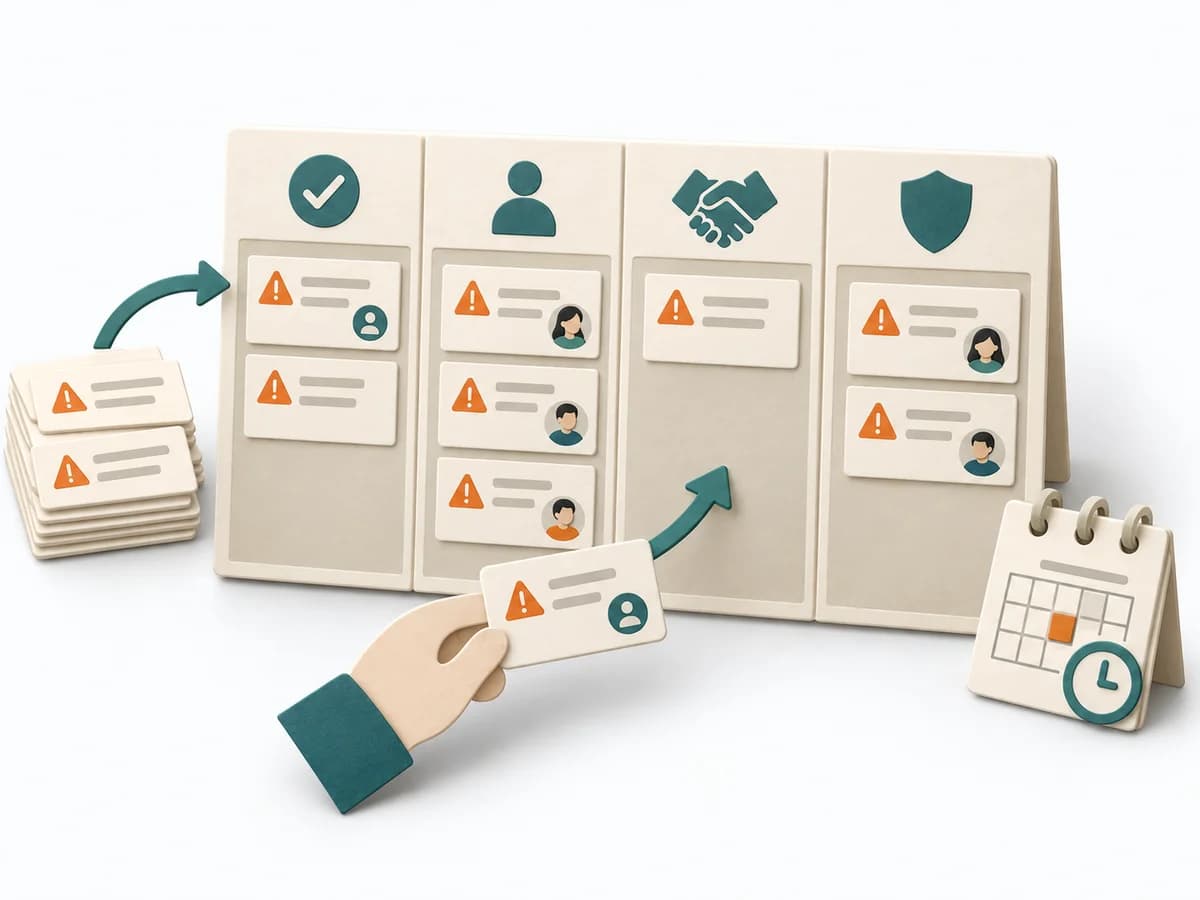
Instead of RAID Log, choose ROAM Board when you want to discuss risks together and only need a living status of actions.
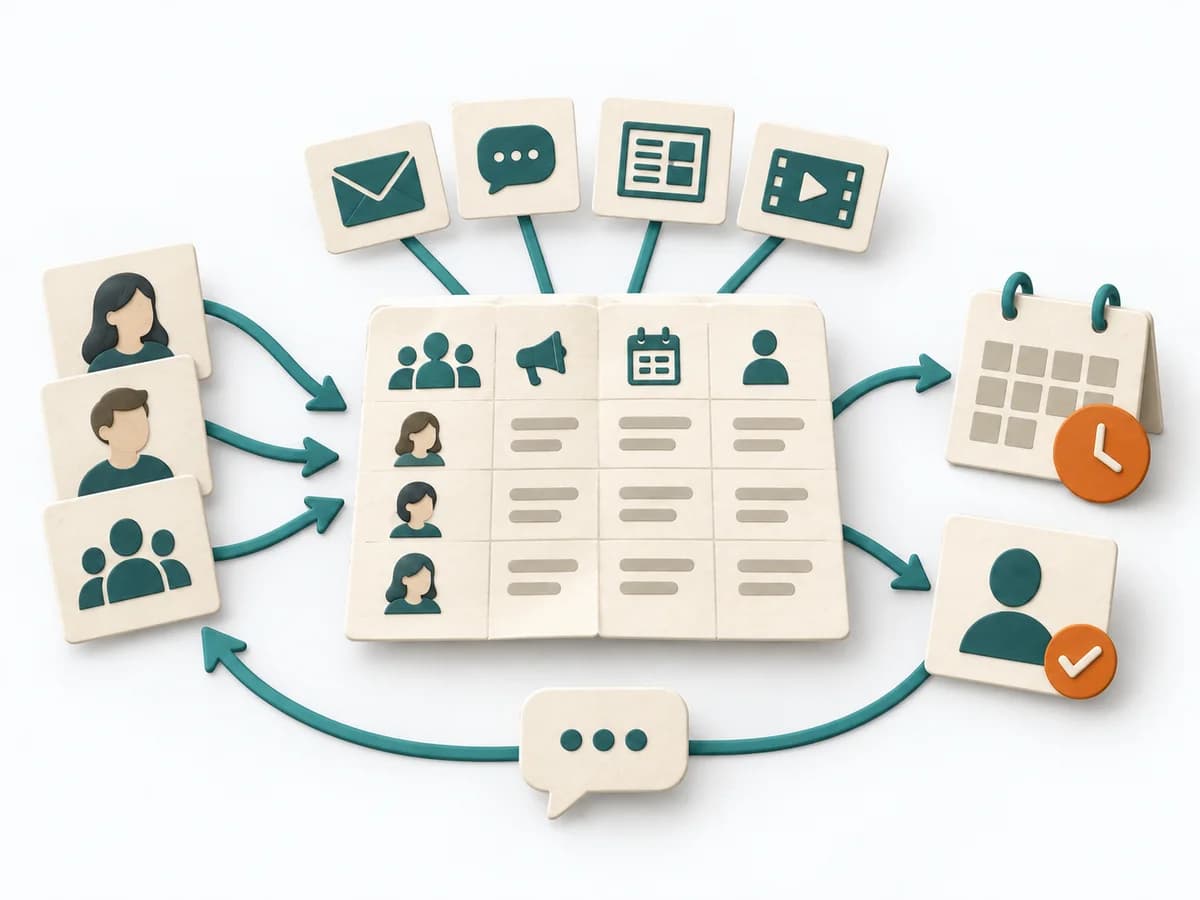
Defines audiences, channels, frequencies, and owners so relevant information reliably gets through.

Moves group input, selection, and decision toward a concrete result through "prepare the stakeholder list", "define power, legitimacy, and urgency", and "derive strategy by class".
Prioritizes requirements across must, should, could, and won't, creating a negotiable release set with clear boundaries.

Moves group input, selection, and decision toward a concrete result through "collect stakeholders individually and by group", "explain power and interest", and "derive a strategy for each quadrant".

Clarifies responsibility for tasks and deliverables, exposes gaps or overload, and improves alignment.