Architecture Inception Canvas: Worksheet
Plan a session or initiative to match the actual scope of work.
# Architecture Inception Canvas: Worksheet

## Question
To be confirmed

## Desired outcome
To be confirmed

## Scope
Prepare the full method
Time: 60–120 minutes with prepared participants; missing requirements or technical research are separate.

Complete this worksheet on paper or in your own document during the work.

## Preparation for this scope

### Method setup
- **Materials:** Official canvas, business goals, communication partners, known constraints and key stakeholders.
- **Roles:** Product/business · software architecture · engineering · stakeholders responsible for quality.
- **Advance information:** Choose materials, data access and participants to fit the research or decision question.
- **Overall time needed:** 60–120 minutes with prepared participants; missing requirements or technical research are separate.
- **Setup:** Open the method-specific structure. Fictional examples are for orientation only; keep the blank worksheet separate from actual findings.

### Prepare for the work steps

#### System: Name system and business case
- Use the published Architecture Inception Canvas and record system, team, workshop date and iteration.
- Official canvas, business goals, communication partners, known constraints and key stakeholders.

#### Goals: Capture context and quality goals
- Context for a greenfield inception
- Official canvas, business goals, communication partners, known constraints and key stakeholders.

#### Constraints: Record constraints
- Context diagram and quality goals
- Official canvas, business goals, communication partners, known constraints and key stakeholders.

#### Hypotheses: Record hypotheses and risks
- Traceable constraints
- Official canvas, business goals, communication partners, known constraints and key stakeholders.


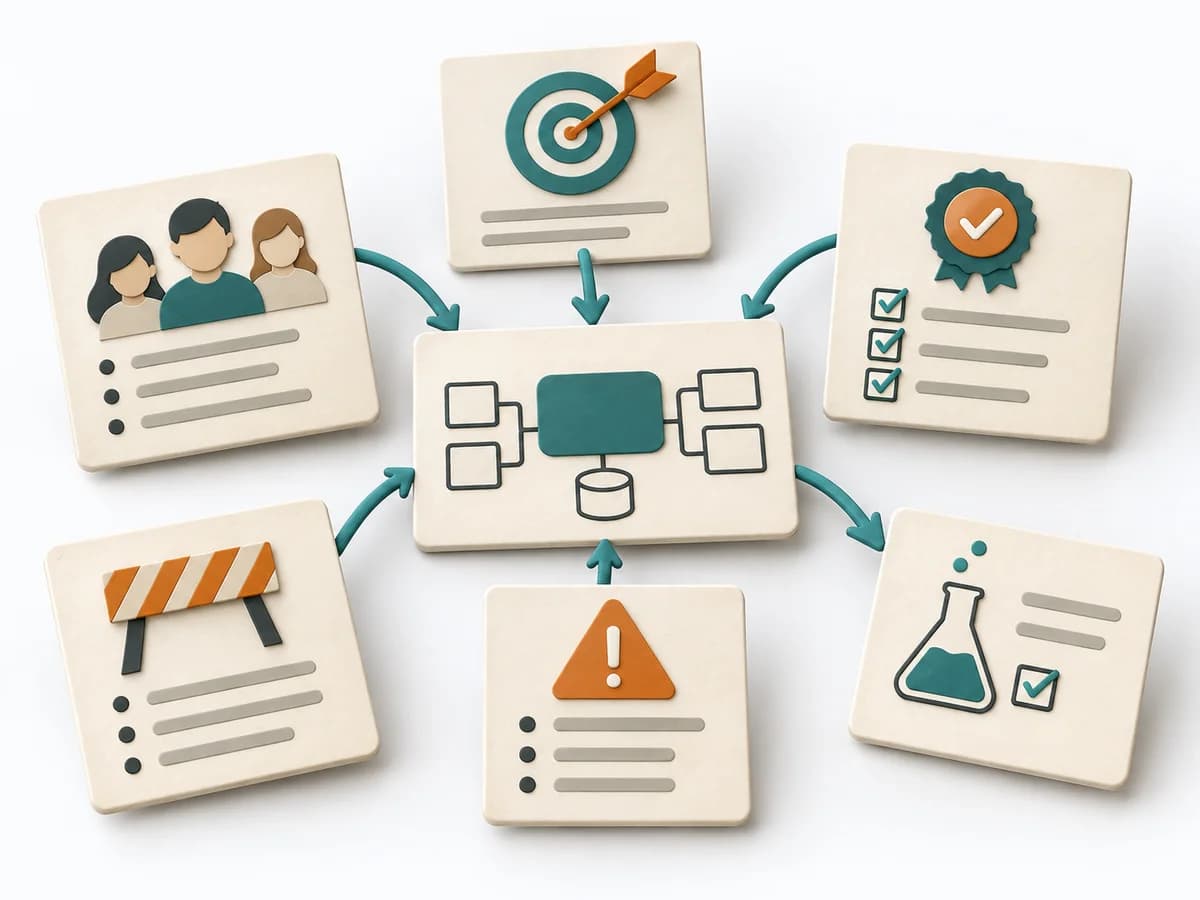
## Architecture Inception Canvas fields from the published template

### Business Case
Describe the business or economic driver.

...

### Functional Overview
List the most important functions at high level.

...

### Business Context
Show the system as a black box and its communication partners.

...

### Organisational Constraints
Record organizational limits on design choices.

...

### Quality Goals
Name three top quality goals from key stakeholder view.

...

### Technical Constraints
Record technical limits on design choices.

...

### Architectural Hypotheses
Record consequential architecture hypotheses and reasons.

...

### Technical Challenges & Risks
List known technical challenges and risks.

...

[Architecture Inception Canvas (official PDF)](https://canvas.arc42.org/downloads/architecture-inception-canvas.pdf)


## System: Name system and business case
Expected artifact: Context for a greenfield inception

Context for a greenfield inception

Entry:

...

- [ ] Is purpose separate from technology?

## Goals: Capture context and quality goals
Expected artifact: Context diagram and quality goals

Context diagram and quality goals

Entry:

...

- [ ] Are partners and quality expectations concrete?

## Constraints: Record constraints
Expected artifact: Traceable constraints

Traceable constraints

Entry:

...

- [ ] Is every constraint binding and verifiable?

## Hypotheses: Record hypotheses and risks
Expected artifact: Hypotheses and technical challenges

Hypotheses and technical challenges

Entry:

...

- [ ] Is a concrete check planned?

## Open questions and next steps

...

Method guide: https://methodatlas.meierhoff-systems.de/en/methods/architecture-inception-canvas/run-sheet
Quality Attribute Workshop: Worksheet
Prepare Quality Attribute Workshop with a clear question, roles, and sources.
# Quality Attribute Workshop: Worksheet

## Question
To be confirmed

## Desired outcome
To be confirmed

## Scope
Plan the full method
Time: Set according to scope and available evidence

Complete this worksheet on paper or in your own document during the work.

## Preparation for this scope

### Method setup
- **Materials:** Shared workspace, accessible sources, and a decision log.
- **Roles:** Facilitator · stakeholders · architecture · scribe
- **Advance information:** Clarify the question, timeframe, data access, roles, and known uncertainties in advance.
- **Overall time needed:** A full facilitated workshop; additional stakeholder groups may require further workshops.
- **Setup:** Create a shared version. Label facts, assumptions, and decisions separately.

### Prepare for the work steps

#### Drivers: Understand drivers and stakeholders
- Business drivers, users, and system context

#### Scenarios: Elicit quality scenarios
- Stakeholder needs and quality scenarios

#### Prioritization: Consolidate and prioritize
- Scenarios and prioritization rationale

#### Refinement: Refine key scenarios
- Refined stimulus-environment-response measures


## Prioritized quality scenarios, not a finished architecture

### Driver
Record business goals, system context, and represented roles.

...

### Scenario
Write concrete stimulus, context, and response scenarios.

...

### Priority
Record consolidated scenarios and prioritization rationale.

...

### Open question
Add source, quality attribute, and testable response.

...

Blank worksheet: start with a bounded question. Enter observed facts only, mark assumptions, and record open questions and sources.

[Quality Attribute Workshop Collection · Software Engineering Institute](https://www.sei.cmu.edu/library/quality-attribute-workshop-collection/)


## Drivers: Understand drivers and stakeholders
Expected artifact: Consolidated business and architecture drivers

Consolidated business and architecture drivers

Entry:

...

- [ ] Are important perspectives represented?

## Scenarios: Elicit quality scenarios
Expected artifact: Quality scenarios from stakeholder perspectives

Quality scenarios from stakeholder perspectives

Entry:

...

- [ ] Are scenarios observable and contextual?

## Prioritization: Consolidate and prioritize
Expected artifact: Prioritized scenarios with rationale

Prioritized scenarios with rationale

Entry:

...

- [ ] Are conflicts and trade-offs visible?

## Refinement: Refine key scenarios
Expected artifact: Refined stimulus-environment-response measures

Refined stimulus-environment-response measures

Entry:

...

- [ ] Can results inform architecture, prototypes, or tests?

## Open questions and next steps

...

Method guide: https://methodatlas.meierhoff-systems.de/en/methods/quality-attribute-workshop/run-sheet
Risk Storming: Worksheet
Set subject, data, roles, flow, and review.
# Risk Storming: Worksheet

## Question
To be confirmed

## Desired outcome
To be confirmed

## Scope
Complete run
Time: 90–150 minutes for one architecture view; action tracking separate.

Complete this worksheet on paper or in your own document during the work.

## Preparation for this scope

### Method setup
- **Materials:** Current C4/architecture diagrams, quality goals and constraints, risk stickies, evidence, action and decision log
- **Roles:** Architecture/tech lead · developers · operations/security · domain/product · facilitator · risk owners
- **Advance information:** Set architecture boundary, current diagram version, quality goals, and operating condition; invite required perspectives.
- **Overall time needed:** 90–150 minutes for one architecture view; action tracking separate.
- **Setup:** Prepare a workspace with Context · Solo · Share · Assess · Treat · Review; separate example from live data.

### Prepare for the work steps

#### Context: Shared map
- Set architecture boundary, current diagram version, quality goals, and operating condition; invite required perspectives.
- Current C4/architecture diagrams, quality goals and constraints, risk stickies, evidence, action and decision log

#### Solo: Risk stickies
- Shared map

#### Share: Risk clusters
- Risk stickies

#### Assess: Priority view
- Risk clusters

#### Treat: Treatment plan
- Priority view

#### Review: Risk decision
- Treatment plan


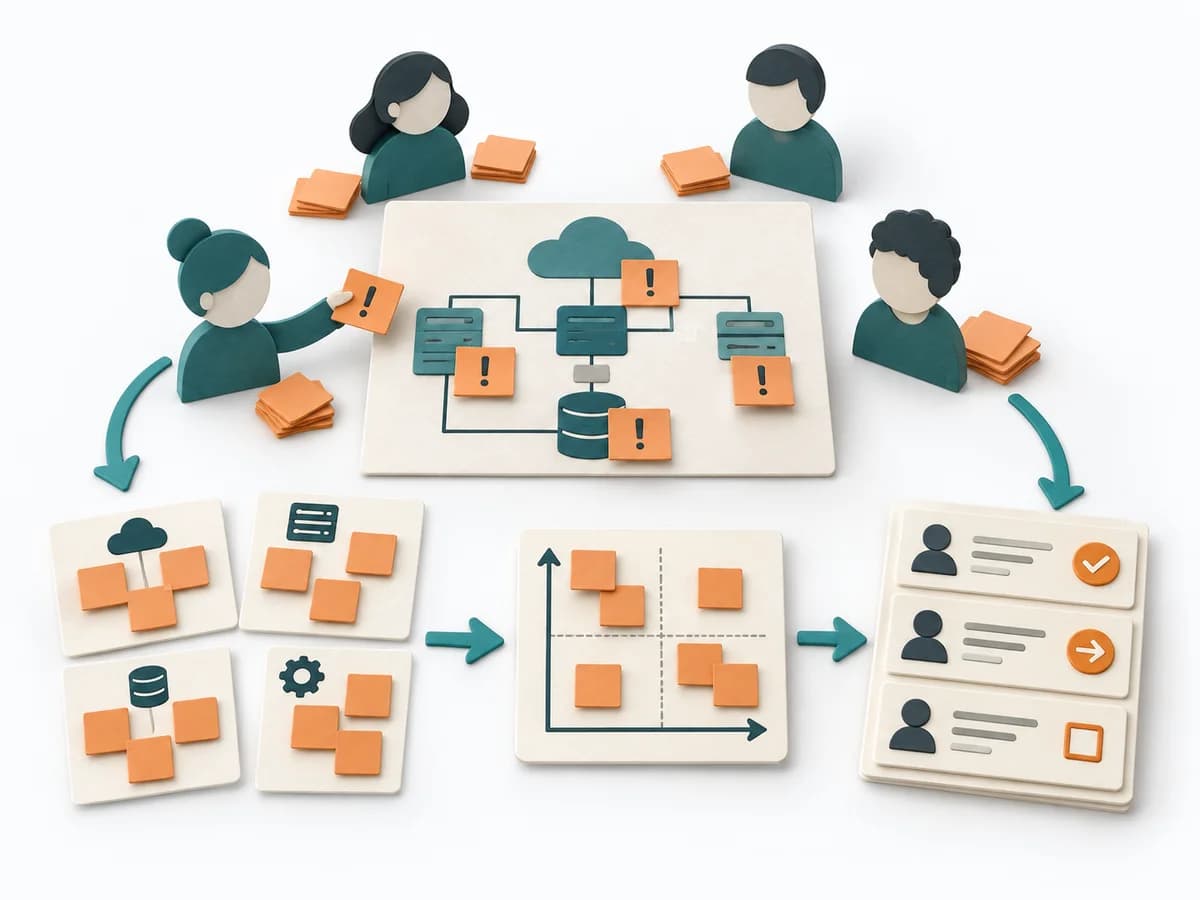
## Risk Storming · working structure

| Risk | Location | Scenario | Quality goal | Evidence | Exposure | Treatment | Owner/review |
| --- | --- | --- | --- | --- | --- | --- | --- |
| R1 · Payment latency |   |   |   |   |   |   |   |
| R2 · Retry storm |   |   |   |   |   |   |   |

- **R1 · Payment latency:** Add evidence and rationale.
- **R2 · Retry storm:** Add evidence and rationale.

The blank worksheet contains prompts only.

[Reference · original teaching example](https://simonbrown.je/workshops/)


## Context: Shared map
Expected artifact: Shared map

Read diagram, scope, quality goals, and assumptions together; resolve comprehension questions.

Entry:

...

- [ ] Does everyone understand elements, relationships, and critical quality goals alike?

## Solo: Risk stickies
Expected artifact: Risk stickies

Each person silently identifies concrete risk scenarios and locates them on an element or relationship.

Entry:

...

- [ ] Does every note contain trigger, event, and impact?

## Share: Risk clusters
Expected artifact: Risk clusters

Explain notes in turn, cluster duplicates, and preserve different perspectives.

Entry:

...

- [ ] Do distinct scenarios stay separate and common causes remain visible?

## Assess: Priority view
Expected artifact: Priority view

Justify qualitative exposure from plausible occurrence and consequence; mark evidence and unknowns.

Entry:

...

- [ ] Is high exposure grounded in scenario and evidence rather than calculated points?

## Treat: Treatment plan
Expected artifact: Treatment plan

For material risks avoid, reduce, transfer, or accept; assign experiment/ADR and owner.

Entry:

...

- [ ] Does every action state expected risk effect and proof?

## Review: Risk decision
Expected artifact: Risk decision

Approve residual risk, update diagram/ADR, and set trigger for another risk storm.

Entry:

...

- [ ] Is acceptance owned by an authorised person with review date?

## Open questions and next steps

...

Method guide: https://methodatlas.meierhoff-systems.de/en/methods/risk-storming/run-sheet
Request for Comments: Worksheet
Plan Request for Comments (RFC) around its domain steps and the concrete decision question.
# Request for Comments: Worksheet

## Question
To be confirmed

## Desired outcome
To be confirmed

## Scope
Establish and review the practice
Time: 2–10 working days by consequence

Complete this worksheet on paper or in your own document during the work.

## Preparation for this scope

### Method setup
- **Materials:** Problem and constraints, design draft and alternatives, reviewers and decision owner, shared workspace, source links, and decision log.
- **Roles:** Author · reviewers · decision owner · affected implementers
- **Advance information:** Collect Problem and constraints, design draft and alternatives, reviewers and decision owner in advance and mark open assumptions.
- **Overall time needed:** 2–10 working days by consequence
- **Setup:** Prepare versioned proposal with open review window, resolved comments, and explicit status visibly and calibrate assessment terms before starting.

### Prepare for the work steps

#### Draft: Draft
- Problem and constraints
- design draft and alternatives
- reviewers and decision owner

#### Review: Review
- RFC draft
- design draft and alternatives
- reviewers and decision owner

#### Decision: Decision
- review record
- design draft and alternatives
- reviewers and decision owner

#### Lifecycle: Lifecycle
- RFC decision
- design draft and alternatives
- reviewers and decision owner


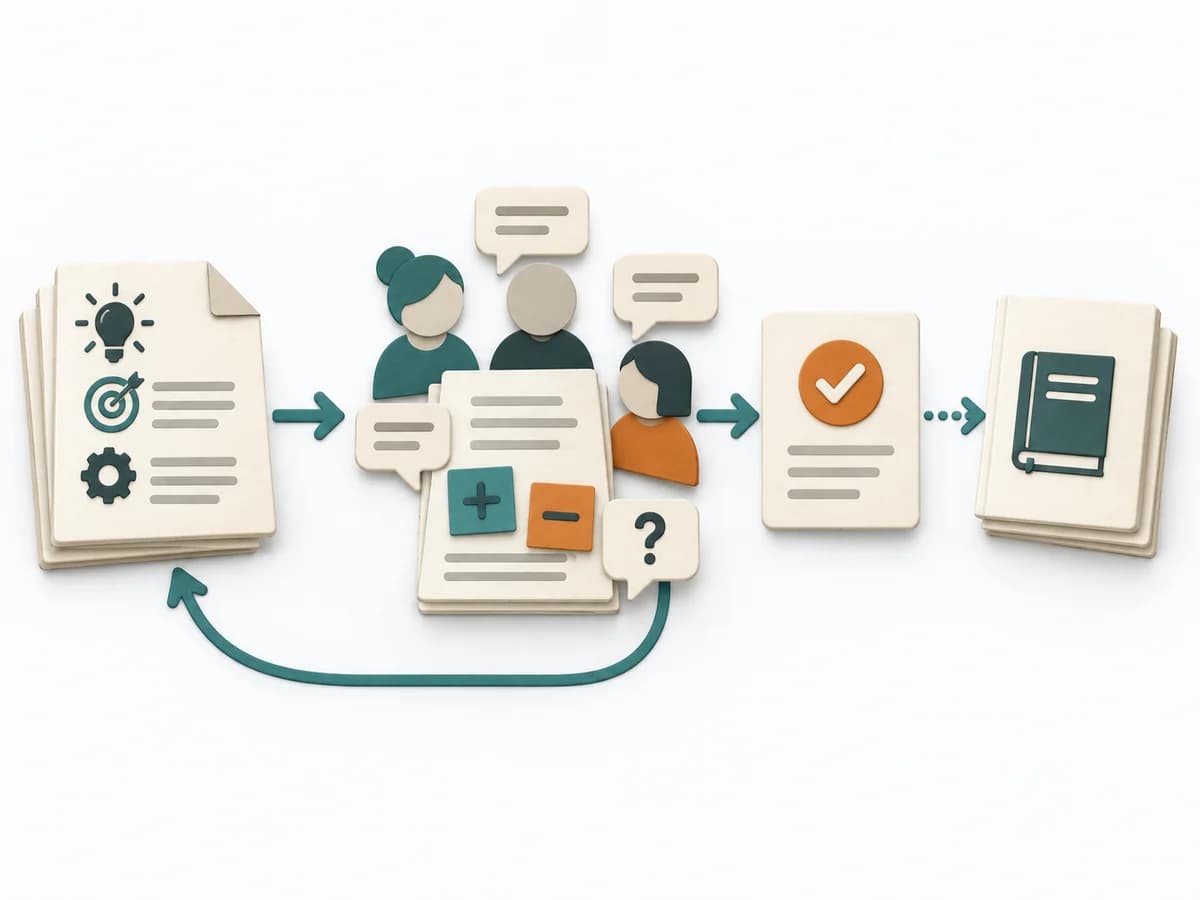
## RFC record

### Problem/goals
Problem/goals information to record

...

### Proposal/alternatives
Proposal/alternatives information to record

...

### Review/decision
Review/decision information to record

...

### Migration/status
Migration/status information to record

...

Enter only real input, sources, and decisions.

[IETF RFC 2026: The Internet Standards Process](https://www.rfc-editor.org/rfc/rfc2026)


## Draft: Draft
Expected artifact: RFC draft

RFC draft · source · uncertainty · next decision

Entry:

...

- [ ] Are trade-offs included rather than only benefits?

## Review: Review
Expected artifact: review record

review record · source · uncertainty · next decision

Entry:

...

- [ ] Are Security, Operations, and consumers represented?

## Decision: Decision
Expected artifact: RFC decision

RFC decision · source · uncertainty · next decision

Entry:

...

- [ ] Is every material objection addressed?

## Lifecycle: Lifecycle
Expected artifact: RFC lifecycle

RFC lifecycle · source · uncertainty · next decision

Entry:

...

- [ ] Does status reflect reality?

## Open questions and next steps

...

Method guide: https://methodatlas.meierhoff-systems.de/en/methods/rfc/run-sheet