Purpose
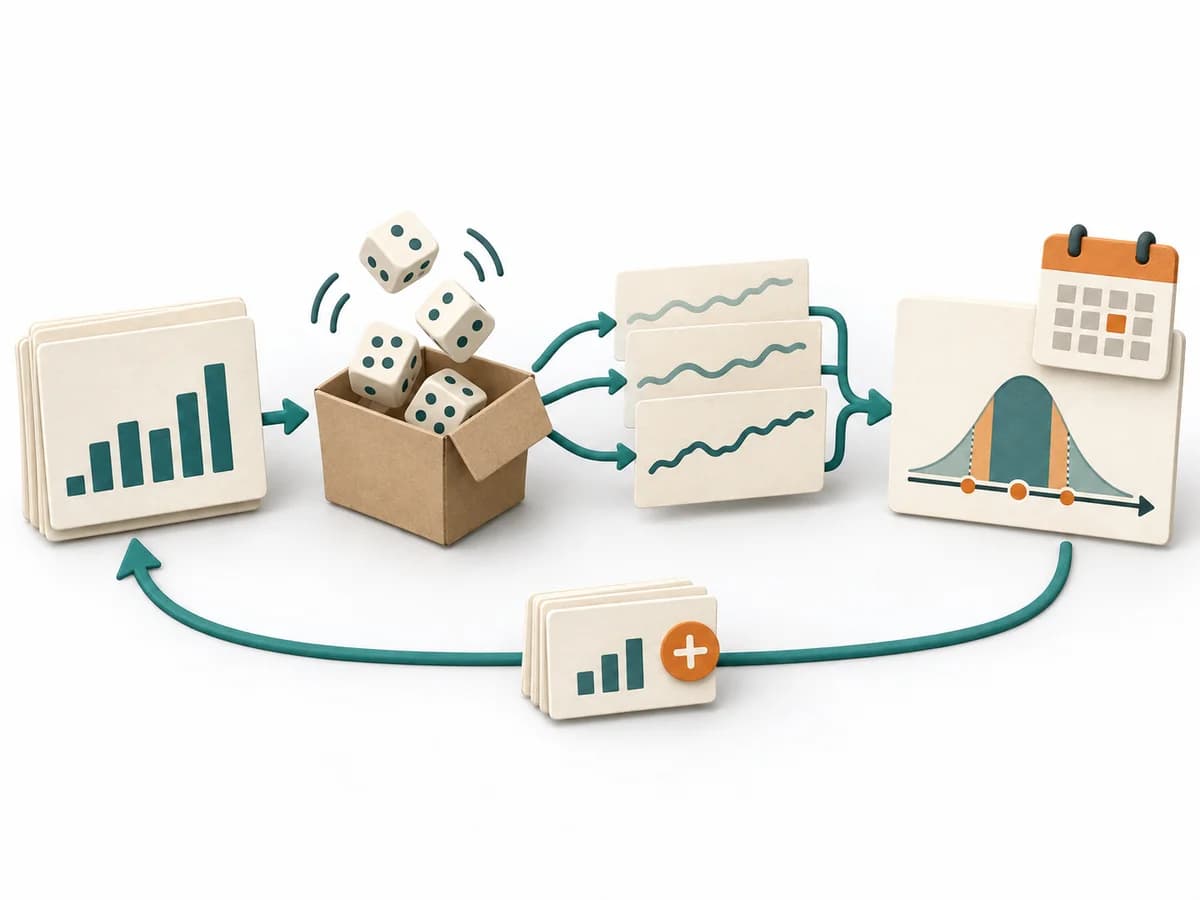
On complex initiatives, a plain average tends to understate just how uncertain the outcome really is. It separates options, evaluation criteria, and open risks. The result is captured as a PERT Estimate, Expected Value, and Risk Notes.
Decision Making Decision method
Combines three estimates into an expected value and makes variation and risk visible.
Optimistische, wahrscheinlichste und pessimistische Einschätzungen werden mathematisch gewichtet, statt einfach gemittelt zu werden. So entsteht eine Planungszahl, die Unsicherheit sichtbar mitführt und weniger von Extremwerten verzerrt wird. Nützlich ist vor allem die konsistente Verbindung von Schätzung und Risikobild.
What PERT expected values and variances follow from O/M/P, and how are independent work packages aggregated correctly?
The steps form one complete method run.
Scope
Capture work packages, unit, Done, dependencies, and common risks.
Values
Set O, M, and P per package as plausible scenarios with O ≤ M ≤ P.
Calculate
For each package calculate E=(O+4M+P)/6, SD=(P−O)/6, and variance=SD².
Aggregate
Only under independence add expected values and variances; total SD is square root of summed variance.
Interpret
Use measures with assumptions; do not claim confidence without a validated distribution.
Add new evidence at review and version estimates with the prior state.
Bei komplexen Vorhaben verfälscht ein reiner Mittelwert die Unsicherheit oft zu stark. PERT Estimation verbindet drei Lagebilder zu einem erwarteten Wert und hält das Risiko der Streuung mit im Blick.
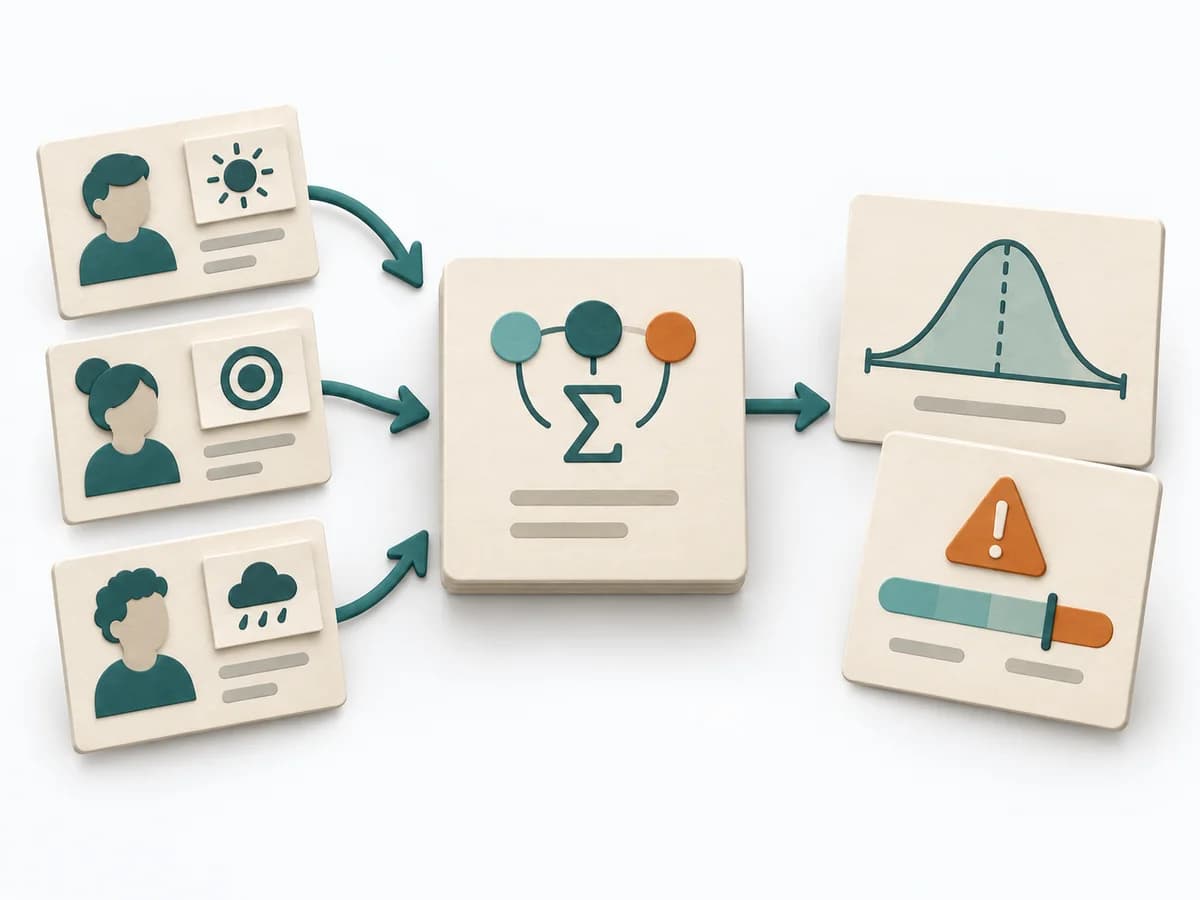
PERT table with E=(O+4M+P)/6, SD=(P−O)/6, variance=SD², aggregated independent variances, and stated model limits.
Fictional example
Fictional values show the actual method fields.
| Package | O / M / P | E = (O+4M+P)/6 | SD = (P−O)/6 | Variance | Dependency | Model limit |
|---|---|---|---|---|---|---|
| A · TokenisationAdd evidence and rationale. | 4 / 7 / 16 days | (4+28+16)/6 = 8.00 | (16−4)/6 = 2.00 | 4.00 | Independent of B for example | Check shared certification |
| B · RolloutAdd evidence and rationale. | 2 / 3 / 8 days | (2+12+8)/6 = 3.67 | (8−2)/6 = 1.00 | 1.00 | Independent of A for example | Rollout window fixed |
| AggregateAdd evidence and rationale. | Do not average again | 8.00+3.67 = 11.67 | √(4+1) = 2.24 | 5.00 | Only under independence | No guaranteed interval |
All values are fictional.
Close work packages, unit, Done, and dependencies; explicitly check independence before aggregating variance.
On complex initiatives, a plain average tends to understate just how uncertain the outcome really is. It separates options, evaluation criteria, and open risks. The result is captured as a PERT Estimate, Expected Value, and Risk Notes.
Optimistic, most likely, and pessimistic estimates are weighted mathematically instead of simply averaged. This produces a planning figure that visibly carries uncertainty along with it and is distorted less by extreme values. What is especially useful is the consistent link between estimate and risk picture.
PERT Estimation uses the same three values as Three-Point Estimation but gives the most likely value more weight. That produces an expected value that is less distorted by extremes than a simple average. The method can also consider variance or standard deviation to communicate schedule or cost risk. It remains an expert estimate and should not be mistaken for a precise prediction.
Explain the formula and the meaning of the three values up front. Calculate transparently and record assumptions, especially when pessimistic values are driven by dependencies or external risks. Use the numbers as decision input, not as a delivery promise.
The method guide walks execution through 5 phases, timing, 5 pitfalls, and clear stop criteria.
Open method guideYour perspective
Your feedback helps shape the next improvements to methodatlas.
Set subject, data, roles, flow, and review.
To be confirmed
To be confirmed
Complete run Time: 45–90 minutes for a small set of independent work packages; network scheduling separate.
Complete this worksheet on paper or in your own document during the work.
| Package | O / M / P | E = (O+4M+P)/6 | SD = (P−O)/6 | Variance | Dependency | Model limit |
|---|---|---|---|---|---|---|
| A · Tokenisation | ||||||
| B · Rollout | ||||||
| Aggregate |
The blank worksheet contains prompts only.
Reference · original teaching example
Expected artifact: PERT frame
Capture work packages, unit, Done, dependencies, and common risks.
Entry:
...
Expected artifact: O/M/P table
Set O, M, and P per package as plausible scenarios with O ≤ M ≤ P.
Entry:
...
Expected artifact: PERT measures
For each package calculate E=(O+4M+P)/6, SD=(P−O)/6, and variance=SD².
Entry:
...
Expected artifact: Aggregate
Only under independence add expected values and variances; total SD is square root of summed variance.
Entry:
...
Expected artifact: Planning finding
Use measures with assumptions; do not claim confidence without a validated distribution.
Entry:
...
...
Method guide: https://methodatlas.meierhoff-systems.de/en/methods/pert-estimation/run-sheet
Fitting alternatives with decision guidance, followed by other related methods.

Instead of PERT Estimation, choose Ideal Days when you want to express effort in pure working days and keep team calibration manageable.

Instead of PERT Estimation, choose Story Points when you want to estimate relative complexity instead of calendar time and calibrate your estimation as a team.

Moves options, criteria, and risks toward a concrete result through "clarify the estimate object and unit", "collect independent estimates", and "document another round and the outcome".

Clarifies options, criteria, and risks by framing the initiative or decision, collecting implicit assumptions, and planning tests or research.

Thinks through failure in advance to surface risks, countermeasures, and critical assumptions early.

Examines an initiative from an opposing perspective, collects weaknesses, and derives prioritized mitigations.