

Purpose
Helps clarify observations, needs, and patterns in concrete terms. It groups observations into patterns, questions, and decisions. The result is captured as a HEART-GSM table and dashboard.
UX Research Framework
Translates UX goals across Happiness, Engagement, Adoption, Retention, and Task Success into signals and measurable metrics.
HEART is not a mandatory set of five metrics. Teams select relevant categories and move from Goal to Signal to Metric. The metric must represent the signal and support a product decision.
Which UX goals matter, what behaviour or experience signals progress, and which metric measures it reliably?
HEART Framework uses a Goal-Signal-Metric chain for selected HEART categories. Assessments remain justified and context-bound.

Select categories
Select relevant HEART categories from the product objective and user problem.
Goals/signals
State one user-centred goal and observable signals of progress or degradation per category.
Define metrics
Operationalise the signal with formula, population, window, segment, and data source.
Review decisions
Set baseline, target direction, guardrails, and product decision, then review regularly.
Review goals and signals after product changes; version metric definitions and inspect segment effects.
Useful for digital product experiences with measurable user behaviour. Add other frameworks for purely business or system metrics.
HEART goals-signals-metrics map with traceable sources, assumptions, and domain decisions.
Owners, dates, and next review for HEART goals-signals-metrics map.
Fictional worked example
a Goal-Signal-Metric chain for selected HEART categories as a precise working structure with a fictional example.
| UX goal | HEART category | Goal | Signal | Metric | Interpretation and decision |
|---|---|---|---|---|---|
| Complete team reviewSelected UX objective | Task Success | Teams complete reviews without facilitator help. | Outcome and decision are saved. | Reviews with saved outcome ≤30 min / started reviews. | Baseline 54%, target +10 pp; abandonment guardrail; test flow if flat. |
The example demonstrates the domain logic of HEART Framework; worksheets remain blank.
Google Research: Measuring the User Experience on a Large Scale
Start with the core question: Which UX goals matter, what behaviour or experience signals progress, and which metric measures it reliably?
Helps clarify observations, needs, and patterns in concrete terms. It groups observations into patterns, questions, and decisions. The result is captured as a HEART-GSM table and dashboard.
Each dimension is linked to a goal, a matching signal, and a concrete metric, so that measurement is tied to impact rather than to data volume. This creates a stable measurement picture that structures reviews and brings qualitative impressions together with behavior.
The HEART Framework was developed at Google and combines qualitative and behavioral signals into a multi-axis view of UX. The five dimensions Happiness, Engagement, Adoption, Retention, and Task Success are each linked to concrete metrics through Goals and Signals. HEART is often operationalized in a GSM table with Goals, Signals, and Metrics.
Choose at most one or two metrics per dimension. Avoid collecting data without a clear goal.
The method guide walks execution through 4 phases, timing, 4 pitfalls, and clear stop criteria.
Open method guideYour perspective
Your feedback helps shape the next improvements to methodatlas.
Plan HEART Framework around its domain steps and the concrete decision question.
To be confirmed
To be confirmed
Establish and review the practice Time: 60–90 minutes initially; quarterly review
Complete this worksheet on paper or in your own document during the work.
| UX goal | Happiness/Engagement/Adoption/Retention/Task Success | User-centred objective, not a metric | Observable behaviour or experience | Formula · population · window · source | Baseline · target direction · guardrail · action |
|---|---|---|---|---|---|
| Complete team review |
Enter only real input, sources, and decisions.
Google Research: Measuring the User Experience on a Large Scale
Expected artifact: HEART focus
HEART focus · source · uncertainty · next decision
Entry:
...
Expected artifact: goal-signal chains
goal-signal chains · source · uncertainty · next decision
Entry:
...
Expected artifact: HEART metric contract
HEART metric contract · source · uncertainty · next decision
Entry:
...
Expected artifact: UX measurement plan
UX measurement plan · source · uncertainty · next decision
Entry:
...
...
Method guide: https://methodatlas.meierhoff-systems.de/en/methods/heart-framework/run-sheet
Fitting alternatives with decision guidance, followed by other related methods.

Instead of HEART Framework, choose Pirate Metrics AARRR when you want to track acquisition, activation, retention, referral, and revenue as a growth chain.

Moves technical problems, hypotheses, and next steps toward a concrete result through "formulate the goal clearly", "derive probing questions for each goal", and "set the review cadence".
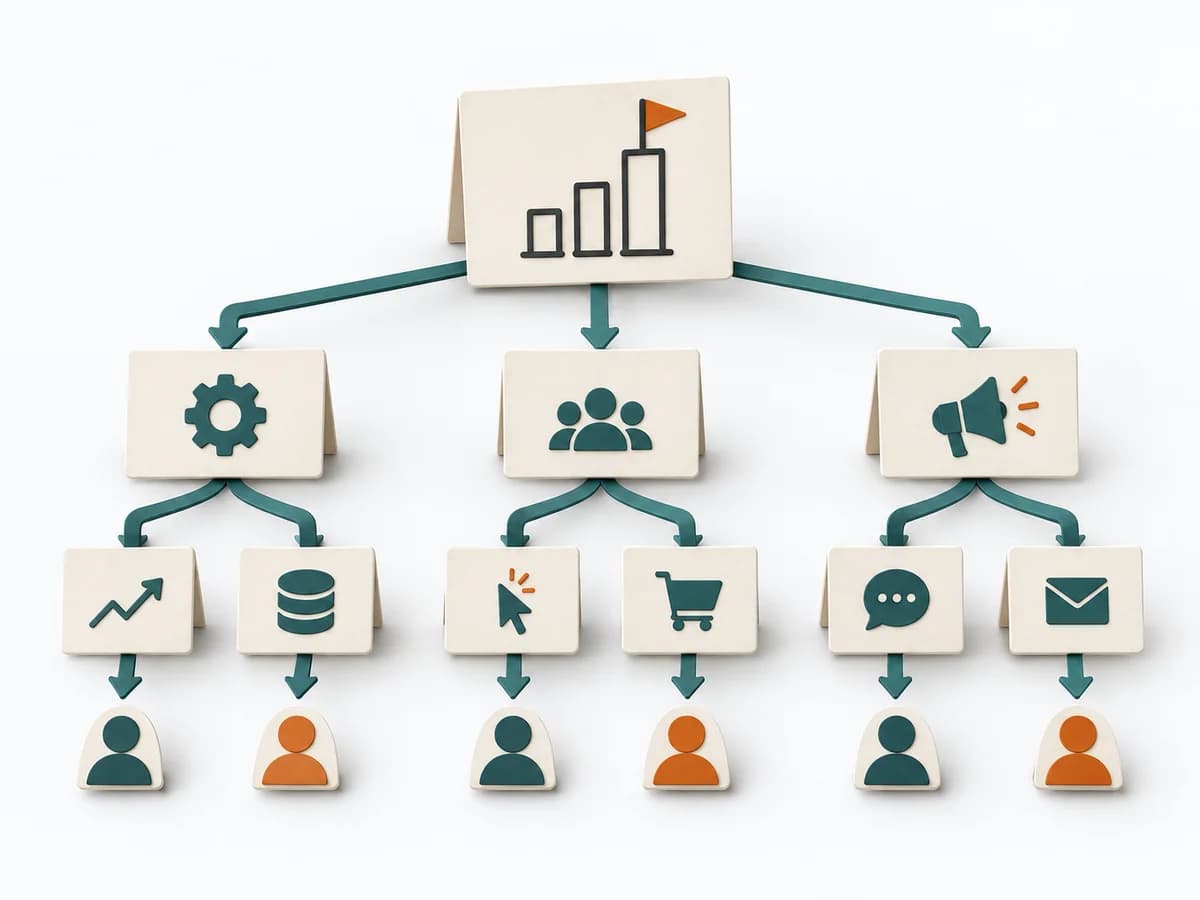
Moves target group, value, goals, and priorities toward a concrete result through "define the top metric", "describe the main driver of the top metric", and "set the review cadence".

Observes real work in context and pairs it with follow-up questions to capture workflow insights precisely.

Captures experiences over time in diary entries and reveals longitudinal patterns that a single session would miss.

Analyzes conversion and drop-offs along the funnel and condenses the findings into optimization hypotheses.