
Purpose
Helps clarify technical problems, hypotheses, and next steps in concrete terms. It breaks a technical problem into testable parts. The result is captured as a GQM table and metric briefs.
Engineering Planning tool
Derives metrics top-down from an explicit goal and the questions whose answers assess that goal.
GQM starts with a measurement goal defined by object, purpose, quality focus, viewpoint, and context. Questions operationalise the goal; metrics come afterwards. A data source without a question is not a measurement programme.
Which questions must be answered to assess the defined goal from the chosen viewpoint, and which metrics provide those answers?
Goal Question Metric uses Goal → Questions → Metrics with an explicit interpretation model. Assessments remain justified and context-bound.

GQM goal
State object, purpose, quality focus, viewpoint, and context precisely.
Questions
Derive questions whose answers jointly assess the goal.
Metrics
Define objective and subjective metrics with formula, source, segment, and data quality.
Interpretation
Before viewing data, define how metrics answer questions and trigger decisions.
Revise questions and metrics when goal, viewpoint, or context changes; version interpretation models with results.
Useful for software, process, and quality goals with multiple information needs.
GQM plan with traceable sources, assumptions, and domain decisions.
Owners, dates, and next review for GQM plan.
Fictional worked example
Goal → Questions → Metrics with an explicit interpretation model as a precise working structure with a fictional example.
Object · purpose · quality focus · viewpoint · context
Checkout service · release decision · reliability · Operations · EU platform
Which answers assess the goal?
Q1 failure frequency? Q2 detection time? Q3 segment outliers?
Formula · unit · source · segment · quality
Failure rate; median/P95 detection time; payment type.
How do values yield a domain decision?
Release below 0.8%, P95 under 5 min, no segment outlier.
The example demonstrates the domain logic of Goal Question Metric; worksheets remain blank.
NASA Software Engineering Handbook: The Goal Question Metric Approach
Start with the core question: Which questions must be answered to assess the defined goal from the chosen viewpoint, and which metrics provide those answers?
Helps clarify technical problems, hypotheses, and next steps in concrete terms. It breaks a technical problem into testable parts. The result is captured as a GQM table and metric briefs.
Starting from the goal, the questions are derived that actually show whether progress or a quality gain is occurring. From these follow metrics that do not merely count but reflect the logic of the goal and enable review rhythms. This keeps metrics tied to intent rather than to the mere availability of data.
Goal Question Metric, often abbreviated as GQM, was developed by Victor Basili for software measurement. Each goal leads to a set of probing questions, and each question leads to at least one concrete metric. The method also works beyond software engineering because it anchors data to strategy.
Always start with the goal, never with available data. A metric must not be collected if it does not answer a question.
The method guide walks execution through 4 phases, timing, 4 pitfalls, and clear stop criteria.
Open method guideYour perspective
Your feedback helps shape the next improvements to methodatlas.
Plan Goal Question Metric around its domain steps and the concrete decision question.
To be confirmed
To be confirmed
Full workshop Time: 60–90 minutes
Complete this worksheet on paper or in your own document during the work.
Object · purpose · quality focus · viewpoint · context
...
Which answers assess the goal?
...
Formula · unit · source · segment · quality
...
How do values yield a domain decision?
...
Enter only real input, sources, and decisions.
NASA Software Engineering Handbook: The Goal Question Metric Approach
Expected artifact: GQM goal
GQM goal · source · uncertainty · next decision
Entry:
...
Expected artifact: question tree
question tree · source · uncertainty · next decision
Entry:
...
Expected artifact: metric set
metric set · source · uncertainty · next decision
Entry:
...
Expected artifact: interpretation model
interpretation model · source · uncertainty · next decision
Entry:
...
...
Method guide: https://methodatlas.meierhoff-systems.de/en/methods/goal-question-metric/run-sheet
Fitting alternatives with decision guidance, followed by other related methods.
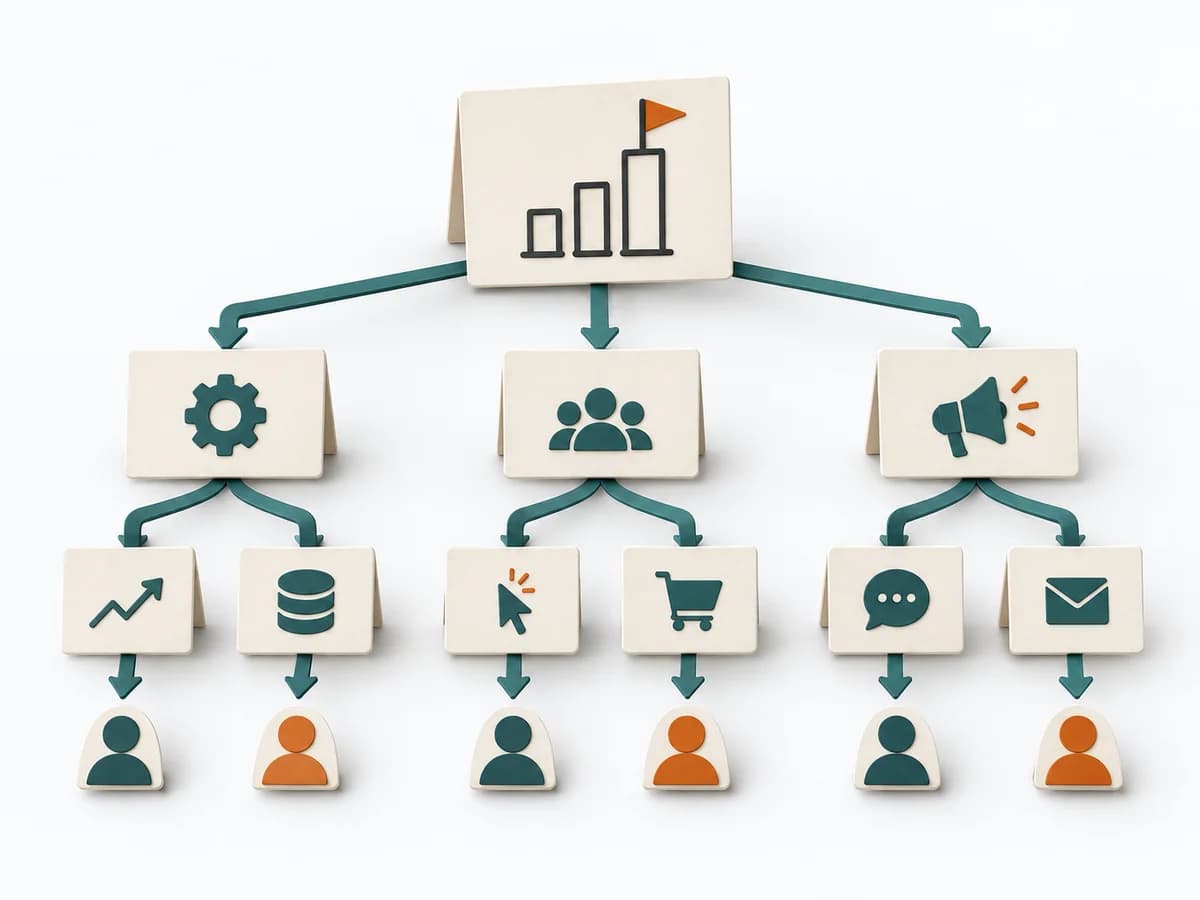
Instead of Goal Question Metric, choose KPI Tree when you want to cleanly break goals down into a few metrics and their drivers.

Moves observations, needs, and patterns toward a concrete result through "define a goal for each HEART dimension", "identify signals for each goal", and "agree on a review cadence".

Moves target group, value, goals, and priorities toward a concrete result through "name the main metric", "collect possible unintended side effects", and "use counter metrics alongside the main metric in reviews".

Formulates goals precisely enough that measure, relevance, and deadline together form a clear basis for steering.

Visualizes strategic objectives and cause-and-effect relationships so a leadership team sees the same strategy story.
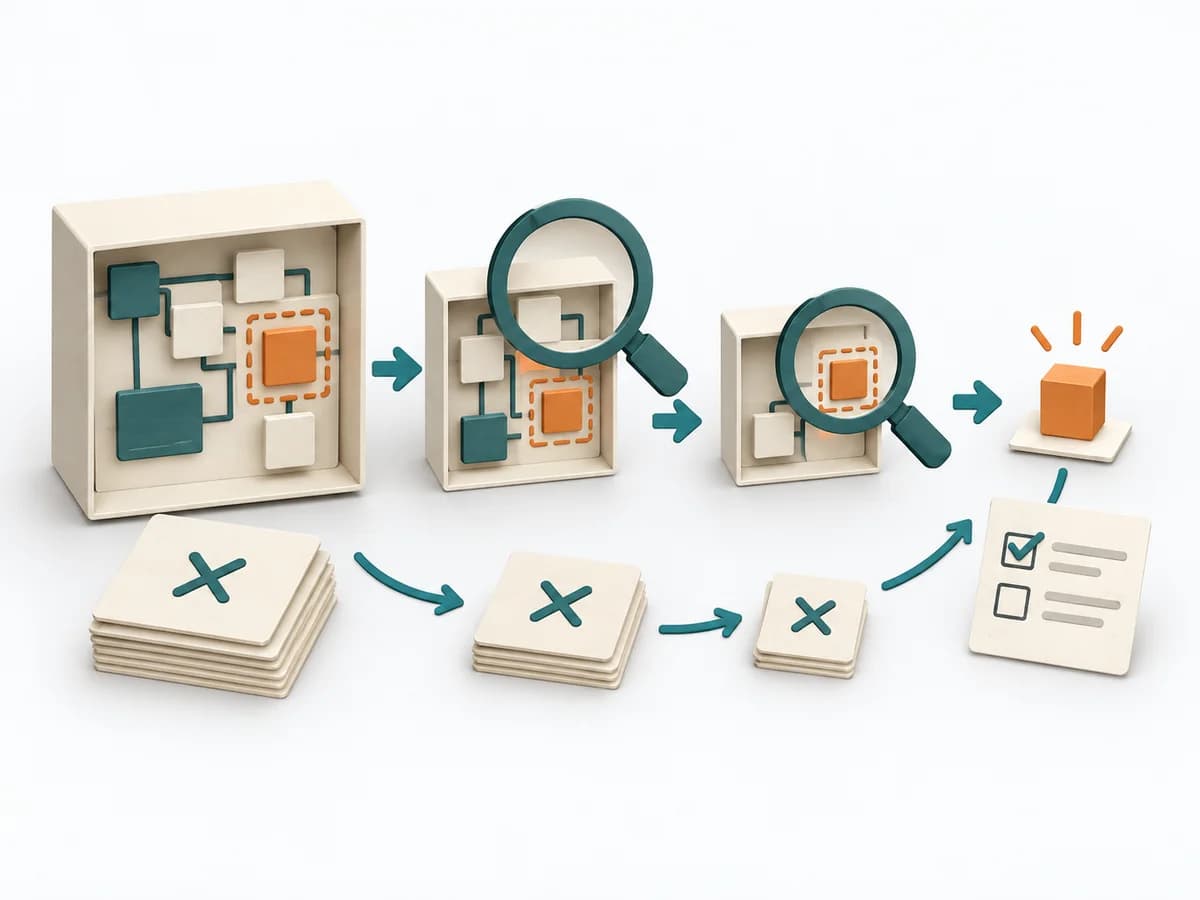
Narrows down the fault space and symptoms step by step until only a few hypotheses and targeted tests remain.