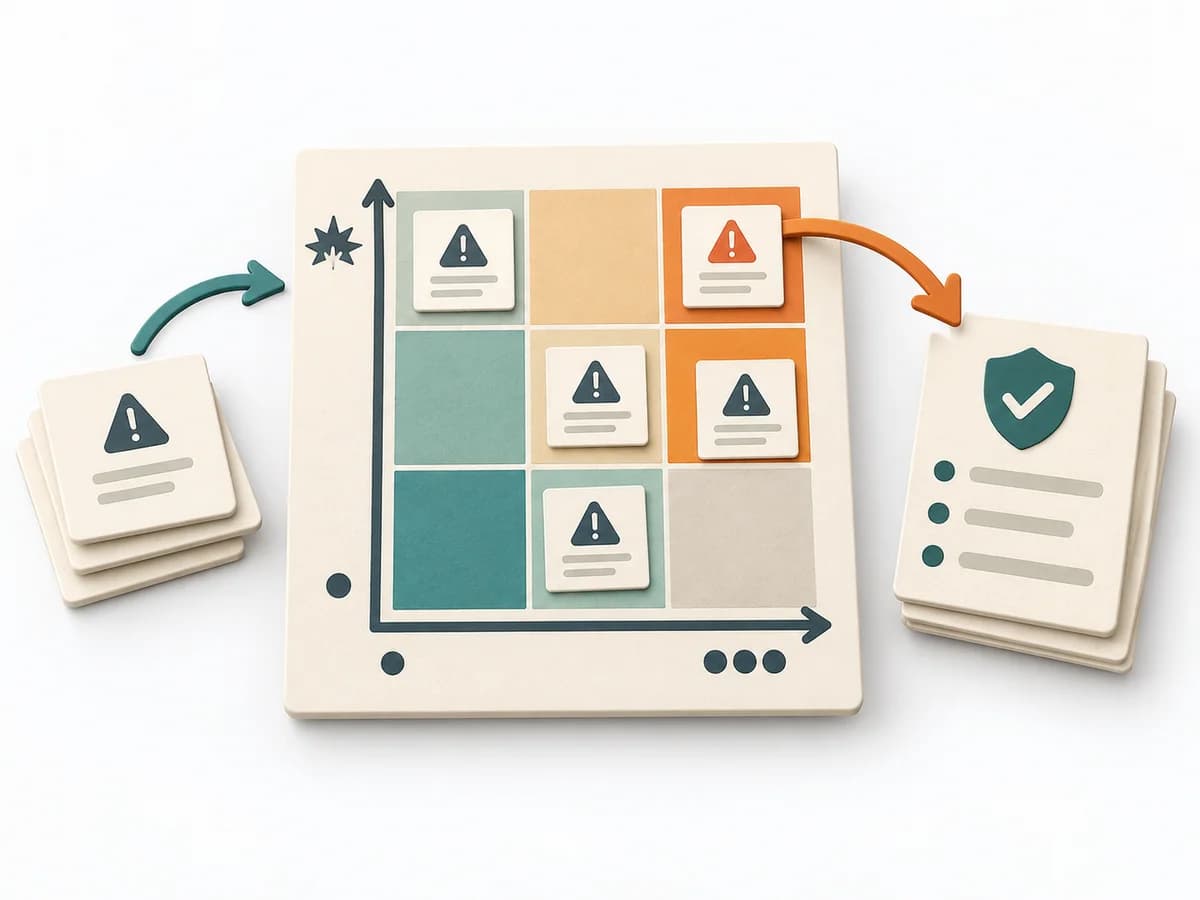
Complete firstClear boundary
Set decision, owner, horizon, boundaries, and real choices; include status quo.
Without a boundary, cases, periods, or variables become mixed.
A practical method guide: clarify prerequisites and materials, understand the complete process, and look up outputs, pitfalls, and stop criteria.
What needs to be finished first
Set decision, owner, horizon, boundaries, and real choices; include status quo.
Decision frame, real alternatives, fundamental objectives, scales, evidence, consequence matrix, and sensitivity analysis
What needs to be ready before start
Decision frame, real alternatives, fundamental objectives, scales, evidence, consequence matrix, and sensitivity analysis
Decision owner · affected stakeholders · domain/data experts · facilitator
Set decision, owner, horizon, boundaries, and real choices; include status quo.
90–180 minutes for 3–6 alternatives; evidence work beforehand.
Prepare a workspace with Frame · Objectives · Consequences · Trade-offs · Robustness; separate example from live data.
The one question this method answers
Which alternative offers the best justified value across conflicting objectives, and under which assumptions does the choice change?
Phases with goal, actions, output and pitfall
Options are compared across competing criteria instead of being optimised in isolation. The comparison makes accepted compromises and red lines explicit. It creates a clear decision space.
Fictional example
Fictional values show the actual method fields.
| Alternative | p80 wait | Predictability | Emergency access | Implementation effort | Uncertainty |
|---|---|---|---|---|---|
| A · Status quoAdd evidence and rationale. | 18–24 minutes | Low | Immediate but unmanaged | 0 PT | Load variation ±6 minutes |
| B · Fixed slotsAdd evidence and rationale. | 12–14 minutes | High | Medium; reserve window | 20 PT | Four-Saturday pilot |
| C · Dynamic slotsAdd evidence and rationale. | 9–13 minutes | Medium to high | High | 55 PT | Forecast quality unclear |
All values are fictional.
Frame
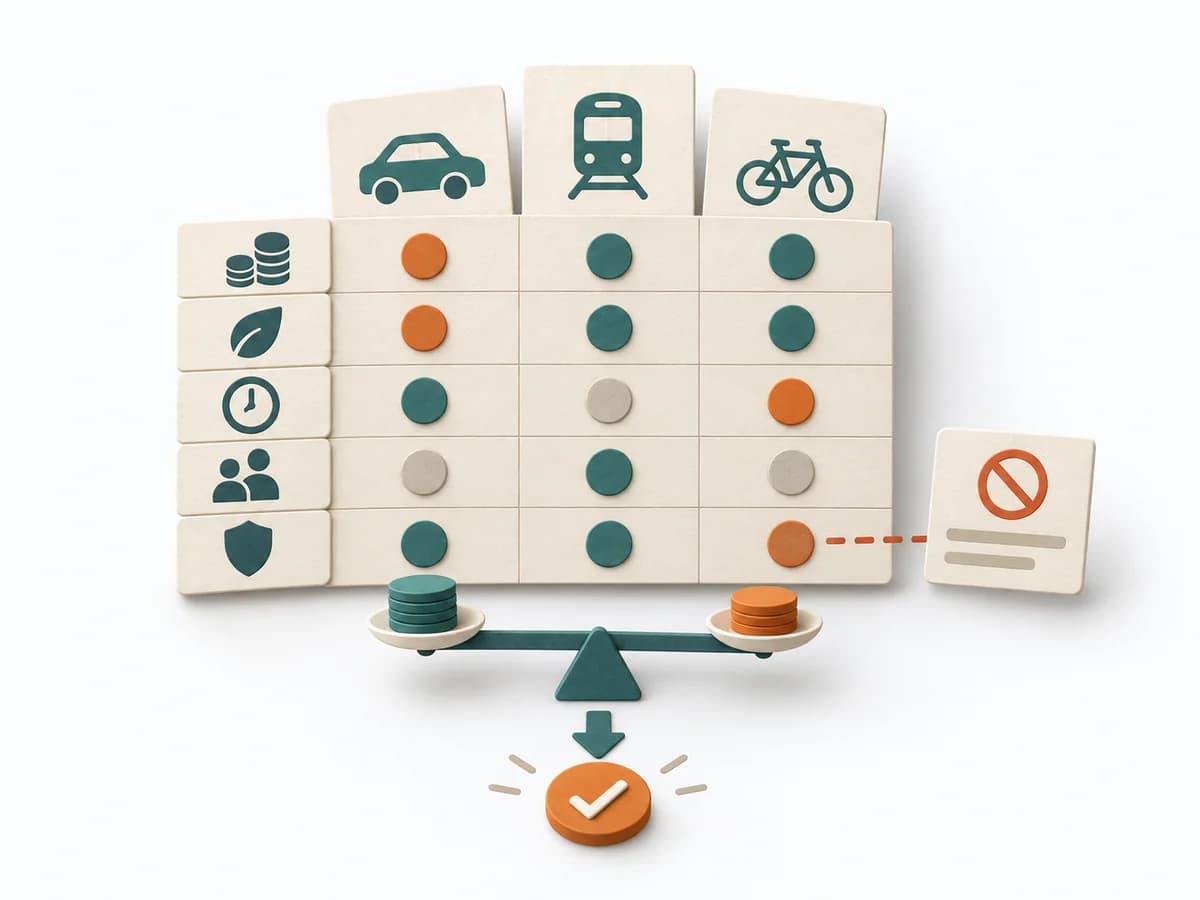
Goal
Decision frame: Define decision, owner, scope, horizon, and alternatives including status quo.
Inputs for this step
Actions
Output
Decision frame
Define decision, owner, scope, horizon, and alternatives including status quo.
Quality check
Are alternatives genuinely selectable and distinct?
Pitfall
Criteria are debated before decision is clear. Close decision statement, owner, and alternatives first.
Timing: 15–25 minutes
Objectives
Goal
Objective hierarchy: Separate fundamental objectives from means and avoid double counting.
Inputs for this step
Actions
Output
Objective hierarchy
Separate fundamental objectives from means and avoid double counting.
Quality check
Does each objective describe value rather than a favourite solution?
Pitfall
Dynamic system is listed as objective. Ask why until fundamental value appears.
Timing: 20–30 minutes
Consequences
Goal
Consequence matrix: Set scales and evidence; assess each alternative on every objective with uncertainty.
Inputs for this step
Actions
Output
Consequence matrix
Set scales and evidence; assess each alternative on every objective with uncertainty.
Quality check
Are scales decision-relevant and values sourced?
Pitfall
Pseudo-precise points replace real consequences. Use natural units and ranges.
Timing: 30–50 minutes
Trade-offs
Goal
Trade-off view: Remove dominated options and negotiate relevant conflicts; use weights only with rationale.
Inputs for this step
Actions
Output
Trade-off view
Remove dominated options and negotiate relevant conflicts; use weights only with rationale.
Quality check
Are sacrifice and gain transparent?
Pitfall
Aggregate score hides a critical consequence. Compare consequences pairwise and test red lines.
Timing: 20–35 minutes
Robustness
Goal
Robust decision: Test sensitivity to uncertain values, weights, and scenarios; document choice and review.
Inputs for this step
Actions
Output
Robust decision
Test sensitivity to uncertain values, weights, and scenarios; document choice and review.
Quality check
Is the assumption that flips choice visible?
Pitfall
One base case is treated as certain. Record tipping points, monitoring, and revisit triggers.
Timing: 20–30 minutes
What comes out at the end
Sketch: what the artifact looks like
Consequence and trade-off matrix with objective hierarchy, scales, evidence, dominance, sensitivity, and rationale.
Record date, owner, source state, and review date; preserve prior versions.
Markdown matrix for comparing options across competing criteria and accepted trade-offs.
| Criterion | Weight | Option A | Option B | Option C |
|---|---|---|---|---|
| Benefit | 30 | |||
| Cost | 20 | |||
| Risk | 20 | |||
| Time-to-Learn | 15 | |||
| Reversibility | 15 |
Which option is recommended and why?
Which small change in weighting or assumption would flip the recommendation?
Set subject, evidence, roles, flow, and review.
To be confirmed
To be confirmed
Complete run Time: 90–180 minutes for 3–6 alternatives; evidence work beforehand.
Complete this worksheet on paper or in your own document during the work.
| Alternative | p80 wait | Predictability | Emergency access | Implementation effort | Uncertainty |
|---|---|---|---|---|---|
| A · Status quo | |||||
| B · Fixed slots | |||||
| C · Dynamic slots |
The blank worksheet contains prompts only.
Reference · original teaching example
Expected artifact: Decision frame
Define decision, owner, scope, horizon, and alternatives including status quo.
Entry:
...
Expected artifact: Objective hierarchy
Separate fundamental objectives from means and avoid double counting.
Entry:
...
Expected artifact: Consequence matrix
Set scales and evidence; assess each alternative on every objective with uncertainty.
Entry:
...
Expected artifact: Trade-off view
Remove dominated options and negotiate relevant conflicts; use weights only with rationale.
Entry:
...
Expected artifact: Robust decision
Test sensitivity to uncertain values, weights, and scenarios; document choice and review.
Entry:
...
...
Method guide: https://methodatlas.meierhoff-systems.de/en/methods/trade-off-analysis/run-sheet
Concrete filled scenario, fictional example
Fictional example for orientation. Counts and timings describe this case and are not universal requirements.
Concrete filled scenario, fictional example
| Alternative | p80 wait | Predictability | Emergency access | Implementation effort | Uncertainty |
|---|---|---|---|---|---|
| A · Status quo | 18–24 minutes | Low | Immediate but unmanaged | 0 PT | Load variation ±6 minutes |
| B · Fixed slots | 12–14 minutes | High | Medium; reserve window | 20 PT | Four-Saturday pilot |
| C · Dynamic slots | 9–13 minutes | Medium to high | High | 55 PT | Forecast quality unclear |
Recognize symptoms and steer against them
Quick overview, the full text is in the matching phase in the flow
Criteria are debated before decision is clear.
Close decision statement, owner, and alternatives first.
Dynamic system is listed as objective.
Ask why until fundamental value appears.
Pseudo-precise points replace real consequences.
Use natural units and ranges.
Aggregate score hides a critical consequence.
Compare consequences pairwise and test red lines.
One base case is treated as certain.
Record tipping points, monitoring, and revisit triggers.
When to pause, resolve prerequisites, or choose another approach
Go to the profile for purpose, similar methods, and sources or continue to the next method in the catalog.