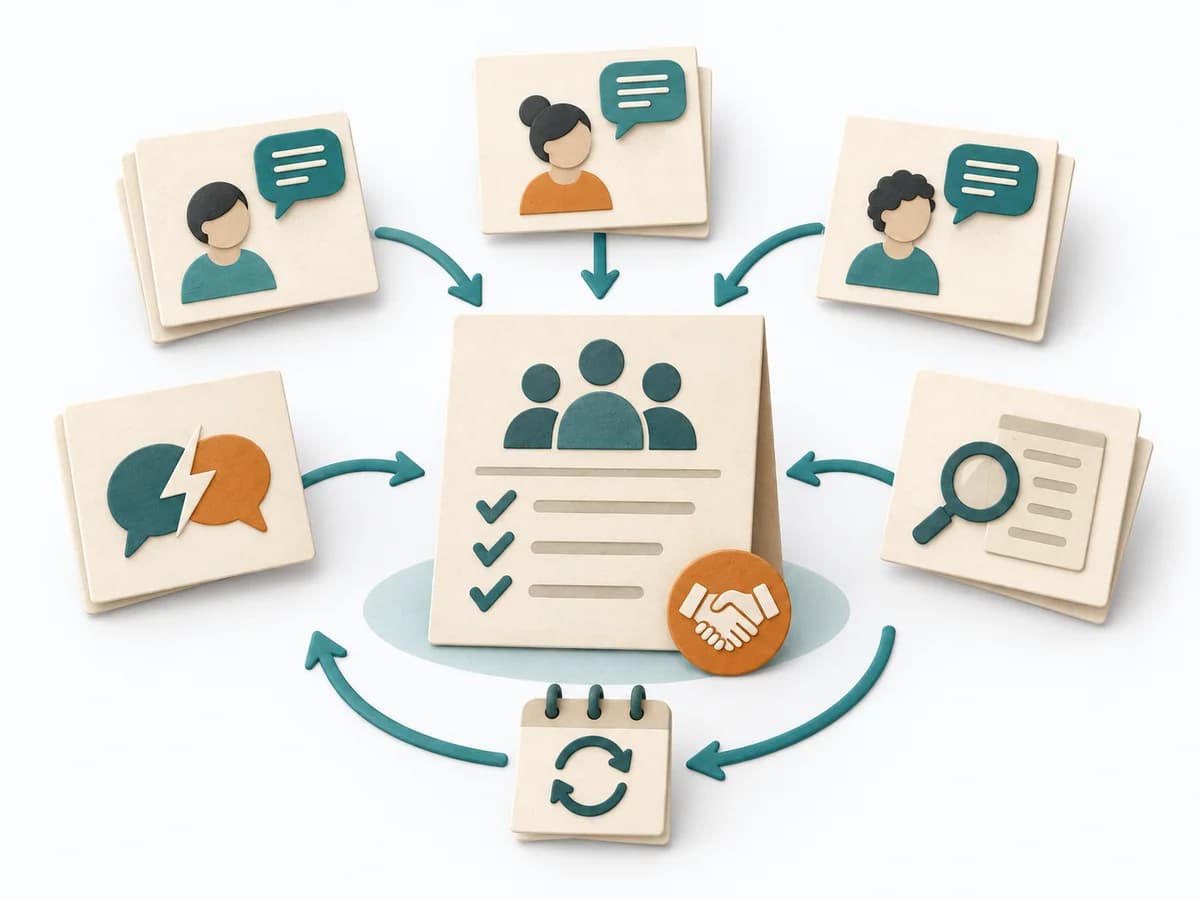
Team Charter: Worksheet
Plan the question, inputs, complete run, and review with clear ownership.
# Team Charter: Worksheet

## Question
To be confirmed

## Desired outcome
To be confirmed

## Scope
Complete run
Time: 75–120 minutes for the first version; review after 4–6 weeks and after material team changes.

Complete this worksheet on paper or in your own document during the work.

## Preparation for this scope

### Method setup
- **Materials:** Charter template, mandate or project brief, known goals and interfaces, role overview, and calendar for the review.
- **Roles:** Whole team · sponsor for mandate and boundaries · facilitator · documentation owner
- **Advance information:** The sponsor clarifies purpose, decision space, and hard boundaries. Team members add role, experience, capacity, and important dependencies.
- **Overall time needed:** 75–120 minutes for the first version; review after 4–6 weeks and after material team changes.
- **Setup:** Mark the draft as changeable. Clarify mandate and boundaries before roles and collaboration; collect unresolved sponsor questions separately.

### Prepare for the work steps

#### Mandate: Clarify mandate
- The sponsor clarifies purpose, decision space, and hard boundaries. Team members add role, experience, capacity, and important dependencies.

#### Boundaries: Set scope
- Shared mandate

#### Roles: Assign responsibility
- Explicit scope

#### Ways of working: Agree collaboration
- Role and decision map

#### Review: Maintain charter
- Agreed collaboration


## Team charter

### Purpose and customers
Why does the team exist, whom does it help, and what value should result?

...

### Outcomes and boundaries
Which outcomes does the team own, and what is explicitly outside?

...

### Roles and decisions
Who decides, executes, or contributes to key outcomes?

...

### Collaboration
Which channels, rhythms, and conflict paths apply?

...

### Open points and review
What remains open, who resolves it, and when is the charter reviewed?

...

Clarify mandate and hard boundaries with the sponsor; write team agreements together.

[Atlassian Team Charter · original teaching example](https://www.atlassian.com/work-management/project-collaboration/team-charter)


## Mandate: Clarify mandate
Expected artifact: Shared mandate

Shared mandate

Entry:

...

- [ ] Can team and sponsor state the same purpose, served people, and expected value?

## Boundaries: Set scope
Expected artifact: Explicit scope

Explicit scope

Entry:

...

- [ ] Are owned outcomes, out-of-scope work, and external dependencies explicit?

## Roles: Assign responsibility
Expected artifact: Role and decision map

Role and decision map

Entry:

...

- [ ] For key outcomes, is it clear who decides, executes, and contributes?

## Ways of working: Agree collaboration
Expected artifact: Agreed collaboration

Agreed collaboration

Entry:

...

- [ ] Are communication and conflict rules written as observable behaviour?

## Review: Maintain charter
Expected artifact: Published charter with review

Published charter with review

Entry:

...

- [ ] Are unresolved mandate questions, owners, and the next review visible?

## Open questions and next steps

...

Method guide: https://methodatlas.meierhoff-systems.de/en/methods/team-charter/run-sheet
Working Agreements: Worksheet
Plan the initial agreement, use, and review with clear ownership.
# Working Agreements: Worksheet

## Question
To be confirmed

## Desired outcome
To be confirmed

## Scope
Complete run
Time: 10 minutes of preparation and about 60 minutes for the first agreement; then ongoing use and regular reviews.

Complete this worksheet on paper or in your own document during the work.

## Preparation for this scope

### Method setup
- **Materials:** Shared document or board, individual work preferences, current friction examples, channel overview, and calendar.
- **Roles:** Whole team · facilitator · team lead as participant, not sole author · rotating agreement owner
- **Advance information:** Everyone notes working hours, focus time, feedback preferences, and current friction. The lead drafts at most communication and escalation questions, not finished rules.
- **Overall time needed:** 10 minutes of preparation and about 60 minutes for the first agreement; then ongoing use and regular reviews.
- **Setup:** Make existing rules visible, collect personal preferences silently first, and adopt only agreements the team can concretely try.

### Prepare for the work steps

#### Context: Bound friction
- Everyone notes working hours, focus time, feedback preferences, and current friction. The lead drafts at most communication and escalation questions, not finished rules.

#### Perspectives: Gather needs
- Bounded friction situations

#### Rules: Write observable norms
- Visible work preferences

#### Escalation: Clarify interfaces
- Observable team rules

#### Maintenance: Plan review
- Communication and escalation path


## Working agreements

### Hours and focus
When are we available, when do we protect focus, and which exceptions apply?

...

### Communication channels
Which channel serves which purpose and what response is expected?

...

### Feedback and decisions
How do we give feedback and where are decisions recorded?

...

### Blockers and escalation
When and to whom do we escalate?

...

### Review
When and through what process do rules change?

...

Collect personal preferences, then agree on a few observable rules for a trial period.

[Atlassian Working Agreements · original teaching example](https://www.atlassian.com/team-playbook/plays/working-agreements)


## Context: Bound friction
Expected artifact: Bounded friction situations

Bounded friction situations

Entry:

...

- [ ] Are friction points described as concrete situations without judging people?

## Perspectives: Gather needs
Expected artifact: Visible work preferences

Visible work preferences

Entry:

...

- [ ] Could everyone contribute work conditions and feedback preferences independently?

## Rules: Write observable norms
Expected artifact: Observable team rules

Observable team rules

Entry:

...

- [ ] Does each rule name a trigger and observable behaviour?

## Escalation: Clarify interfaces
Expected artifact: Communication and escalation path

Communication and escalation path

Entry:

...

- [ ] For urgent and non-urgent cases, are channel and escalation path clear?

## Maintenance: Plan review
Expected artifact: Reviewable agreement

Reviewable agreement

Entry:

...

- [ ] Can the team change rules that no longer work, and is the next review scheduled?

## Open questions and next steps

...

Method guide: https://methodatlas.meierhoff-systems.de/en/methods/working-agreements/run-sheet