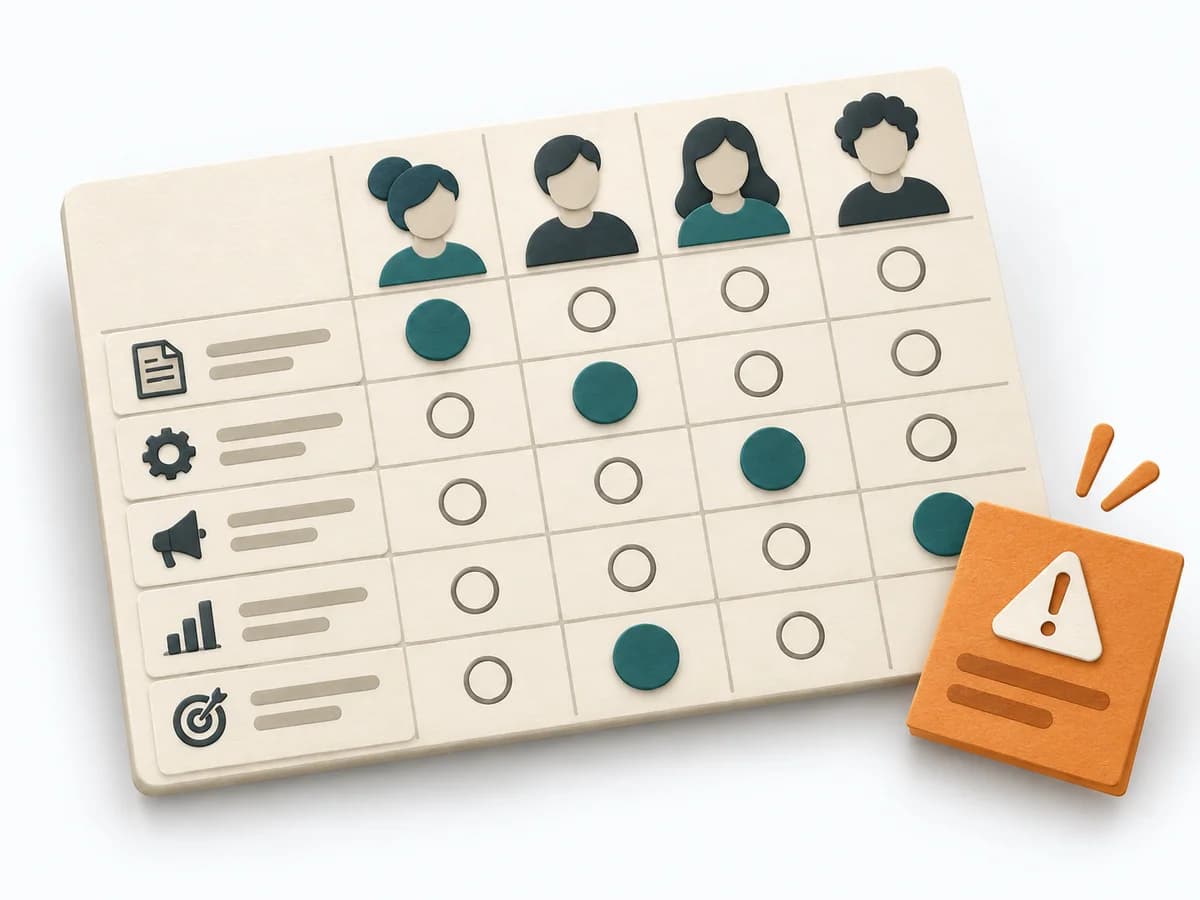
Complete firstMandate
The sponsor clarifies purpose, decision space, and hard boundaries. Team members add role, experience, capacity, and important dependencies.
Describe the mandate through value and impact.
A practical method guide: clarify prerequisites and materials, understand the complete process, and look up outputs, pitfalls, and stop criteria.
What needs to be finished first
The sponsor clarifies purpose, decision space, and hard boundaries. Team members add role, experience, capacity, and important dependencies.
Mark the draft as changeable. Clarify mandate and boundaries before roles and collaboration; collect unresolved sponsor questions separately.
What needs to be ready before start
Charter template, mandate or project brief, known goals and interfaces, role overview, and calendar for the review.
Whole team · sponsor for mandate and boundaries · facilitator · documentation owner
The sponsor clarifies purpose, decision space, and hard boundaries. Team members add role, experience, capacity, and important dependencies.
75–120 minutes for the first version; review after 4–6 weeks and after material team changes.
Mark the draft as changeable. Clarify mandate and boundaries before roles and collaboration; collect unresolved sponsor questions separately.
The one question this method answers
What shared agreement enables this team to fulfil its mandate with clear boundaries and responsibilities?
Phases with goal, actions, output and pitfall
A Team Charter connects purpose, customers, responsibilities, communication paths, and decision rules. It provides a shared reference for formation, handover, and conflict clarification.
Fictional example
Fictional short version for a team operating a digital booking service.
Why does the team exist, whom does it help, and what value should result?
We help small workshops book maintenance appointments reliably without phone queues.
Which outcomes does the team own, and what is explicitly outside?
Owns booking flow and confirmation. Outside: workshop ERP and pricing.
Who decides, executes, or contributes to key outcomes?
Product decides priorities; Tech decides implementation; Support is consulted on confirmation-flow changes.
Which channels, rhythms, and conflict paths apply?
Blockers appear on the board daily; domain decisions go into the decision log; unresolved goal conflicts go to Product and sponsor within two working days.
What remains open, who resolves it, and when is the charter reviewed?
Open: access to ERP test data, owner Samira by 12 Oct; charter review on 30 Oct.
The example shows a useful level of detail, not a universal team design.
Mandate

Goal
Shared mandate: Record purpose, expected value, and customers together.
Inputs for this step
Actions
Output
Shared mandate
Shared mandate
Quality check
Can team and sponsor state the same purpose, served people, and expected value?
Pitfall
The mandate lists activities such as building a platform but omits customer value and success signals. Return to “Clarify mandate” and repeat this method step: Record purpose, expected value, and customers together.
Timing: 15–20 minutes
Boundaries
Goal
Explicit scope: Name owned outcomes, dependencies, and explicitly excluded work.
Inputs for this step
Actions
Output
Explicit scope
Explicit scope
Quality check
Are owned outcomes, out-of-scope work, and external dependencies explicit?
Pitfall
Every adjacent task is included in scope as a precaution. Return to “Set scope” and repeat this method step: Name owned outcomes, dependencies, and explicitly excluded work.
Timing: 15–25 minutes
Roles
Goal
Role and decision map: Record decision, execution, and advice roles for concrete outcomes.
Inputs for this step
Actions
Output
Role and decision map
Role and decision map
Quality check
For key outcomes, is it clear who decides, executes, and contributes?
Pitfall
Roles are only job titles; responsibility for decisions and outcomes remains open. Return to “Assign responsibility” and repeat this method step: Record decision, execution, and advice roles for concrete outcomes.
Timing: 20–30 minutes
Ways of working
Goal
Agreed collaboration: Document communication, meetings, conflict path, and relevant agreements.
Inputs for this step
Actions
Output
Agreed collaboration
Agreed collaboration
Quality check
Are communication and conflict rules written as observable behaviour?
Pitfall
The charter says communicate openly but omits channels, response paths, and a conflict rule. Return to “Agree collaboration” and repeat this method step: Document communication, meetings, conflict path, and relevant agreements.
Timing: 20–30 minutes
Review
Goal
Published charter with review: Set assumptions, open points, and the next joint review.
Inputs for this step
Actions
Output
Published charter with review
Published charter with review
Quality check
Are unresolved mandate questions, owners, and the next review visible?
Pitfall
The file is stored without sharing it with sponsor and interfaces or scheduling a review. Return to “Maintain charter” and repeat this method step: Set assumptions, open points, and the next joint review.
Timing: 10–15 minutes
What comes out at the end
Sketch: what the artifact looks like
Versioned team charter with purpose, customers, success signals, scope, roles, decision paths, working rules, open points, and review date.
Version the published charter with review with date, owner, source state, and review date. Preserve earlier observations and append changes with their reason.
Plan the question, inputs, complete run, and review with clear ownership.
To be confirmed
To be confirmed
Complete run Time: 75–120 minutes for the first version; review after 4–6 weeks and after material team changes.
Complete this worksheet on paper or in your own document during the work.
Why does the team exist, whom does it help, and what value should result?
...
Which outcomes does the team own, and what is explicitly outside?
...
Who decides, executes, or contributes to key outcomes?
...
Which channels, rhythms, and conflict paths apply?
...
What remains open, who resolves it, and when is the charter reviewed?
...
Clarify mandate and hard boundaries with the sponsor; write team agreements together.
Atlassian Team Charter · original teaching example
Expected artifact: Shared mandate
Shared mandate
Entry:
...
Expected artifact: Explicit scope
Explicit scope
Entry:
...
Expected artifact: Role and decision map
Role and decision map
Entry:
...
Expected artifact: Agreed collaboration
Agreed collaboration
Entry:
...
Expected artifact: Published charter with review
Published charter with review
Entry:
...
...
Method guide: https://methodatlas.meierhoff-systems.de/en/methods/team-charter/run-sheet
Concrete filled scenario, fictional example
Fictional example for orientation. Counts and timings describe this case and are not universal requirements.
Concrete filled scenario, fictional example
We help small workshops book maintenance appointments reliably without phone queues.
Owns booking flow and confirmation. Outside: workshop ERP and pricing.
Product decides priorities; Tech decides implementation; Support is consulted on confirmation-flow changes.
Blockers appear on the board daily; domain decisions go into the decision log; unresolved goal conflicts go to Product and sponsor within two working days.
Open: access to ERP test data, owner Samira by 12 Oct; charter review on 30 Oct.
The example shows a useful level of detail, not a universal team design.
Recognize symptoms and steer against them
Quick overview, the full text is in the matching phase in the flow
The mandate lists activities such as building a platform but omits customer value and success signals.
Return to “Clarify mandate” and repeat this method step: Record purpose, expected value, and customers together.
Every adjacent task is included in scope as a precaution.
Return to “Set scope” and repeat this method step: Name owned outcomes, dependencies, and explicitly excluded work.
Roles are only job titles; responsibility for decisions and outcomes remains open.
Return to “Assign responsibility” and repeat this method step: Record decision, execution, and advice roles for concrete outcomes.
The charter says communicate openly but omits channels, response paths, and a conflict rule.
Return to “Agree collaboration” and repeat this method step: Document communication, meetings, conflict path, and relevant agreements.
The file is stored without sharing it with sponsor and interfaces or scheduling a review.
Return to “Maintain charter” and repeat this method step: Set assumptions, open points, and the next joint review.
When to pause, resolve prerequisites, or choose another approach
Go to the profile for purpose, similar methods, and sources or continue to the next method in the catalog.