Complete firstPerspectives
Everyone notes working hours, focus time, feedback preferences, and current friction. The lead drafts at most communication and escalation questions, not finished rules.
Use individual preparation and a joint decision.
A practical method guide: clarify prerequisites and materials, understand the complete process, and look up outputs, pitfalls, and stop criteria.
What needs to be finished first
Everyone notes working hours, focus time, feedback preferences, and current friction. The lead drafts at most communication and escalation questions, not finished rules.
Make existing rules visible, collect personal preferences silently first, and adopt only agreements the team can concretely try.
What needs to be ready before start
Shared document or board, individual work preferences, current friction examples, channel overview, and calendar.
Whole team · facilitator · team lead as participant, not sole author · rotating agreement owner
Everyone notes working hours, focus time, feedback preferences, and current friction. The lead drafts at most communication and escalation questions, not finished rules.
10 minutes of preparation and about 60 minutes for the first agreement; then ongoing use and regular reviews.
Make existing rules visible, collect personal preferences silently first, and adopt only agreements the team can concretely try.
The one question this method answers
Which observable agreements help this team collaborate reliably and respectfully?
Phases with goal, actions, output and pitfall
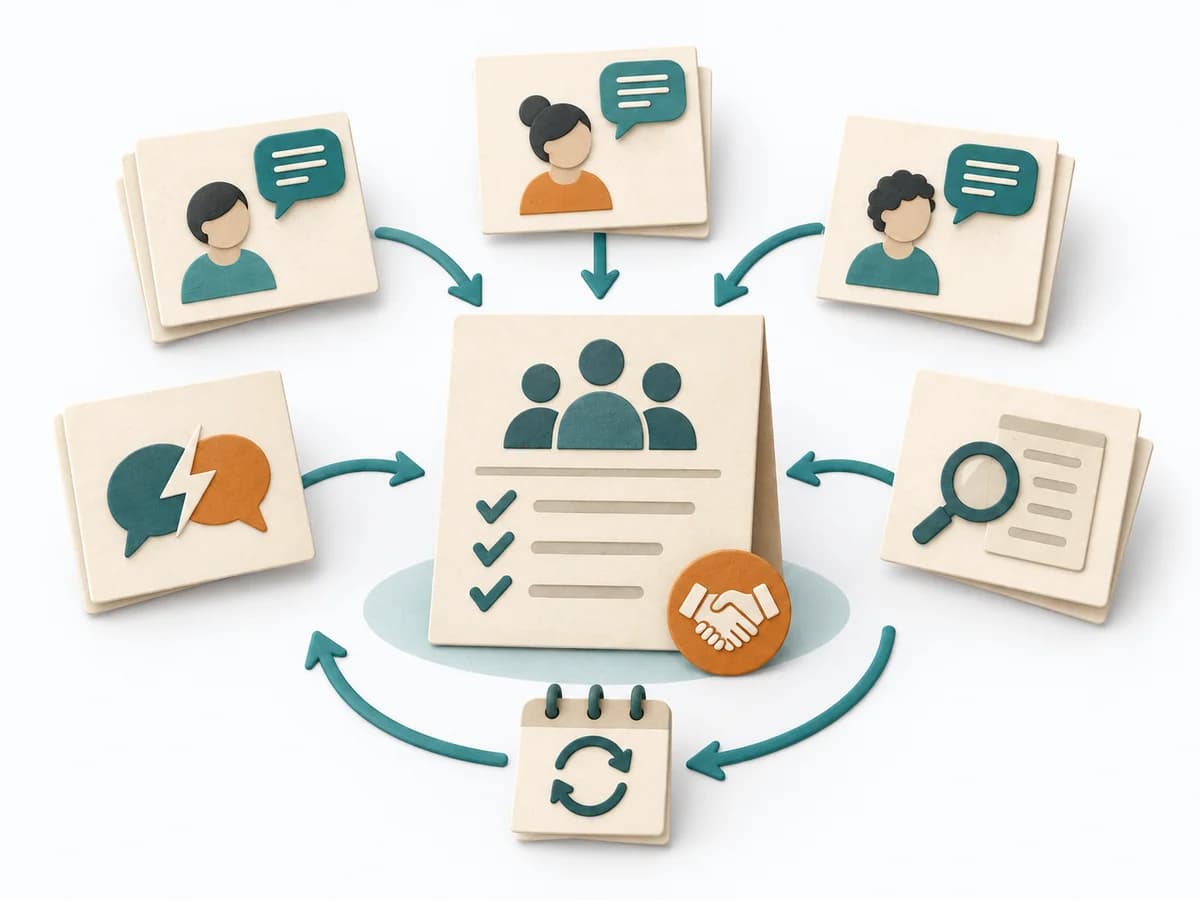
Working Agreements make implicit ways of working visible. The team gathers individual needs, writes observable rules, and decides how to adapt them later.
Fictional example
Fictional agreements for a distributed product team.
When are we available, when do we protect focus, and which exceptions apply?
Core overlap 10:00–15:00; no internal meetings 09:00–11:00 except incidents.
Which channel serves which purpose and what response is expected?
Board for work status; chat for coordination within one working day; phone only for production incidents.
How do we give feedback and where are decisions recorded?
Critical feedback directly first; decisions with context in the decision log.
When and to whom do we escalate?
Mark a blocker after four working hours; escalate to Team Lead and Product after one working day.
When and through what process do rules change?
Review in six weeks and additionally after onboarding or reorganisation.
The examples are starting points for joint negotiation.
Context
Goal
Bounded friction situations: Make current collaboration, occasion, and observed friction visible.
Inputs for this step
Actions
Output
Bounded friction situations
Bounded friction situations
Quality check
Are friction points described as concrete situations without judging people?
Pitfall
The session opens with a list of difficult people instead of observable situations. Return to “Bound friction” and repeat this method step: Make current collaboration, occasion, and observed friction visible.
Timing: 10 minutes
Perspectives
Goal
Visible work preferences: Record individual hours, communication, and feedback preferences separately.
Inputs for this step
Actions
Output
Visible work preferences
Visible work preferences
Quality check
Could everyone contribute work conditions and feedback preferences independently?
Pitfall
More vocal members define the norm before others share preferences. Return to “Gather needs” and repeat this method step: Record individual hours, communication, and feedback preferences separately.
Timing: 10 minutes
Rules
Goal
Observable team rules: Turn needs into clear “we” rules with trigger and expected behavior.
Inputs for this step
Actions
Output
Observable team rules
Observable team rules
Quality check
Does each rule name a trigger and observable behaviour?
Pitfall
Rules say be respectful or respond quickly without defining behaviour. Return to “Write observable norms” and repeat this method step: Turn needs into clear “we” rules with trigger and expected behavior.
Timing: 15 minutes
Escalation
Goal
Communication and escalation path: Agree channels, response rules, decision ownership, and escalation path.
Inputs for this step
Actions
Output
Communication and escalation path
Communication and escalation path
Quality check
For urgent and non-urgent cases, are channel and escalation path clear?
Pitfall
Everything is urgent and every request lands in the same channel. Return to “Clarify interfaces” and repeat this method step: Agree channels, response rules, decision ownership, and escalation path.
Timing: 15 minutes
Maintenance
Goal
Reviewable agreement: Set review date, change path, and response when an agreement cannot be kept.
Inputs for this step
Actions
Output
Reviewable agreement
Reviewable agreement
Quality check
Can the team change rules that no longer work, and is the next review scheduled?
Pitfall
Agreements remain unchanged after new members or changed working conditions. Return to “Plan review” and repeat this method step: Set review date, change path, and response when an agreement cannot be kept.
Timing: 10 minutes; recurring later
What comes out at the end
Sketch: what the artifact looks like
Living working-agreement document with observable rules, communication channels, escalation path, exceptions, owner, and review rhythm.
Version the reviewable agreement with date, owner, source state, and review date. Preserve earlier observations and append changes with their reason.
Plan the initial agreement, use, and review with clear ownership.
To be confirmed
To be confirmed
Complete run Time: 10 minutes of preparation and about 60 minutes for the first agreement; then ongoing use and regular reviews.
Complete this worksheet on paper or in your own document during the work.
When are we available, when do we protect focus, and which exceptions apply?
...
Which channel serves which purpose and what response is expected?
...
How do we give feedback and where are decisions recorded?
...
When and to whom do we escalate?
...
When and through what process do rules change?
...
Collect personal preferences, then agree on a few observable rules for a trial period.
Atlassian Working Agreements · original teaching example
Expected artifact: Bounded friction situations
Bounded friction situations
Entry:
...
Expected artifact: Visible work preferences
Visible work preferences
Entry:
...
Expected artifact: Observable team rules
Observable team rules
Entry:
...
Expected artifact: Communication and escalation path
Communication and escalation path
Entry:
...
Expected artifact: Reviewable agreement
Reviewable agreement
Entry:
...
...
Method guide: https://methodatlas.meierhoff-systems.de/en/methods/working-agreements/run-sheet
Concrete filled scenario, fictional example
Fictional example for orientation. Counts and timings describe this case and are not universal requirements.
Concrete filled scenario, fictional example
Core overlap 10:00–15:00; no internal meetings 09:00–11:00 except incidents.
Board for work status; chat for coordination within one working day; phone only for production incidents.
Critical feedback directly first; decisions with context in the decision log.
Mark a blocker after four working hours; escalate to Team Lead and Product after one working day.
Review in six weeks and additionally after onboarding or reorganisation.
The examples are starting points for joint negotiation.
Recognize symptoms and steer against them
Quick overview, the full text is in the matching phase in the flow
The session opens with a list of difficult people instead of observable situations.
Return to “Bound friction” and repeat this method step: Make current collaboration, occasion, and observed friction visible.
More vocal members define the norm before others share preferences.
Return to “Gather needs” and repeat this method step: Record individual hours, communication, and feedback preferences separately.
Rules say be respectful or respond quickly without defining behaviour.
Return to “Write observable norms” and repeat this method step: Turn needs into clear “we” rules with trigger and expected behavior.
Everything is urgent and every request lands in the same channel.
Return to “Clarify interfaces” and repeat this method step: Agree channels, response rules, decision ownership, and escalation path.
Agreements remain unchanged after new members or changed working conditions.
Return to “Plan review” and repeat this method step: Set review date, change path, and response when an agreement cannot be kept.
When to pause, resolve prerequisites, or choose another approach
Go to the profile for purpose, similar methods, and sources or continue to the next method in the catalog.