
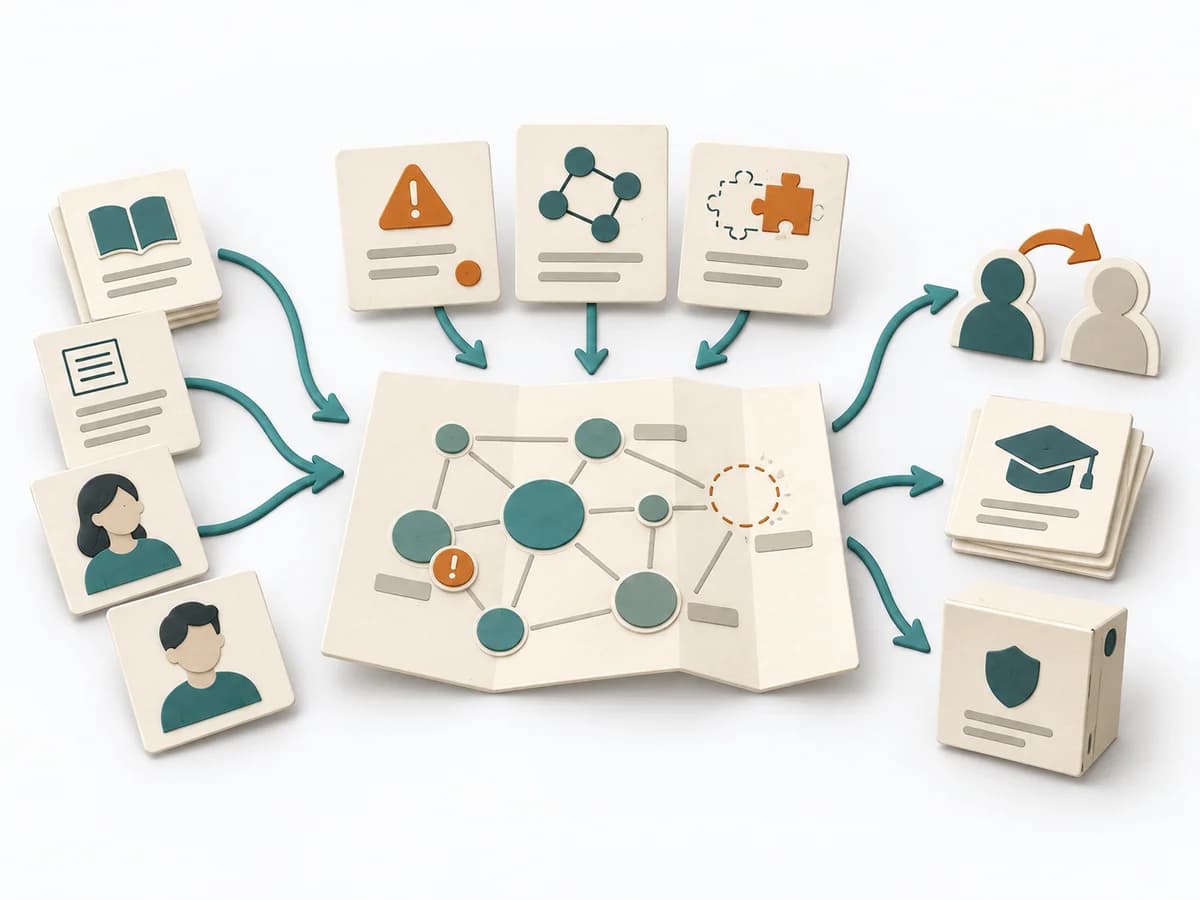
Purpose
Peer Instruction uses group thinking to clarify difficult terms or concepts faster. The method combines individual reflection with social correction and shared precision.
Knowledge Modeling Facilitation method
Deepens conceptual understanding through an individual Concept Question, peer discussion, and a second vote.
Peer Instruction starts with a demanding conceptual question that each person answers alone. Participants then exchange reasons with peers and answer again. The teacher does not reveal the answer too early.
Which reasoning supports the answer, and how does understanding change after peer exchange?
Each step produces a concrete domain result for the complete run.

Question
Ask a conceptual question with plausible options and common misconceptions.
Individual vote
Everyone chooses and reasons alone so the starting assumption is visible.
Distribution
Show the distribution without revealing the answer and name the contested idea.
Peer dialogue
Peers persuade one another with reasons; the instructor withholds the answer.
Revote
Vote again, record changed reasoning, and close with a transfer case.
Use response distributions and reasoning to improve the question, distractors, or follow-up explanation for the next run.
Use it in teaching and workshops where misconceptions should become visible and be worked through by reasoned exchange.
Concept-question log with learning target, options, first and second distributions, observed reasoning, explanation, and teaching decision.
Fictional example
Fictional Concept Question about scaling a rectangle.
| Run | Concept Question | First vote | Peer reasoning | Second vote and decision |
|---|---|---|---|---|
| Area under scalingWhich reasoning supports the answer, and how does understanding change after peer exchange? | A doubles · B triples · C quadruples · D unchanged | A 9 · B 2 · C 11 · D 1 | C explains 2a × 2b = 4ab; A notices that both factors matter. | A 2 · B 0 · C 21 · D 0. Instructor closes with a volume transfer case. |
The response distributions are fictional.
Prepare a Concept Question with plausible options and common misconceptions.
Peer Instruction uses group thinking to clarify difficult terms or concepts faster. The method combines individual reflection with social correction and shared precision.
A short question is first answered individually so each person has their own position. Participants then discuss their reasoning before voting again or noting what changed. The effect is often a markedly deeper conceptual understanding.
Peer Instruction works because learners must actively test and reorganize their understanding in exchange with others. The method is more than a question poll; it lives on good concept questions provoking thinking errors and making different reasoning audible. Used cleanly, it keeps the loop of individual commitment, conversation, and renewed decision tight, so robust understanding forms in each person's own mind.
Prepare a few but demanding concept questions and phrase answer options so typical misconceptions really become visible. The dynamic tips the moment reasoning stays superficial; then targeted follow-up on the why behind a choice pays off. End the round with a brief synthesis of the key insight and a follow-up question for transfer or deepening.
The method guide walks execution through 5 phases, timing, 5 pitfalls, and clear stop criteria.
Open method guideYour perspective
Your feedback helps shape the next improvements to methodatlas.
Plan the question, inputs, complete run, and review with clear ownership.
To be confirmed
To be confirmed
Complete run Time: 10–20 minutes per Concept Question; combine several questions with short instruction blocks.
Complete this worksheet on paper or in your own document during the work.
| Run | Concept Question | First vote | Peer reasoning | Second vote and decision |
|---|---|---|---|---|
| Area under scaling |
Record first and second distributions separately; add the answer only after peer dialogue.
Mazur Group · original teaching example
Expected artifact: Reviewed Concept Question
Reviewed Concept Question
Entry:
...
Expected artifact: Independent first vote
Independent first vote
Entry:
...
Expected artifact: Visible first distribution
Visible first distribution
Entry:
...
Expected artifact: Peer explanations
Peer explanations
Entry:
...
Expected artifact: Second vote and teaching decision
Second vote and teaching decision
Entry:
...
...
Method guide: https://methodatlas.meierhoff-systems.de/en/methods/peer-instruction/run-sheet
Fitting alternatives with decision guidance, followed by other related methods.

Instead of Peer Instruction, choose Teach-back when you want to check whether someone can really reproduce content in their own words.

Gives one person precise peer feedback through three roles and records key next actions and observations.
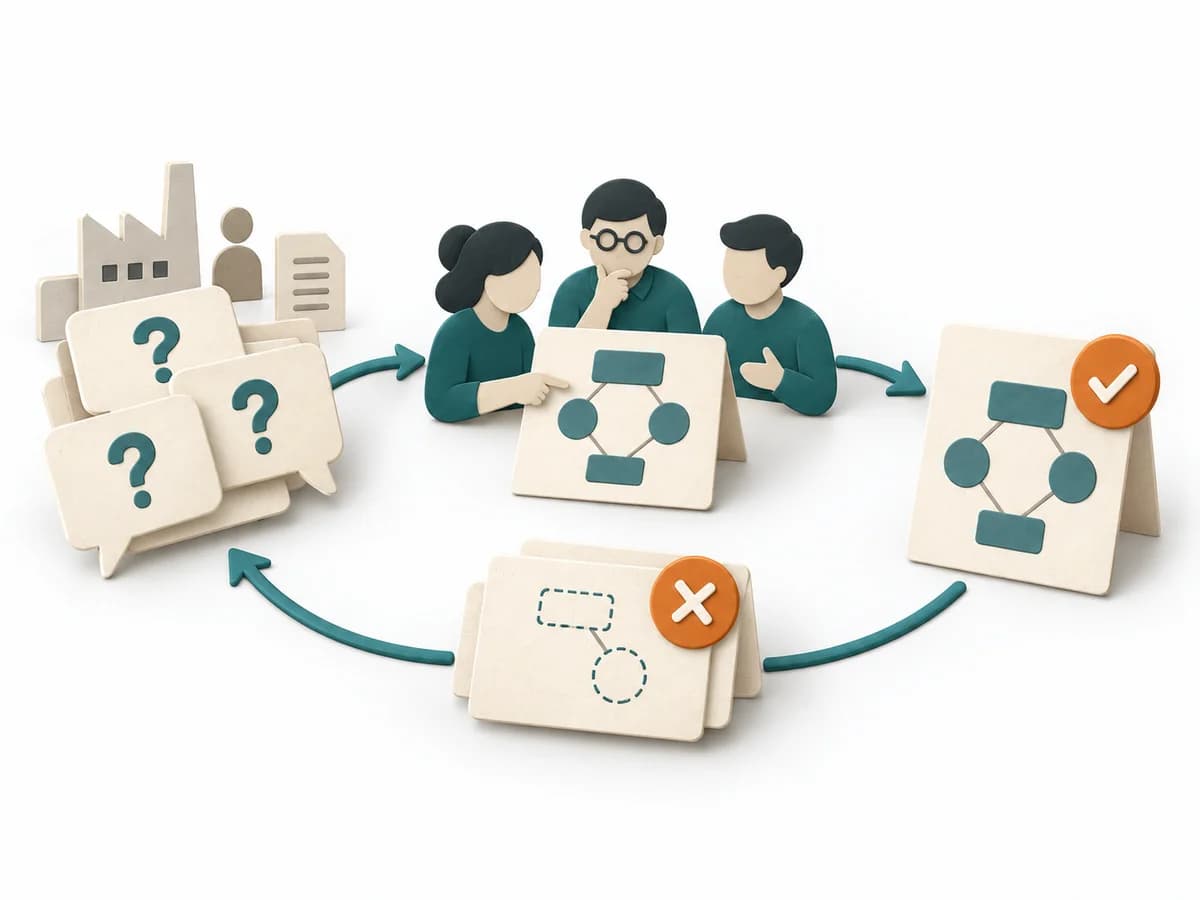
Concrete domain questions define what an ontology or knowledge model must be able to answer and test.

Clarifies concepts, relationships, and rules by framing the focus question, gathering concepts, and checking gaps and contradictions.

Links events, commands, and views into a flow picture that brings UI, behavior, and implementation together.

Clarifies concepts, relationships, and rules by framing the issue, collecting positions, and marking decisions or open questions.