Purpose
Competency Questions translate a domain model into concrete questions that it must be able to answer. The method keeps the model's scope clean and prevents pretty but useless structures.
Knowledge Modeling Analysis method
Defines answerable domain questions as testable requirements for an ontology.
Competency questions state in natural language which inferences an ontology should enable. Terms, quantification, example answer, and test query are explicit.
Which domain questions must the ontology answer with defined data and inferences?
Competency Questions uses translate a natural-language domain question into terms, formal query, test data, and expected answer. Assessments remain justified and context-bound.

Elicit question
Collect real decision questions with domain actors.
Specify
Clarify quantifier, horizon, terms, and desired answer.
Formalise
Translate CQ into a query and required axioms.
CQ tests
Run positive, negative, and boundary test data.
Update after new evidence or a material context change and retain the previous version.
Before and during ontology development to clarify scope and acceptance.
competency question test suite with traceable sources, assumptions, and domain decisions.
Owners, dates, and next review for competency question test suite.
Fictional worked example
translate a natural-language domain question into terms, formal query, test data, and expected answer as a precise working structure with a fictional example.
User · question · decision
Which open actions are overdue?
Terms · quantifier · horizon
status=open; dueDate<today.
Data · expected answer · negative case
A-17; completed A-18 excluded.
Query · axioms · version
SPARQL + hasOwner/memberOf.
The example demonstrates the domain logic of Competency Questions; worksheets remain blank.
Grüninger and Fox: Methodology for the Design and Evaluation of Ontologies
Start with the core question: Which domain questions must the ontology answer with defined data and inferences?
Competency Questions translate a domain model into concrete questions that it must be able to answer. The method keeps the model's scope clean and prevents pretty but useless structures.
First, real questions from everyday domain work are collected. The team then checks whether a planned model can answer these questions or whether concepts and relationships are missing. This makes domain usefulness the actual quality criterion.
Competency Questions are effective because they measure a model against the questions that actually need to be answerable in everyday domain work. The method keeps modeling honest as soon as every question is traced back to concepts, relationships, and necessary distinctions. Good use takes care to include operational examples, edge cases, and later query forms, so that no elegant schema emerges that misses practical information needs.
At the start, collect real questions from reports, search cases, or decision routines and sort them by domain relevance. The lever lies in questions that allow multiple interpretations; there the meaning must be sharpened before the model grows further. End with a small set of prioritized questions against which new model parts will be checked in the future.
The method guide walks execution through 4 phases, timing, 4 pitfalls, and clear stop criteria.
Open method guideYour perspective
Your feedback helps shape the next improvements to methodatlas.
Plan Competency Questions around its domain steps and the concrete decision question.
To be confirmed
To be confirmed
Full workshop Time: 60–90 minutes initially; ongoing test maintenance
Complete this worksheet on paper or in your own document during the work.
User · question · decision
...
Terms · quantifier · horizon
...
Data · expected answer · negative case
...
Query · axioms · version
...
Enter only real input, sources, and decisions.
Grüninger and Fox: Methodology for the Design and Evaluation of Ontologies
Expected artifact: CQ backlog
CQ backlog · source · uncertainty · next decision
Entry:
...
Expected artifact: precise CQ
precise CQ · source · uncertainty · next decision
Entry:
...
Expected artifact: query test
query test · source · uncertainty · next decision
Entry:
...
Expected artifact: CQ test suite
CQ test suite · source · uncertainty · next decision
Entry:
...
...
Method guide: https://methodatlas.meierhoff-systems.de/en/methods/competency-questions/run-sheet
Fitting alternatives with decision guidance, followed by other related methods.

Instead of Competency Questions, choose Concept Mapping when you want to connect terms with labeled relationships in a subject-matter network.

Query patterns drive node labels, relationships, and constraints so property graphs match real retrieval needs.

Existing vocabularies become reusable term candidates with ownership, versioning, and maintenance decisions attached.

Validation shapes define required classes, properties, and constraints before graph data enters production pipelines.
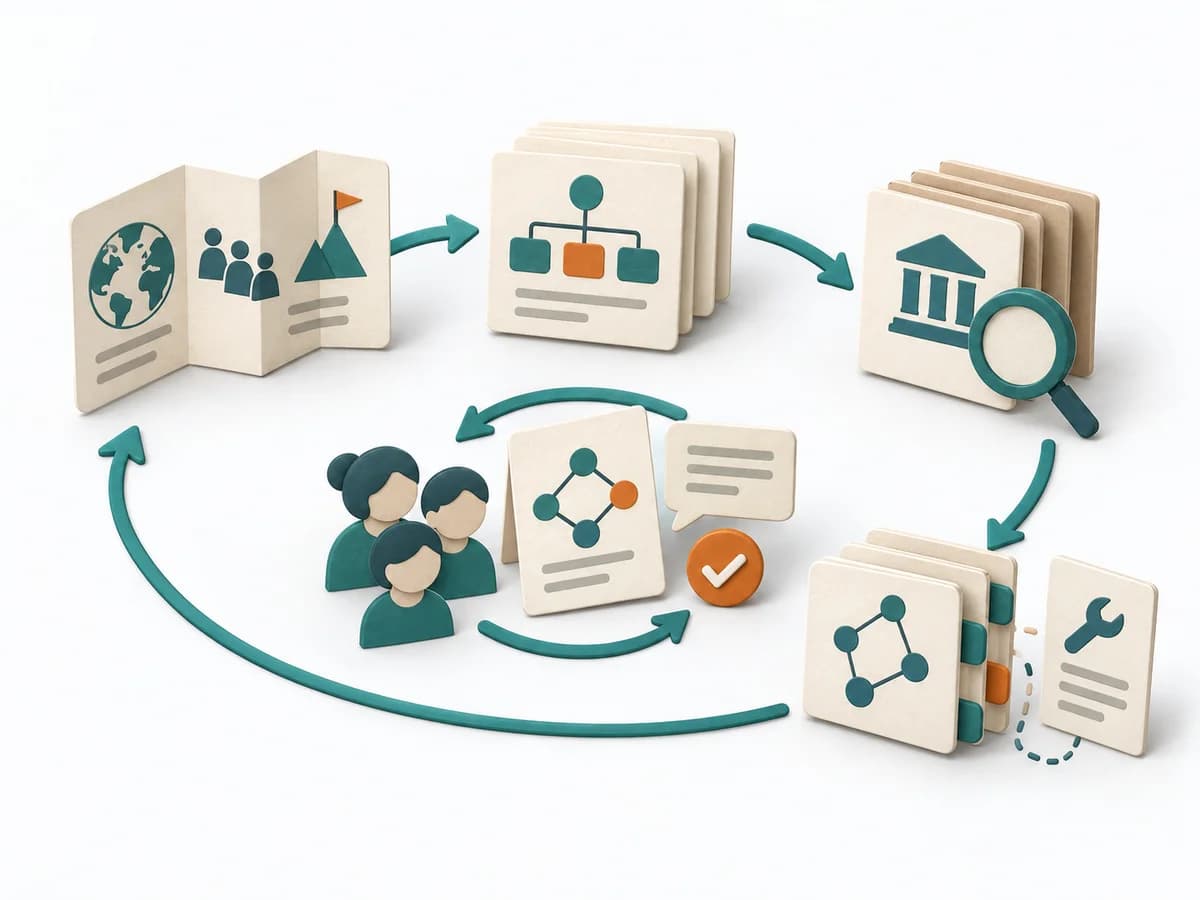
Ontology work is organized as a scenario-based process for reuse, collaboration, evaluation, and long-term maintenance.

Links events, commands, and views into a flow picture that brings UI, behavior, and implementation together.