Goal Question Metric: Worksheet
Plan Goal Question Metric around its domain steps and the concrete decision question.
# Goal Question Metric: Worksheet

## Question
To be confirmed

## Desired outcome
To be confirmed

## Scope
Full workshop
Time: 60–90 minutes

Complete this worksheet on paper or in your own document during the work.

## Preparation for this scope

### Method setup
- **Materials:** Measurement object and purpose, Quality focus and viewpoint, Context and available data, shared workspace, source links, and decision log.
- **Roles:** Goal owner · domain expert · measurement/analytics · data owner
- **Advance information:** Collect Measurement object and purpose, Quality focus and viewpoint, Context and available data in advance and mark open assumptions.
- **Overall time needed:** 60–90 minutes
- **Setup:** Prepare Goal → Questions → Metrics with an explicit interpretation model visibly and calibrate assessment terms before starting.

### Prepare for the work steps

#### GQM goal: GQM goal
- Measurement object and purpose
- Quality focus and viewpoint
- Context and available data

#### Questions: Questions
- GQM goal
- Quality focus and viewpoint
- Context and available data

#### Metrics: Metrics
- question tree
- Quality focus and viewpoint
- Context and available data

#### Interpretation: Interpretation
- metric set
- Quality focus and viewpoint
- Context and available data


## GQM plan

### Goal
Object · purpose · quality focus · viewpoint · context

...

### Questions
Which answers assess the goal?

...

### Metrics
Formula · unit · source · segment · quality

...

### Interpretation model
How do values yield a domain decision?

...

Enter only real input, sources, and decisions.

[NASA Software Engineering Handbook: The Goal Question Metric Approach](https://swehb.nasa.gov/spaces/7150/pages/16450343/SWEREF-391)


## GQM goal: GQM goal
Expected artifact: GQM goal

GQM goal · source · uncertainty · next decision

Entry:

...

- [ ] Are all five goal elements unambiguous?

## Questions: Questions
Expected artifact: question tree

question tree · source · uncertainty · next decision

Entry:

...

- [ ] Does every question cover a relevant aspect of the goal?

## Metrics: Metrics
Expected artifact: metric set

metric set · source · uncertainty · next decision

Entry:

...

- [ ] Can every metric answer at least one question?

## Interpretation: Interpretation
Expected artifact: interpretation model

interpretation model · source · uncertainty · next decision

Entry:

...

- [ ] Is the combination of metrics into a decision traceable?

## Open questions and next steps

...

Method guide: https://methodatlas.meierhoff-systems.de/en/methods/goal-question-metric/run-sheet
Kanban: Worksheet
Plan setup, initial trials and regular reviews. Select one step to prepare a specific appointment.
# Kanban: Worksheet

## Question
To be confirmed

## Desired outcome
To be confirmed

## Scope
Set up and continue Kanban
Time: Several setup steps, followed by ongoing management and improvement

Complete this worksheet on paper or in your own document during the work.

## Preparation for this scope

### Method setup
- **Materials:** Shared board, representative work items, visible policies and start and finish dates. A simple physical board can support the initial work.
- **Roles:** People in the workflow · ownership of policies and improvement · stakeholders as needed
- **Advance information:** Gather real items, actual waiting and handover steps, known blockers and available time data.
- **Overall time needed:** Setup and initial trials across several appointments; ongoing practice afterward.
- **Setup:** Define work item types, start and finish points, relevant states, WIP control and transition policies. Establish a Service Level Expectation (SLE) with elapsed time and probability, initially a clearly labeled estimate and later based on historical Cycle Times. Limits fit your workflow and are reviewed; no fixed team-size formula is prescribed.

### Prepare for the work steps

#### Setup: Define the workflow
- Examples of started and completed work

#### Policies: Agree on WIP and policies
- Defined workflow
- Current started work

#### Active work: Manage started work
- Current board
- Age and blockers of open items

#### Observe: Understand flow data
- Stable start and finish definitions
- Dated work items

#### Improve: Try one improvement
- Flow observations
- Participant feedback


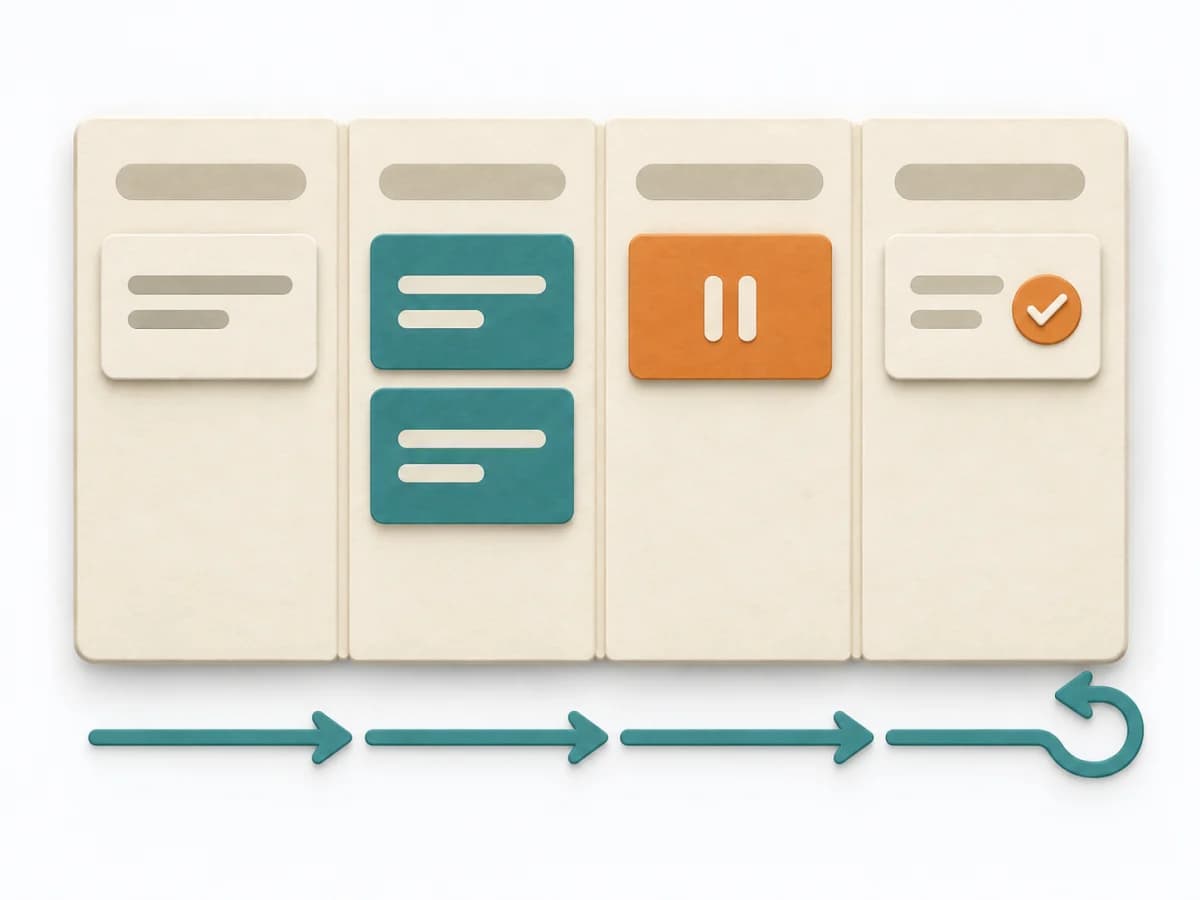
## Manage the workflow together

### Ready

...

### In progress
WIP limit: ...

...

### Review
WIP limit: ...

...

### Done

...

### Working policies

**WIP boundary**
...

**Pull and completion**
...

**Blocker**
...

**SLE and learning**
...

[The Kanban Guide · original educational rendering](https://kanbanguides.org/the-kanban-guide/)


## Setup: Define the workflow
Expected artifact: Definition of Workflow

Scope · items · start · finish · states

Entry:

...

- [ ] Do columns represent actual states?
- [ ] Are start and finish unambiguous?

## Policies: Agree on WIP and policies
Expected artifact: Visible working policies

WIP · pull · blockers · SLE

Entry:

...

- [ ] Do policies prevent uncontrolled starts?
- [ ] Is the SLE labeled as a forecast?

## Active work: Manage started work
Expected artifact: Actively managed work

Next action · ownership · blocker

Entry:

...

- [ ] Does blocked work still count as WIP?
- [ ] Does aging work have a next action?

## Observe: Understand flow data
Expected artifact: Flow observations

WIP · Throughput · Work Item Age · Cycle Time

Entry:

...

- [ ] Are measurement boundaries stable?
- [ ] Are open and completed items distinguished?

## Improve: Try one improvement
Expected artifact: Improvement experiment

Change · expected effect · review

Entry:

...

- [ ] Is the expected effect observable?
- [ ] Will the change be reviewed?

## Open questions and next steps

...

Method guide: https://methodatlas.meierhoff-systems.de/en/methods/kanban/run-sheet
Hypothesis-Driven Troubleshooting: Worksheet
Set subject, evidence, roles, flow, and review.
# Hypothesis-Driven Troubleshooting: Worksheet

## Question
To be confirmed

## Desired outcome
To be confirmed

## Scope
Complete run
Time: 30–180 minutes per failure; for production-critical events run alongside safe containment.

Complete this worksheet on paper or in your own document during the work.

## Preparation for this scope

### Method setup
- **Materials:** Precise symptom, architecture and changes, hypothesis board, predictions, safe tests, and evidence log
- **Roles:** Troubleshooting lead · hypothesis owners · operator · system experts · scribe
- **Advance information:** Set symptom, affected/unaffected cases, current signals, and safe test boundaries; separate containment from diagnosis.
- **Overall time needed:** 30–180 minutes per failure; for production-critical events run alongside safe containment.
- **Setup:** Prepare a workspace with Symptom · Hypotheses · Predictions · Test · Decide; separate example from live data.

### Prepare for the work steps

#### Symptom: Symptom view
- Set symptom, affected/unaffected cases, current signals, and safe test boundaries; separate containment from diagnosis.
- Precise symptom, architecture and changes, hypothesis board, predictions, safe tests, and evidence log

#### Hypotheses: Hypothesis space
- Symptom view

#### Predictions: Prediction matrix
- Hypothesis space

#### Test: Test result
- Prediction matrix

#### Decide: Diagnostic finding
- Test result


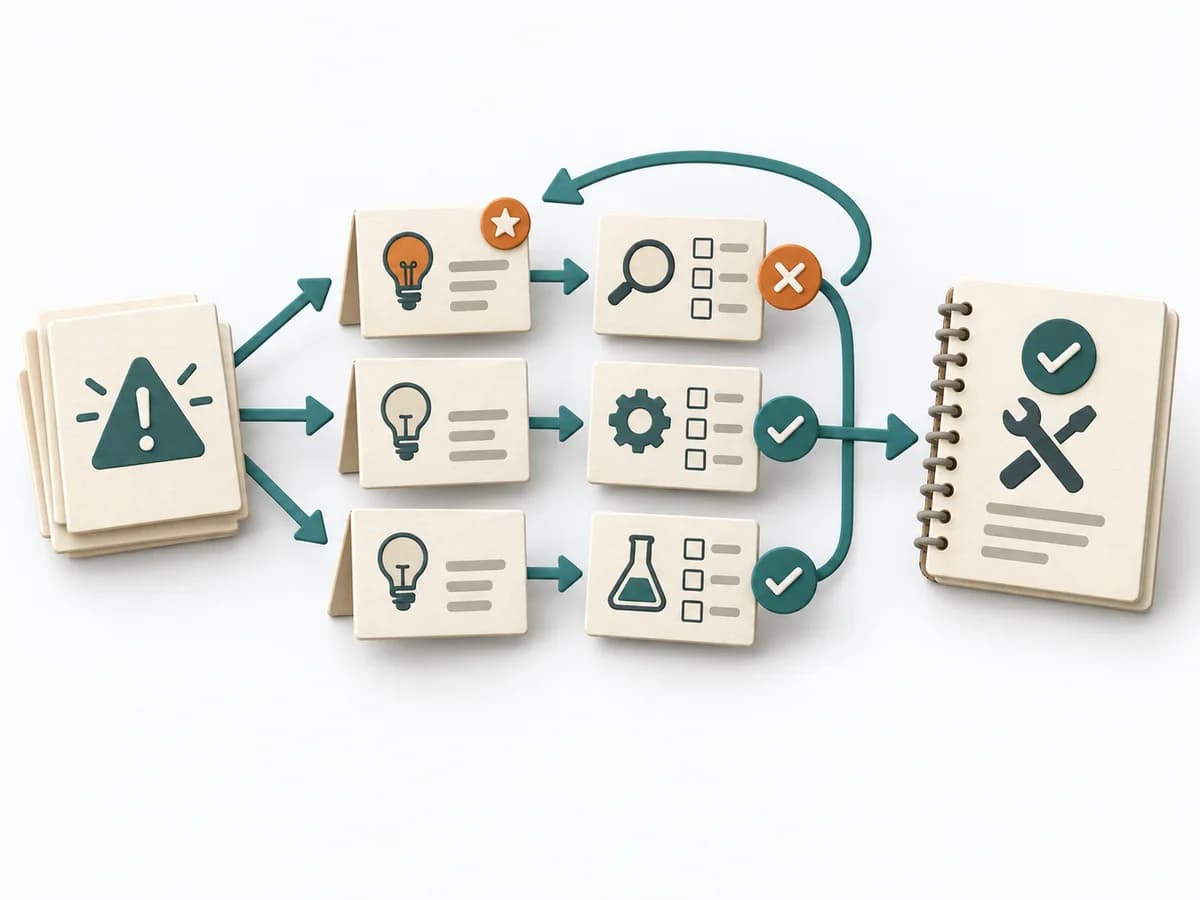
## Hypothesis-Driven Troubleshooting · working structure

| Hypothesis | Mechanism | Prediction | Falsifier | Test | Finding | Status |
| --- | --- | --- | --- | --- | --- | --- |
| Shared pool exhausted |   |   |   |   |   |   |
| EU network fault |   |   |   |   |   |   |
| Web release blocks |   |   |   |   |   |   |

- **Shared pool exhausted:** Add evidence and rationale.
- **EU network fault:** Add evidence and rationale.
- **Web release blocks:** Add evidence and rationale.

The blank worksheet contains prompts only.

[Reference · original teaching example](https://sre.google/sre-book/effective-troubleshooting/)


## Symptom: Symptom view
Expected artifact: Symptom view

Operationalise observed failure and collect Is/Is-Not cases.

Entry:

...

- [ ] Is success/failure measurable and free of causal claims?

## Hypotheses: Hypothesis space
Expected artifact: Hypothesis space

Derive several mechanistic explanations from signals, architecture, and changes.

Entry:

...

- [ ] Does each explain affected and unaffected cases?

## Predictions: Prediction matrix
Expected artifact: Prediction matrix

Write observable predictions and falsifying signals for every hypothesis.

Entry:

...

- [ ] Are predictions recorded before testing and discriminating?

## Test: Test result
Expected artifact: Test result

Run safest highest-information test, changing one condition at a time.

Entry:

...

- [ ] Does test vary exactly the discriminating condition and remain reversible?

## Decide: Diagnostic finding
Expected artifact: Diagnostic finding

Update hypotheses against all evidence, record mechanism, and hand over next action/residual uncertainty.

Entry:

...

- [ ] Does leading hypothesis explain all signals with a serious alternative tested?

## Open questions and next steps

...

Method guide: https://methodatlas.meierhoff-systems.de/en/methods/hypothesis-driven-troubleshooting/run-sheet
Fault Isolation: Worksheet
Set subject, evidence, roles, flow, and review.
# Fault Isolation: Worksheet

## Question
To be confirmed

## Desired outcome
To be confirmed

## Scope
Complete run
Time: 30–180 minutes per failure; duration depends on test access and system complexity.

Complete this worksheet on paper or in your own document during the work.

## Preparation for this scope

### Method setup
- **Materials:** Symptom and reproduction, architecture/dependency map, comparison signals, safe tests, and isolation log
- **Roles:** Troubleshooting lead · system/component experts · operator · scribe
- **Advance information:** Set symptom, success/failure criterion, affected and unaffected cases, and safe test boundaries.
- **Overall time needed:** 30–180 minutes per failure; duration depends on test access and system complexity.
- **Setup:** Prepare a workspace with Boundary · Candidates · Split · Test · Confirm; separate example from live data.

### Prepare for the work steps

#### Boundary: Fault boundary
- Set symptom, success/failure criterion, affected and unaffected cases, and safe test boundaries.
- Symptom and reproduction, architecture/dependency map, comparison signals, safe tests, and isolation log

#### Candidates: Candidate map
- Fault boundary

#### Split: Isolation plan
- Candidate map

#### Test: Isolation log
- Isolation plan

#### Confirm: Confirmed domain
- Isolation log


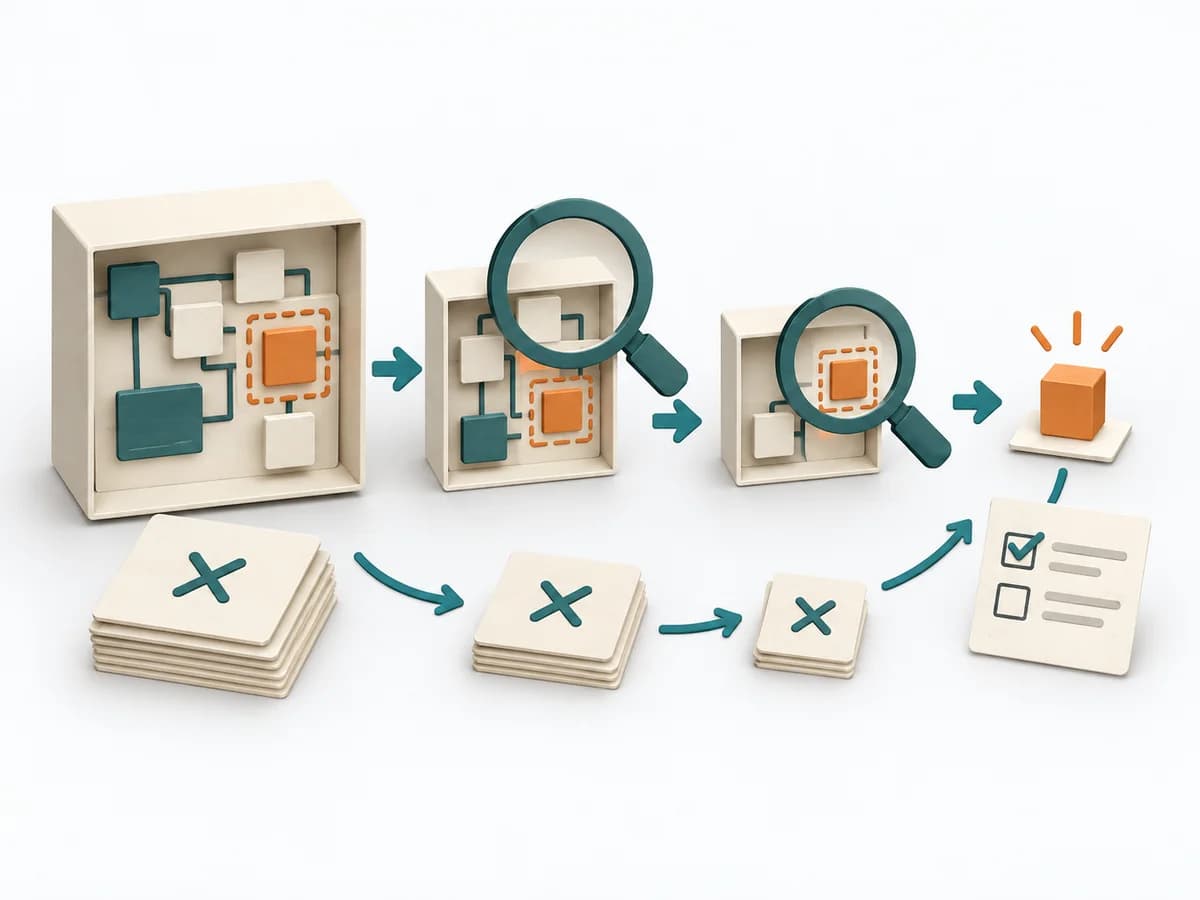
## Fault Isolation · working structure

| Test | Candidates before | Test change | Discriminating prediction | Result | Excluded | Remaining |
| --- | --- | --- | --- | --- | --- | --- |
| Direct API call |   |   |   |   |   |   |
| Isolated pool |   |   |   |   |   |   |

- **Direct API call:** Add evidence and rationale.
- **Isolated pool:** Add evidence and rationale.

The blank worksheet contains prompts only.

[Reference · original teaching example](https://sre.google/sre-book/effective-troubleshooting/)


## Boundary: Fault boundary
Expected artifact: Fault boundary

Describe reproducible symptom and collect Is/Is-Not cases.

Entry:

...

- [ ] Are affected, unaffected, and trigger concrete?

## Candidates: Candidate map
Expected artifact: Candidate map

Map dependency path and collect plausible fault domains without fixing cause.

Entry:

...

- [ ] Does map cover signal path end to end?

## Split: Isolation plan
Expected artifact: Isolation plan

Choose the most discriminating test, preferably safe bisection or affected/unaffected comparison.

Entry:

...

- [ ] Will either result exclude several candidates?

## Test: Isolation log
Expected artifact: Isolation log

Run one test at a time, record result and side effect, and update candidate space.

Entry:

...

- [ ] Was only one distinguishing condition changed?

## Confirm: Confirmed domain
Expected artifact: Confirmed domain

Confirm isolated area by reproduction or controlled return and hand over residual uncertainty.

Entry:

...

- [ ] Does symptom occur with the domain and disappear without it?

## Open questions and next steps

...

Method guide: https://methodatlas.meierhoff-systems.de/en/methods/fault-isolation/run-sheet
Golden Path: Worksheet
Choose a common developer use case and supported target environment; inspect access, security requirements and existing tools.
# Golden Path: Worksheet

## Question
To be confirmed

## Desired outcome
To be confirmed

## Scope
Complete cycle
Time: Multiple sessions for construction and pilot; ongoing maintenance

Complete this worksheet on paper or in your own document during the work.

## Preparation for this scope

### Method setup
- **Materials:** Reference repository, runnable development environment, template, CI/CD, checklist and feedback channel.
- **Roles:** Platform team, a pilot development team, security and operations owners.
- **Advance information:** Choose a common developer use case and supported target environment; inspect access, security requirements and existing tools.
- **Overall time needed:** Multiple sessions for construction and pilot; ongoing maintenance
- **Setup:** Prepare a fresh test environment and reference repository; follow instructions alongside the running workflow.

### Prepare for the work steps

#### Standard case: Bound the standard case
- User needs
- Platform capabilities

#### Build route: Build an executable route
- Use case
- Environment and tool access

#### Operations: Include quality and operations
- Reference path
- Quality and operational requirements

#### Pilot: Pilot with a team
- Operable route
- Pilot team

#### Maintenance: Support and exceptions
- Pilot feedback
- Maintenance owner


## Golden Path· worksheet

### Supported case
Who uses the path for which outcome and what is outside scope?

...

### Prerequisites
Which access, tools and knowledge are checked before starting?

...

### Executable route
Specify steps, linked templates and expected results.

...

### Quality and operations
Which checks, operating information and recovery steps are included?

...

### Maintenance and exceptions
Who maintains which version and how are support or deviations handled?

...

Answer the prompts with your own information. Explicitly mark unknowns and assumptions.

[Spotify Engineering: How We Use Golden Paths](https://engineering.atspotify.com/2020/8/how-we-use-golden-paths-to-solve-fragmentation-in-our-software-ecosystem)


## Standard case: Bound the standard case
Expected artifact: Use case

Are audience and supported case unambiguous?

Entry:

...

- [ ] Are audience and supported case unambiguous?

## Build route: Build an executable route
Expected artifact: Reference route

Can someone follow the route without insider knowledge?

Entry:

...

- [ ] Can someone follow the route without insider knowledge?

## Operations: Include quality and operations
Expected artifact: Operating standard

Is the generated result operable?

Entry:

...

- [ ] Is the generated result operable?

## Pilot: Pilot with a team
Expected artifact: Pilot feedback

Did the pilot team reach the endpoint independently?

Entry:

...

- [ ] Did the pilot team reach the endpoint independently?

## Maintenance: Support and exceptions
Expected artifact: Supported route

Are support and the exception route visible?

Entry:

...

- [ ] Are support and the exception route visible?

## Open questions and next steps

...

Method guide: https://methodatlas.meierhoff-systems.de/en/methods/golden-path/run-sheet