Complete firstRecurring use case
A concrete workflow with several actual users is known.
Without demand, the platform template may go unused.
A practical method guide: clarify prerequisites and materials, understand the complete process, and look up outputs, pitfalls, and stop criteria.
What needs to be finished first
A concrete workflow with several actual users is known.
A group owns maintenance, support and version changes.
What needs to be ready before start
Reference repository, runnable development environment, template, CI/CD, checklist and feedback channel.
Platform team, a pilot development team, security and operations owners.
Choose a common developer use case and supported target environment; inspect access, security requirements and existing tools.
Multiple sessions for construction and pilot; ongoing maintenance
Prepare a fresh test environment and reference repository; follow instructions alongside the running workflow.
The one question this method answers
How does a team reliably move from entry to an operable result in the supported standard case?
Phases with goal, actions, output and pitfall
A golden path is an opinionated, supported route for development teams to implement a common technical use case. Guidance, templates, automation and operating rules together form the platform offering.
Fictional example
A golden path is an opinionated, supported route for development teams to implement a common technical use case. Guidance, templates, automation and operating rules together form the platform offering.
Who uses the path for which outcome and what is outside scope?
Fictional: product teams create an internal HTTP service on the existing container platform; batch jobs are out of scope.
Which access, tools and knowledge are checked before starting?
Git access, team identifier and sandbox permission are checked before invoking the template.
Specify steps, linked templates and expected results.
The template creates repository and pipeline; a commit starts tests; an approved build deploys to the sandbox.
Which checks, operating information and recovery steps are included?
Dependency scan, health check, dashboard, service owner and return to the previous version are tested in the pilot.
Who maintains which version and how are support or deviations handled?
The platform team maintains version 1.2 monthly; different runtimes are documented with service owner and support boundary.
All example details are fictional and illustrate the application.
Standard case
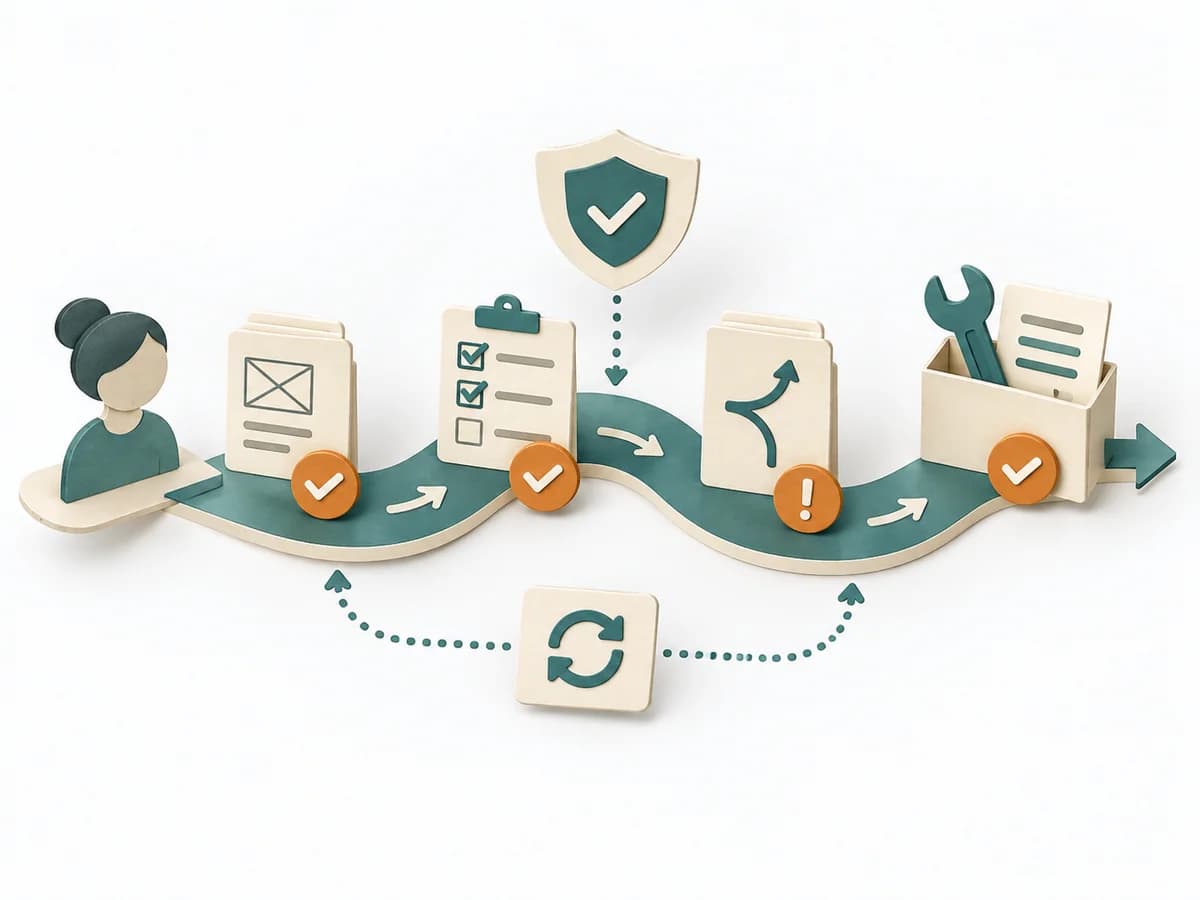
Goal
Bounded platform use case
Inputs for this step
Actions
Output
Use case
Are audience and supported case unambiguous?
Quality check
Are audience and supported case unambiguous?
Pitfall
A universal path is expected to cover every architecture. Start with one frequent, homogeneous use case.
Timing: 30–60 minutes
Build route
Goal
Runnable reference path
Inputs for this step
Actions
Output
Reference route
Can someone follow the route without insider knowledge?
Quality check
Can someone follow the route without insider knowledge?
Pitfall
Instructions assume hidden local configuration. Test in a fresh environment and include all prerequisites.
Timing: 60–120 minutes
Operations
Goal
Operable standard
Inputs for this step
Actions
Output
Operating standard
Is the generated result operable?
Quality check
Is the generated result operable?
Pitfall
The template ends at the first successful build. Demonstrate deployment, observability and recovery in the pilot.
Timing: 30–90 minutes
Pilot
Goal
Tested path with feedback
Inputs for this step
Actions
Output
Pilot feedback
Did the pilot team reach the endpoint independently?
Quality check
Did the pilot team reach the endpoint independently?
Pitfall
The author performs all critical steps. Repeat the pilot and record help as a documented product gap.
Timing: 60–120 minutes
Maintenance
Goal
Supported golden path
Inputs for this step
Actions
Output
Supported route
Are support and the exception route visible?
Quality check
Are support and the exception route visible?
Pitfall
The preferred path becomes an unquestioned mandate. Examine deviation needs and handle missing capabilities transparently.
Timing: 30–60 minutes
What comes out at the end
Sketch: what the artifact looks like
Versioned entry path with prerequisites, executable steps, quality checks, operational handover, support and exception policy.
Record date and scope; retain the previous version and reason when changing it.
Choose a common developer use case and supported target environment; inspect access, security requirements and existing tools.
To be confirmed
To be confirmed
Complete cycle Time: Multiple sessions for construction and pilot; ongoing maintenance
Complete this worksheet on paper or in your own document during the work.
Who uses the path for which outcome and what is outside scope?
...
Which access, tools and knowledge are checked before starting?
...
Specify steps, linked templates and expected results.
...
Which checks, operating information and recovery steps are included?
...
Who maintains which version and how are support or deviations handled?
...
Answer the prompts with your own information. Explicitly mark unknowns and assumptions.
Spotify Engineering: How We Use Golden Paths
Expected artifact: Use case
Are audience and supported case unambiguous?
Entry:
...
Expected artifact: Reference route
Can someone follow the route without insider knowledge?
Entry:
...
Expected artifact: Operating standard
Is the generated result operable?
Entry:
...
Expected artifact: Pilot feedback
Did the pilot team reach the endpoint independently?
Entry:
...
Expected artifact: Supported route
Are support and the exception route visible?
Entry:
...
...
Method guide: https://methodatlas.meierhoff-systems.de/en/methods/golden-path/run-sheet
Concrete filled scenario, fictional example
Fictional example for orientation. Counts and timings describe this case and are not universal requirements.
Concrete filled scenario, fictional example
Supported case: Fictional: product teams create an internal HTTP service on the existing container platform; batch jobs are out of scope.
Prerequisites: Git access, team identifier and sandbox permission are checked before invoking the template.
Executable route: The template creates repository and pipeline; a commit starts tests; an approved build deploys to the sandbox.
Quality and operations: Dependency scan, health check, dashboard, service owner and return to the previous version are tested in the pilot.
Maintenance and exceptions: The platform team maintains version 1.2 monthly; different runtimes are documented with service owner and support boundary.
Recognize symptoms and steer against them
Quick overview, the full text is in the matching phase in the flow
A universal path is expected to cover every architecture.
Start with one frequent, homogeneous use case.
Instructions assume hidden local configuration.
Test in a fresh environment and include all prerequisites.
The template ends at the first successful build.
Demonstrate deployment, observability and recovery in the pilot.
The author performs all critical steps.
Repeat the pilot and record help as a documented product gap.
The preferred path becomes an unquestioned mandate.
Examine deviation needs and handle missing capabilities transparently.
When to pause, resolve prerequisites, or choose another approach
Go to the profile for purpose, similar methods, and sources or continue to the next method in the catalog.