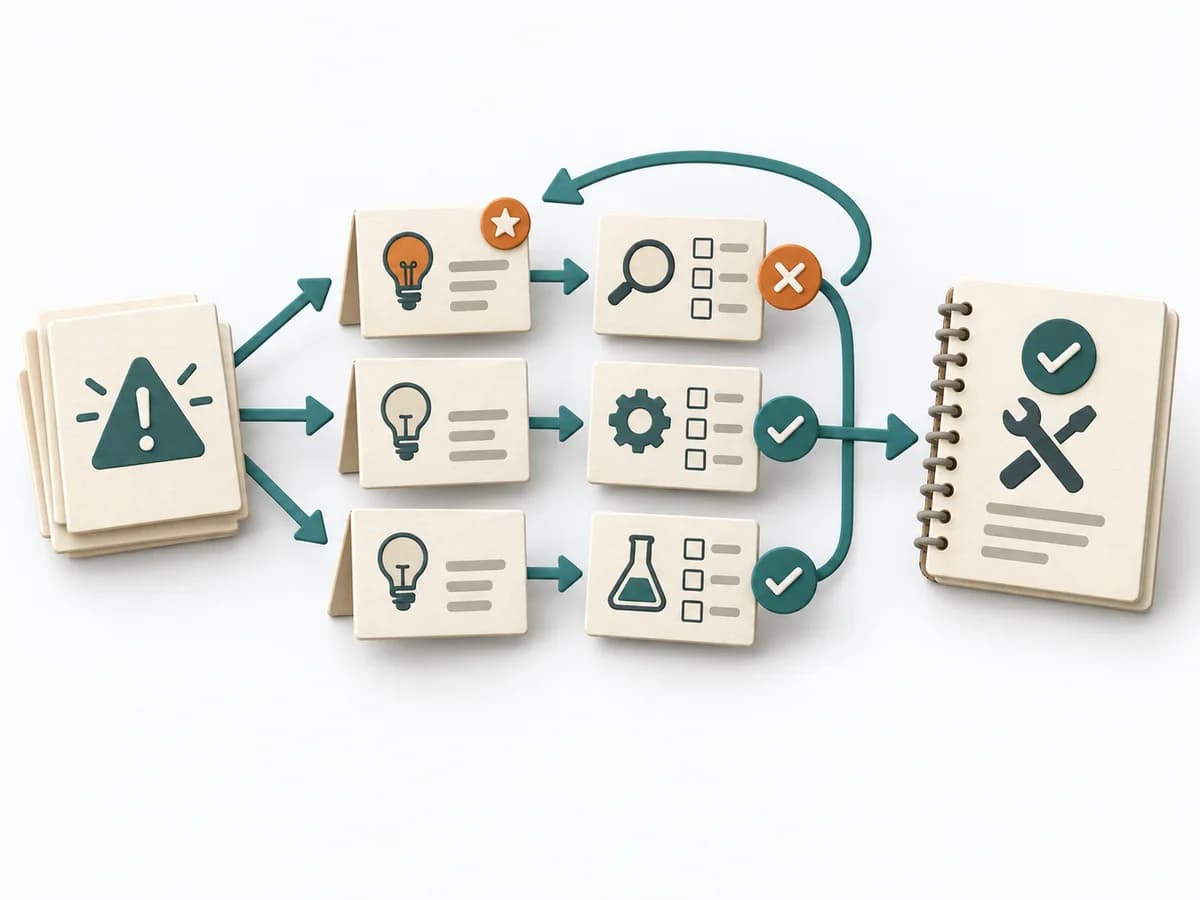
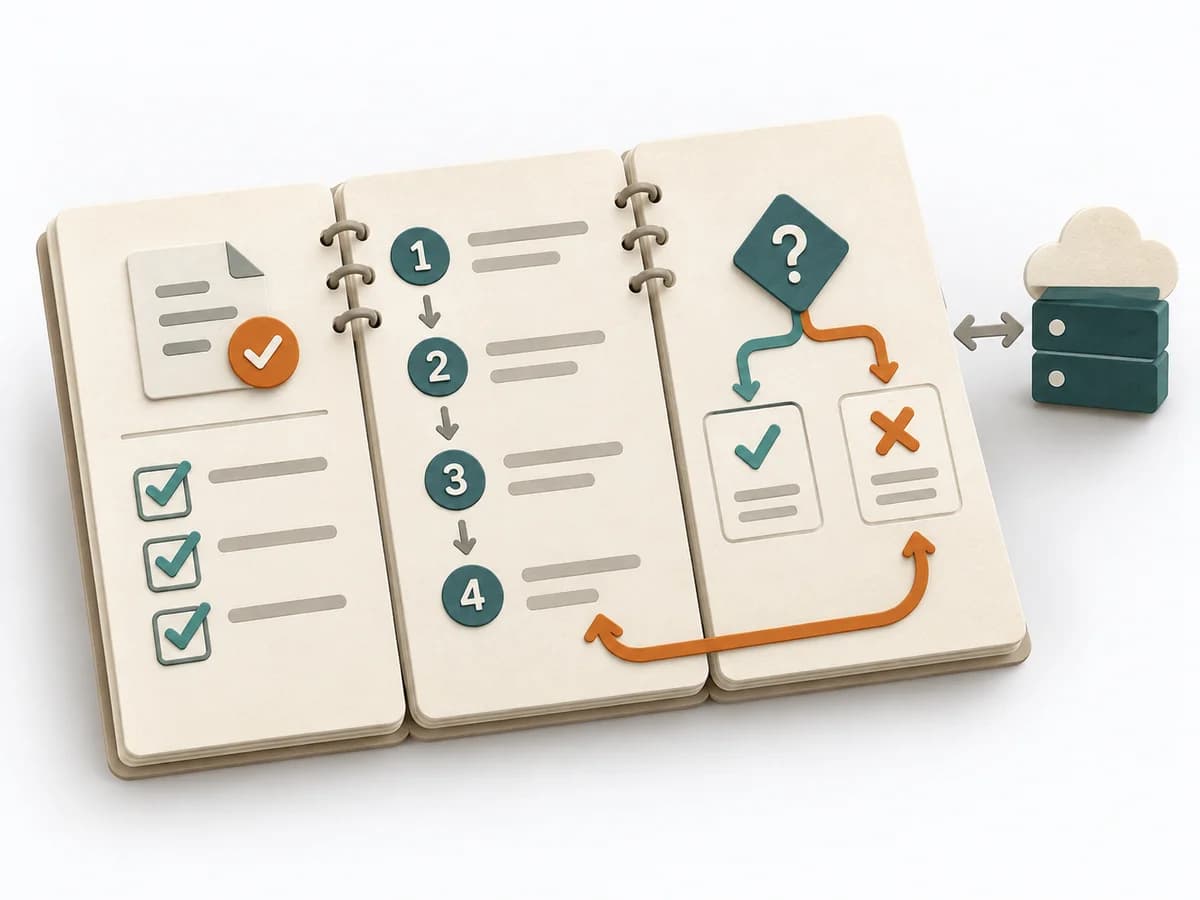
Complete firstClear boundary
Set symptom, success/failure criterion, affected and unaffected cases, and safe test boundaries.
Without a boundary, cases, periods, or variables become mixed.
A practical method guide: clarify prerequisites and materials, understand the complete process, and look up outputs, pitfalls, and stop criteria.
What needs to be finished first
Set symptom, success/failure criterion, affected and unaffected cases, and safe test boundaries.
Symptom and reproduction, architecture/dependency map, comparison signals, safe tests, and isolation log
What needs to be ready before start
Symptom and reproduction, architecture/dependency map, comparison signals, safe tests, and isolation log
Troubleshooting lead · system/component experts · operator · scribe
Set symptom, success/failure criterion, affected and unaffected cases, and safe test boundaries.
30–180 minutes per failure; duration depends on test access and system complexity.
Prepare a workspace with Boundary · Candidates · Split · Test · Confirm; separate example from live data.
The one question this method answers
Which smallest subsystem contains the fault when candidates are systematically excluded through discriminating tests?
Phases with goal, actions, output and pitfall
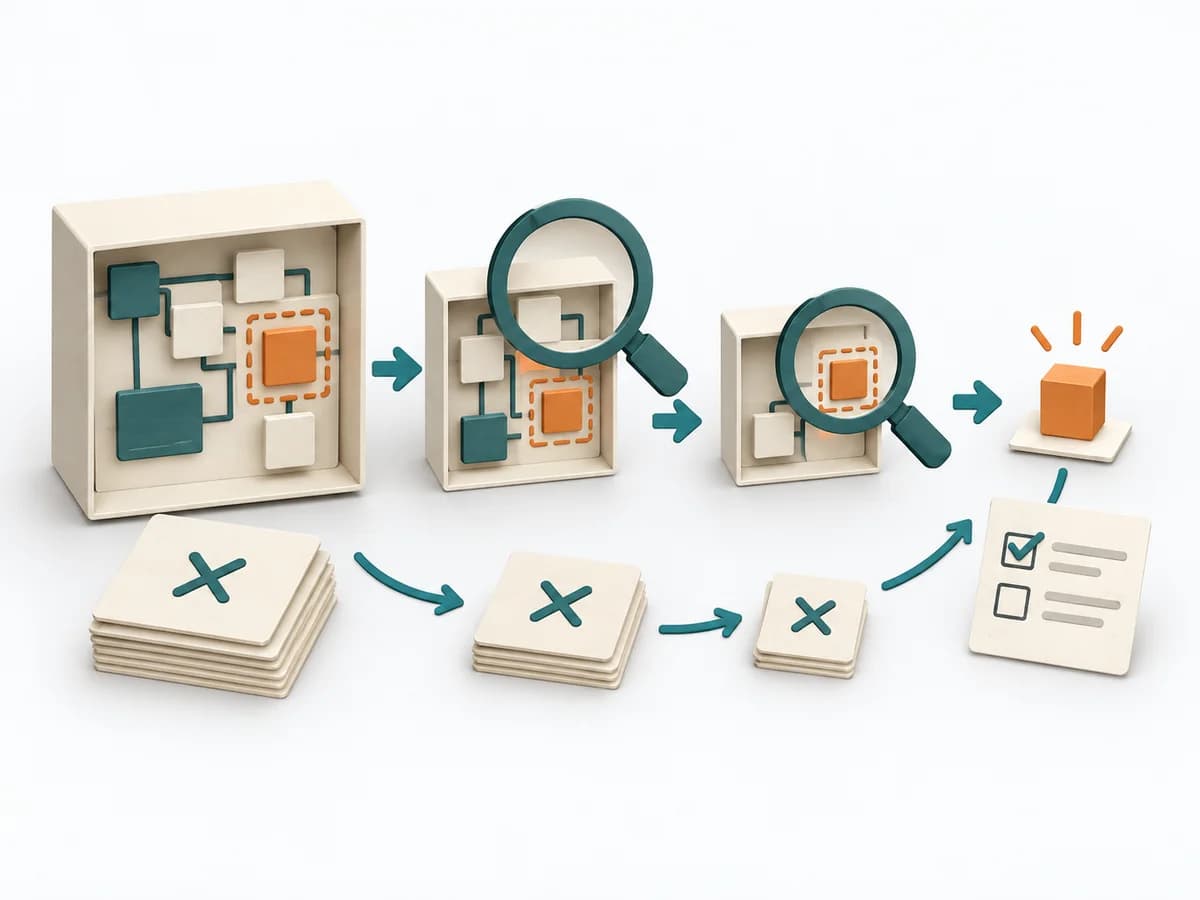
Fault isolation narrows system boundaries, symptoms, and candidate fault areas so tests can target the likely origin. Each exclusion reduces the candidate space and makes the remaining domain more tangible.
Fictional example
Fictional values show the actual method fields.
| Test | Candidates before | Test change | Discriminating prediction | Result | Excluded | Remaining |
|---|---|---|---|---|---|---|
| Direct API callAdd evidence and rationale. | Frontend, API, pool, DB, network | Bypass frontend | Fails if backend path is faulty | Timeout remains | Frontend | API, pool, DB, network |
| Isolated poolAdd evidence and rationale. | API, pool, DB, network | Change pool path only | Failure disappears for shared-pool fault | Checkout works | API, DB, network | Shared pool |
All values are fictional.
Boundary
Goal
Fault boundary: Describe reproducible symptom and collect Is/Is-Not cases.
Inputs for this step
Actions
Output
Fault boundary
Describe reproducible symptom and collect Is/Is-Not cases.
Quality check
Are affected, unaffected, and trigger concrete?
Pitfall
Checkout broken is too broad. Slice by region, channel, time, and dependency.
Timing: 10–20 minutes
Candidates
Goal
Candidate map: Map dependency path and collect plausible fault domains without fixing cause.
Inputs for this step
Actions
Output
Candidate map
Map dependency path and collect plausible fault domains without fixing cause.
Quality check
Does map cover signal path end to end?
Pitfall
Team jumps to the latest changed component. Draw full path and order candidates by signal boundary.
Timing: 15–25 minutes
Split
Goal
Isolation plan: Choose the most discriminating test, preferably safe bisection or affected/unaffected comparison.
Inputs for this step
Actions
Output
Isolation plan
Choose the most discriminating test, preferably safe bisection or affected/unaffected comparison.
Quality check
Will either result exclude several candidates?
Pitfall
Many measurements are collected without decision logic. State which result excludes which domains before testing.
Timing: 10–20 minutes
Test
Goal
Isolation log: Run one test at a time, record result and side effect, and update candidate space.
Inputs for this step
Actions
Output
Isolation log
Run one test at a time, record result and side effect, and update candidate space.
Quality check
Was only one distinguishing condition changed?
Pitfall
Several components restart together. One change per test; label diagnostic value of emergency action.
Timing: 15–90 minutes
Confirm
Goal
Confirmed domain: Confirm isolated area by reproduction or controlled return and hand over residual uncertainty.
Inputs for this step
Actions
Output
Confirmed domain
Confirm isolated area by reproduction or controlled return and hand over residual uncertainty.
Quality check
Does symptom occur with the domain and disappear without it?
Pitfall
Isolation is confused with root cause. Confirm fault domain and investigate causal mechanism separately.
Timing: 15–30 minutes
What comes out at the end
Sketch: what the artifact looks like
Fault-isolation log with candidate space, tests, results, excluded areas, and isolated fault domain.
Record date, owner, source state, and review date; preserve prior versions.
Set subject, evidence, roles, flow, and review.
To be confirmed
To be confirmed
Complete run Time: 30–180 minutes per failure; duration depends on test access and system complexity.
Complete this worksheet on paper or in your own document during the work.
| Test | Candidates before | Test change | Discriminating prediction | Result | Excluded | Remaining |
|---|---|---|---|---|---|---|
| Direct API call | ||||||
| Isolated pool |
The blank worksheet contains prompts only.
Reference · original teaching example
Expected artifact: Fault boundary
Describe reproducible symptom and collect Is/Is-Not cases.
Entry:
...
Expected artifact: Candidate map
Map dependency path and collect plausible fault domains without fixing cause.
Entry:
...
Expected artifact: Isolation plan
Choose the most discriminating test, preferably safe bisection or affected/unaffected comparison.
Entry:
...
Expected artifact: Isolation log
Run one test at a time, record result and side effect, and update candidate space.
Entry:
...
Expected artifact: Confirmed domain
Confirm isolated area by reproduction or controlled return and hand over residual uncertainty.
Entry:
...
...
Method guide: https://methodatlas.meierhoff-systems.de/en/methods/fault-isolation/run-sheet
Concrete filled scenario, fictional example
Fictional example for orientation. Counts and timings describe this case and are not universal requirements.
Concrete filled scenario, fictional example
| Test | Candidates before | Test change | Discriminating prediction | Result | Excluded | Remaining |
|---|---|---|---|---|---|---|
| Direct API call | Frontend, API, pool, DB, network | Bypass frontend | Fails if backend path is faulty | Timeout remains | Frontend | API, pool, DB, network |
| Isolated pool | API, pool, DB, network | Change pool path only | Failure disappears for shared-pool fault | Checkout works | API, DB, network | Shared pool |
Recognize symptoms and steer against them
Quick overview, the full text is in the matching phase in the flow
Checkout broken is too broad.
Slice by region, channel, time, and dependency.
Team jumps to the latest changed component.
Draw full path and order candidates by signal boundary.
Many measurements are collected without decision logic.
State which result excludes which domains before testing.
Several components restart together.
One change per test; label diagnostic value of emergency action.
Isolation is confused with root cause.
Confirm fault domain and investigate causal mechanism separately.
When to pause, resolve prerequisites, or choose another approach
Go to the profile for purpose, similar methods, and sources or continue to the next method in the catalog.