Complete firstClear boundary
Set symptom, affected/unaffected cases, current signals, and safe test boundaries; separate containment from diagnosis.
Without a boundary, cases, periods, or variables become mixed.
A practical method guide: clarify prerequisites and materials, understand the complete process, and look up outputs, pitfalls, and stop criteria.
What needs to be finished first
Set symptom, affected/unaffected cases, current signals, and safe test boundaries; separate containment from diagnosis.
Precise symptom, architecture and changes, hypothesis board, predictions, safe tests, and evidence log
What needs to be ready before start
Precise symptom, architecture and changes, hypothesis board, predictions, safe tests, and evidence log
Troubleshooting lead · hypothesis owners · operator · system experts · scribe
Set symptom, affected/unaffected cases, current signals, and safe test boundaries; separate containment from diagnosis.
30–180 minutes per failure; for production-critical events run alongside safe containment.
Prepare a workspace with Symptom · Hypotheses · Predictions · Test · Decide; separate example from live data.
The one question this method answers
Which competing hypothesis best explains all observed signals, and which safe test discriminates among them most strongly?
Phases with goal, actions, output and pitfall
Jede Vermutung wird mit einer Prüfung verknüpft, die möglichst viel Information pro Test liefert. Dadurch entsteht eine Reihenfolge, in der die stärksten Hypothesen zuerst unter Druck geraten und die Diagnostik nicht im Kreis läuft. Der Ansatz verbindet Debugging mit sauberer Evidenz.
Fictional example
Fictional values show the actual method fields.
| Hypothesis | Mechanism | Prediction | Falsifier | Test | Finding | Status |
|---|---|---|---|---|---|---|
| Shared pool exhaustedAdd evidence and rationale. | Batch occupies shared pool | Isolated pool removes timeout | Timeout persists with isolated pool | Compare shared and isolated pool | Failure only with shared pool | Supported |
| EU network faultAdd evidence and rationale. | Regional packet loss | EU loss affects web and mobile | Mobile remains stable | Compare EU web and mobile | Mobile has no loss | Weakened |
| Web release blocksAdd evidence and rationale. | Release blocks requests in browser | Direct API works | Direct call also fails | Bypass web and call API | Direct call fails | Rejected |
All values are fictional.
Symptom
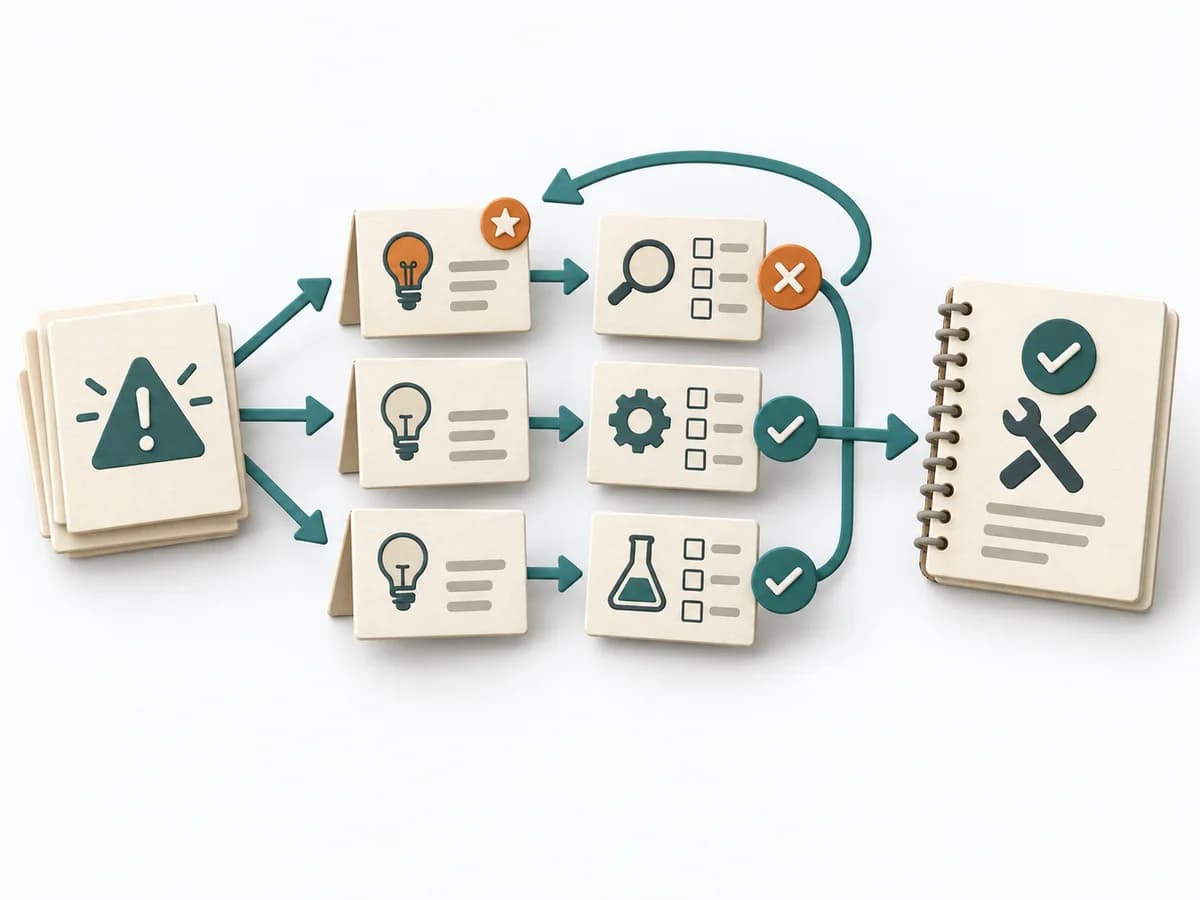
Goal
Symptom view: Operationalise observed failure and collect Is/Is-Not cases.
Inputs for this step
Actions
Output
Symptom view
Operationalise observed failure and collect Is/Is-Not cases.
Quality check
Is success/failure measurable and free of causal claims?
Pitfall
Database problem is written as symptom. State only observable behaviour, scope, and time.
Timing: 10–20 minutes
Hypotheses
Goal
Hypothesis space: Derive several mechanistic explanations from signals, architecture, and changes.
Inputs for this step
Actions
Output
Hypothesis space
Derive several mechanistic explanations from signals, architecture, and changes.
Quality check
Does each explain affected and unaffected cases?
Pitfall
Team pursues only first plausible idea. Add a competing explanation and null hypothesis.
Timing: 10–20 minutes
Predictions
Goal
Prediction matrix: Write observable predictions and falsifying signals for every hypothesis.
Inputs for this step
Actions
Output
Prediction matrix
Write observable predictions and falsifying signals for every hypothesis.
Quality check
Are predictions recorded before testing and discriminating?
Pitfall
Tests are reinterpreted after results. Record expected findings and exclusion rule before execution.
Timing: 10–20 minutes
Test
Goal
Test result: Run safest highest-information test, changing one condition at a time.
Inputs for this step
Actions
Output
Test result
Run safest highest-information test, changing one condition at a time.
Quality check
Does test vary exactly the discriminating condition and remain reversible?
Pitfall
Multiple restarts destroy diagnostic information. One change per test; label emergency action separately.
Timing: 15–90 minutes
Decide
Goal
Diagnostic finding: Update hypotheses against all evidence, record mechanism, and hand over next action/residual uncertainty.
Inputs for this step
Actions
Output
Diagnostic finding
Update hypotheses against all evidence, record mechanism, and hand over next action/residual uncertainty.
Quality check
Does leading hypothesis explain all signals with a serious alternative tested?
Pitfall
One successful test is called full root cause. State diagnostic boundary and pass remaining cause question separately.
Timing: 15–30 minutes
What comes out at the end
Sketch: what the artifact looks like
Troubleshooting log with prioritised hypotheses, predictions, discriminating tests, results, and residual uncertainty.
Record date, owner, source state, and review date; preserve prior versions.
Set subject, evidence, roles, flow, and review.
To be confirmed
To be confirmed
Complete run Time: 30–180 minutes per failure; for production-critical events run alongside safe containment.
Complete this worksheet on paper or in your own document during the work.
| Hypothesis | Mechanism | Prediction | Falsifier | Test | Finding | Status |
|---|---|---|---|---|---|---|
| Shared pool exhausted | ||||||
| EU network fault | ||||||
| Web release blocks |
The blank worksheet contains prompts only.
Reference · original teaching example
Expected artifact: Symptom view
Operationalise observed failure and collect Is/Is-Not cases.
Entry:
...
Expected artifact: Hypothesis space
Derive several mechanistic explanations from signals, architecture, and changes.
Entry:
...
Expected artifact: Prediction matrix
Write observable predictions and falsifying signals for every hypothesis.
Entry:
...
Expected artifact: Test result
Run safest highest-information test, changing one condition at a time.
Entry:
...
Expected artifact: Diagnostic finding
Update hypotheses against all evidence, record mechanism, and hand over next action/residual uncertainty.
Entry:
...
...
Method guide: https://methodatlas.meierhoff-systems.de/en/methods/hypothesis-driven-troubleshooting/run-sheet
Concrete filled scenario, fictional example
Fictional example for orientation. Counts and timings describe this case and are not universal requirements.
Concrete filled scenario, fictional example
| Hypothesis | Mechanism | Prediction | Falsifier | Test | Finding | Status |
|---|---|---|---|---|---|---|
| Shared pool exhausted | Batch occupies shared pool | Isolated pool removes timeout | Timeout persists with isolated pool | Compare shared and isolated pool | Failure only with shared pool | Supported |
| EU network fault | Regional packet loss | EU loss affects web and mobile | Mobile remains stable | Compare EU web and mobile | Mobile has no loss | Weakened |
| Web release blocks | Release blocks requests in browser | Direct API works | Direct call also fails | Bypass web and call API | Direct call fails | Rejected |
Recognize symptoms and steer against them
Quick overview, the full text is in the matching phase in the flow
Database problem is written as symptom.
State only observable behaviour, scope, and time.
Team pursues only first plausible idea.
Add a competing explanation and null hypothesis.
Tests are reinterpreted after results.
Record expected findings and exclusion rule before execution.
Multiple restarts destroy diagnostic information.
One change per test; label emergency action separately.
One successful test is called full root cause.
State diagnostic boundary and pass remaining cause question separately.
When to pause, resolve prerequisites, or choose another approach
Go to the profile for purpose, similar methods, and sources or continue to the next method in the catalog.